An EV charging extension cord sounds straightforward, until the plug type and outlet don’t match. Then you can end up with slow charging, loose or failed connections, or outright safety risks from using the wrong cord gauge for a long, steady electrical load. Regular “extension cord” comparisons don’t cover how EV charging differs from running a power tool.
This guide helps you choose by need first, not by brand. It maps common charging setups to the right extension type, whether you run a J1772 Level 1/Level 2 charger, use a 14-50 outlet for RV-style charging, or extend a Tesla NACS wall or destination charger. Each section explains the tradeoff between higher amperage, usable voltage, and cord flexibility. It also highlights practical fit checks like plug geometry, maximum supported amperage, and certification claims you should verify before purchase.
List of Ev Charging Extension Cord
A good EV extension cord purchase depends on compatibility and safe current delivery, not just “works outdoors.” This review focuses on how each product fits a specific buyer scenario, such as adding reach for a home driveway, charging from a 50A RV pedestal, or extending a J1772 wall charger while keeping the cable protected in rain. The decision map and product explanations focus on the constraints that cause real buying problems: connector type, voltage, amperage headroom, and whether the cord’s weatherproofing and jacket construction match your environment. Watch-outs call out limits to confirm with your charger and outlet.
Product-by-product explanation
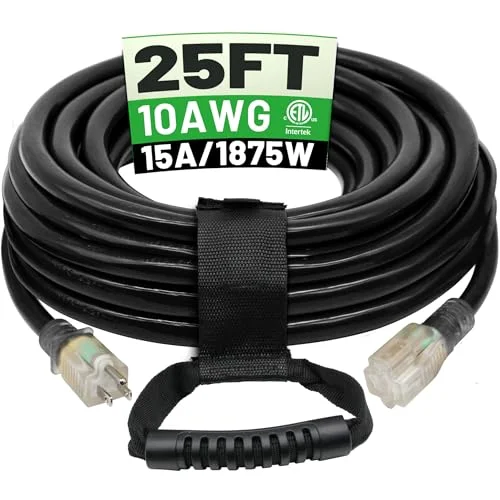
This is a heavy-duty outdoor extension cord with a waterproof focus and a lighted end, meant for grounded power loads. The thicker jacket and cold flexibility are aimed at staying usable outdoors, and the strain relief/visible LED helps with “is it powered?” uncertainty. But it’s built for general extension use, not a dedicated EV-charging pathway. If you’re using it for EV charging, I would verify your EV charger manual’s guidance and that your required connector/gauge/amperage are explicitly supported.
Best for: Outdoor grounded power needs like construction tools or other heavy-duty appliances where a 10AWG outdoor cord fits your charging plan.
Not ideal for: EV charging unless your EV charger documentation explicitly allows using an outdoor extension cord like this.
Decision cue: Shortlist it only when the use case matches grounded heavy-duty extension needs and you confirm EV-charging compatibility in the charger instructions.
Check Amazon
This cord extends a 50A RV-style connection using a NEMA 14-50P to 14-50R male-to-female setup. That makes it a fit for certain Level 2 EV charging scenarios that require a 14-50-style power source. The listing emphasizes weatherproofing with an IP65 rating and corrosion/heat-resistant materials. It also includes a more user-friendly insulated handle for easier plugging and unplugging. Because EV charging draws power continuously, the real value depends on matching the exact outlet and making sure the rest of your equipment supports 50A.
Best for: Drivers charging from a 14-50 power source, such as some RV pedestals or Level 2 setups wired for NEMA 14-50.
Not ideal for: J1772-only home wall charging where your chain requires a J1772 extension instead of a 14-50 pathway.
Decision cue: Shortlist when your charging source is truly NEMA 14-50 and your EV charging equipment supports that 50A pathway.
Check Amazon
This J1772 EV charging extension cable adds distance for J1772-capable EVs and chargers without forcing a specific RV outlet type. It’s described as compatible with both 120V and 240V scenarios, which matters when you might charge from standard receptacles in some places and from Level 2 circuits in others. The build emphasizes safety and durability with IP66 waterproofing and fire-resistant materials, and the design is aimed at everyday use or road trips. The key is that it’s for J1772, if your setup isn’t J1772, you’ll need the right adapter path.
Best for: J1772 Level 1 or Level 2 charging when the charger-to-vehicle distance is longer than your current cable reach.
Not ideal for: Tesla charging without the correct adapter approach, or any Supercharging workflow that uses different coupling expectations.
Decision cue: Shortlist when your charger and EV use J1772 and you need a 120V/240V-capable extension to add reach.
Check Amazon
This option focuses on a J1772 extension for Level 1/Level 2 charging and highlights a sturdier build. The listing calls out 50A capacity, IP66 weather resistance, and silver-plated inlet contact design intended to support conductivity and reduce overheating at the inlet interface. Since extension cords often fail at the ends under repeated plug-in cycles, the connector-side design matters as much as the cable length. I’d still verify that your specific EV charger and station settings can actually use the amperage you’re buying.
Best for: J1772 owners who want a durable, weather-ready extension for Level 2 charging where the station allows higher amperage.
Not ideal for: Anyone needing Tesla NACS-style extension support or a NEMA 14-50 RV-style pathway.
Decision cue: Shortlist when you have J1772 equipment, need around 20ft of reach, and plan to use it outdoors on a regular basis.
Check Amazon
This is a 50A extension cord for 14-50 RV/EV-style setups using 14-50P and 14-50R connectors. It’s aimed at Level 2 charging scenarios where the power source provides 50A at either 125V or 250V, with the listing calling out ETL/cETL certification. The heavier-gauge jacket and weather-resistant design target frequent outdoor/travel use. The disconnect handle design also aims to keep fingers away from connection points when plugging in, and the included organizational items help reduce cord stress when you pack and move the cable.
Best for: Charging setups that rely on a NEMA 14-50 outlet and need a longer 50A cable run to reach the charger.
Not ideal for: J1772 wall-charger extension where your charging chain already uses J1772 connectors and you only need connector-to-connector extension.
Decision cue: Shortlist when your charger plugs into a 14-50 outlet and the rest of the equipment supports a 50A-capable pathway.
Check Amazon
This J1772 extension cable is the same basic idea, adding reach for J1772 EVs/chargers, with a 21ft length and dual-voltage support. It’s positioned for convenience if you might charge across both 120V and 240V environments, like moving between home and public locations. The listing highlights IP66 waterproofing and fire-resistant materials, along with durable cabling meant to resist the routine wear of plugging and unplugging. The practical upside is flexibility; the main downside risk is mismatch, so you’ll want to confirm your connectors are truly J1772 and that your charger’s amperage expectations line up with the extension.
Best for: J1772 EV/PHEV owners who want flexibility across 120V and 240V charging environments with a manageable 21ft run.
Not ideal for: Tesla NACS charging paths or RV 14-50 scenarios that require different plug standards.
Decision cue: Shortlist when your equipment is J1772 and your outlet/charger situation changes between 120V and 240V.
Check Amazon
This Tesla-focused NACS extension cable is designed to add distance between a Tesla wall/destination charger and the vehicle. It targets higher charging power up to 50A at 240V, while also noting that lower output may apply for some wall connector configurations. The listing emphasizes compatibility boundaries, especially that Supercharger use is excluded, and that the extension doesn’t control the vehicle’s port door. The upside is convenience within the Tesla connector ecosystem; the tradeoff is that you’ll need the right scenario for it to work as intended.
Best for: Tesla owners using NACS home or destination charging who need extra cable reach up to 50A-compatible scenarios.
Not ideal for: Supercharger compatibility or any setup that requires different connector standards.
Decision cue: Shortlist only if your charger is Tesla-rated for the relevant 50A/250V-or-lower limits and you avoid Supercharging workflows.
Check Amazon
This heavy-duty outdoor cord is aimed at general 120V grounded power extension, with a lighted indicator end so you can see power is present. It uses a 12AWG design intended for 15A use and is described with waterproof and cold-resistant construction for seasonal outdoor handling. The yellow jacket improves visibility and helps reduce trip hazards around outdoor work areas. Strain relief features and a safer socket design are intended to reduce stress at the plug connections, an issue that matters whenever the cord gets handled frequently. Like other general-purpose cords, the big question is whether your EV charging setup explicitly allows using a general outdoor extension cord.
Best for: Outdoor 15A grounded power tasks where visibility, cold flexibility, and waterproofing matter.
Not ideal for: EV charging unless your charger manual explicitly approves a general-purpose extension cord.
Decision cue: Shortlist for outdoor power work, and skip it for EV charging if there’s no explicit approval in your charger instructions.
Check Amazon
This J1772 extension cord is built to connect J1772 chargers to J1772-equipped EVs, with a stated 21ft reach and up to 40A charging capacity. The listing emphasizes heat management through silver-plated inlet design and uses copper TPE cabling with IP66 waterproof protection. It also includes a key compatibility reminder: Tesla vehicles need a J1772 adapter if you want to use this cord, because it doesn’t target Tesla’s NACS port directly. This makes it a good fit when you have J1772 equipment and you’re trying to extend reach outdoors while maintaining a reasonably high amperage ceiling.
Best for: J1772 EV owners needing a 21ft extension for 120V/240V Level 1/2 charging at up to 40A.
Not ideal for: Tesla NACS charging without using a J1772 adapter, or setups that require a 50A-rated extension pathway.
Decision cue: Shortlist if you have J1772 equipment and want IP66 weather protection with about 21ft of reach at up to 40A.
Check Amazon
This J1772 extension cord targets 240V Level 2 charging with a 50A, 21ft setup and highlights certifications like ETL and UL claims. It positions itself as a stable option for J1772 EV charging, aiming to reduce the odds of slow charging caused by an under-rated extension. Weatherproofing and heavy-duty materials are intended to handle rain, UV exposure, and regular wear. It also calls out copper wiring and a flame-retardant jacket to support safer operation. The practical “pass/fail” condition is straightforward: the rest of your charging chain has to support the 50A capacity you’re buying.
Best for: J1772 owners running Level 2 at 240V who need 21ft reach and plan for higher-amperage charging.
Not ideal for: Anyone needing Tesla NACS extension or a 14-50 RV-style extension cable.
Decision cue: Shortlist when charging is J1772/240V Level 2 and your station/EV can actually use the 50A capability.
Check Amazon
Reader questions answered
What connector standard do I need for EV extension charging: J1772, NEMA 14-50, or Tesla NACS?
Connector standard determines whether the cord can connect at all, and whether current flows through the right pathway. A J1772 extension connects between a Level 1/Level 2 charger and a J1772 vehicle inlet. A NEMA 14-50 extension extends an RV-style 50A source using a 14-50P to 14-50R pairing. Tesla NACS extensions are built for Tesla-specific wall/destination charging and exclude Superchargers. Start by choosing the connector type that matches your existing charging setup, then verify amperage and voltage limits so the extension doesn’t force an unsafe mismatch.
How do I choose the right amperage rating for charging speed and safety?
Amperage rating affects both charging speed and safety margins, especially over longer cable runs. Higher-capable cords can support faster charging when your EV and charger settings allow it, but the whole system has to agree on the allowed current. A 50A-rated extension only helps if the station, vehicle, and charger settings permit that draw. Don’t treat “maximum” as guaranteed output; your charger may throttle current based on temperature, installation limits, or its own configuration. Before buying, I’d match the cord’s maximum rating to your charger’s allowed current setting.
Will the cord handle outdoor weather, and what waterproof rating should matter?
Outdoor use exposes EV extension cords to moisture, corrosion risks, and temperature swings that can degrade connections over time. EV-focused products may claim waterproof ratings like IP66, which generally indicates strong rain/water protection. That matters more for EV charging because power flows continuously, not in short bursts like many tools. Cold performance also matters: flexible jackets help prevent stiff conductors and handling damage in winter. But waterproofing doesn’t override connector compatibility or amperage mismatch, so verify both the IP rating and the jacket’s temperature range, then confirm the rated connector ends are included in the waterproof construction.
What length should I buy, and how should I manage the cable to avoid overheating and damage?
Length mostly affects convenience, until current and voltage drop start interacting. When the extension supports the correct amperage and connector standard, the bigger remaining risks become mechanical: kinks, repeated bending at the plug ends, and damage from coiling. Best practice is usually to fully uncoil the cable during charging and avoid tight wrapping, since trapped heat can stress insulation. Choose a length that reaches without stretching the cord over sharp edges or pulling it taut at either end. Strain relief designs and storage straps help reduce end stress after charging. Finally, I’d confirm how it behaves outdoors by checking recent reviews and warranty/return terms.
What the comparison teaches
Match the connector standard first, then worry about amperage.
A J1772 extension won’t fix a NEMA 14-50 or Tesla NACS charging setup. After connector fit, amperage headroom is what determines whether you’ll actually get the charging speed you expect.
Weatherproofing matters, but it cannot replace compatibility checks.
IP66 or IP65 ratings help in rain, but a waterproof cord still won’t help if it has the wrong plug type. Verify both the connector ecosystem and the cord rating that matches your entire charging chain.
“Maximum” amperage is only useful when the charger and EV allow it.
A 50A-rated cord doesn’t force 50A charging. The vehicle and charger settings throttle the real output, so check the amperage your system will request.
Longer cords require good mechanical handling to avoid end failure.
Even a strong jacket and strain relief can suffer if you repeatedly coil tightly or bend heavily near the connectors. Fully uncoil during charging and store with straps or in a bag to reduce wear.
Before you buy
- Confirm the connector standard end-to-end: J1772 vs NEMA 14-50 vs Tesla NACS, matching your charger and your vehicle inlet.
- Verify voltage and amperage compatibility with your charger’s selected output mode and the EV’s allowed charging limits.
- Check the certification claims shown on the listing (ETL/UL/cETL) and confirm they match the exact cord model you’re selecting.
- Confirm weatherproof details: IP rating, jacket temperature range, and whether the connector ends are covered by the same waterproof construction.
- Confirm length guidance: the safest approach is usually fully uncoiled cable during use, and avoiding coiling while charging.
- Review warranty/return terms, connector wear can show up after repeated plug-in cycles, not always within short return windows.
- Read recent reviews for issues like overheating warnings, plug looseness, or reduced charging speed after extended use.
Final takeaway
Picking an EV charging extension cord is mostly about compatibility. If you’re using J1772, choose a J1772-rated extension that supports the connector and voltage pathway your charger uses (often for Level 1 or Level 2). If your charging source uses a 14-50 outlet, pick a NEMA 14-50 50A extension and make sure the rest of your equipment supports that current. Tesla owners needing extra reach should use a Tesla NACS extension intended for home or destination charging, and avoid Supercharger use. Heavy-duty general outdoor extension cords can be useful for tools, but you’ll want explicit EV-charging approval before using them for charging.
FAQ
Can a regular heavy-duty outdoor extension cord be used for EV charging?
Only if your EV charger manual explicitly permits it and the cord matches the required gauge, amperage, and safety standards for continuous EV loads. Many general-purpose cords don’t meet EV-specific connector and certification expectations.
What happens if the extension cord has a lower amperage rating than my charger?
The system may throttle charging or refuse to charge, and you can get heat buildup if the cord isn’t rated for the current your setup demands. Match the cord’s maximum rating to your charger’s allowed current.
Are Tesla NACS extensions compatible with Tesla Superchargers?
No. The Tesla NACS extensions in this list specifically note Supercharger incompatibility, and Supercharger systems use different coupling and power-control expectations.
Do I need different extensions for 120V versus 240V charging?
Not necessarily. Many J1772 extensions work for both 120V and 240V, but you still need to confirm the cord’s amperage rating matches your charger’s output mode.
Why does a longer cord change charging speed?
Length can increase voltage drop and influence how the charger limits current. A properly rated extension supports your chosen current, but an under-rated cable may cause reduced charging or error messages.