An RV roof heat pump solves a real, day-to-day problem: the same rooftop opening has to handle summer cooling and spring/fall warmth. Generic “go bigger on BTUs” advice often ignores the stuff that actually blocks installs and comfort, your cutout size, whether you need ducted vs. non-ducted airflow, and what your electrical setup can support.
Use this as a pick-first checklist: start with your comfort need (cooling, shoulder-season heat, or both), then weigh the tradeoffs. You’ll see which models lean into quieter nights, which are built for simpler DIY installs, and which aim for lower power draw when you’re running off-grid.
List of Rv Roof Heat Pump
An RV roof heat pump purchase succeeds or fails based on fit and real-world use, not marketing terms. This review treats the decision like a checklist: your roof opening and ceiling thickness, ducted airflow requirements, whether you need 120V power or 12V DC, and how much noise you can tolerate at night. It also treats “heat pump” correctly: many units target mild-to-cool weather and work best as supplemental warmth. Each product explanation connects comfort goals to install realities and power limitations, then highlights what to verify before ordering so the rooftop unit matches the RV you already own.
Product-by-product explanation
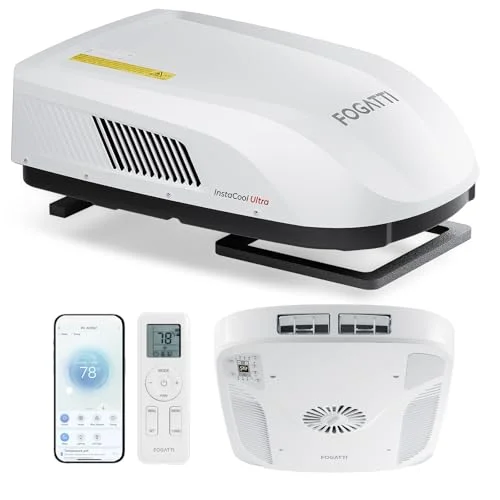
FOGATTI’s non-ducted 16K rooftop unit is aimed at quick comfort while keeping things quiet. It combines cooling and heat pump capability for year-round climate control, using a dual-motor, triple-fan airflow design intended to bring you to temperature faster. It supports multiple control paths (remote and other included options depending on the listing), which is helpful when you don’t want to reach up to the ceiling thermostat. The non-ducted design is a practical install advantage because it targets a standard 14.25” x 14.25” cutout and includes sealing material for rooftop mounting.
Best for: RV owners replacing a non-ducted rooftop unit who want fast comfort, quiet operation, and multi-mode control options.
Not ideal for: RV owners who need ducted ceiling distribution, or anyone with a rooftop cutout outside the stated 14.25” x 14.25” size.
Decision cue: I’d shortlist it if your RV has a standard non-ducted opening and you want multi-control convenience plus low-noise operation.
Check Amazon
TOSOT’s 16,000 BTU rooftop AC includes a built-in heat pump for more convenient warmth in mild seasons. The listing’s low-noise target is meant for light sleepers, and it supports everyday modes like Cool, Heat, Dry, Fan, plus timer scheduling. It also claims it works across a wide ambient temperature range, which can help during warm weeks and around spring/fall mornings, without relying only on the furnace for every cool snap. Installation is positioned as DIY-friendly since it matches a common 14.25” x 14.25” opening and includes the necessary setup material.
Best for: Campers who prioritize quiet nights and want heat pump support for shoulder-season trips.
Not ideal for: Buyers who need ducted air routing through existing ceiling ducting, or those expecting the heat pump to replace furnace heat during deep winter cold.
Decision cue: Shortlist if 43dB sleep comfort and straightforward heat-pump modes matter, and your RV uses the standard rooftop opening.
Check Amazon
Gidrox is geared toward buyers who want a 12V DC rooftop AC with heat pump capability and energy practicality. With an integrated heat pump, it can cool and warm while aiming to reduce how much you depend on an inverter in many setups. The listing highlights reported low nighttime power draw and includes control options that make it easier to manage temperature modes on the road. It also emphasizes comfort features like ultra-quiet operation (including a Sleep mode) and multiple operating modes so you can match the unit to conditions.
Best for: Off-grid van, truck, and camper owners who want 12V DC operation to simplify power planning.
Not ideal for: RV owners who have plenty of 120V shore power and would rather maximize cooling output without worrying about battery constraints.
Decision cue: I’d shortlist if your priority is 12V DC rooftop cooling plus heat, and you can support the runtime with enough battery capacity.
Check Amazon
Furrion Chill Cube is designed for smoother comfort than older fixed-speed rooftop ACs. Its variable speed compressor is intended to move cool air efficiently while reducing abrupt start/stop behavior that can affect comfort and power draw spikes. That makes it appealing for generator users and off-grid setups where power stability matters. The higher stated cooling capacity is meant to help in hotter conditions or larger spaces. The listing also frames it as straightforward to mount on the rooftop with bolt-on style installation, with a note that this SKU is the AC unit only and certain installation components/controls (ADB) are sold separately.
Best for: Owners with ducted setups who want more stable, variable-speed comfort behavior.
Not ideal for: Buyers expecting a fully turnkey bundle that includes every ceiling control component in the box.
Decision cue: Shortlist if you want ducted performance and variable-speed smoothing, but verify what control/ceiling hardware is included for this exact SKU.
Check Amazon
RecPro’s 15K rooftop heat pump unit focuses on a practical balance: efficient operation through low amp draw, durable road-ready construction, and multi-mode comfort with a noise level aimed at sleeping well. The listing includes both remote and LED touch controls to keep day-to-day temperature changes simple (and to reduce the need for extra thermostat wiring depending on your setup). The heat pump is positioned as supplemental warmth, often the difference-maker in shoulder seasons, rather than a guaranteed furnace replacement during extreme cold. The profile also calls out off-grid, solar, and generator-friendly use cases where electrical headroom is a key concern.
Best for: RV owners managing limited electrical load who want quiet operation plus heat pump supplemental warmth and easy controls.
Not ideal for: RVs that require very specific proprietary mounting, or anyone demanding guaranteed full furnace replacement performance in severe winter temperatures.
Decision cue: Shortlist if off-grid power planning matters and you want a low-amp rooftop heat pump with straightforward controls.
Check Amazon
VEVOR’s 15,000 BTU ducted rooftop heat pump is built around the idea of distributing air through ceiling ductwork for more even comfort. It uses a variable-speed compressor to help maintain steadier temperatures while reducing abrupt cycling and component wear over time. The controls include both a remote and a button panel, with modes plus timer/sleep functions aimed at managing day-to-night comfort. The listing also highlights a slim rooftop profile to reduce wind resistance, which can matter for highway travel and overall rooftop drag.
Best for: Owners with ducted rooftop systems who want even distribution and steadier comfort from variable-speed operation.
Not ideal for: RVs without ducted ceiling routing, since ducted performance depends on that infrastructure.
Decision cue: I’d shortlist if your RV supports ducting and you want variable-speed stability with a slim rooftop profile.
Check Amazon
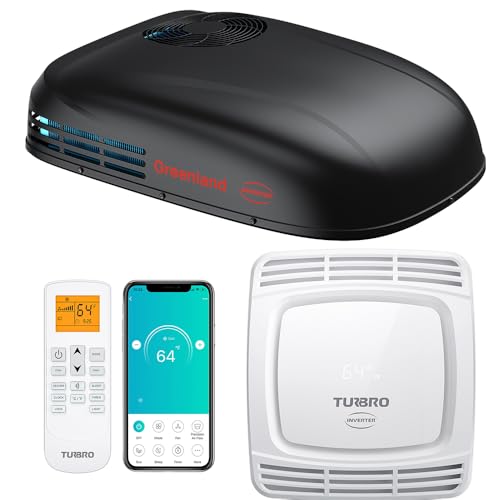
TURBRO’s inverter 13.5K rooftop unit emphasizes efficiency and smooth operation rather than maximum cooling headroom. An inverter compressor can adjust output to match conditions, which may reduce wasted energy and help with quieter cycling compared to single-speed ACs. The listing includes a heat pump plus supporting modes and claims operation across a broad ambient range. It’s also presented as slim, which can help with rooftop clearance and reduce rooftop drag. Controls are offered via remote and app capability (depending on model specifics in the listing).
Best for: Travelers who want inverter efficiency, quieter cycling, and non-ducted installation with slim rooftop clearance.
Not ideal for: Buyers who need the strongest cooling headroom for very large interiors during extreme heat.
Decision cue: Shortlist if efficiency and smooth inverter behavior matter more than topping out on BTU size.
Check Amazon
FOGATTI’s 16K non-ducted rooftop unit is built around quick climate response and low noise for travel comfort. The dual-sync motor plus triple-fan airflow design is intended to reach cooling or heating comfort quickly after you turn it on. The 43dB operation claim is meant to reduce nighttime disturbance, and the listing highlights multiple control options (remote, touchscreen panel, and WiFi) to make it easier to manage temperature without climbing to the ceiling. The low-profile thickness is also positioned as helpful for clearance considerations when driving under low bridges. Road-readiness is part of the overall design story.
Best for: Owners with non-ducted RV rooftops who want strong 16K comfort, quiet operation, and low-profile clearance.
Not ideal for: RVs with non-standard cutout sizes or setups requiring ducted airflow routing.
Decision cue: I’d shortlist if you need a 16K quiet, non-ducted replacement and your electrical setup supports the listed breaker/fuse requirements.
Check Amazon
TURBRO’s second inverter option follows the same inverter-focused idea: it adjusts cooling and heat demand to reduce wasted energy and keep operation smoother. The listing also leans into quiet comfort, with an inverter compressor intended to minimize abrupt cycling. It includes multiple modes plus a heat pump for year-round comfort and is described as slim (to help with clearance and reduce rooftop drag). Smart control via remote or app adds everyday convenience, and the unit also includes a ceiling atmosphere lamp as part of the feature set.
Best for: RV buyers who want inverter efficiency and smoother operation in a slim, install-friendly package.
Not ideal for: Buyers with large, high-heat-load interiors who need maximum cooling capacity at the high end of summer conditions.
Decision cue: Shortlist if your priority is inverter efficiency and smoother comfort, and your rooftop opening/thickness matches the installation requirements.
Check Amazon
RecPro’s 15K non-ducted heat pump unit is designed for straightforward comfort where you don’t want ducting complexity. The listing highlights low amp draw to support energy efficiency, especially useful for off-grid, solar, and generator setups where you don’t have unlimited circuit capacity. Quiet operation (with a stated 55.4 dB target) is aimed at reducing disruption for sleeping and relaxing, and it includes remote control plus LED touch display for simple temperature and mode adjustments. With the integrated heat pump, it can provide supplemental warmth during chilly evenings and mild mornings without forcing you into furnace use every time.
Best for: Owners who want non-ducted rooftop heat pump comfort with low amp draw and simple controls.
Not ideal for: RVs that need ducted air distribution for evenly chilled/heated rooms, or buyers who are chasing ultra-quiet performance below the mid-40dB range.
Decision cue: Shortlist if you want a non-ducted 15K heat pump that balances quiet operation with low amp draw for mixed camping.
Check Amazon
Reader questions answered
Which RV roof heat pump setup matches my roof opening and ducted needs?
For RVs, the rooftop opening and ducting model often decide whether installation is smooth or frustrating. Many non-ducted units target a standard 14.25” x 14.25” cutout, while ducted models require ceiling ductwork to move air properly. Ducted setups can feel more even in larger interiors, but you’ll need matching ceiling layout and return paths. Non-ducted designs tend to simplify mounting and can be easier to swap into existing cutouts, though airflow may concentrate more near the vents. Before buying, match your current system type (ducted vs. non-ducted) and measure ceiling thickness and cutout size.
| Product |
Answer |
Why |
| FOGATTI RV AC Unit 16K BTU, with Heat Pump, Non-Ducted, Wh… |
Non-ducted, fits 14.25” x 14.25” cutout. |
Built for no-duct installation and includes sealing material for rooftop mounting. |
| TOSOT 16000 BTU RV Air Conditioner, 43dB Ultra Quiet, Whit… |
Non-ducted, fits 14.25” x 14.25” rooftop openings. |
Aimed at DIY replacement into common RV cutouts with complete hardware. |
| Furrion Chill Cube 18k BTU Variable Speed RV Rooftop Air C… |
Ducted unit, but AC unit only in this SKU. |
Ducted distribution depends on ceiling ducting, and control/ceiling components may be separate. |
| VEVOR RV Air Conditioner, 15000 BTU RV AC Unit, 120V Ducte… |
Ducted rooftop air conditioner with ducted compatibility. |
Installation assumes ceiling ductwork for airflow across the RV. |
How much heating does a roof heat pump actually provide for winter-like conditions?
An RV roof heat pump usually focuses on supplemental warmth, not a guaranteed furnace replacement during deep winter. Comfort depends on ambient temperature, insulation quality, and how quickly heat escapes when the door opens. Some listings highlight broad operating temperatures for shoulder seasons; others frame heating as most useful for spring and fall. I’d think about your typical low temps, how long the RV stays cold between cycles, and whether you’ll need backup heat. If temperatures regularly plunge below what the listing supports, plan on supplemental heat and use the heat pump for the early-morning/transition times.
Which unit best suits off-grid power limits and generator/solar setups?
Power planning is what makes or breaks compatibility with solar, batteries, and generators. Low-amp 120V units can help you run other appliances without overloading circuits. With 12V DC units, you change the math, runtime depends heavily on battery capacity, especially when heating is running. Inverter/variable-speed designs can reduce wasted energy and smooth out cycling, potentially helping with peak draw. Start by identifying your power source and circuit protection, then estimate how long you need heating or cooling and at what outside temperatures.
What matters most for comfort at night: noise level, control options, or airflow?
Night comfort is usually about two things: noise and stable temperature control. Quietness helps you fall asleep even if the unit cycles, so I’d prioritize a low dB rating that reflects normal operation (not only a specific fan mode). Controls matter too, scheduling and easy “set it and forget it” operation reduce late-night fiddling. Airflow affects how quickly the cabin cools after you arrive, and how evenly temperatures settle. Non-ducted systems can create stronger temperature gradients near the opening, while ducted systems can spread air more evenly across the interior. Choose based on your sleep sensitivity and your RV’s layout.
| Product |
Answer |
Why |
| TOSOT 16000 BTU RV Air Conditioner, 43dB Ultra Quiet, Whit… |
43dB target and WiFi-ready smart control. |
Ultra-quiet operation aimed at light sleepers, with easy remote/app control. |
| FOGATTI RV AC Unit 16K BTU, with Heat Pump, Non-Ducted, Wh… |
43dB and multi-control (remote, touchscreen, WiFi). |
Quiet operation plus flexible controls helps maintain comfort without waking you up. |
| RecPro RV 15K AC Heat Pump Ducted/Non-Ducted White 110-120… |
55.4 dB and remote plus LED touch panel. |
Quiet enough for many users, but not as low as the 43dB class; controls focus on day-to-day simplicity. |
| Gidrox 12000 BTU 12V DC RV Air Conditioner with Heat Pump… |
About 40dB sleep mode on 12V system. |
Designed around ultra-quiet sleep, though comfort time depends on battery and heating demand. |
What the comparison teaches
Quiet ratings vary by operating mode, so confirm what’s loud during real cooling or heating.
Watch for dB claims that describe normal operation, not only fan or sleep settings. In RVs, cycling behavior can feel louder than steady sound.
Inverter and variable-speed tech can smooth power draw but does not remove electrical constraints.
Efficiency features can reduce peaks and energy waste, helpful for generator and solar planning, but circuit protection still sets the safe operating limits.
Ducted versus non-ducted affects both comfort and installation effort.
Ducted units can distribute air more evenly, but only if your ceiling ductwork matches the setup. Non-ducted units are easier to mount, yet airflow may concentrate near the unit.
Heat pump comfort often targets transition seasons, so plan for backup heat in deep cold.
Most RV heat pump systems do best when mornings are cool, not when you’re trying to replace full furnace heat in extreme cold. Verify the stated ambient range and assume supplemental heat outside it.
Before you buy
- Measure your rooftop cutout opening and confirm it matches the unit’s specified 14.25” x 14.25” requirement for non-ducted models.
- Confirm whether your RV is set up for ducted or non-ducted airflow, ducted units depend on ceiling ductwork for proper distribution.
- Check ceiling thickness range and roof-thickness compatibility before ordering, especially for 12V and slim-profile designs.
- Verify electrical circuit protection and amperage requirements, including any time-delay fuse or breaker rating mentioned for the model.
- Confirm power-source compatibility: 120V models versus 12V DC power expectations, and whether you need an inverter.
- Read the bundle contents carefully, some listings sell the AC unit only, which can mean controls/control components are purchased separately.
- Scan recent owner reviews for real nighttime noise and for heat pump behavior in the ambient temperatures you expect.
Final takeaway
Picking an RV roof heat pump comes down to three fit checks: can the unit mount to your rooftop opening and ceiling thickness, does your RV support the ducted vs. non-ducted airflow you’re buying, and does your power setup support the runtime you expect. If quiet is your priority, focus on low dB claims paired with easy remote/app control. If you’re off-grid, prioritize low amp draw, and for 12V setups, confirm battery capacity. For most people, the real payoff is shoulder-season comfort, so verify the listed ambient range and plan backup heat for deeper cold. That approach turns a rooftop purchase into a dependable travel upgrade instead of a spec mismatch.
FAQ
Are RV roof heat pumps good enough to replace a furnace?
Usually, they’re meant for supplemental warmth, think chilly mornings and spring/fall camping. How well they do depends on ambient temperature, insulation, and runtime; for deep cold, most setups still need furnace or another backup heat source.
Do I need a ducted RV ceiling for ducted rooftop heat pump units?
Yes. Ducted models rely on ceiling ductwork to distribute air. If your RV is non-ducted, a ducted unit may not spread air properly or may require additional modifications.
What should be checked before installing any rooftop heat pump?
Confirm cutout size, ducted vs. non-ducted compatibility, ceiling thickness, and roof thickness fit. Then verify electrical requirements (like 15A/20A time-delay breaker needs), or for 12V systems confirm your available 12V power and battery capacity.
Why do inverter or variable-speed models matter for RVs?
They can help reduce abrupt cycling and may improve energy use. That often improves comfort stability and can lower peak draw, but you still have to stay within circuit and power-source limits.
How do noise ratings translate to night comfort in an RV?
A low dB number helps, but cycling and mode selection matter too. Look for units that target quiet operation during real cooling/heating use and offer reliable sleep or timer controls so the unit doesn’t wake sleepers.