Picking a ham radio linear amplifier isn’t really about chasing “more watts.” It’s about keeping your RF clean and stable on the bands you actually use, while avoiding the stuff that ruins sessions: drive mismatch, SWR trouble, weak cooling, and bypass behavior that can cut you off mid-SSB or during long CW runs.
Use this to narrow down what fits your setup, not just what sounds good on a listing. It also breaks down what “linear” should mean in real life: steady amplification for SSB, CW, and digital modes without ugly distortion, backed by protection when SWR or drive gets out of line.
List of Ham Radio Linear Amplifier
A reader-first buying review focuses on workflow fit: how the amplifier behaves during real transmission, not just what it claims on paper. Linear amps must manage heat, SWR, and power levels while keeping signals spectrally clean, especially on voice and digital modes. This review frames products around installation and operating style, such as band switching automation, bypass alarms, cooling capacity, and how much cabling and configuration you face. The goal is to reduce guesswork: identify the amplifier that matches your transceiver, your intended modulation, and your tolerance for verification work before purchasing.
Product-by-product explanation
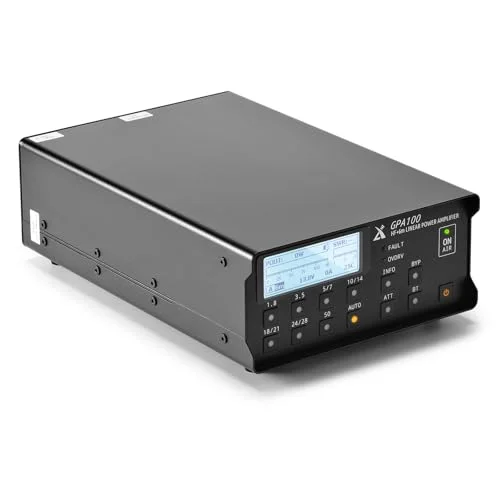
The Xiegu GPA100 is aimed at a clean, stable HF linear station upgrade that can scale from low-power rigs up to roughly a 100W-class level for SSB, CW, and digital modes. It leans into signal purity and linear behavior, while also building in protection for common failure triggers like high SWR, overheating, overcurrent, and incorrect drive conditions. It also takes band handling seriously, offering manual 7-band selection plus auto band tracking (via BT) for compatible Xiegu transceivers, reducing the fiddly setup when you bounce between bands.
Best for: Xiegu owners running HF QRP transceivers who want smoother band handling and steady linear output for SSB/CW/digital, especially when operating isn’t “set-and-forget.”
Not ideal for: Anyone who needs 6m power without first confirming how the BT band mapping matches their exact transceiver and supported band list.
Decision cue: Shortlist it when you want clean HF linear amplification and band control friction to be as low as possible.
Check Amazon
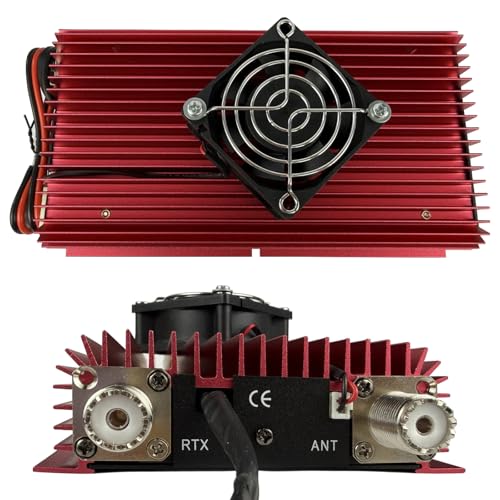
The BJ-300 Plus is a 12-14V linear amplifier built for multimode HF operation, covering AM, FM, SSB, and CW, with cooling support designed for longer use. It’s focused on quick installation and simple day-to-day operation, mode selection, plus high/low power adjustment, with cooling from a built-in fan and heat sink. Safety is framed around practical wiring/abuse protections like polarity reversal protection (to prevent damage from incorrect power hookup) and fusing. It also signals drive compatibility by stating expected input power ranges by modulation mode.
Best for: Operators building a vehicle or base station who want an HF linear amplifier that’s straightforward to wire, easy to select modes on, and guarded against common hookup mistakes.
Not ideal for: Rig-automation-first buyers who require deeper, radio-specific band-switching integration.
Decision cue: Choose it when straightforward installation and protection features fit your workflow, and you can verify your rig’s drive levels stay within the amplifier’s input expectations.
Check Amazon
The Xiegu XPA125B combines an automatic antenna tuner with a power amplifier into a single unit style. It’s designed to handle a wide range of antenna load conditions across its stated tuner load range for HF and 6m, then deliver amplified output up to about the 125W maximum class (depending on operating mode). Like other linear-minded units, it includes protection logic that can drop the amplifier into bypass and show alarms when operating conditions go off-script, such as high SWR, too much drive, or overtemperature. A large display is included to keep operators aware of what’s happening at a glance.
Best for: Portable or multi-antenna operators who want automatic tuning plus clear monitoring while driving an HF/6m linear-ready station.
Not ideal for: Buyers who want the simplest possible unit with zero bypass surprises, because tuner interactions and protection triggers can vary with antenna characteristics and operator drive discipline.
Decision cue: Shortlist it when automatic tuning saves you time and you’re confident your antenna system and operating habits match the unit’s intended behavior.
Check Amazon
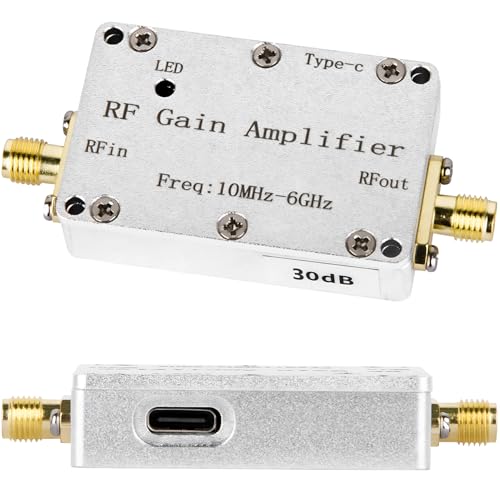
The RF Gain Amplifier labeled for 10M-6GHz is positioned as a receive-side broadband LNA, not a transmitter linear amplifier. It’s built for wide coverage and a stated low noise figure to make weak received signals look clearer in FM, SDR, and other receiving scenarios. The form factor is compact and suited to receive chains, with power designed for low-consumption operation (DC 5V, modest current draw). This can be helpful in the right receive setup, but it doesn’t replace an HF SSB/CW transmit linear amplifier, its role is reception improvement, not boosting transmitter output.
Best for: Users improving reception for FM, SDR monitoring, or other weak-signal receiving tasks where an LNA and low noise matter.
Not ideal for: Anyone trying to increase HF SSB/CW transmit power through the amplifier.
Decision cue: Skip it for transmit linear amplification; keep it only if you specifically want receive-side gain.
Check Amazon
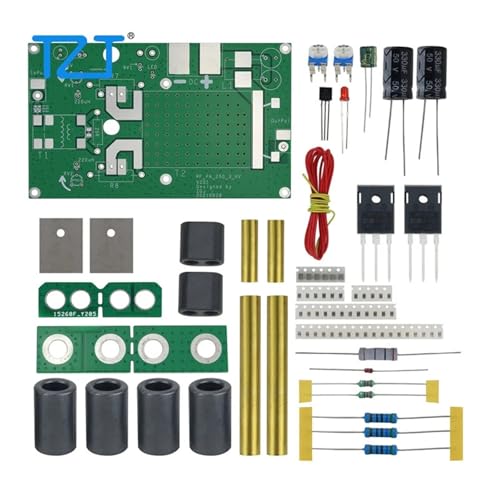
The Power Amplifier DIY Kit is aimed at delivering an SSB linear HF amplifier experience across 3.5-30MHz using a 13.8V supply and a lower input drive target. It emphasizes stable operation using an AB linear approach and includes a fan for heat management, with claims around practical output levels once built. This type of kit can appeal to builders who like assembling and verifying performance themselves, because real results depend on correct assembly, component matching, and post-build testing. If you’re comfortable measuring and validating linearity and protection, it can be a solid DIY path; if you want instant plug-and-play performance, it’s a bigger risk.
Best for: Hobbyists who want to build and validate an HF linear amplifier kit, especially for mixed-mode use like SSB and CW (and possibly AM-adjacent workflows).
Not ideal for: Buyers who expect factory-calibrated linearity and minimal verification work.
Decision cue: Shortlist it only if your comfort level includes assembly, tuning, and measurement steps after the build.
Check Amazon
The BJ-200 Linear Power AMP targets a simpler CB-to-ham-friendly HF amplification setup across 3-30MHz. It supports AM, FM, and SSB with controls that are easy to use, mode selection plus a HI/LO power adjustment, and it includes LED status feedback. For safety, it highlights polarity reversal protection to reduce the chance of damaging the amplifier during wiring mistakes. Cooling is handled through a heat-sink design intended to keep output stable for continuous use. Output claims are presented in a mode-dependent way (higher for SSB than FM), while drive expectations focus on typical 3-5W input ranges for many small transceivers.
Best for: Operators who want a compact 12-14V HF linear amplifier for AM/FM/SSB across 3-30MHz with basic controls and practical protections.
Not ideal for: Buyers who require advanced band automation or strict, deep integration with a specific transceiver ecosystem.
Decision cue: Shortlist when you want straightforward mode controls and you can confirm your rig’s drive stays within the amplifier’s stated input range.
Check Amazon
The CYTGOUPER Low Noise Amplifier is another wideband receive preamp/LNA focused on improving listening sensitivity rather than transmitting power. It spans roughly 10M to 6GHz and uses a small aluminum package with 50-ohm SMA-style connections, plus a low-power operating approach designed for portable or battery-friendly use. Its “low noise” positioning signals its job is to strengthen weak signals in the receiver front end and improve stability in receive chains, particularly relevant for SDR and FM monitoring setups. For ham operators, it’s a reception upgrade; it won’t convert into a transmit linear amplifier for SSB/CW.
Best for: Users who want a wideband receive preamp for FM/GPS-like monitoring or SDR improvement tasks.
Not ideal for: Operators who need a linear amplifier to increase SSB/CW transmit power output.
Decision cue: Skip it unless the requirement is receive-side gain with low noise.
Check Amazon
The BJ-300 Plus Linear Wideband Radio AMP positions itself as a multimode HF linear amplifier with mode-dependent output claim styles (including 100W/120W/150W class figures) across FM, AM, and SSB. It follows a convenience-first approach with a cooling fan, reverse polarity protection, simple controls, and typical radio-style connectors (like PL-259). It also includes a high/low power adjustment meant to make operation easier when switching between power levels. There’s a clear target audience here: operators who want a straightforward linear amplifier upgrade for smaller rigs, assuming their drive stays within the expected range and they maintain proper cooling and antenna matching during longer transmissions. The two-pack option suggests repeat installs across two radio sites or two similar setups.
Best for: Buyers who want an easy-to-wire HF linear amp and value having a second unit for another radio site or station layout.
Not ideal for: Anyone expecting sophisticated band automation, deep radio monitoring integration, or advanced control beyond basic alerts.
Decision cue: Shortlist it when you want a straightforward multimode linear amp and you’re willing to verify drive level and cooling habits for longer sessions.
Check Amazon
The 180W linear power amplifier kit is a higher-output kit concept aimed at scaling transmit power for FM ham or similar radio uses. Beyond the basic kit framing and rated linear amplification power, the listing doesn’t provide a lot of build-specific detail, so buyers should treat it as an opportunity for experienced builders rather than a fully guided turnkey solution. This can work well for people who already understand output-stage matching, linearity requirements, and how protection should behave under stress. For many ham operators, pushing to 180W also brings real-world constraints: stronger cooling, power supply capability, and careful measurement to confirm the amplifier stays linear and properly protected during operation.
Best for: Experienced builders who want a higher-power linear kit and can validate protection behavior, drive needs, and output cleanliness on their bench/setup.
Not ideal for: First-time amplifier buyers who need clearer mode-by-mode guidance and documented, reliable protection behavior.
Decision cue: Consider it only if you can confirm mode requirements and safety circuit behavior using independent references, not just the headline kit promise.
Check Amazon
FORIOT’s low noise RF amplifier is a wideband receive preamp spanning about 0.1 to 2000MHz, designed to improve reception sensitivity across shortwave, FM broadcast, and broader ham/SDR listening contexts. It’s framed as an LNA with a low noise target, meaningful gain, and a 50-ohm interface. It can run from a small DC range (9 to 12V) with low current draw, which supports portable operation. Since it’s presented as receive-side amplification, buyers should treat it as a receiving upgrade rather than a transmitter-side linear amplifier. Its value is in making weak incoming signals sound stronger and clearer, not in boosting SSB/CW transmitter output power.
Best for: Listeners and SDR users who want a wideband receive preamp powered from a battery or simple 12V setup.
Not ideal for: Operators who actually need an HF transmit linear amplifier for SSB/CW power output.
Decision cue: Shortlist only when your goal is receive-side amplification across 0.1-2000MHz.
Check Amazon
Reader questions answered
Does this amplifier actually fit transmit linear use for HF SSB/CW, or is it only for receiving?
A linear transmit amplifier boosts RF power for SSB, CW, and often AM/FM, while trying to stay spectrally clean and safe under SWR and temperature stress. A receive-only LNA boosts weak signals in the front end and usually supports much lower output power. So the real question is: can the unit handle your transmitter’s drive levels and modulation, and does the listing describe meaningful protection or bypass behavior for abnormal SWR/overtemperature? If the product is clearly marketed as an LNA with a noise figure and low current consumption, it belongs in the receive chain, not as a transmit linear amplifier.
How important is band handling and integration with a specific transceiver?
Band switching changes how often you touch controls and whether the amplifier tracks what your radio expects. Some linear amps use manual band selection; others add automation through Bluetooth or tighter integration with specific transceiver families. If your style is constantly hopping bands, syncing band selection can reduce mistakes like transmitting on the wrong amplifier band or forgetting to update tuning. If you rarely change bands, you can prioritize simplicity and skip the extra automation. Either way, I would verify supported bands, mapping behavior, and whether bypass/ALC behavior changes your “safe operation” on each band.
What power and cooling expectations should guide a purchase for long SSB or CW sessions?
For linear amps, cooling and protection decide whether the station stays reliable during extended transmit windows. Don’t just chase peak power claims, look for overtemperature handling, SWR protection behavior, and whether the unit goes into bypass when conditions go wrong. A fan and heat sink help, but the meaningful question is how the amplifier behaves at your duty cycle and ambient temperature. When the amp shows alarms and clear bypass behavior, it’s easier to monitor what’s happening instead of guessing why output paused. Also check whether your power supply can handle the current draw that comes with higher output.
Is this worth buying if the drive level from your transceiver is small?
Most linear amps require a specific drive level to reach the output you want while staying linear. A listing may say “compatible,” but the safe match depends on your rig’s ALC behavior, output swing, and how it behaves in each mode. I would verify the amplifier’s stated input power ranges for AM/FM versus SSB, and do conservative testing before running full output. If the listing mentions ALC/band synchronization support, it can reduce risk, but only when the radio actually supports it. For QRP-to-amp upgrades, drive matching matters more than raw wattage, because overdrive can distort your signal and trigger protection.
What installation and safety checks prevent the most common amplifier buying mistakes?
Big failures usually come down to wiring mistakes, power supply limitations, and antenna matching that pushes SWR higher than you expect. Check connector types, fuse ratings, reverse polarity protection, and whether the amplifier offers clear bypass alarms for abnormal conditions. I would also verify grounding and coax routing to reduce RF feedback into your power leads. If the amplifier includes a built-in tuner, confirm it’s compatible with your antenna system, and understand what bypass mode does to the radio’s state. Finally, look at recent buyer feedback for heat, reliability, and whether actual output matches the claims under real operating conditions.
What the comparison teaches
Automation can reduce operator error, but only for supported rigs and bands.
BT or similar band tracking can help when you switch bands often, but I’d still verify supported bands, mapping behavior, and what happens when a band isn’t supported.
Protection features matter as much as output power claims.
A linear amp that enters bypass with alarms can prevent damage and make troubleshooting easier. If the unit has limited protection messaging, you may still be protected, but you’ll lose time figuring out what caused output to drop.
Cooling is a duty-cycle decision, not a spec checkbox.
A fan and heat sink help, but buyers should factor ambient temperature, continuous transmit windows, and power supply health. Repeated thermal or SWR trips are a sign the amp can’t comfortably run at your settings.
Many high-gain RF products are for reception, not transmit.
Automatic tuning reduces manual mismatch stress and can simplify portable setups. But amplifier-tuner behavior depends on antenna characteristics, verify SWR, bypass behavior, and drive discipline.
A tuner-plus-amp can save time when antenna loads change.
Automatic tuning reduces manual matching and can simplify portable setups. However, the amplifier-tuner behavior depends on antenna characteristics, so validate SWR, bypass conditions, and drive discipline.
Before you buy
- Confirm the product category: transmit linear amplifier versus receive-only LNA/preamp.
- Verify your transceiver model and whether drive power and ALC behavior match the amplifier’s input expectations.
- Check band support and band switching method, including BT compatibility for the specific transceiver ecosystem if applicable.
- Inspect connectors and wiring needs, including PL-259 types, grounding points, and required coax lengths.
- Confirm power supply capability for 12-14V operation, including current draw and fuse compatibility with your wiring gauge.
- Validate protection behavior in a controlled test: SWR response, overtemperature handling, and bypass/alarm messages.
- Read recent buyer feedback for reliability, cooling performance, and whether real output aligns with the listed claims.
Final takeaway
A ham radio linear amplifier is “right” when its real behavior matches how you actually operate: mode support, drive requirements, cooling, and protection that responds predictably to SWR and temperature. If you want smooth HF linear cleanliness and band control that fits the workflow, the Xiegu GPA100 is a strong place to start. For simpler wiring and day-to-day safety features, the BJ-300 Plus and BJ-200 lines are aimed at straightforward operation with fan cooling and polarity protection. If you expect antenna matching to change often, the XPA125B’s tuner-and-monitoring approach can reduce friction. And if you see LNA language (noise figure, low current, wide receive coverage), treat those as receive-chain improvements, not transmit linear amplification.
FAQ
Do linear amplifiers work for SSB and CW without distortion?
Linear amplifiers are designed around SSB and CW operation by using biasing and protection to stay stable. Clean operation still depends on correct drive level, proper band setup, and acceptable SWR with your antenna system.
What input drive power should be used to avoid triggering protection?
Use the drive range listed for your specific mode, then test at conservative output first. Overdrive can introduce distortion or trigger protection/bypass events, both harm signal quality.
Is BT band switching required, or is manual band selection fine?
Manual band selection works well if you change bands infrequently and follow the same setup routine every time. BT band control helps most when you move constantly between bands and want fewer opportunities to misconfigure amplifier settings.
Can an automatic tuner replace good antenna matching?
An automatic tuner helps reduce mismatch stress by adapting the load, which is useful when antennas or feedlines change. Still, severe mismatch or repeated bypass events usually point to an underlying antenna/setup issue you’ll want to fix.
How can buyers avoid buying an amplifier when they actually need an LNA?
Transmit linear amps focus on output power, drive requirements, and SWR/overtemperature protection. Receive LNAs focus on noise figure, gain, low current draw, and wide receive coverage, and they typically shouldn’t be treated as transmitter-side power boosters.