Picking a ham radio power supply should be straightforward, until noise shows up in receive audio, voltage sags cause resets, or the terminals don’t match how your station is wired. A lot of listings lead with amperage, but your rig mainly cares about regulation quality, grounding, and whether it can hold steady 13.8V when you’re transmitting.
Use this to choose a ham radio power supply based on your setup, not the brand name. Focus on whether you want fixed 13.8V or an adjustable 9-15V output, how the noise-offset feature affects what you hear, and which connection style (terminals and sockets) will actually plug into your installation.
List of Ham Radio Power Supply
Ham radio stations demand steady DC and low interference, so a reader-first review must translate marketing into station fit. This review separates power needs into practical categories: fixed versus adjustable output, noise control priority, connector style, and extra convenience like USB or cigarette sockets. It also highlights the most important limitation in each product, such as reliance on a noise-offset adjustment, peak-current headroom, or less flexible terminals. Because listings vary in detail and ratings, the decision cues encourage verification on the exact output stability, protection, and included cables, before relying on the supply for on-air operation.
Product-by-product explanation
This is a regulated 13.8V bench supply intended to power a ham rig from AC mains. The focus here is day-to-day radio practicality: it’s built around a front cigarette-lighter style socket for smaller loads, plus common controls and readouts for quick voltage/current checks. A noise-offset knob is included to help reduce switching noise that can show up as hash in receive audio. It also lists protections like short-circuit and over-current, along with a temperature-controlled fan for longer operating sessions. It works best when your setup expects 13.8V and you can use the front socket and noise control in a way that matches your radio wiring.
Best for: Operators with a standard 13.8V ham radio who want a fixed-voltage supply that’s straightforward to run and includes noise-offset adjustment.
Not ideal for: Installations that need adjustable output voltage (9-15V) or stations that require lots of different terminal types beyond what the front socket approach supports.
Decision cue: I would shortlist it when your radio runs on 13.8V and you can use the included socket style and noise-offset control effectively.
Check Amazon
This compact bench supply targets the same 13.8V ham-radio world, with stable output and a few practical conveniences. It converts 110V AC to 13.8V DC and is rated for 30A maximum current, with a lower continuous figure, important during long key-ups or higher-duty operation. There’s a noise-offset knob intended to reduce pulse interference, and the front cigarette socket can power portable devices up to its stated limit. Cooling is designed to kick in once internal temperature reaches a threshold, and the unit includes overload and short-circuit protection (with a replaceable fuse).
Best for: Shack builders who want a small 13.8V supply, noise adjustment, and a front socket for accessories.
Not ideal for: Wiring-heavy stations that need multiple terminal styles or adjustable output voltage for nonstandard equipment.
Decision cue: Choose it if a compact fixed 13.8V supply fits your radio and accessory needs, and you can verify continuous current headroom.
Check Amazon
This Jesverty model is a compact, tabletop-friendly AC-to-DC converter built for 13.8V radio equipment. The most practical differentiator is the connection style: screw-type terminals make hardwired loads simpler and more secure than relying on plug adapters. It plugs into AC and outputs constant DC without requiring a separate battery. Cooling support and multiple protections are included to keep it safer under normal radio loads, while the fixed 13.8V output keeps behavior predictable for devices designed around 13.8V. Because the main output is built for hardwiring, it’s a good match for permanent desk setups.
Best for: Operators who want a compact fixed 13.8V supply with screw terminals for clean station wiring.
Not ideal for: Users who prefer Anderson-style connectors or who want adjustable output voltage beyond 13.8V.
Decision cue: I would shortlist it when screw terminal wiring matches your station layout and all your devices accept fixed 13.8V.
Check Amazon
This SKY TOPPOWER unit pairs a 13.8V bench power supply with an extra 5V USB charging output. That USB port is meant for powering or charging small station devices, handy when your desk doesn’t already have a dedicated charger. The main supply converts 110V AC into fixed 13.8V DC for ham radios, scanners, and other 12V mobile gear, with a cooling fan and protections designed for safer long-term use. It’s also built with a compact footprint to fit crowded benches. The noise-control expectation follows the typical switching-supply idea: the noise offset feature is there to help manage reception interference, but your wiring and grounding still matter.
Best for: Operators who want the radio power handled in one box and also want a simple USB charging option at the operating position.
Not ideal for: People who need multiple auxiliary output voltages or lots of terminal flexibility beyond the described front ports.
Decision cue: Pick it when USB convenience matters and your station is happy with fixed 13.8V output.
Check Amazon
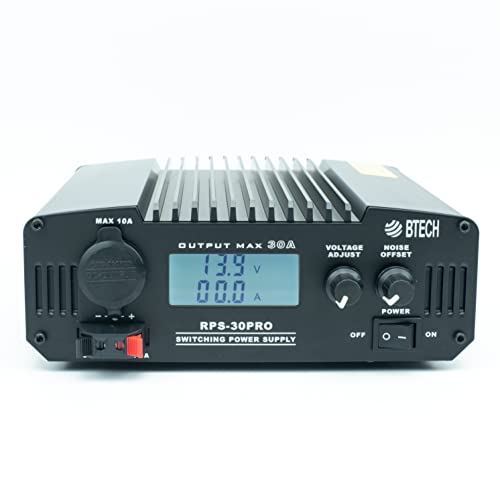
The BTECH RPS-30PRO is designed for radios that may benefit from either a fixed 13.8V setup or an adjustable 9-15V range. That makes it easier to match more equipment types without swapping supplies. It converts AC to stable DC and includes noise offset adjustment aimed at controlling switching interference, especially useful with sensitive HF and broadband receivers. For connections, it offers multiple wiring options: a cigarette plug, universal hardwired screw-type terminals, and snap-in terminals. Operation is described as simple plug-in use, including switch-activated power control, and it can be used for radios (CB, ham, GMRS, LMR two-way radios), scanners, and other DC equipment.
Best for: Shacks that want adjustable voltage options plus noise-offset tuning and multiple connection styles.
Not ideal for: Buyers who only want one fixed-voltage output and don’t want extra controls.
Decision cue: Shortlist it when your station benefits from 9-15V adjustability and you want stronger noise control plus wiring flexibility.
Check Amazon
This higher-capacity Jesverty SPS-50II is aimed at stations that may run higher loads or want extra margin for future gear. It supports fixed 13.8V output as well as continuous adjustment from 9V to 15V, which can be useful when multiple accessories don’t all share the exact same input expectations. Like the other ham-focused supplies, it includes a noise-offset circuit intended to reduce unwanted switching noise by shifting interference behavior. On the wiring side, it adds screw-type main terminals plus auxiliary snap-in terminals and a front cigarette socket, which helps when you’re powering more than just one device from the same supply.
Best for: Operators planning multiple DC accessories or wanting adjustable 9-15V headroom with cooling support for long sessions.
Not ideal for: Tiny desks where a simpler fixed 13.8V supply would save space and reduce wiring complexity.
Decision cue: Choose it when you need adjustable 9-15V and multiple output points, and you can use the higher capacity safely within its limits.
Check Amazon
The Jesverty SPS-30II emphasizes flexibility without going to the largest chassis. It provides continuous output adjustment from 9V to 15V, while also supporting a fixed 13.8V setting for standard ham rigs. A noise-offset circuit is included to help manage switching noise so the radio can stay cleaner in both receive and monitoring. For wiring, screw-type main terminals support hardwired connections, and it also includes auxiliary snap-in terminals plus a front cigarette socket for convenience. Analog meters let you do quick voltage/current checks while you’re operating.
Best for: Shacks that power mixed 12V gear and want adjustable voltage while still staying compatible with typical 13.8V ham setups.
Not ideal for: Users who only need a single fixed 13.8V rail and prefer the simplest possible controls and layout.
Decision cue: I would shortlist it when you need either 13.8V or occasional 9-15V adjustments, and you want more than one terminal option.
Check Amazon
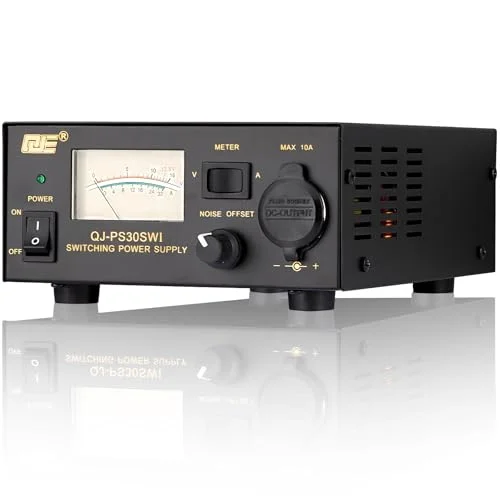
This Tekpower TP30SWI is a straightforward fixed-output 13.8V bench supply built for ham and CB radio use, with a noise-offset feature intended to address switching interference. The overall approach is the classic “one rail for the rig” workflow, where stable 13.8V matters more than voltage tweaking. It claims a 30A maximum output, but heavy transmit scheduling depends on the real continuous duty behavior and thermal performance, so verification matters if you plan to run at or near the high end. It includes cooling support and a stated 1-year USA warranty, which can be reassuring when you’re trying to cover baseline needs like protection and temperature management.
Best for: Operators who want a fixed 13.8V supply with a simple noise-offset approach and warranty-backed buying.
Not ideal for: Stations that need adjustable output voltage for nonstandard equipment requirements.
Decision cue: Consider it when every device runs on 13.8V and a fixed supply best matches your station workflow.
Check Amazon
This JESVERTY SS-30P combines fixed 13.8V output with more than one connection style, which can help when you’re feeding the station with multiple cables. It includes Anderson connector options along with screw-type terminals using binding posts, useful for building a cleaner, more repeatable harness. That matters because high-current radio wiring often benefits from solid, consistent terminations rather than constant adapter changes. The unit claims constant current up to the mid-20A range, which can cover many typical ham duty cycles, but I would still verify continuous draw against your transmit habits so you’re not relying only on a maximum headline number.
Best for: Stations that are wired with Anderson PowerPole connectors and want a fixed 13.8V bench PSU with matching output options.
Not ideal for: Users who want adjustable output voltage or who need many auxiliary terminals beyond the described connector types.
Decision cue: Shortlist it when Anderson-style cabling matches your shack and you can keep continuous current within the stated limits.
Check Amazon
This generic 13.8V fixed-output bench power supply is aimed at common ham and CB equipment, using a compact switching design with a readout and a noise-offset concept. It includes grounding considerations and multiple protections plus thermal management through a cooling fan and side vents. The practical intent is simple: power radios from AC with minimal hassle, and support popular cable lead connection methods, including banana-style leads and PowerPole-compatible approaches. A replaceable fuse provides a baseline layer of fault handling, and the included feature set is focused on day-to-day station use rather than fine-tuning output settings.
Best for: Operators who need a compact fixed 13.8V bench supply with flexible cable lead options.
Not ideal for: Users who need fine voltage adjustability or stations that require extensive accessory terminals beyond the included approaches.
Decision cue: Choose it if your gear accepts fixed 13.8V and your cabling matches the listed connector lead types.
Check Amazon
Reader questions answered
Should the power supply output stay fixed at 13.8V, or do I need adjustable 9-15V?
Most ham radios work well with a regulated 13.8V nominal rail, so a fixed-output supply can reduce setup mistakes and keep the rig in its expected operating range. Adjustable 9-15V units can help when your station includes accessories that expect a different DC input, or when you’re planning equipment upgrades. The tradeoff is that adjustable models add a setting step, so the safest approach is to use your radio manual’s input requirements, set the supply once, then verify voltage at the radio under load before longer operating sessions.
How much does noise-offset matter, and can these supplies really reduce interference?
Switching supplies can generate pulsed noise that may show up as hiss or spurs in sensitive receivers. Noise-offset features can help shift or filter that behavior, but what you hear depends heavily on grounding, cable routing, and physical separation from the radio. A knob or circuit can improve outcomes, but it can’t replace good station practices like bonding grounds to a single point and keeping high-current leads away from microphone and RF cables. My buy approach is to prioritize supplies that actually include noise-offset control, then confirm the effect by monitoring the receive output with your station wired as intended.
Which terminal or connector type best fits my station wiring plan?
Ham shacks often mix radio power poles, screw terminals, and accessory leads. Terminal style affects both convenience and reliability, especially when you’re moving higher currents. Screw-type terminals are ideal for permanent installations and neat hardwired terminations. Anderson PowerPole-style connectors simplify modular builds and quicker reconfiguration. Cigarette-lighter sockets can be convenient for small accessories, but they usually aren’t a universal answer for full rig draw. The best approach is to list every device you plan to power, note its connector type, and then choose a supply that offers at least one compatible high-current connection plus auxiliary options for smaller loads.
Will the supply survive real operating duty, especially during long transmissions or multiple loads?
Listings like ‘30A max’ can be misleading because many supplies also state a lower continuous rating. Sustained transmit or powering multiple accessories at once can raise internal temperature, so cooling design and protection circuits matter in real operation. I would look for stated continuous current, thermal protection details, and cooling behavior that prevents overheating during longer sessions. Also check fuse type/rating and whether the supply limits current cleanly during faults. For on-air use, plan to measure voltage at the radio during load and confirm the supply maintains regulation without excessive sag or shutdown.
What the comparison teaches
Fixed 13.8V reduces mistakes, but adjustable supplies fit mixed stations better.
If your radio and accessories all accept 13.8V, a fixed-output unit keeps voltage management simple. If you have equipment with different DC expectations, 9-15V adjustability can prevent you from swapping supplies later.
Noise-offset helps reception, but installation determines the final result.
Noise-offset circuitry can reduce switching interference, but it can’t promise clean audio in every station build. Distance, grounding, and cable routing often decide whether adjustments actually help reception.
“30A max” means little without continuous-current headroom.
Radio transmit duty cycles can stress the supply even if you never hit the headline current rating. Confirm continuous current capability and verify voltage stability at the radio during load.
Connector choice can save troubleshooting time.
Screw terminals suit permanent builds, while Anderson-style connectors fit modular PowerPole wiring. Cigarette sockets add convenience for small loads, but don’t treat them as universal high-current outputs.
Before you buy
- Confirm the supply’s continuous current rating and compare it to your radio’s measured draw during transmit and receive.
- Verify output voltage stability at the radio terminals under load, not just idle voltage on the meter.
- Check noise performance with the radio connected, then adjust the noise-offset control while watching for changes in receive audio.
- Inspect grounding provisions and plan a single-point ground to your station and radio chassis before powering up.
- Match terminal compatibility: screw, Anderson, binding posts, snap-in, and cigarette socket current limits against what you’ll actually connect in the shack.
- Confirm fuse type and rating, and see whether the listing specifies fuse access/availability.
- Scan recent buyer feedback for real-world heat, fan behavior, and any repeated interference complaints.
Final takeaway
A ham radio power supply should match your station’s voltage expectations, noise sensitivity, and wiring style. Fixed 13.8V models are best for common radios and reduce setup errors, while adjustable 9-15V units help when accessories need different input ranges. Noise-offset controls can improve receive quality, but only after proper grounding, cable routing, and physical separation from the radio. Prioritize continuous current headroom, cooling behavior, and real protection features, because long transmissions are where weaknesses show up. Finally, pick connector and terminal types that match your cabling plan so your power wiring stays secure and easier to troubleshoot.
FAQ
Do I need a regulated power supply for a ham radio?
Most ham rigs do best with a regulated DC supply that holds voltage under load. Unregulated supplies can sag during transmit and lead to resets or reduced output.
What current rating should guide the purchase?
Use the supply’s continuous-current rating for your duty cycle, then confirm it still holds near-13.8V at the radio during transmit. Peak ratings usually don’t reflect sustained operation.
How can a noise-offset circuit be used correctly?
Adjust the noise-offset knob while monitoring receive audio or a spectrum display, then lock in the best position. Pair that with good grounding and keep the supply and power leads away from RF and microphone cables.
Can I power a whole shack from the rig supply?
You can power accessories, but include their current draw in your budget. Use auxiliary outputs within their stated limits and make sure the wiring can handle the combined current safely.
Is it normal for the fan to run during operation?
Fan operation helps maintain safe temperatures under load. If the fan ramps aggressively or the unit shuts down, it may be exceeding continuous capacity.