Choosing a low voltage transformer for landscape lighting usually isn’t about chasing the biggest watt number. The real trouble spots are feature fit (timer/sensor behavior), wiring limits, and whether the unit outputs the voltage type your lights actually need. If you pick the wrong sensor or timer style, you can end up with lights that won’t respond the way you expect, or that keep running after you wanted them off.
This review format walks you through the choices that typically matter in real setups: dusk-to-dawn photocell automation, countdown and timer modes, whether you need one output zone or multiple independent zones, and any “smart control” features. It also calls out tradeoffs like whether a removable/detachable photocell matters for an indoor transformer mount. Each product summary is written to show who it fits, and what you should double-check before buying, transformer output type, load limits, and compatibility with your outdoor lights.
List of Low Voltage Transformer Landscape Lighti…
Landscape lighting systems run on safer low-voltage power, but transformers still behave like the system brain. This review uses a reader-first lens that centers on daily behavior, not marketing claims. It groups buying decisions around how the lights should operate at night, how many zones require separate modes, and how safely the transformer must handle connected loads. The goal is to make shortlist decisions quickly, then reduce risk with a verification checklist for wiring, output compatibility, and support terms. Each product entry translates features into “what you’ll notice at home.”
Product-by-product explanation
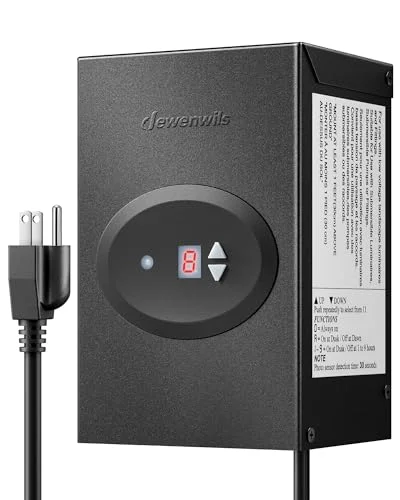
This DEWENWILS 120W transformer converts 120V household power into low-voltage power for landscape lighting, with built-in dusk-to-dawn automation. It also includes a countdown option, so the lights can turn on at dusk and shut off automatically after 1-9 hours. Mode selection is simple button-based, and a memory function helps it resume the last setting after power returns. The housing is weatherproof for outdoor mounting, with a short power cord designed for direct setup. Choose this when a smaller, single-zone
Best for: Smaller yards with one main circuit needing dusk-to-dawn plus an optional countdown shutoff
Not ideal for: Homes that require dual-zone independent control or lighting fixtures that require 12/14V AC output
Decision cue: Shortlist this if your lighting layout fits within 120W and you want dusk-to-dawn with easy countdown control.
Check Amazon
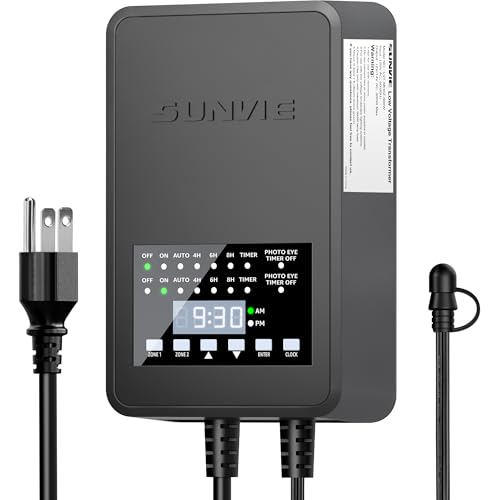
This SUNVIE 300W transformer is built around multi-mode control with two independent output zones. Each zone can follow its own behavior, which is handy when one area is more of a walkway that you want to go off earlier, while another stays on later for ambiance. It uses a removable photocell sensor for dusk-to-dawn control, and its timer/countdown-style modes support energy savings. Memory retention helps it avoid reconfiguration after power interruptions, and circuit protection is designed to disconnect if conditions go abnormal. Weatherproof construction
Best for: Larger properties needing two zones with different schedules using one transformer unit
Not ideal for: Installations that use 12V DC fixtures or need Wi‑Fi/voice control
Decision cue: Pick it when you need 300W capacity and two independently scheduled zones.
Check Amazon
This DEWENWILS 60W transformer fits smaller lighting plans that want automatic night control. It uses a dusk-to-dawn sensor for hands-free operation and adds a countdown timer that turns the lights off after 2, 4, 6, or 8 hours. A memory function retains the last timer selection even after power outages, so the system restarts predictably. An automatic circuit breaker adds overload/short-circuit protection, and the weatherproof body supports outdoor mounting. It also calls out that it is not for halogen lights
Best for: Small LED landscape lighting runs needing dusk-to-dawn and basic countdown control
Not ideal for: Halogen fixture setups or larger installs exceeding 60W total load
Decision cue: Shortlist this only when the project stays within 60W and you’re using LED-compatible systems.
Check Amazon
This SUNVIE 100W transformer provides dusk-to-dawn control using an external photocell sensor. The sensor can connect with a replaceable cord, letting the transformer mount indoors while the sensor sits outside for better detection. It also supports countdown durations with a memory function, so the transformer can return to the last chosen mode after power interruptions. A built-in circuit breaker is there to protect connected fixtures by cutting power when overloads or shorts happen, and it emphasizes safe, compatible low-voltage operation. The listing also notes it is not for halogen setups
Best for: Single-circuit LED landscape lighting needing dusk-to-dawn plus countdown options
Not ideal for: Systems that require 12/14V AC output or multi-zone independent control
Decision cue: Choose it when your total load fits around 100W of compatible low-voltage lighting and you want sensor placement flexibility.
Check Amazon
This WILAWELS 300W transformer is aimed at larger low-voltage landscape runs and explicitly supports both LED and halogen compatible fixtures. It converts 120V AC to 12/14V AC and includes a detachable photocell sensor for dusk-to-dawn automation. Mode control covers manual on/off, auto (dusk-to-dawn), countdown, timer, plus dusk-on/timer-off style options for a few different schedule patterns. Circuit protection shuts the transformer down during abnormal conditions, and a memory feature helps it return to the last setting after re
Best for: Larger installs that may include halogen and need 300W capacity with flexible mode options
Not ideal for: Installations that must place the transformer indoors or require Wi‑Fi app control
Decision cue: Shortlist when you need 300W capacity, 12/14V AC compatibility, and the detachable sensor for proper dusk detection.
Check Amazon
This SUNVIE 200W transformer leans into compatibility and day-to-day convenience. It converts 120V AC to 12/14V AC so it can power low-voltage LED and halogen systems. A removable photocell sensor enables dusk-to-dawn operation, and the included sensor power cord allows either indoor or outdoor transformer mounting while placing the sensor where it can “see” ambient light best. The mode lineup includes manual, auto, timer, and photocell-on/timer-off behaviors, plus a test mode for setup. Built-in ov
Best for: Medium-size yards needing 12/14V AC output and dusk-to-dawn with timer options
Not ideal for: Users needing independent multi-zone control or Wi‑Fi smart features
Decision cue: Pick it when your total load fits 200W and you want one transformer to handle multiple fixture types safely.
Check Amazon
This DEWENWILS smart transformer adds app-style (and voice-ready) control to an outdoor low-voltage system. It provides 300W capacity with three independent zones, so each area can follow its own automated schedule instead of sharing one rule. Scheduling options include randomized and astronomical-style behavior, plus countdown support, useful when you want seasonal changes without constantly reconfiguring. A key setup detail is that it’s designed for 2.4GHz Wi‑Fi only (no hub requirement), which affects how you plan installation. It converts 120V AC to 12/14V AC and includes overload pr
Best for: Users who want zone-based scheduling through an app or voice assistant on a 2.4GHz network
Not ideal for: Projects where smart control is unnecessary or where fixtures need 12V DC output
Decision cue: Shortlist when you want three zones and prefer smart scheduling over photocell-only automation.
Check Amazon
This WILAWELS 300W transformer gives practical two-zone independence with straightforward controls. It converts 120V AC to 12/14V AC for outdoor landscape lights and uses a removable photocell sensor with a sensor cord for flexible placement. Two separate zone buttons let each area run different modes, useful if one part should shut down earlier while another stays on later. The mode set includes manual on/off, auto dusk-to-dawn, countdown, timer, and photocell-on/timer-off options. Circuit protection c
Best for: Two distinct lighting areas needing different schedules with 300W capacity
Not ideal for: Single-zone projects that only need basic dusk-to-dawn and countdown
Decision cue: Choose this when you want 2-zone independent modes and 12/14V AC compatibility for a larger setup.
Check Amazon
This WILAWELS 300W transformer supports 2-zone independent control and is compatible with both LED and halogen fixtures via 12/14V AC conversion. A detachable photocell sensor automates dusk-to-dawn switching, and the sensor cord helps you install the sensor where ambient light changes will be detected more accurately. Each zone can run its own mode, including manual on/off, auto on/off, countdown, timer, and dusk-on with timer-off. Built-in circuit protection helps prevent damage during overloads or short circuits, and memory r
Best for: Larger outdoor lighting with two zones that need different on/off timing
Not ideal for: People who need only one zone or who want app-based smart scheduling
Decision cue: Shortlist when two-zone mode control matters and your total wattage stays within the safer capacity limits.
Check Amazon
This DEWENWILS 150W transformer is aimed at medium-capacity landscape lighting with multi-tap output voltage support at 12/15V AC. It uses a dusk-to-dawn sensor for automatic switching and offers countdown settings from 1 to 9 hours, plus always-on and auto modes through simple button controls. Memory retention keeps the selected mode after power loss, which reduces repetitive setup. Safety features include short-circuit protection that automatically resets after a fault condition clears. The metal shielded, waterproof h
Best for: Medium-size LED landscape lighting needing dusk-to-dawn and countdown with 12/15V AC compatible fixtures
Not ideal for: 12V DC-only systems or halogen designs that require 12/14V AC standard output
Decision cue: Pick it when your fixtures accept 12/15V AC and you want flexible countdown without multi-zone complexity.
Check Amazon
Reader questions answered
Should the transformer output match 12V DC or 12/14V AC for my landscape lights?
Transformers in this category can output either DC or AC depending on the model. Some DEWENWILS units specify 12V DC, while several SUNVIE and WILAWELS models specify 12/14V AC. That matters because many LED landscape lights include built-in drivers designed for AC input, while others expect DC. Before comparing timers and sensors, confirm what voltage type your fixtures require from the light datasheet or label, then make sure the transformer’s output type matches it. If the types don’t line up, lights can flicker, underperform, or fail to turn on consistently.
Do you need dusk-to-dawn only, or dusk-to-dawn plus a countdown or timer schedule?
A dusk-to-dawn photocell is the simplest form of control, it’s great for basic security lighting and “always on at night” behavior. Countdown and timer modes are where you can tighten energy savings by turning lights off after a set window, even if dusk lasts longer on that particular day. Countdown setups typically start at dusk and then shut off after a fixed number of hours. Timer modes aim to turn on and off at particular times, depending on the unit. Memory functions also matter, because power loss during storms can reset controls. Choose based on how long you actually want lights to run, and whether your schedule changes by season.
How do you decide between one-zone control and multi-zone independent scheduling?
A one-zone transformer assumes your fixtures share the same on/off routine. If you want different behavior for a walkway versus a patio, multi-zone control avoids awkward compromises. Two-zone models let each area use its own mode without needing extra systems beyond the zone terminals. Three-zone smart models extend that with app scheduling and zone-by-zone automations. The tradeoff is cost and upfront planning, so you distribute load properly and don’t overload one zone. Always confirm your transformer supports independent modes for the zones you plan to control.
Where will the transformer and photocell sensor mount, and how should cables reach?
Some transformers allow indoor mounting by placing only the photocell sensor outside. Others call for outdoor-only installation, which changes where you can safely mount the unit. Sensor cord length also affects placement, longer cords make it easier to set the photocell away from direct fixture glare, walls, and reflective surfaces. Power cord length matters too, so you can reach the outlet/junction point without unsafe extensions. Before buying, check installation guidance and cord lengths, then route cables so moisture stays sealed. The right approach helps prevent false dusk detection and reduces troubleshooting later.
What the comparison teaches
Output type beats mode features when choosing a transformer.
A great timer won’t fix an incompatible voltage type. Confirm whether your lights expect 12V DC or 12/14V AC before comparing wattage or any scheduling modes.
Countdown simplifies energy saving, but the range matters.
If you want shorter runs after dusk, choose a model with a countdown window that matches your real usage. Even fewer options can be fine, but the wrong countdown length can leave lights on longer than you want.
Zones prevent schedule compromises across different yard areas.
When different areas need different behavior, independent zones can save you from splitting lights into multiple systems. The catch is more planning for load distribution and setup.
Detachable sensors reduce false dusk behavior.
Sensors placed in direct fixture glare can trigger at the wrong time. A longer, removable sensor helps you position it so it reads true ambient light.
Before you buy
- Verify fixture input type: 12V DC versus 12/14V AC versus 12/15V AC, using the light labels or datasheets.
- Calculate total connected wattage and keep headroom; confirm any listing guidance about not exceeding roughly 80% of the transformer’s rated power for safer continuous use.
- Confirm whether halogen lights are allowed for your chosen transformer, since some models explicitly exclude halogen usage.
- Check sensor mounting guidance and cord lengths so the photocell can sit outdoors away from direct fixture glare and reflections.
- Ensure your wiring plan matches the terminal style and zone count, especially for 2-zone models that expect separate outputs.
- Confirm installation constraints: some transformers emphasize outdoor-only mounting for the unit, while others support indoor transformer placement with an outdoor sensor.
- Review warranty/support terms from the seller listing and confirm options for the exact model number you’re buying.
Final takeaway
A low voltage transformer choice gets easy once you lock down the basics: output compatibility, safe load sizing, and how you want lights to behave overnight. Smaller one-zone yards often do well with dusk-to-dawn plus a countdown option, while larger properties may need 200W-300W capacity. If different areas need different schedules, two-zone or three-zone control prevents awkward compromises. Finally, sensor placement (and whether you can position the sensor with the included cord) can make the difference between reliable automation and annoying false triggering. Start by matching your fixture voltage and zoning needs, then verify wiring and mounting details before installing.
FAQ
Can a low voltage transformer replace a dimmer switch?
Most landscape lighting transformers are designed for on/off control, not dimming. If the listing says “do not use with a dimmer switch,” follow that to avoid flicker or damage.
What happens if power goes out and returns?
Many models include a memory function that restores the last selected mode after power returns. Some work best when the transformer runs in the selected mode long enough, so read the listing notes if that matters for you.
How do I choose between countdown and timer modes?
Countdown typically turns lights on at dusk and off after a set number of hours. Timer modes aim to turn on and off at specific times, which can fit routines well but may feel less flexible across seasonal dusk changes.
How many fixtures can one transformer run?
Count by total wattage, not just number of lights. Stay within the transformer’s rated capacity and keep headroom, many listings suggest not exceeding about 80% for safer continuous operation.
Why do some transformers include an external photocell sensor?
A photocell sensor enables automatic dusk-to-dawn behavior. Detachable/removable sensors help you mount the detection point away from direct fixture glare, which can improve when the lights trigger.