
Understanding phrases is crucial for mastering English grammar. When studying English grammar, it is important to recognize the types of phrases in English. A phrase and its types determine how words group together to function within a sentence, and understanding types of phrases examples can clarify their usage.
For learners asking, “what are the different types of phrases,” the nine categories—noun, verb, adjective, adverb, prepositional, gerund, participle, infinitive, and absolute phrases—provide a comprehensive framework for constructing precise sentences.
Phrases are groups of related words that don’t contain both a subject and a verb, and they function as a single unit within a sentence.
Recognizing different types of phrases enhances your ability to construct clear, grammatically correct, and sophisticated sentences. This comprehensive guide explores nine essential types of phrases in English, providing definitions, examples, and practical exercises to improve your language skills.
This guide will benefit English language learners of all levels, from beginners to advanced students, as well as teachers looking for a structured approach to teaching phrases.
Table of Contents
- Introduction
- What is a Phrase?
- Structural Breakdown of Phrases
- Types of Phrases
- Examples of Phrases
- Usage Rules for Phrases
- Common Mistakes with Phrases
- Practice Exercises
- Advanced Topics
- Frequently Asked Questions (FAQ)
- Conclusion
What is a Phrase?
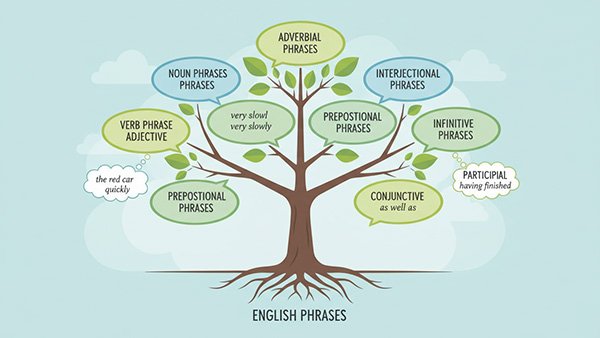
A phrase is a group of related words that functions as a single unit but does not contain both a subject and a verb performing an action. Unlike a clause, a phrase cannot stand alone as a complete sentence.
Phrases add detail and complexity to sentences, enriching their meaning and providing more information about subjects, verbs, and other elements. They are essential building blocks for constructing well-formed and expressive sentences in English.
Phrases can be classified based on the type of word that serves as the head, or main element, of the phrase. For example, a noun phrase has a noun as its head, while a verb phrase has a verb as its head.
The function of a phrase within a sentence depends on its type. Noun phrases often act as subjects or objects, while adverb phrases modify verbs, adjectives, or other adverbs.
Structural Breakdown of Phrases
Understanding the structural elements of phrases is critical to using them effectively. Each type of phrase has its own characteristic structure, although there can be variations within each category.
Head: The head of a phrase is the main word around which the phrase is built. It determines the type of phrase. For example, in the phrase “very old house,” the noun “house” is the head, making it a noun phrase.
Modifiers: Modifiers are words or groups of words that describe or limit the meaning of the head. They can come before or after the head. In the phrase “extremely quickly,” “extremely” is a modifier that intensifies the adverb “quickly.”
Qualifiers: Qualifiers add specific details or conditions to the head. For instance, in the phrase “the book on the table,” “on the table” is a qualifier that specifies which book is being referred to.
Determiners: Determiners (like articles, possessives, and demonstratives) specify which noun is being referred to. In the phrase “the old car,” “the” is a determiner.
Types of Phrases
Noun Phrase
A noun phrase consists of a noun and any related modifiers, complements, or determiners. It functions as a noun, typically acting as the subject, object, or complement in a sentence.
The noun is the head of the phrase.
Examples:
- The old, creaky house
- A bright sunny day
- My favorite book
Verb Phrase
A verb phrase includes the main verb and any auxiliary verbs that precede it. It expresses the action or state of being of the subject in a sentence.
The main verb is the head of the phrase.
Examples:
- Is running
- Has been studying
- Will be going
Adjective Phrase
An adjective phrase consists of an adjective and any words that modify it. It functions as an adjective, describing a noun or pronoun.
The adjective is the head of the phrase.
Examples:
- Extremely beautiful
- Very tall
- Somewhat difficult
Adverb Phrase
An adverb phrase consists of an adverb and any words that modify it. It functions as an adverb, modifying a verb, adjective, or another adverb.
The adverb is the head of the phrase.
Examples:
- Very quickly
- Quite slowly
- Extremely carefully
Prepositional Phrase
A prepositional phrase consists of a preposition and its object, which is usually a noun or pronoun. It functions as an adjective or adverb, modifying other words in the sentence.
Examples:
- On the table
- In the garden
- With great enthusiasm
Gerund Phrase
A gerund phrase consists of a gerund (a verb ending in -ing that functions as a noun) and any related modifiers or complements. It functions as a noun in a sentence.
Examples:
- Reading books
- Swimming in the ocean
- Learning new languages
Participle Phrase
A participle phrase consists of a participle (a verb form ending in -ing or -ed/-en that functions as an adjective) and any related modifiers or complements. It functions as an adjective, modifying a noun or pronoun.
Examples:
- Running quickly
- Covered in snow
- Broken into pieces
Infinitive Phrase
An infinitive phrase consists of an infinitive (the base form of a verb preceded by “to”) and any related modifiers or complements. It can function as a noun, adjective, or adverb in a sentence.
Examples:
- To read a book
- To travel the world
- To learn new things
Absolute Phrase
An absolute phrase modifies an entire clause or sentence. It consists of a noun or pronoun and a participle, along with any related modifiers.
It is set off by commas and does not directly modify any specific word in the main clause.
Examples:
- The weather being warm, we went for a walk.
- His work finished, he went home.
- The game having ended, the crowd dispersed.
Examples of Phrases
This section provides extensive examples of each type of phrase, illustrating their structure and function within sentences. Understanding these examples will help solidify your grasp of phrase usage.
Noun Phrase Examples
The following table provides 30 examples of noun phrases used in various contexts. Notice how each phrase functions as a noun within the sentence, acting as a subject, object, or complement.
| Sentence | Noun Phrase | Function |
|---|---|---|
| The big, red ball rolled down the hill. | The big, red ball | Subject |
| She loves her new car. | her new car | Object |
| He is a talented musician. | a talented musician | Complement |
| The student with the highest score won the prize. | The student with the highest score | Subject |
| I saw a flock of birds. | a flock of birds | Object |
| That is my old friend. | my old friend | Complement |
| The little girl was playing in the park. | The little girl | Subject |
| He bought a new computer. | a new computer | Object |
| She is a dedicated teacher. | a dedicated teacher | Complement |
| The dog with the floppy ears is very friendly. | The dog with the floppy ears | Subject |
| I need a cup of coffee. | a cup of coffee | Object |
| This is her favorite song. | her favorite song | Complement |
| The tall building is a landmark. | The tall building | Subject |
| He found a lost wallet. | a lost wallet | Object |
| She became a successful entrepreneur. | a successful entrepreneur | Complement |
| The car with the tinted windows is suspicious. | The car with the tinted windows | Subject |
| I want a piece of cake. | a piece of cake | Object |
| That is his only excuse. | his only excuse | Complement |
| The heavy rain caused flooding. | The heavy rain | Subject |
| She painted a beautiful picture. | a beautiful picture | Object |
| He is a skilled craftsman. | a skilled craftsman | Complement |
| The house on the hill is for sale. | The house on the hill | Subject |
| I need a new pair of shoes. | a new pair of shoes | Object |
| This is my best effort. | my best effort | Complement |
| The old wooden chair is antique. | The old wooden chair | Subject |
| She wrote a heartfelt letter. | a heartfelt letter | Object |
| He is a reliable friend. | a reliable friend | Complement |
| The book on the shelf is interesting. | The book on the shelf | Subject |
| I bought a new coffee maker. | a new coffee maker | Object |
| That is her final decision. | her final decision | Complement |
Verb Phrase Examples
The following table provides 30 examples of verb phrases, illustrating different tenses and aspects. Note how the auxiliary verbs combine with the main verb to express various meanings.
| Sentence | Verb Phrase |
|---|---|
| She is singing beautifully. | is singing |
| They have been working hard. | have been working |
| He will be traveling next week. | will be traveling |
| We should have studied more. | should have studied |
| I am going to the store. | am going |
| They were playing in the park. | were playing |
| She had finished her homework. | had finished |
| He will arrive tomorrow. | will arrive |
| We must leave now. | must leave |
| I can speak English. | can speak |
| She is watching TV. | is watching |
| They have eaten dinner. | have eaten |
| He will be here soon. | will be |
| We should go home. | should go |
| I am learning Spanish. | am learning |
| They were laughing loudly. | were laughing |
| She had seen that movie. | had seen |
| He will call you later. | will call |
| We must remember to buy milk. | must remember |
| I can help you with that. | can help |
| She is writing a book. | is writing |
| They have visited Paris. | have visited |
| He will be attending the meeting. | will be attending |
| We should have listened to her. | should have listened |
| I am thinking about it. | am thinking |
| They were discussing the issue. | were discussing |
| She had prepared the presentation. | had prepared |
| He will send the email. | will send |
| We must consider all options. | must consider |
| I can understand your point. | can understand |
Adjective Phrase Examples
The following table contains 30 examples of adjective phrases, demonstrating how they modify nouns and pronouns by providing descriptive details.
| Sentence | Adjective Phrase |
|---|---|
| The cake was extremely delicious. | extremely delicious |
| He is very tall. | very tall |
| The task was somewhat difficult. | somewhat difficult |
| She is incredibly talented. | incredibly talented |
| The weather is unusually warm. | unusually warm |
| He is surprisingly strong. | surprisingly strong |
| The movie was exceptionally good. | exceptionally good |
| She is remarkably intelligent. | remarkably intelligent |
| The book is quite interesting. | quite interesting |
| He is unbelievably rich. | unbelievably rich |
| The view was breathtakingly beautiful. | breathtakingly beautiful |
| She is wonderfully kind. | wonderfully kind |
| The coffee is perfectly brewed. | perfectly brewed |
| He is exceptionally skilled. | exceptionally skilled |
| The food was surprisingly tasty. | surprisingly tasty |
| She is incredibly patient. | incredibly patient |
| The music was beautifully composed. | beautifully composed |
| He is remarkably calm. | remarkably calm |
| The performance was exceptionally captivating. | exceptionally captivating |
| She is wonderfully creative. | wonderfully creative |
| The story was extremely interesting. | extremely interesting |
| He is very handsome. | very handsome |
| The problem was somewhat complicated. | somewhat complicated |
| She is incredibly charming. | incredibly charming |
| The weather is unusually cold. | unusually cold |
| He is surprisingly athletic. | surprisingly athletic |
| The dessert was exceptionally delicious. | exceptionally delicious |
| She is remarkably talented. | remarkably talented |
| The event was quite successful. | quite successful |
| He is unbelievably lucky. | unbelievably lucky |
Adverb Phrase Examples
This table provides a comprehensive list of adverb phrase examples, showcasing their role in modifying verbs, adjectives, or other adverbs to provide more context.
| Sentence | Adverb Phrase |
|---|---|
| She ran very quickly. | very quickly |
| He spoke quite softly. | quite softly |
| They worked extremely hard. | extremely hard |
| She sang incredibly beautifully. | incredibly beautifully |
| He finished the task surprisingly quickly. | surprisingly quickly |
| They arrived unusually early. | unusually early |
| She danced exceptionally gracefully. | exceptionally gracefully |
| He explained the concept remarkably clearly. | remarkably clearly |
| They played quite well. | quite well |
| She performed unbelievably impressively. | unbelievably impressively |
| He spoke breathtakingly eloquently. | breathtakingly eloquently |
| They treated him wonderfully kindly. | wonderfully kindly |
| She prepared the meal perfectly skillfully. | perfectly skillfully |
| He solved the problem exceptionally cleverly. | exceptionally cleverly |
| They responded surprisingly positively. | surprisingly positively |
| She acted incredibly bravely. | incredibly bravely |
| He painted the picture beautifully artistically. | beautifully artistically |
| They remained remarkably calm. | remarkably calm |
| She presented the argument exceptionally convincingly. | exceptionally convincingly |
| He managed the situation wonderfully tactfully. | wonderfully tactfully |
| She smiled very sweetly. | very sweetly |
| He walked quite slowly. | quite slowly |
| They worked extremely diligently. | extremely diligently |
| She sang incredibly softly. | incredibly softly |
| He answered surprisingly honestly. | surprisingly honestly |
| They arrived unusually late. | unusually late |
| She danced exceptionally gracefully. | exceptionally gracefully |
| He explained the concept remarkably simply. | remarkably simply |
| They played quite badly. | quite badly |
| She performed unbelievably professionally. | unbelievably professionally |
Usage Rules for Phrases
Understanding the rules governing phrase usage is crucial for constructing grammatically correct and clear sentences. Each type of phrase has specific rules that dictate its placement and function within a sentence.
Noun Phrases: Noun phrases should agree in number with the verb they modify. Singular noun phrases require singular verbs, while plural noun phrases require plural verbs. For example: The cat sleeps (singular) vs. The cats sleep (plural).
Verb Phrases: The auxiliary verbs in a verb phrase must agree with the subject in person and number. For example: I am, he is, we are. Also, the correct form of the main verb must be used depending on the auxiliary verb (e.g., have eaten, is eating, will eat).
Adjective Phrases: Adjective phrases typically precede the noun they modify. However, they can also follow a linking verb (e.g., is, are, was, were). For example: The very tall building vs. The building is very tall.
Adverb Phrases: Adverb phrases can modify verbs, adjectives, or other adverbs. They can be placed at the beginning, middle, or end of a sentence, depending on the desired emphasis. For example: Quickly, she ran to the door, She quickly ran to the door, or She ran to the door quickly.
Prepositional Phrases: Prepositional phrases usually follow the word they modify. When used as adjectives, they typically follow the noun they describe. When used as adverbs, they can be more flexible in placement. Misplaced prepositional phrases can lead to ambiguity. For example, “I saw the dog in the park with a telescope” could mean you used a telescope to see the dog or the dog was in the park with a telescope. Clarity is key.
Gerund Phrases: Gerund phrases function as nouns and can be used as subjects, objects, or complements. They should be used in contexts where a noun is required. For example: Swimming is good exercise (subject), I enjoy reading books (object), His hobby is collecting stamps (complement).
Participle Phrases: Participle phrases must clearly modify a noun or pronoun in the sentence. Dangling participles occur when the participle phrase does not have a clear word to modify, leading to confusion. For example, “Running down the street, the car hit a tree” is incorrect because the car wasn’t running. A correct version would be “Running down the street, I saw the car hit a tree.”
Infinitive Phrases: Infinitive phrases can function as nouns, adjectives, or adverbs. Their placement depends on their function. As nouns, they can be subjects or objects. As adjectives, they modify nouns. As adverbs, they modify verbs, adjectives, or other adverbs. For example: To err is human (noun – subject), I need a book to read (adjective), He studied hard to pass the exam (adverb).
Absolute Phrases: Absolute phrases should be set off by commas because they provide additional information that is not essential to the main clause. They should not directly modify any specific word in the main clause but rather provide context or background information. For example: The weather being fine, we decided to go for a picnic.
Common Mistakes with Phrases
Several common errors occur when using phrases, particularly among English language learners. Recognizing these mistakes can help you avoid them and improve your accuracy.
Misplaced Prepositional Phrases: Placing a prepositional phrase in the wrong location can change the meaning of the sentence or create ambiguity.
- Incorrect: I saw a dog walking down the street with a red collar. (Did the street have a red collar?)
- Correct: Walking down the street, I saw a dog with a red collar.
Dangling Participles: A dangling participle occurs when the participle phrase does not clearly modify a noun or pronoun in the sentence.
- Incorrect: Having finished the work, the movie was watched. (Who finished the work?)
- Correct: Having finished the work, we watched the movie.
Incorrect Verb Tense in Verb Phrases: Using the wrong tense or form of the verb in a verb phrase is a common mistake.
- Incorrect: She have been working here for five years.
- Correct: She has been working here for five years.
Lack of Agreement in Noun Phrases: Noun phrases must agree in number with the verb.
- Incorrect: The books is on the table.
- Correct: The books are on the table.
Incorrect Use of Infinitives: Using the infinitive form incorrectly can lead to grammatical errors.
- Incorrect: I want that he comes.
- Correct: I want him to come.
Misusing Gerunds and Infinitives: Confusing when to use a gerund (-ing form) versus an infinitive (to + base form) can lead to errors.
- Incorrect: I enjoy to swim.
- Correct: I enjoy swimming.
Practice Exercises
Test your understanding of phrases with these practice exercises. Identify the type of phrase used in each sentence and explain its function.
Exercise 1: Identifying Phrase Types
Identify the type of phrase (noun, verb, adjective, adverb, prepositional, gerund, participle, infinitive, or absolute) in each of the following sentences:
| Question | Answer |
|---|---|
| The tall, green tree swayed in the wind. | Noun Phrase |
| She is singing a beautiful song. | Verb Phrase |
| The cake was extremely delicious. | Adjective Phrase |
| He ran very quickly. | Adverb Phrase |
| The book on the table is mine. | Prepositional Phrase |
| Reading books is a great hobby. | Gerund Phrase |
| Running quickly, he caught the bus. | Participle Phrase |
| To travel the world is my dream. | Infinitive Phrase |
| The weather being warm, we went for a walk. | Absolute Phrase |
| She is always studying hard. | Adverb Phrase |
Exercise 2: Correcting Sentence with Phrases
Correct the following sentences to eliminate dangling participles or misplaced prepositional phrases:
| Question | Corrected Answer |
|---|---|
| Walking down the street, the tree was tall. | Walking down the street, I saw a tall tree. |
| I saw a dog with a telescope in the park. | In the park, I saw a dog with a telescope. |
| Having finished the homework, the TV was turned on. | Having finished the homework, I turned on the TV. |
| Covered in mud, the car looked terrible. | Covered in mud, I saw that the car looked terrible. |
| To improve my grades, studying is important. | To improve my grades, I need to study. |
| After eating dinner, the dishes were washed. | After eating dinner, I washed the dishes. |
| Sitting on the porch, the sunset was beautiful. | Sitting on the porch, I watched the beautiful sunset. |
| Being very tired, the bed was comfortable. | Being very tired, I found the bed comfortable. |
| To pass the exam, hard work is required. | To pass the exam, you must work hard. |
| Having read the book, the movie was watched. | Having read the book, I watched the movie. |
Exercise 3: Using Phrases in Sentences
Create sentences using the following phrases, ensuring they are used correctly:
| Phrase | Example Sentence |
|---|---|
| extremely happy | She was extremely happy to receive the gift. |
| has been working | He has been working on the project for months. |
| on the table | The book on the table is mine. |
| reading a book | She enjoys reading a book in her free time. |
| covered in snow | The mountains were covered in snow. |
| to learn new things | He is eager to learn new things. |
| the weather permitting | The weather permitting, we will go for a hike. |
| very carefully | She drove the car very carefully. |
| a beautiful painting | He created a beautiful painting. |
| will be arriving | They will be arriving
tomorrow morning. |
Advanced Topics
For advanced learners, delving deeper into the nuances of phrase usage can further refine your English skills. This section explores complex aspects of phrases, including idiomatic expressions, advanced phrase structures, and stylistic considerations.
Idiomatic Phrases: Idiomatic phrases are expressions whose meanings cannot be understood from the literal meanings of the individual words. These phrases often have cultural or historical origins and add color and expressiveness to the language.
- Kick the bucket (to die)
- Bite the bullet (to face a difficult situation with courage)
- Hit the nail on the head (to be exactly right)
Elliptical Phrases: Elliptical phrases are phrases in which some words are omitted because they are understood from the context. This is common in informal speech and writing.
- “Want to go?” (Do you want to go?)
- “Coffee or tea?” (Would you like coffee or tea?)
- “Better late than never.” (It is better to be late than never to arrive.)
Embedded Phrases: Embedded phrases are phrases that are contained within other phrases or clauses, adding layers of complexity to the sentence structure.
- The book, a fascinating historical novel, was well-received. (Noun phrase embedded within a clause)
- He spoke, his voice trembling with emotion, about his experiences. (Absolute phrase embedded within a clause)
Stylistic Use of Phrases: The strategic use of phrases can enhance the rhythm, flow, and impact of your writing. Varying the types and lengths of phrases can create a more engaging and dynamic style.
- Using short, concise phrases for emphasis.
- Employing longer, more descriptive phrases to create vivid imagery.
- Balancing different types of phrases to achieve a harmonious and balanced composition.
Frequently Asked Questions (FAQ)
What is the difference between a phrase and a clause?
A phrase is a group of related words that does not contain both a subject and a verb performing an action, while a clause contains both a subject and a verb. A clause can sometimes stand alone as a sentence, but a phrase cannot.
Can a phrase be a sentence?
No, a phrase cannot be a sentence because it lacks either a subject or a verb performing an action, both of which are necessary for a complete sentence.
How do I identify different types of phrases in a sentence?
Identify the head word of the phrase (noun, verb, adjective, adverb, etc.) and determine its function within the sentence. Pay attention to the presence of prepositions, infinitives, participles, and gerunds, as these often indicate the type of phrase.
What is a dangling participle, and how can I avoid it?
A dangling participle is a participle phrase that does not clearly modify a noun or pronoun in the sentence. To avoid it, ensure that the participle phrase is placed close to the word it modifies and that the word is clearly stated.
How can I improve my use of phrases in writing?
Practice identifying and using different types of phrases in your writing. Pay attention to sentence structure and clarity.
Seek feedback from others and study examples of well-written texts.
Are there any phrases that can function as more than one type?
Yes, some phrases can function as different types depending on the context. For example, an infinitive phrase can act as a noun, adjective, or adverb.
What is the role of phrases in sentence construction?
Phrases add detail, complexity, and richness to sentences. They help to provide more information about subjects, verbs, and other elements, making sentences more expressive and informative.
Conclusion
Mastering the different types of phrases in English is essential for effective communication. By understanding the structure, function, and usage rules of noun, verb, adjective, adverb, prepositional, gerund, participle, infinitive, and absolute phrases, you can enhance your ability to construct clear, grammatically correct, and sophisticated sentences.
Consistent practice and attention to detail will help you avoid common mistakes and use phrases effectively in both spoken and written English. Continue to explore and experiment with phrases to refine your language skills and express yourself with greater precision and creativity.