

The idiom “go south” is a common expression in English, but its figurative meaning can sometimes be unclear to learners. Understanding this idiom is crucial for comprehending everyday conversations, news reports, and various forms of media.
This article provides a comprehensive guide to the meaning, usage, and examples of “go south,” helping you master this important idiomatic expression. Whether you are an English language learner or simply want to enhance your understanding of English idioms, this guide will equip you with the knowledge and skills to use “go south” correctly and confidently.
This guide is designed for English language learners, students, and anyone interested in improving their understanding of English idioms. We will explore the different contexts in which “go south” is used, providing numerous examples and practice exercises to solidify your understanding.
By the end of this article, you will be able to recognize, understand, and use “go south” effectively in your own speech and writing.
Table of Contents
- Definition of “Go South”
- Structural Breakdown
- Types and Categories of “Go South” Usage
- Examples of “Go South”
- Usage Rules
- Common Mistakes
- Practice Exercises
- Advanced Topics
- Frequently Asked Questions
- Conclusion
Definition of “Go South”
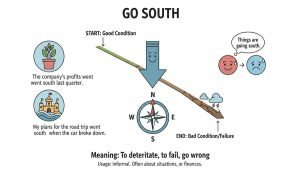
The idiom “go south” means to deteriorate, decline, or fail. When we talk about the “things go south meaning,” it refers to situations where circumstances or events deteriorate unexpectedly. Similarly, “things going south meaning” captures ongoing problems or declines, highlighting a process rather than a completed action.
The phrase “goes south meaning” is often used to describe an immediate or observed decline in any situation, whether it involves plans, relationships, health, or finances. Understanding these subtle distinctions can help learners accurately interpret the idiom in different contexts.
It implies that something is getting worse, often unexpectedly or rapidly. The origin of the phrase is somewhat obscure, but it likely stems from the idea that going south on a map is generally associated with a negative direction or outcome. It doesn’t literally refer to a geographical direction. In metaphorical terms, it suggests a downward spiral or a turn for the worse.
The term is often used in informal contexts, but it can also appear in more formal settings like news reports or business discussions, although often with a slightly more cautious tone. Its function is to provide a concise and impactful way to describe a negative change or outcome.
It often carries a sense of disappointment or concern about the situation.
The classification of “go south” is an idiom, which means its meaning cannot be directly inferred from the individual words. Idioms are a type of figurative language where the overall meaning is different from the literal meanings of the words used. Understanding idioms is crucial for mastering English, as they are frequently used in everyday conversations and writing. The context of the situation usually provides clues about the intended meaning.
Structural Breakdown
The structure of the idiom “go south” is relatively simple, consisting of the verb “go” followed by the direction “south.” However, it’s crucial to remember that the meaning is not literal. The verb “go” acts as a linking verb here, connecting the subject to the state of declining or deteriorating.
The word “south” functions adverbially, modifying the verb “go” to indicate the direction of the change (downward, negative).
The phrase can be used in various tenses, depending on the context and the time frame being discussed:
- Present Tense: Things go south quickly in this market.
- Past Tense: The negotiations went south after the first day.
- Future Tense: If we don’t act now, the situation will go south.
- Present Perfect Tense: Everything has gone south since the new management took over.
The term “went south meaning” specifically refers to instances in the past where a situation deteriorated. For example, when we say “The project went south,” we are describing a past event in which the project failed or declined unexpectedly. Recognizing the past tense usage helps learners differentiate between ongoing issues and those that have already occurred.
The phrase can also be used with auxiliary verbs to express different nuances, such as possibility or obligation:
- Might go south: The project might go south if we don’t secure funding.
- Could go south: The deal could go south if the terms aren’t agreed upon.
- Is going south: The company’s reputation is going south after the scandal.
Types and Categories of “Go South” Usage
While the core meaning of “go south” remains consistent, its application can vary depending on the context. Here are some common categories of usage:
Plans and Projects
In the context of plans and projects, “go south” indicates that a project is failing, encountering significant problems, or not achieving its intended goals. This could involve delays, budget overruns, or a complete failure to deliver the expected results.
Relationships
When applied to relationships, “go south” signifies that a relationship is deteriorating or ending. This could be a romantic relationship, a friendship, or a professional relationship.
It suggests a breakdown in communication, trust, or mutual respect.
Health
In the realm of health, “go south” implies that a person’s health is declining or worsening. This could involve the onset of new symptoms, the progression of an existing illness, or a general decline in physical or mental well-being.
Economy and Finances
Regarding economy and finances, “go south” indicates that the economy is declining, investments are losing value, or a business is failing. This could involve a recession, stock market crash, or bankruptcy.
Sports
In sports, “go south” can describe a team’s performance declining, a player getting injured, or a game turning unfavorable for a particular side.
Examples of “Go South”
To further illustrate the usage of “go south,” here are several examples categorized by the contexts mentioned above. Each table contains a variety of sentences demonstrating the different ways “go south” can be used.
Plans and Projects
The following table provides examples of how “go south” is used in the context of plans and projects. These examples illustrate the idiom’s use in describing failing or problematic ventures.
| No. | Example Sentence |
|---|---|
| 1 | The project went south when the main investor pulled out. |
| 2 | Our plans are going south because of the unexpected delays. |
| 3 | If we don’t get more funding, this venture will go south. |
| 4 | Everything went south after the new manager took over. |
| 5 | The deal could go south if the negotiations fail. |
| 6 | Their marketing campaign went south due to poor planning. |
| 7 | The construction project is going south because of material shortages. |
| 8 | Our initial strategy went south, so we had to pivot. |
| 9 | The software update went south and caused major system errors. |
| 10 | If we don’t address these issues, the whole operation will go south. |
| 11 | The merger went south due to regulatory hurdles. |
| 12 | The company’s expansion plans went south when the market crashed. |
| 13 | Their attempt to launch a new product went south because of poor marketing. |
| 14 | The negotiations went south after the first round of talks. |
| 15 | The rescue mission went south because of the bad weather. |
| 16 | The efforts to revitalize the city went south despite the initial enthusiasm. |
| 17 | The experiment went south due to unforeseen complications. |
| 18 | The festival went south because of lack of funding and poor organization. |
| 19 | The attempt to break the world record went south when the equipment failed. |
| 20 | The plan to renovate the old building went south when they discovered asbestos. |
| 21 | The initiative to improve public transportation went south due to bureaucratic delays. |
| 22 | The project to build a new school went south when the land was found to be contaminated. |
| 23 | The efforts to promote tourism in the region went south because of the negative publicity. |
| 24 | The campaign to raise awareness about climate change went south when the organizers had a public dispute. |
| 25 | The community garden project went south because of a lack of volunteers and resources. |
| 26 | The app development went south due to the lead developer leaving the project. |
| 27 | The film production went south after the director and producer had a falling out. |
| 28 | The book launch went south due to the author’s controversial statements. |
| 29 | The scientific study went south when the results couldn’t be replicated. |
| 30 | The peace talks went south when neither side was willing to compromise. |
Relationships
This table illustrates how “go south” is used to describe relationships that are deteriorating or ending. The examples cover various types of relationships, including romantic, familial, and professional ones.
| No. | Example Sentence |
|---|---|
| 1 | Their relationship went south after the argument last week. |
| 2 | Things are going south between them; they’re always fighting. |
| 3 | If they don’t communicate better, their marriage will go south. |
| 4 | The friendship went south when they started competing. |
| 5 | The partnership could go south if they can’t resolve their differences. |
| 6 | Their business relationship went south after the financial dispute. |
| 7 | The family dynamic is going south since the inheritance issues arose. |
| 8 | Our working relationship went south due to conflicting priorities. |
| 9 | The alliance went south when one party broke the agreement. |
| 10 | If trust is broken, our collaboration will go south. |
| 11 | The bond between the siblings went south after years of resentment. |
| 12 | The mentor-mentee relationship went south when the mentor betrayed the mentee’s trust. |
| 13 | The diplomatic relations between the two countries went south after the trade dispute. |
| 14 | The relationship between the band members went south due to creative differences. |
| 15 | The connection between the coach and the athlete went south when the athlete accused the coach of favoritism. |
| 16 | The rapport between the teacher and the student went south after the student was caught cheating. |
| 17 | The cooperation between the two departments went south because of budget cuts. |
| 18 | The camaraderie among the team members went south after a series of losses. |
| 19 | The understanding between the landlord and the tenant went south due to unpaid rent. |
| 20 | The harmony in the choir went south when the lead singer left. |
| 21 | The partnership between the chef and the restaurant owner went south due to disagreements over the menu. |
| 22 | The cooperation between the scientists went south after they disagreed over the interpretation of the data. |
| 23 | The alliance between the political parties went south when one party made a secret deal with the opposition. |
| 24 | The rapport between the doctor and the patient went south when the patient felt their concerns were dismissed. |
| 25 | The relationship between the author and the publisher went south due to disagreements over the book’s cover. |
| 26 | The connection between the artist and the art collector went south when the collector refused to pay the agreed price. |
| 27 | The friendship between the neighbors went south after a dispute over property lines. |
| 28 | The trust between the journalist and the source went south when the journalist revealed the source’s identity. |
| 29 | The understanding between the parent and the child went south due to constant arguments. |
| 30 | The bond between the pet owner and the pet went south when the pet ran away and was never found. |
Health
The following table contains examples of “go south” used in the context of health. These sentences illustrate how the idiom can describe a decline in physical or mental well-being.
| No. | Example Sentence |
|---|---|
| 1 | His health went south after the surgery. |
| 2 | Things are going south with her condition; she needs immediate care. |
| 3 | If he doesn’t change his lifestyle, his health will go south. |
| 4 | Her mental health went south after the traumatic event. |
| 5 | His eyesight could go south if he doesn’t rest his eyes more often. |
| 6 | The patient’s condition went south overnight. |
| 7 | Her physical strength is going south due to her sedentary lifestyle. |
| 8 | His cognitive abilities went south as he aged. |
| 9 | Her recovery went south when she stopped taking her medication. |
| 10 | If they don’t manage their stress, their overall well-being will go south. |
| 11 | The town’s public health went south after the water contamination. |
| 12 | The athlete’s performance went south after the injury. |
| 13 | The patient’s mental state went south due to isolation. |
| 14 | The community’s health went south because of pollution. |
| 15 | The elderly man’s mobility went south after the fall. |
| 16 | Her hearing went south after years of working in a noisy factory. |
| 17 | The child’s development went south due to malnutrition. |
| 18 | The dog’s health went south in its old age. |
| 19 | The plant’s growth went south due to lack of sunlight. |
| 20 | The city’s air quality went south because of increased traffic. |
| 21 | The morale in the office went south after the layoffs. |
| 22 | The team’s spirit went south after the defeat. |
| 23 | The neighborhood’s safety went south after the increase in crime. |
| 24 | The region’s economy went south after the natural disaster. |
| 25 | The school’s reputation went south after the scandal. |
| 26 | The restaurant’s service went south after the change in management. |
| 27 | The product’s quality went south after the company cut costs. |
| 28 | The movie’s plot went south in the second half. |
| 29 | The garden’s beauty went south after the drought. |
| 30 | The car’s performance went south after the accident. |
Economy and Finances
This table provides examples of “go south” used in the context of economy and finances. These examples show the idiom’s application to declining economic conditions and financial failures.
| No. | Example Sentence |
|---|---|
| 1 | The economy went south during the recession. |
| 2 | Things are going south with the stock market; it’s time to sell. |
| 3 | If we don’t diversify our investments, our portfolio will go south. |
| 4 | The company’s profits went south after the new regulations. |
| 5 | The business could go south if they don’t adapt to the changing market. |
| 6 | The real estate market went south after the interest rates increased. |
| 7 | The country’s financial situation is going south due to high debt levels. |
| 8 | Our savings went south after the unexpected expenses. |
| 9 | The investment went south when the company declared bankruptcy. |
| 10 | If we don’t manage our budget, our financial stability will go south. |
| 11 | The country’s trade balance went south after the tariffs were imposed. |
| 12 | The farmer’s crops went south due to the drought. |
| 13 | The city’s infrastructure went south due to years of neglect. |
| 14 | The organization’s reputation went south after the scandal. |
| 15 | The team’s morale went south after the loss. |
| 16 | The neighborhood’s safety went south after the increase in crime. |
| 17 | The region’s economy went south after the natural disaster. |
| 18 | The school’s reputation went south after the cheating incident. |
| 19 | The restaurant’s service went south after the change in management. |
| 20 | The product’s quality went south after the company cut costs. |
| 21 | The movie’s plot went south in the second half. |
| 22 | The garden’s beauty went south after the infestation. |
| 23 | The car’s performance went south after the accident. |
| 24 | The athlete’s stamina went south after the illness. |
| 25 | The student’s grades went south after they started skipping classes. |
| 26 | The musician’s inspiration went south after the criticism. |
| 27 | The writer’s creativity went south after the writer’s block. |
| 28 | The artist’s motivation went south after the rejection. |
| 29 | The chef’s passion went south after the long hours. |
| 30 | The dancer’s technique went south after the injury. |
Sports
The table below demonstrates the use of “go south” in the context of sports. These examples illustrate how the idiom can describe a decline in a team’s or player’s performance.
| No. | Example Sentence |
|---|---|
| 1 | The team’s performance went south in the second half of the game. |
| 2 | Things are going south for the quarterback; he’s making a lot of mistakes. |
| 3 | If they don’t improve their defense, the game will go south. |
| 4 | The athlete’s stamina went south after the injury. |
| 5 | The match could go south if the star player gets injured. |
| 6 | Their chances of winning went south when the rain started. |
| 7 | The team’s morale is going south after the recent losses. |
| 8 | His form went south after the off-season break. |
| 9 | The competition went south when the judges made controversial calls. |
| 10 | If they don’t regain their focus, the entire season will go south. |
| 11 | The tennis player’s serve went south in the final set. |
| 12 | The baseball team’s hitting went south during the playoffs. |
| 13 | The basketball player’s shooting accuracy went south under pressure. |
| 14 | The swimmer’s speed went south after the illness. |
| 15 | The marathon runner’s pace went south in the last few miles. |
| 16 | The cyclist’s endurance went south on the steep climb. |
| 17 | The soccer team’s defense went south after the key player was injured. |
| 18 | The hockey team’s scoring went south in the third period. |
| 19 | The golfer’s putting went south on the final hole. |
| 20 | The bowler’s average went south after changing their technique. |
| 21 | The chess player’s strategy went south after the opponent made a surprising move. |
| 22 | The poker player’s luck went south after losing a big hand. |
| 23 | The race car driver’s vehicle went south after a collision. |
| 24 | The figure skater’s routine went south after a fall. |
| 25 | The gymnast’s performance went south after a shaky landing. |
| 26 | The weightlifter’s strength went south after overtraining. |
| 27 | The boxer’s stamina went south in the later rounds. |
| 28 | The martial artist’s focus went south after a distraction. |
| 29 | The archer’s precision went south in the windy conditions. |
| 30 | The equestrian rider’s control went south after the horse got spooked. |
Usage Rules
The idiom “go south” is generally used in informal contexts, although it can be used in more formal settings if the tone is appropriate. It is important to consider your audience and the overall tone of your communication when using this idiom.
Rule 1: Use “go south” to describe a situation that is deteriorating or failing.
Example: The company’s profits went south after the new regulations.
Rule 2: Ensure the context is clear so that the metaphorical meaning of “go south” is understood.
Example: Without additional context, saying “It went south” might be confusing. Instead, say “The negotiations went south after the first day.”
Rule 3: Be mindful of the tense. Use the correct tense to match the time frame you are discussing.
Example: Use “went south” for past events, “is going south” for current situations, and “will go south” for future possibilities.
Rule 4: Avoid using “go south” in highly formal or technical writing, where a more precise term might be more appropriate.
Instead of: “The project went south,” consider: “The project experienced significant setbacks.”
Common Mistakes
One common mistake is using “go south” in a literal sense when the intended meaning is metaphorical. Another mistake is using the wrong tense or verb conjugation.
Here are some examples of common mistakes and their corrections:
| Incorrect | Correct | Explanation |
|---|---|---|
| “We decided to go south for the winter, but our plans went south.” | “We decided to go south for the winter, but our trip went wrong due to bad weather.” | The first “go south” is literal, while the second should be replaced with a different idiom to avoid confusion. |
| “The deal goes south yesterday.” | “The deal went south yesterday.” | The tense should be past tense (“went”) to match the time frame (“yesterday”). |
| “The project is go south.” | “The project is going south.” | The correct form is “is going south” to indicate a current, ongoing decline. |
| “Everything will south if we don’t act.” | “Everything will go south if we don’t act.” | The verb “go” is necessary before “south” to form the idiom. |
| “The company is south.” | “The company is going south.” | “Going south” is the correct idiomatic phrase to describe the company’s decline. |
Practice Exercises
Test your understanding of “go south” with these practice exercises. Fill in the blanks with the correct form of “go south” or choose the correct sentence that uses “go south” appropriately.
Exercise 1: Fill in the Blanks
| No. | Question | Answer |
|---|---|---|
| 1 | If we don’t secure more funding, the project ___________. | will go south |
| 2 | Their relationship __________ after the big argument. | went south |
| 3 | Things __________ with his health; he needs to see a doctor. | are going south |
| 4 | The economy __________ during the recession of 2008. | went south |
| 5 | The team’s performance __________ after the key player got injured. | went south |
| 6 | The negotiations __________ when the other party refused to compromise. | went south |
| 7 | The new product launch __________ due to poor marketing. | went south |
| 8 | The patient’s condition __________ very quickly. | went south |
| 9 | The company’s stock price __________ after the scandal. | went south |
| 10 | If we don’t address these issues, the entire venture __________ . | will go south |
Exercise 2: Choose the Correct Sentence
| No. | Question | Answer |
|---|---|---|
| 1 | Which sentence uses “go south” correctly? (a) We go south for the winter. (b) The project went south after the budget cuts. |
(b) The project went south after the budget cuts. |
| 2 | Which sentence uses “go south” correctly? (a) The deal is go south. (b) The deal is going south. |
(b) The deal is going south. |
| 3 | Which sentence uses “go south” correctly? (a) The relationship south after the fight. (b) The relationship went south after the fight. |
(b) The relationship went south after the fight. |
| 4 | Which sentence uses “go south” correctly? (a) Her health will south if she doesn’t rest. (b) Her health will go south if she doesn’t rest. |
(b) Her health will go south if she doesn’t rest. |
| 5 | Which sentence uses “go south” correctly? (a) The economy goes south yesterday. (b) The economy went south yesterday. |
(b) The economy went south yesterday. |
| 6 | Which sentence uses “go south” correctly? (a) The investment is south. (b) The investment is going south. |
((b) The investment is going south. |
Advanced Topics
For advanced learners, exploring the nuances and variations of “go south” can further enhance understanding. Here are some advanced topics to consider:
1. Regional Variations: While “go south” is widely used, its frequency and connotations may vary slightly by region. In some areas, it might be considered more informal than in others. Pay attention to how native speakers in different regions use the idiom.
2. Similar Idioms: Explore other idioms that convey a similar meaning to “go south,” such as “go downhill,” “take a turn for the worse,” or “fall apart.” Understanding these synonyms can provide alternative ways to express the same idea and enrich your vocabulary.
3. Contextual Nuances: Consider how the specific context can affect the interpretation of “go south.” For example, in a business context, it might imply financial losses or project failure, while in a personal context, it could refer to deteriorating relationships or health issues.
4. Use in Literature and Media: Analyze how “go south” is used in literature, movies, and news articles. Pay attention to the situations in which it is used, the characters who use it, and the overall effect it has on the narrative.
Frequently Asked Questions
What does “go south” mean in simple terms?
“Go south” means that something is getting worse or failing. It’s a way of saying that a situation is deteriorating.
Is “go south” a formal or informal expression?
“Go south” is generally an informal expression, but it can be used in some formal contexts depending on the tone and audience.
Can “go south” be used in the present, past, and future tenses?
Yes, “go south” can be used in various tenses. For example: “is going south” (present), “went south” (past), “will go south” (future).
What are some similar expressions to “go south”?
Similar expressions include “go downhill,” “take a turn for the worse,” and “fall apart.”
In what situations can I use “go south”?
You can use “go south” to describe situations involving plans, relationships, health, economy, sports, and more, where something is declining or failing.
Is it correct to say “Everything south”?
No, it is not correct. The correct idiomatic phrase is “Everything will go south” or “Everything went south,” depending on the context and tense.
Conclusion
Mastering the idiom “go south” can significantly enhance your understanding and use of the English language. By understanding its definition, structural breakdown, and various applications, you can confidently use this expression in your everyday conversations and writing.
Remember to consider the context and audience to ensure appropriate usage. With the examples and practice exercises provided in this guide, you are well-equipped to recognize, understand, and use “go south” effectively.
Keep practicing, and soon this idiom will become a natural part of your English vocabulary. Happy learning!