

Understanding how to use “having” correctly is crucial for constructing grammatically sound and sophisticated English sentences. “Having” isn’t just a word; it’s a versatile verb form that plays several key roles, from indicating possession to forming perfect tenses and participating in various idiomatic expressions.
This article aims to provide a comprehensive guide to the different uses of “having,” ensuring you can confidently incorporate it into your writing and speech. Whether you’re an ESL learner, a student preparing for exams, or simply someone looking to refine their English skills, this detailed exploration will equip you with the knowledge and practice necessary to master “having.”
Table of Contents
- Definition of “Having”
- Structural Breakdown
- Types and Categories of “Having”
- Examples of “Having” in Sentences
- Usage Rules for “Having”
- Common Mistakes with “Having”
- Practice Exercises
- Advanced Topics
- Frequently Asked Questions
- Conclusion
Definition of “Having”
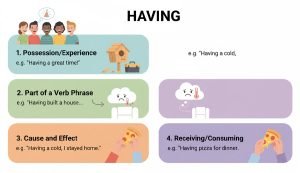
The word “having” is a form of the verb “have,” which is one of the most fundamental and versatile verbs in the English language. “Having” can function as a main verb, an auxiliary verb, a gerund, or a participle, each with its own distinct role and grammatical properties.
Understanding these different functions is essential for using “having” correctly and effectively.
In general, we use “having” when we want to emphasize an ongoing state, a prior completed action, or an action treated as a concept rather than an event. Choosing “having” instead of “have” often depends on whether the speaker wants to highlight duration, cause, or experience. For instance, “having experience” focuses on the state of possessing experience, while “having completed the task” highlights an action finished before another event.
As a main verb, “have” (and consequently “having”) primarily indicates possession, ownership, or the act of holding something. It can also denote experiences, relationships, or characteristics. As an auxiliary verb, “having” is used to form the perfect tenses, indicating actions that are completed before a specific point in time. Its role as a gerund (a verb acting as a noun) and participle (a verb acting as an adjective) further expands its utility in sentence construction.
In essence, “having” connects to a wide range of concepts, from concrete ownership to abstract experiences and temporal relationships. Its versatility allows for nuanced expression and complex sentence structures, making it a key component of proficient English communication.
To master “having,” it is important to understand its various forms and the contexts in which they are appropriately used.
Structural Breakdown
The structural role of “having” within a sentence depends on its function. As a main verb indicating possession, it follows a subject and is often followed by a noun phrase representing the object possessed.
For example, in the sentence “She is having a car,” “having” is the main verb, “she” is the subject, and “a car” is the object.
When “having” functions as an auxiliary verb, it combines with a past participle to form perfect tenses. The structure is typically: Subject + have/has/had + been/past participle. For instance, in “They are having finished the project,” “having” works with the past participle “finished” to create the present perfect continuous tense. The auxiliary “having” always precedes the past participle.
As a gerund, “having” takes on the properties of a noun and can function as a subject, object, or complement. For example, “Having a good time is important” uses “having” as the subject of the sentence.
As a participle, “having” acts as an adjective, modifying a noun or pronoun. In the sentence “Having finished their work, they went home,” “having finished their work” is a participial phrase modifying “they.”
Understanding these structural patterns helps in correctly identifying the function of “having” within a sentence and ensuring grammatical accuracy. Recognizing these patterns also facilitates the construction of more complex and nuanced sentences.
Types and Categories of “Having”
“Having” to Indicate Possession
One of the most common uses of “having” is to indicate possession or ownership. In this context, “having” functions as the main verb in the sentence, expressing that the subject owns or possesses something.
It can also describe characteristics, relationships, or experiences.
Examples of possession include “He is having a new house,” meaning he owns or possesses a new house. Examples of characteristics include “She is having blue eyes,” indicating a physical attribute.
Examples of relationships include “They are having a good relationship,” describing a connection between people. Examples of experiences include “I am having a great time,” expressing an enjoyable experience.
In this usage, “having” is often interchangeable with “possessing” or “owning,” although “having” tends to be more common and versatile in everyday language. The choice between these words often depends on the specific context and the desired level of formality.
“Having” as an Auxiliary Verb
“Having” serves as an auxiliary (or helping) verb in the perfect tenses. It combines with a past participle to form the present perfect continuous, past perfect continuous, and future perfect continuous tenses.
These tenses indicate completed actions, actions that were in progress before a specific time, and actions that will be completed before a future time, respectively.
The present perfect continuous tense (e.g., “I am having been working”) describes an action that started in the past and is still continuing in the present. The past perfect continuous tense (e.g., “I had been having worked”) describes an action that was in progress before another action in the past.
The future perfect continuous tense (e.g., “I will have been having worked”) describes an action that will have been in progress before a specific time in the future.
In these constructions, “having” works in conjunction with “been” and a present participle (verb ending in -ing) to emphasize the duration or continuity of the action. The auxiliary “having” is essential for conveying these specific temporal relationships.
“Having” as a Gerund
When “having” functions as a gerund, it acts as a noun. This means it can occupy positions in a sentence typically reserved for nouns, such as the subject, object, or complement.
The gerund form of “having” is created by adding “-ing” to the base form of the verb.
As a subject, “Having a car” can be stressful. As an object, “They enjoy having parties”.
As a complement, “Her favorite thing is having guests.” In each of these examples, “having” and its associated phrase function as a noun, performing a specific grammatical role within the sentence.
Using “having” as a gerund allows for the expression of actions or states as abstract concepts, enabling more complex and nuanced sentence structures. It’s a powerful tool for conveying ideas in a concise and grammatically correct manner.
“Having” as a Participle
As a participle, “having” functions as an adjective, modifying a noun or pronoun. It typically appears in participial phrases, which provide additional information about the subject or object of the sentence.
These phrases can add detail, context, or explanation to the main clause.
For example, in the sentence “Having finished their dinner, they went for a walk,” the participial phrase “Having finished their dinner” modifies “they,” providing information about the circumstances under which they went for a walk. Similarly, in “Having no money, he couldn’t buy the book,” the phrase “Having no money” explains why he couldn’t buy the book.
Participles add descriptive power to sentences, allowing for the concise expression of complex relationships and circumstances. “Having” as a participle is a valuable tool for creating vivid and informative prose.
“Having” in Idiomatic Expressions
“Having” appears in numerous idiomatic expressions in English, where the meaning of the phrase is not directly deducible from the individual words. These expressions often have cultural or historical roots and are an integral part of everyday language.
Examples include “having a ball” (enjoying oneself), “having a say” (having a voice or influence), “having second thoughts” (reconsidering a decision), and “having a heart” (being compassionate). Understanding these idioms is crucial for comprehending spoken and written English and for communicating effectively.
Idiomatic expressions add color and nuance to language, but they can also be challenging for non-native speakers. Learning common idioms involving “having” is essential for achieving fluency and cultural competence in English.
Examples of “Having” in Sentences
To further illustrate the various uses of “having,” let’s examine a series of examples categorized by function. These examples will provide a clearer understanding of how “having” is used in different contexts and grammatical structures.
Examples of “Having” to Indicate Possession
The following table presents examples of “having” used to indicate possession, ownership, characteristics, relationships, or experiences. Each sentence demonstrates how “having” functions as the main verb to express a connection between the subject and the object.
| Sentence | Explanation |
|---|---|
| She is having a beautiful garden. | Indicates ownership of a garden. |
| He is having a lot of experience in this field. | Indicates possession of experience. |
| They are having a strong friendship. | Indicates a relationship. |
| I am having a terrible headache. | Indicates an experience (negative). |
| We are having a meeting tomorrow. | Indicates a scheduled event. |
| The company is having a successful year. | Indicates a characteristic of the year. |
| She is having a talent for music. | Indicates a natural ability. |
| He is having a hard time adjusting to the new job. | Indicates a difficult experience. |
| They are having a party next weekend. | Indicates a planned event. |
| I am having a good feeling about this project. | Indicates an intuition or sentiment. |
| We are having a discussion about the budget. | Indicates an ongoing conversation. |
| The building is having a modern design. | Indicates a characteristic of the building. |
| She is having a positive attitude towards life. | Indicates a personal quality. |
| He is having a reputation for honesty. | Indicates how he is perceived by others. |
| They are having a significant impact on the community. | Indicates their influence. |
| I am having a craving for chocolate. | Indicates a strong desire. |
| We are having a look at the new features. | Indicates an action of observation. |
| The organization is having a fundraising event. | Indicates a planned activity. |
| She is having a moment of clarity. | Indicates a sudden realization. |
| He is having a strong desire to travel. | Indicates a wish or aspiration. |
| They are having a disagreement about the strategy. | Indicates a conflict of opinion. |
| I am having a better understanding of the topic now. | Indicates improved comprehension. |
| We are having a collaborative relationship with the other team. | Indicates a cooperative connection. |
| The product is having a successful launch. | Indicates a positive outcome. |
| She is having a difficult time making decisions. | Indicates a struggle with decision-making. |
Examples of “Having” as an Auxiliary Verb
This table presents examples of “having” used as an auxiliary verb in the perfect continuous tenses. Note how “having” combines with “been” and a present participle to emphasize the duration or continuity of the action.
| Sentence | Explanation |
|---|---|
| I am having been working on this project for three months. | Present perfect continuous: Action started in the past and continues to the present. |
| She is having been studying English since she was a child. | Present perfect continuous: Action started in the past and continues to the present. |
| They are having been living in this city for ten years. | Present perfect continuous: Action started in the past and continues to the present. |
| He is having been playing the piano for many years. | Present perfect continuous: Action started in the past and continues to the present. |
| We are having been waiting for the bus for an hour. | Present perfect continuous: Action started in the past and continues to the present. |
| The company is having been developing this software for two years. | Present perfect continuous: Action started in the past and continues to the present. |
| I had been having been working on that report before I got sick. | Past perfect continuous: Action was in progress before another past action. |
| She had been having been practicing the violin before the concert started. | Past perfect continuous: Action was in progress before another past action. |
| They had been having been living in the old house before they moved. | Past perfect continuous: Action was in progress before another past action. |
| He had been having been studying all night before the exam. | Past perfect continuous: Action was in progress before another past action. |
| We had been having been traveling for days before we reached our destination. | Past perfect continuous: Action was in progress before another past action. |
| The team had been having been working on the project for months before the deadline. | Past perfect continuous: Action was in progress before another past action. |
| I will have been having been working here for five years next month. | Future perfect continuous: Action will have been in progress before a future time. |
| She will have been having been studying abroad for a year by the end of the summer. | Future perfect continuous: Action will have been in progress before a future time. |
| They will have been having been living in their new house for six months by then. | Future perfect continuous: Action will have been in progress before a future time. |
| He will have been having been playing in the band for a decade next year. | Future perfect continuous: Action will have been in progress before a future time. |
| We will have been having been traveling around the world for a year by this time next year. | Future perfect continuous: Action will have been in progress before a future time. |
| The company will have been having been operating in the market for twenty years by 2025. | Future perfect continuous: Action will have been in progress before a future time. |
| I am having been thinking about that problem. | Present perfect continuous: Action started in the past and continues to the present. |
| She is having been wondering about her test results. | Present perfect continuous: Action started in the past and continues to the present. |
| They are having been considering a new plan. | Present perfect continuous: Action started in the past and continues to the present. |
| He is having been contemplating a career change. | Present perfect continuous: Action started in the past and continues to the present. |
Examples of “Having” as a Gerund
The following table demonstrates “having” used as a gerund, functioning as a noun within the sentence. Observe how “having” occupies positions typically reserved for nouns, such as the subject, object, or complement.
| Sentence | Explanation |
|---|---|
| Having a pet can be very rewarding. | “Having” is the subject of the sentence. |
| They enjoy having parties with their friends. | “Having” is the object of the verb “enjoy.” |
| Her favorite activity is having coffee in the morning. | “Having” is a complement, completing the meaning of the sentence. |
| Having a good education is essential for success. | “Having” is the subject of the sentence. |
| I appreciate having the opportunity to work here. | “Having” is the object of the verb “appreciate.” |
| His passion is having adventures in new places. | “Having” is a complement, completing the meaning of the sentence. |
| Having a supportive family makes a big difference. | “Having” is the subject of the sentence. |
| She avoids having arguments with her colleagues. | “Having” is the object of the verb “avoids.” |
| One of the best things about summer is having picnics. | “Having” is a complement, completing the meaning of the sentence. |
| Having a positive attitude can change your life. | “Having” is the subject of the sentence. |
| They dislike having to wake up early on weekends. | “Having” is the object of the verb “dislike.” |
| His greatest joy is having his family around him. | “Having” is a complement, completing the meaning of the sentence. |
| Having a stable job provides security. | “Having” is the subject of the sentence. |
| She regrets having said those hurtful words. | “Having” is the object of the verb “regrets.” |
| The purpose of the event is having fun and networking. | “Having” is a complement, completing the meaning of the sentence. |
| Having access to information is crucial in today’s world. | “Having” is the subject of the sentence. |
| They remember having a great time at the concert. | “Having” is the object of the verb “remember.” |
| The key to success is having a clear vision. | “Having” is a complement, completing the meaning of the sentence. |
| Having a good support system is important for mental health. | “Having” is the subject of the sentence. |
| She misses having the opportunity to travel. | “Having” is the object of the verb “misses.” |
| The main reason for the meeting is having a discussion. | “Having” is a complement, completing the meaning of the sentence. |
| Having a strong work ethic is highly valued. | “Having” is the subject of the sentence. |
| They appreciate having the support of their community. | “Having” is the object of the verb “appreciate.” |
| The goal of the project is having a positive impact. | “Having” is a complement, completing the meaning of the sentence. |
Examples of “Having” as a Participle
This table illustrates “having” used as a participle, functioning as an adjective to modify a noun or pronoun. Observe how the participial phrases add descriptive detail and context to the sentences.
In each example, the having phrase is followed by a comma.
| Sentence | Explanation |
|---|---|
| Having finished their work, they went home. | “Having finished their work” modifies “they,” explaining why they went home. |
| Having no money, he couldn’t buy the book. | “Having no money” modifies “he,” explaining why he couldn’t buy the book. |
| Having studied diligently, she passed the exam with flying colors. | “Having studied diligently” modifies “she,” explaining why she passed the exam. |
| Having eaten dinner, we decided to go for a walk. | “Having eaten dinner” modifies “we,” explaining the context for the walk. |
| Having seen the movie before, I knew what to expect. | “Having seen the movie before” modifies “I,” explaining why I knew what to expect. |
| Having completed the project, the team celebrated their success. | “Having completed the project” modifies “the team,” explaining the reason for their celebration. |
| Having traveled extensively, she had many interesting stories to tell. | “Having traveled extensively” modifies “she,” explaining why she had interesting stories. |
| Having practiced for hours, he performed exceptionally well. | “Having practiced for hours” modifies “he,” explaining the reason for his excellent performance. |
| Having read the book already, she didn’t need to see the movie. | “Having read the book already” modifies “she,” explaining why she didn’t need to see the movie. |
| Having lived in Japan, he spoke Japanese fluently. | “Having lived in Japan” modifies “he,” explaining why he spoke Japanese fluently. |
| Having worked in the industry for years, she had a wealth of knowledge. | “Having worked in the industry for years” modifies “she,” explaining why she had a wealth of knowledge. |
| Having considered all the options, they made a decision. | “Having considered all the options” modifies “they,” explaining the basis for their decision. |
| Having understood the instructions, he proceeded with the task. | “Having understood the instructions” modifies “he,” explaining why he proceeded. |
| Having visited the museum, she wrote a detailed review. | “Having visited the museum” modifies “she,” explaining the context for her review. |
| Having learned from his mistakes, he was more successful the next time. | “Having learned from his mistakes” modifies “he,” explaining why he was more successful. |
| Having prepared thoroughly, she felt confident about the presentation. | “Having prepared thoroughly” modifies “she,” explaining why she felt confident. |
| Having experienced similar challenges, he offered valuable advice. | “Having experienced similar challenges” modifies “he,” explaining why he offered valuable advice. |
| Having analyzed the data, the scientists drew their conclusions. | “Having analyzed the data” modifies “the scientists,” explaining the basis for their conclusions. |
| Having anticipated the problem, they had a solution ready. | “Having anticipated the problem” modifies “they,” explaining why they had a solution. |
| Having noticed the error, she corrected it immediately. | “Having noticed the error” modifies “she,” explaining why she corrected it. |
Usage Rules for “Having”
Using “having” correctly requires adherence to specific grammatical rules. These rules govern its function as a main verb, auxiliary verb, gerund, and participle.
A common question among learners is whether it is grammatically acceptable to begin a sentence with “having.” The short answer is yes—starting a sentence with “having” is correct when it functions as a participle introducing a participial phrase. In these cases, “having” is typically followed by a past participle or an object, and the phrase provides background information, context, or a reason related to the main clause.
For example, “Having finished the assignment, she submitted it early” is a well-formed sentence. Here, “having finished the assignment” explains the condition under which the action in the main clause occurred. This structure is especially common in formal and academic writing, where writers aim to condense information and avoid unnecessary repetition.
However, clarity is essential when starting a sentence with “having.” The subject of the participial phrase must match the subject of the main clause to avoid dangling modifiers. Compare “Having reviewed the data, the conclusion was clear” (incorrect) with “Having reviewed the data, the researcher reached a clear conclusion” (correct). Used carefully, sentence-initial “having” phrases add sophistication and precision to English writing.
When “having” indicates possession, it must agree with the subject in number and tense. For example, “I am having a car” (present tense, singular subject) vs. “They are having cars” (present tense, plural subject). As an auxiliary verb, “having” must be used in conjunction with “been” and a past participle to form the perfect continuous tenses. The correct order is Subject + am/is/are/was/were + having + been + Present Participle. For example, “I am having been working.”
As a gerund, “having” functions as a noun and must be treated accordingly. It can be singular or plural, depending on the context.
As a participle, “having” must clearly modify a noun or pronoun, and the participial phrase should be placed close to the word it modifies to avoid ambiguity.
Exceptions to these rules are rare, but certain idiomatic expressions may deviate from standard grammatical patterns. In such cases, the idiomatic meaning takes precedence over the literal meaning of the words.
Common Mistakes with “Having”
One common mistake is using “having” incorrectly as an auxiliary verb. For instance, saying “I am having finished” instead of “I have finished” is incorrect.
The correct form requires the past participle “finished” without the progressive “having.”
Another frequent error is misplacing participial phrases, leading to unclear or nonsensical sentences. For example, “Having eaten dinner, the cat was fed by Mary” is incorrect because it implies the cat ate dinner.
The correct sentence is “Having eaten dinner, Mary fed the cat.”
Confusing the gerund and participle forms is also a common mistake. Using “having” as a gerund when it should be a participle, or vice versa, can lead to grammatical errors and miscommunication.
Understanding the function of each form is crucial for avoiding these mistakes.
Here’s a list of common mistakes:
- Incorrect: I am having finished my homework. Correct: I have finished my homework.
- Incorrect: Having walked the dog, the dinner was cooked by him. Correct: Having walked the dog, he cooked dinner.
- Incorrect: Having is good for you. (Intended: Exercising is good for you.) Correct: Exercising is good for you.
Practice Exercises
These practice exercises will help you solidify your understanding of “having” and its various uses. Each exercise focuses on a specific function of “having,” providing opportunities to apply the rules and concepts discussed in this article.
Exercise 1: Identifying the Function of “Having”
Identify the function of “having” in each of the following sentences (possessive, auxiliary, gerund, participle).
| Sentence | Function |
|---|---|
| 1. She is having a new car. | |
| 2. Having finished the report, he submitted it. | |
| 3. Having a good time is important. | |
| 4. They are having been working on this project for months. | |
| 5. He is having a headache. | |
| 6. Having no experience, she was nervous about the interview. | |
| 7. Having a pet requires responsibility. | |
| 8. We are having been waiting for the concert to start. | |
| 9. She is having a talent for painting. | |
| 10. Having studied hard, he aced the test. |
Answer Key: 1. Possessive, 2. Participle, 3. Gerund, 4. Auxiliary, 5. Possessive, 6. Participle, 7. Gerund, 8. Auxiliary, 9. Possessive, 10. Participle
Exercise 2: Using “Having” in Sentences
Complete the following sentences using the correct form of “having.”
| Sentence | Answer |
|---|---|
| 1. She is _______ a great time on vacation. | |
| 2. _______ finished his work, he went home. | |
| 3. They enjoy _______ parties with their friends. | |
| 4. I am _______ been waiting for you for an hour. | |
| 5. He is _______ a new laptop. | |
| 6. _______ no money, she couldn’t afford the trip. | |
| 7. _______ a good support system is crucial. | |
| 8. We are _______ been working on this project for weeks. | |
| 9. She is _______ a natural talent for music. | |
| 10. _______ studied diligently, he passed the exam. |
Answer Key: 1. having, 2. Having, 3. having, 4. having, 5. having, 6. Having, 7. Having, 8. having, 9. having, 10. Having
Exercise 3: Correcting Mistakes with “Having”
Identify and correct the mistakes in the following sentences.
| Incorrect Sentence | Corrected Sentence |
|---|---|
| 1. I am having finished my homework. | |
| 2. Having walked the dog, the dinner was cooked by him. | |
| 3. Having is good for your health. | |
| 4. She is having been study English for years. | |
| 5. He is having a new car, it’s very expensive. | |
| 6. Having no experience, the job was hard for her. | |
| 7. Having makes me happy. | |
| 8. We are having been waiting for a long time. | |
| 9. She is having a great, she is happy. | |
| 10. Having studied, the test was easy. |
Answer Key: 1. I have finished my homework, 2. Having walked the dog, he cooked dinner, 3. Exercising is good for your health, 4. She has been studying English for years, 5. He has a new car; it’s very expensive, 6. Having no experience, she found the job hard, 7. Having friends makes me happy, 8. We have been waiting for a long time, 9. She is having a great time; she is happy, 10. Having studied, he found the test was easy
Advanced Topics
For advanced learners, exploring more nuanced aspects of “having” can further enhance their understanding and proficiency. This includes examining the subtle differences between “having” and other verbs with similar meanings, such as “possessing” or “owning.” While these verbs can often be used interchangeably, there are contexts in which one is more appropriate than the others.
For example, “having” is generally used for temporary states or experiences, while “possessing” or “owning” implies a more permanent or legal connection.
Another advanced topic is the use of “having” in complex sentence structures, such as those involving multiple clauses or embedded phrases. These structures require a strong understanding of grammar and syntax to ensure clarity and coherence.
Finally, exploring the historical evolution of “having” and its usage can provide valuable insights into the development of the English language.
Frequently Asked Questions
This FAQ section addresses common questions about the use of “having” in English sentences, providing clear and concise answers to help learners avoid confusion and improve their understanding.
Q: Can “having” always be used interchangeably with “have”?
A: No, “having” is a specific form of “have” used in continuous tenses, gerunds, and participles. While “have” indicates possession or a state, “having” indicates an ongoing action or a state of being in progress. For example, “I have a car” (possession) is different from “I am having a car repaired” (ongoing action).
Q: Is it correct to say “I am having been working here for five years”?
A: Yes, the sentence “I am having been working here for five years” is grammatically correct and uses the present perfect continuous tense. It indicates
an action that began in the past and continues into the present, emphasizing the duration of the action.
Q: How can I avoid misplacing participial phrases with “having”?
A: Ensure that the participial phrase is placed as close as possible to the noun or pronoun it modifies. This helps to avoid ambiguity and ensures that the sentence conveys the intended meaning clearly. For example, instead of “Having finished the report, the manager reviewed it,” say “Having finished the report, the manager reviewed the report”.
Q: Is “having” formal or informal?
A: “Having” is generally considered a neutral term suitable for both formal and informal contexts. However, the choice between “having,” “possessing,” and “owning” may depend on the level of formality desired. “Having” is often the most versatile and commonly used option.
Q: Can “having” be used in the passive voice?
A: Yes, “having” can be used in the passive voice, particularly in participial phrases. For example, “Having been informed of the situation, they took immediate action.” In this case, “having been informed” is a passive participial phrase modifying “they.”
Q: What is the difference between “having” as a gerund and as a participle?
A: As a gerund, “having” functions as a noun, acting as a subject, object, or complement in a sentence. As a participle, “having” functions as an adjective, modifying a noun or pronoun. The key difference lies in their grammatical role: gerunds act as nouns, while participles act as adjectives.
Q: Are there any regional variations in the use of “having”?
A: While the core grammatical rules for “having” remain consistent across different regions, some idiomatic expressions or colloquial uses may vary. It’s always beneficial to be aware of regional variations in language, but the standard uses of “having” are widely understood.
Q: How do I teach the use of “having” to ESL students?
A: Start with the basic uses of “having” to indicate possession, then gradually introduce its roles as an auxiliary verb, gerund, and participle. Provide plenty of examples and practice exercises, focusing on common mistakes and providing clear explanations. Encourage students to use “having” in their writing and speaking to reinforce their learning.
Q: Can “having” be used with other auxiliary verbs?
A: Yes, “having” can be used with other auxiliary verbs, particularly in the perfect continuous tenses. For example, “I will have been having worked” uses both “will” and “have” as auxiliary verbs in conjunction with “having” to form the future perfect continuous tense.
Q: What are some common idioms that use “having”?
A: Common idioms include “having a ball” (enjoying oneself), “having a say” (having influence), “having second thoughts” (reconsidering), “having a heart” (being compassionate), and “having a blast” (enjoying very much). Learning these idioms can enhance your understanding of idiomatic English.
Conclusion
Mastering the use of “having” in English sentences is a significant step towards achieving fluency and grammatical accuracy. By understanding its various functions as a main verb, auxiliary verb, gerund, and participle, learners can construct more complex and nuanced sentences, express a wider range of ideas, and communicate more effectively.
This article has provided a comprehensive guide to the different uses of “having,” complete with examples, usage rules, common mistakes, practice exercises, and frequently asked questions. By applying the knowledge and skills gained from this guide, you can confidently incorporate “having” into your writing and speech, enhancing your overall proficiency in the English language.
Remember to practice regularly and pay attention to the contexts in which “having” is used to further refine your understanding and mastery.