
Understanding the correct usage of “is,” “am,” and “are” is fundamental to constructing grammatically sound sentences in English. These verbs, forms of the verb “to be,” serve as the building blocks for expressing states of being, identifying subjects, and linking subjects to descriptive information.
This article provides a comprehensive exploration of these essential verbs, covering their definitions, structural roles, usage rules, common errors, and advanced applications. Whether you’re a beginner or an advanced learner, this guide will equip you with the knowledge and practice needed to confidently use “is,” “am,” and “are” in your everyday communication.
This guide will benefit ESL learners, students of all ages, and anyone who wants to improve their English grammar skills. By mastering these basic yet crucial verbs, you can significantly enhance the clarity and accuracy of your writing and speaking.
Table of Contents
- Introduction
- Definition of ‘Is,’ ‘Am,’ and ‘Are’
- Structural Breakdown
- Categories of Use
- Examples
- Usage Rules
- Common Mistakes
- Practice Exercises
- Advanced Topics
- FAQ
- Conclusion
Definition of ‘Is,’ ‘Am,’ and ‘Are’
“Is,” “am,” and “are” are all forms of the verb “to be,” one of the most fundamental and frequently used verbs in the English language. They are primarily used in the present tense and serve several crucial grammatical functions. As forms of “to be,” they are linking verbs, connecting the subject of a sentence to a noun or adjective that describes or identifies it. They can also act as auxiliary verbs, helping to form continuous (progressive) tenses.
Specifically:
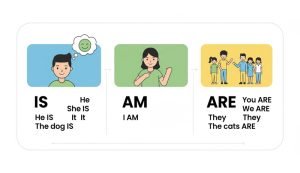
- Am is used with the first-person singular pronoun I.
- Is is used with third-person singular pronouns (he, she, it) and singular nouns.
- Are is used with first-person plural pronoun (we), second-person pronouns (you, whether singular or plural), third-person plural pronouns (they), and plural nouns.
Understanding the use of “is,” “am,” and “are” goes beyond simple subject-verb agreement. These verbs serve as both linking verbs and auxiliary verbs, providing clarity and precision in sentences. The correct use of “is” links singular third-person subjects to their complements, “am” pairs with the first-person singular pronoun, and “are” connects plural subjects or the pronoun “you” to the appropriate complement. Mastering these uses ensures that both written and spoken English convey meaning accurately and naturally.
Are “Is,” “Am,” and “Are” Verbs?
“Is,” “am,” and “are” are verbs, specifically forms of the verb “to be.” As verbs, they perform two key functions. First, as linking verbs, they connect the subject to a noun or adjective that describes it—for example, “She is a teacher,” where “is” links “she” to “teacher.” Second, as auxiliary verbs, they help form continuous tenses, such as “I am reading” or “They are studying.” Recognizing these words as verbs is essential for understanding sentence structure and expressing actions, states, or characteristics accurately.
In essence, “is,” “am,” and “are” indicate a state of being, an identity, a characteristic, or an ongoing action in the present. They are essential for constructing simple yet meaningful sentences.
Structural Breakdown
The structure of sentences using “is,” “am,” and “are” typically follows a Subject-Verb-Complement (SVC) pattern, especially when functioning as linking verbs. The subject is what or whom the sentence is about.
The verb (“is,” “am,” or “are”) connects the subject to the complement, which provides additional information about the subject. When used as auxiliary verbs, they combine with a present participle (verb ending in -ing) to form continuous tenses, indicating an ongoing action.
Here are the basic structural patterns:
- Subject + Am + Complement: I am happy.
- Subject + Is + Complement: He is a doctor.
- Subject + Are + Complement: They are students.
- Subject + Am + Verb-ing: I am studying.
- Subject + Is + Verb-ing: She is singing.
- Subject + Are + Verb-ing: We are learning.
Understanding these patterns helps in constructing grammatically correct and meaningful sentences. The correct form of “to be” depends entirely on the subject of the sentence.
Categories of Use
“Is,” “am,” and “are” can be categorized based on their function within a sentence. The primary categories are:
Linking Verbs
As linking verbs, “is,” “am,” and “are” connect the subject to a noun or adjective that describes or identifies the subject. The complement renames or describes the subject.
This usage emphasizes a state of being or a characteristic.
Auxiliary Verbs (Helping Verbs)
As auxiliary verbs, they combine with a present participle (verb ending in -ing) to form the present continuous (or progressive) tense. This usage indicates an action that is currently in progress.
Existential ‘There’
In sentences beginning with “There,” “is” and “are” indicate the existence of something. The choice between “is” and “are” depends on the noun that follows the verb.
Examples
The following sections provide extensive examples of “is,” “am,” and “are” used in different contexts. Each table will include a diverse range of sentences to illustrate the various ways these verbs can be employed.
Simple Present Tense
In the simple present tense, “is,” “am,” and “are” express a current state, fact, or general truth. The following table provides examples of this usage.
| Subject | Verb | Complement |
|---|---|---|
| I | am | a teacher. |
| He | is | tall. |
| She | is | My sister. |
| It | is | cold today. |
| We | are | friends. |
| You | are | kind. |
| They | are | students. |
| The book | is | interesting. |
| The flowers | are | beautiful. |
| My dog | is | friendly. |
| My parents | are | happy. |
| The sky | is | blue. |
| The coffee | is | hot. |
| The children | are | playing. (Note: Progressive aspect here) |
| The house | is | big. |
| The weather | is | nice. |
| My car | is | red. |
| These shoes | are | expensive. |
| Her hair | is | long. |
| Our team | is | strong. |
| The test | is | easy. |
| The movie | is | exciting. |
| The food | is | delicious. |
| The birds | are | singing. (Note: Progressive aspect here) |
| The music | is | loud. |
| The game | is | fun. |
| My job | is | stressful. |
| The party | is | tonight. |
Present Continuous Tense
In the present continuous tense, “is,” “am,” and “are” combine with a verb ending in “-ing” to describe an action happening now or around now. The following table illustrates this usage.
| Subject | Verb | Verb-ing |
|---|---|---|
| I | am | working. |
| He | is | reading. |
| She | is | writing. |
| It | is | raining. |
| We | are | studying. |
| You | are | listening. |
| They | are | playing. |
| The baby | is | sleeping. |
| The dogs | are | barking. |
| My mother | is | cooking. |
| My friends | are | traveling. |
| The sun | is | shining. |
| The wind | is | blowing. |
| The students | are | learning. |
| The cat | is | eating. |
| The birds | are | flying. |
| The computer | is | working. |
| The machine | is | running. |
| The actor | is | performing. |
| The band | is | practicing. |
| The chef | is | preparing. |
| The customer | is | complaining. |
| The economy | is | improving. |
| The government | is | investing. |
| The population | is | increasing. |
| The price | is | rising. |
| The quality | is | improving. |
| The situation | is | changing. |
Linking Verbs
As linking verbs, “is,” “am,” and “are” connect the subject to a complement that describes or renames it. These verbs do not express action but rather a state of being.
The following table provides examples of this usage, focusing on descriptive complements.
| Subject | Verb | Complement (Adjective/Noun) |
|---|---|---|
| I | am | tired. |
| He | is | a doctor. |
| She | is | beautiful. |
| It | is | a problem. |
| We | are | happy. |
| You | are | intelligent. |
| They | are | musicians. |
| The food | is | delicious. |
| The movie | is | interesting. |
| My job | is | challenging. |
| My parents | are | supportive. |
| The weather | is | pleasant. |
| The concert | is | amazing. |
| The books | are | educational. |
| The game | is | fun. |
| My friend | is | reliable. |
| The flowers | are | fragrant. |
| The lesson | is | informative. |
| The test | is | difficult. |
| The children | are | energetic. |
| His suggestion | is | helpful. |
| Her idea | is | innovative. |
| Our plan | is | organized. |
| Their performance | is | impressive. |
| The project | is | successful. |
| The result | is | positive. |
| The situation | is | complicated. |
| This explanation | is | clear. |
Existential ‘There’
When used with “there,” “is” and “are” indicate the existence or presence of something. The choice between “is” and “are” depends on whether the noun that follows is singular or plural.
The following table illustrates this usage.
| Phrase | Verb | Noun |
|---|---|---|
| There | is | a book on the table. |
| There | are | many students in the classroom. |
| There | is | a cat sleeping on the sofa. |
| There | are | several reasons for this decision. |
| There | is | no milk in the refrigerator. |
| There | are | some apples in the basket. |
| There | is | a problem with the computer. |
| There | are | a few tickets left for the concert. |
| There | is | a beautiful garden behind the house. |
| There | are | many opportunities available. |
| There | is | a famous restaurant in this city. |
| There | are | several ways to solve this problem. |
| There | is | a new movie playing at the cinema. |
| There | are | some interesting articles in the magazine. |
| There | is | a chance of rain tomorrow. |
| There | are | a lot of people at the party. |
| There | is | a good reason to be optimistic. |
| There | are | several factors to consider. |
| There | is | a meeting scheduled for next week. |
| There | are | some important documents on my desk. |
| There | is | a solution to every problem. |
| There | are | always challenges to overcome. |
| There | is | a light at the end of the tunnel. |
| There | are | many stars in the sky. |
| There | is | a river running through the city. |
| There | is | a secret hidden in the attic. |
| There | are | mysteries waiting to be solved. |
| There | is | comfort in knowing the truth. |
Usage Rules
The correct usage of “is,” “am,” and “are” is governed by subject-verb agreement. The rules governing “am,” “is,” and “are” are straightforward once subject-verb agreement is understood. Simply put, “am” is always used with “I,” “is” with singular third-person subjects, and “are” with plural subjects and “you.” These basic am is are rules are crucial for forming correct sentences and avoiding frequent errors.
This means that the verb form must agree in number (singular or plural) with the subject of the sentence.
Understanding and applying this rule is crucial for grammatical accuracy.
Subject-Verb Agreement
The basic rule of subject-verb agreement is as follows:
- Singular subjects take singular verbs (is).
- Plural subjects take plural verbs (are).
- The pronoun “I” takes “am.”
- The pronoun “you” takes “are,” regardless of whether it is singular or plural.
Examples:
- The dog is barking. (Singular subject, singular verb)
- The dogs are barking. (Plural subject, plural verb)
- I am a student. (Pronoun “I,” verb “am”)
- You are my friend. (Pronoun “you,” verb “are”)
Exceptions to the Rules
While subject-verb agreement is generally straightforward, there are some exceptions and special cases to consider:
- Collective nouns: Collective nouns (e.g., team, family, committee) can be singular or plural depending on whether they are acting as a single unit or as individual members.
- The team is playing well. (Team as a unit)
- The team are arguing about the strategy. (Team as individual members)
- Indefinite pronouns: Some indefinite pronouns (e.g., each, every, someone, nobody) are always singular, while others (e.g., several, both, few) are always plural.
- Each student is responsible for their own work.
- Several students are absent today.
- Compound subjects: Subjects joined by “and” are usually plural unless they refer to the same person or thing.
- John and Mary are coming to the party.
- The author and editor is arriving soon. (Same person)
Special Cases
Some special cases require careful attention to subject-verb agreement:
- Sentences starting with “Here” or “There”: In these sentences, the subject follows the verb.
- Here is the book you wanted.
- There are many reasons to be happy.
- Titles of books, movies, and songs: Titles are generally treated as singular even if they contain plural nouns.
- “The Adventures of Tom Sawyer” is a classic novel.
- Words used as words: When a word is referred to as a word, it is treated as singular.
- “Data” is often used as a singular noun, though it is technically plural.
Common Mistakes
Several common mistakes can occur when using “is,” “am,” and “are.” Being aware of these errors can help learners avoid them.
| Incorrect | Correct | Explanation |
|---|---|---|
| I is happy. | I am happy. | “Am” is used with the first-person singular pronoun “I.” |
| He are a doctor. | He is a doctor. | “Is” is used with third-person singular pronouns. |
| They is playing. | They are playing. | “Are” is used with third-person plural pronouns. |
| We is going. | We are going. | “Are” is used with first-person plural pronouns. |
| You is wrong. | You are wrong. | “Are” is used with the second-person pronoun “you.” |
| There is many books. | There are many books. | “Are” is used because “books” is plural. |
| The team are united. | The team is united. | “Is” is used when the team acts as a single unit. |
| Each of the students are ready. | Each of the students is ready. | “Is” is used because “each” is singular. |
| John and Mary is here. | John and Mary are here. | “Are” is used with compound subjects joined by “and.” |
| The Adventures of Tom Sawyer are a good book. | The Adventures of Tom Sawyer is a good book. | “Is” is used because the title is treated as singular. |
| She am tired. | She is tired. | “Is” is used with third-person singular pronouns. |
| It are cold outside. | It is cold outside. | “Is” is used with the third-person singular pronoun “it.” |
| My friends is coming. | My friends are coming. | “Are” is used with the plural noun “friends.” |
| One of the boys are absent. | One of the boys is absent. | “Is” is used because the subject is “one,” which is singular. |
| Nobody are perfect. | Nobody is perfect. | “Is” is used with the indefinite pronoun “nobody,” which is singular. |
Practice Exercises
The following exercises provide opportunities to practice using “is,” “am,” and “are” correctly. Each exercise focuses on a different aspect of their usage.
Exercise 1: Fill in the Blanks
Fill in the blanks with the correct form of the verb “to be” (is, am, are).
| Question | Answer |
|---|---|
| I ______ a student. | am |
| He ______ my brother. | is |
| They ______ playing in the park. | are |
| We ______ happy to see you. | are |
| You ______ very kind. | are |
| It ______ raining outside. | is |
| The book ______ on the table. | is |
| The flowers ______ beautiful. | are |
| My dog ______ friendly. | is |
| My parents ______ at home. | are |
| There ______ a cat on the roof. | is |
| There ______ many people in the room. | are |
| Each of us ______ responsible. | is |
| Some of the apples ______ rotten. | are |
| The weather ______ nice today. | is |
| John and I ______ going to the movies. | are |
| The news ______ surprising. | is |
| Physics ______ my favorite subject. | is |
| My shoes ______ too tight. | are |
| The children ______ excited about the trip. | are |
Exercise 2: Error Correction
Identify and correct the errors in the following sentences.
| Incorrect Sentence | Correct Sentence |
|---|---|
| I is going to the store. | I am going to the store. |
| He are a good student. | He is a good student. |
| They is my friends. | They are my friends. |
| We is studying for the test. | We are studying for the test. |
| You is always late. | You are always late. |
| It are a beautiful day. | It is a beautiful day. |
| The books is on the shelf. | The books are on the shelf. |
| My cat are sleeping. | My cat is sleeping. |
| My parents is doctors. | My parents are doctors. |
| There is many problems. | There are many problems. |
| Each student are unique. | Each student is unique. |
| Some of the cake is gone. | Some of the cake is gone. |
| The team are playing well together. | The team is playing well together. |
| John and Mary is married. | John and Mary are married. |
| The news are good. | The news is good. |
| Mathematics are difficult. | Mathematics is difficult. |
| My pants is too long. | My pants are too long. |
| The child are playing outside. | The child is playing outside. |
| Nobody are here. | Nobody is here. |
| One of the girls are singing. | One of the girls is singing. |
Exercise 3: Sentence Construction
Construct sentences using the given subjects and the correct form of the verb “to be.”
| Subject | Sentence |
|---|---|
| I (happy) | I am happy. |
| He (a teacher) | He is a teacher. |
| They (tired) | They are tired. |
| We (studying) | We are studying. |
| You (kind) | You are kind. |
| It (raining) | It is raining. |
| The dog (barking) | The dog is barking. |
| The flowers (blooming) | The flowers are blooming. |
| My mother (cooking) | My mother is cooking. |
| My friends (arriving) | My friends are arriving. |
| There (a car) | There is a car. |
| There (many cars) | There are many cars. |
| Each person (unique) | Each person is unique. |
| Some books (interesting) | Some books are interesting. |
| The weather (sunny) | The weather is sunny. |
| John and I (friends) | John and I are friends. |
| The news (good) | The news is good. |
| Physics (fascinating) | Physics is fascinating. |
| My shoes (comfortable) | My shoes are comfortable. |
| The children (playing) | The children are playing. |
Advanced Topics
For advanced learners, understanding the nuances of “is,” “am,” and “are” in more complex grammatical structures can further enhance their proficiency.
Subjunctive Mood
The subjunctive mood is used to express wishes, suggestions, or hypothetical situations. In some cases, the verb “to be” takes the form “were” regardless of the subject.
This is most commonly seen in “if” clauses expressing unreal conditions.
Example:
- If I were you, I would take the job. (Instead of “If I was you…”)
Inverted Sentences
Inverted sentences occur when the verb comes before the subject. This is often seen in questions or sentences beginning with certain adverbs.
Subject-verb agreement remains crucial in inverted sentences.
Examples:
- Is he coming to the party? (Instead of “He is coming to the party?”)
- Here are the keys. (Instead of “The keys are here.”)
FAQ
Here are some frequently asked questions about the use of “is,” “am,” and “are.”
Q: When do I use “is” versus “are”?
A: “Is” is used with singular subjects (e.g., he, she, it, the dog), while “are” is used with plural subjects (e.g., we, you, they, the dogs).
Q: Why do we use “are” with “you” even when it’s singular?
A: The pronoun “you” historically takes the plural form of the verb “to be” regardless of whether it refers to one person or multiple people. This is a grammatical convention in English.
Q: How do I know if a collective noun is singular or plural?
A: If the collective noun is acting as a single unit, use a singular verb (is). If the members of the collective noun
are acting individually, use a plural verb (are). Context is key.
Q: What about sentences that begin with “there”?
A: In sentences that begin with “there,” the verb (“is” or “are”) agrees with the noun that follows the verb. For example, “There is a cat” (singular) versus “There are cats” (plural).
Q: Can “is,” “am,” and “are” be contracted?
A: Yes, these verbs can be contracted, especially in informal writing and speech. For example, “I am” can be contracted to “I’m,” “he is” to “he’s,” and “they are” to “they’re.”
Conclusion
Mastering the use of “is,” “am,” and “are” is essential for building a strong foundation in English grammar. These verbs, though simple in appearance, play a crucial role in constructing clear, accurate, and meaningful sentences.
By understanding their definitions, structural roles, usage rules, and common pitfalls, learners can significantly improve their communication skills.
This comprehensive guide has provided a detailed exploration of these fundamental verbs, covering various aspects from basic usage to advanced topics. Through numerous examples and practice exercises, readers can reinforce their understanding and develop confidence in using “is,” “am,” and “are” correctly.
Whether you are a student, an ESL learner, or simply someone looking to refine their grammar skills, this knowledge will undoubtedly contribute to more effective and articulate communication.