

Complements are essential components of sentence structure in English grammar. They complete the meaning of a verb or subject, providing crucial information that allows sentences to be fully understood.
Mastering complements is vital for constructing clear, grammatically correct, and meaningful sentences. This article provides a comprehensive guide to understanding complements, covering their definition, types, usage rules, common mistakes, and advanced topics.
It is designed for English language learners of all levels, from beginners to advanced speakers, as well as teachers and anyone interested in improving their understanding of English grammar.
Table of Contents
- Introduction
- Definition of Complements
- Structural Breakdown
- Types of Complements
- Examples of Complements
- Usage Rules
- Common Mistakes
- Practice Exercises
- Advanced Topics
- FAQ
- Conclusion
Definition of Complements
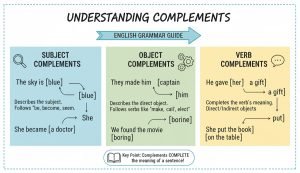
A complement is a word, phrase, or clause that is required to complete the meaning of another element in a sentence. Many learners ask, “What is a complement in grammar?” In English, a complement in English grammar is a word, phrase, or clause that completes the meaning of a sentence element.
Understanding what is a complement in a sentence is crucial because it ensures clarity and grammatical completeness. The complement meaning in English grammar highlights its essential role: without a complement, the sentence can feel incomplete or fail to convey the intended idea. Essentially, a complement in English grammar provides information that the subject, verb, or object alone cannot fully express.
Unlike adjuncts (which provide optional information), complements are essential for a sentence to be grammatically complete and semantically sound. They typically follow a verb or a subject and provide additional details about them. Without a complement, the sentence may feel incomplete or make little sense.
Complements can be classified based on the element they modify or complete. The primary types of complements include:
- Subject Complements: These follow a linking verb and describe or identify the subject.
- Object Complements: These follow the direct object and describe or identify it.
- Adjective Complements: These follow an adjective and complete its meaning.
- Adverbial Complements: These follow a verb and complete its meaning by indicating time, place, manner, or reason.
- Prepositional Complements: These are prepositional phrases required by a verb, noun, or adjective to complete its meaning.
Understanding complement examples can help clarify their function in sentences. For instance, learners often wonder, “What is a complement following an action verb?” In such cases, the complement completes the meaning of the direct object after the action verb. Consider these complement examples: “They elected him president.” Here, “president” is the complement following an action verb, describing the direct object “him.” Another example is: “She painted the door red,” where “red” is a complement following an action verb, giving essential information about the object “door.”
Complement examples like these demonstrate how complements make sentences grammatically complete and meaningful. By studying what is a complement following an action verb, English learners can distinguish essential sentence elements from optional modifiers. Incorporating complement examples into practice strengthens understanding of sentence structure, making it easier to communicate clearly and accurately.
Structural Breakdown
Understanding the structure of sentences with complements is crucial for proper usage. The basic sentence structures involving complements are:
- Subject + Linking Verb + Subject Complement: This structure is used to describe or identify the subject. For example, “She is a doctor.”
- Subject + Verb + Direct Object + Object Complement: This structure is used to describe or identify the direct object. For example, “They elected him president.”
- Subject + Verb + Adjective Complement: This structure includes a verb followed by an adjective phrase that complements the verb’s meaning. For example, “I found the book interesting.”
- Subject + Verb + Adverbial Complement: This structure uses an adverbial phrase to complement the verb, often indicating time, place, or manner. For example, “The meeting is tomorrow.”
- Subject + Verb + Prepositional Complement: This structure uses a prepositional phrase to complete the meaning of the verb. For example, “He relies on his friends.”
These structures provide a framework for constructing grammatically correct sentences with complements. Recognizing these patterns helps in identifying and using complements effectively.
Types of Complements
Subject Complements
A subject complement follows a linking verb and renames or describes the subject of the sentence. Linking verbs connect the subject to the complement, indicating a state of being or a characteristic. Common linking verbs include be (is, am, are, was, were, being, been), become, seem, appear, look, feel, sound, taste, smell, and grow.
Subject complements can be nouns, pronouns, or adjectives. A noun or pronoun subject complement is called a predicate nominative, while an adjective subject complement is called a predicate adjective.
For example:
- “She is a teacher.” (Predicate nominative)
- “It was he.” (Predicate nominative)
- “The soup tastes delicious.” (Predicate adjective)
Object Complements
An object complement follows a direct object and renames or describes it. The verb in the sentence must be transitive, meaning it takes a direct object. Object complements provide additional information about the direct object, clarifying its state or identity after the action of the verb.
Object complements can be nouns or adjectives. They answer the question “What?” or “What kind?” about the direct object.
For example:
- “They elected him president.” (Noun)
- “She painted the door red.” (Adjective)
Adjective Complements
An adjective complement is a phrase or clause that follows an adjective and completes its meaning. Adjectives often require complements to fully express their intended meaning. These complements are typically prepositional phrases or clauses.
For example:
- “I am glad that you came.” (Clause)
- “He is fond of music.” (Prepositional phrase)
Adverbial Complements
An adverbial complement is an adverb or adverbial phrase that is required to complete the meaning of a verb. These complements often indicate time, place, manner, or reason. Unlike regular adverbs, adverbial complements are essential for the sentence’s grammaticality.
For example:
- “The meeting is tomorrow.” (Time)
- “She lives in London.” (Place)
Prepositional Complements
A prepositional complement is a prepositional phrase that is required by a verb, noun, or adjective to complete its meaning. These complements are essential for the sentence’s grammatical correctness and semantic completeness.
For example:
- “He depends on his parents.” (Verb)
- “The reason for his success is hard work.” (Noun)
- “She is afraid of spiders.” (Adjective)
Examples of Complements
Here are several tables with examples of each type of complement to illustrate their usage in sentences.
Table 1: Subject Complements
The following table provides examples of subject complements, illustrating how they complete the meaning of the subject through a linking verb. The subject complements are highlighted in bold.
| Sentence | Linking Verb | Subject Complement |
|---|---|---|
| She is a doctor. | is | a doctor |
| The sky looks blue. | looks | blue |
| He became a teacher. | became | a teacher |
| The food smells delicious. | smells | delicious |
| It was he. | was | he |
| They are students. | are | students |
| The music sounds beautiful. | sounds | beautiful |
| The cake tastes sweet. | tastes | sweet |
| She seems happy. | seems | happy |
| He appears tired. | appears | tired |
| The flowers are roses. | are | roses |
| The answer is correct. | is | correct |
| My dream is to travel. | is | to travel |
| Her hobby is painting. | is | painting |
| The result was a surprise. | was | a surprise |
| John remained silent. | remained | silent |
| The weather turned cold. | turned | cold |
| This is my friend. | is | my friend |
| They were late. | were | late |
| The movie seemed interesting. | seemed | interesting |
| He is an engineer. | is | an engineer |
| The coffee smells strong. | smells | strong |
| It became obvious. | became | obvious |
| The situation is serious. | is | serious |
| She is my sister. | is | my sister |
| The task appears easy. | appears | easy |
Table 2: Object Complements
This table provides examples of object complements, illustrating how they describe or identify the direct object in a sentence. The object complements are in bold.
| Sentence | Direct Object | Object Complement |
|---|---|---|
| They elected him president. | him | president |
| She painted the door red. | door | red |
| We consider him a friend. | him | a friend |
| The class found the lecture boring. | lecture | boring |
| They named their dog Buddy. | dog | Buddy |
| He made her angry. | her | angry |
| The audience found the play captivating. | play | captivating |
| She declared the project complete. | project | complete |
| They appointed her chairperson. | her | chairperson |
| He considers himself lucky. | himself | lucky |
| The company deemed the strategy successful. | strategy | successful |
| She called the movie amazing. | movie | amazing |
| They labeled the situation critical. | situation | critical |
| He thought the book fascinating. | book | fascinating |
| The judge ruled the evidence inadmissible. | evidence | inadmissible |
| She described the event memorable. | event | memorable |
| They regarded him highly. | him | highly |
| He found the task easy. | task | easy |
| She made the room comfortable. | room | comfortable |
| They consider her talented. | her | talented |
| The team named him captain. | him | captain |
| She thought the idea brilliant. | idea | brilliant |
| They declared the game over. | game | over |
| He found the class interesting. | class | interesting |
| She called the design innovative. | design | innovative |
| They deemed the plan viable. | plan | viable |
Table 3: Adjective Complements
The following table illustrates adjective complements, which complete the meaning of an adjective. The adjective complements are highlighted in bold.
| Sentence | Adjective | Adjective Complement |
|---|---|---|
| I am glad that you came. | glad | that you came |
| He is fond of music. | fond | of music |
| She is afraid of spiders. | afraid | of spiders |
| We are certain of success. | certain | of success |
| They were unaware of the danger. | unaware | of the danger |
| He is keen on sports. | keen | on sports |
| She is proud of her achievements. | proud | of her achievements |
| I am grateful for your help. | grateful | for your help |
| He is worried about the exam. | worried | about the exam |
| She is happy with her new job. | happy | with her new job |
| They are aware of the risks. | aware | of the risks |
| He is interested in history. | interested | in history |
| She is responsible for the project. | responsible | for the project |
| I am excited about the trip. | excited | about the trip |
| He is skilled at playing the piano. | skilled | at playing the piano |
| She is good at cooking. | good | at cooking |
| They are famous for their hospitality. | famous | for their hospitality |
| He is known for his honesty. | known | for his honesty |
| She is ready for the challenge. | ready | for the challenge |
| I am sure of his success. | sure | of his success |
| He is dependent on his family. | dependent | on his family |
| She is dedicated to her work. | dedicated | to her work |
| They are committed to the cause. | committed | to the cause |
| He is accustomed to waking up early. | accustomed | to waking up early |
| She is similar to her mother. | similar | to her mother |
Table 4: Adverbial Complements
This table provides examples of adverbial complements. These phrases provide essential information about time, place, or manner.
The adverbial complements are in bold.
| Sentence | Adverbial Complement | Type |
|---|---|---|
| The meeting is tomorrow. | tomorrow | Time |
| She lives in London. | in London | Place |
| The concert is tonight. | tonight | Time |
| He works downtown. | downtown | Place |
| The store is nearby. | nearby | Place |
| The event is next week. | next week | Time |
| They are upstairs. | upstairs | Place |
| The show starts soon. | soon | Time |
| He is outside. | outside | Place |
| The train leaves at 6 PM. | at 6 PM | Time |
| She is here. | here | Place |
| The party is this evening. | this evening | Time |
| He arrived yesterday. | yesterday | Time |
| They are inside. | inside | Place |
| The class is online. | online | Place |
| She will arrive later. | later | Time |
| He is there. | there | Place |
| The game is on Sunday. | on Sunday | Time |
| They are around. | around | Place |
| The session is now. | now | Time |
Table 5: Prepositional Complements
This table provides examples of prepositional complements. These phrases are essential for completing the meaning of a verb, noun, or adjective.
The prepositional complements are in bold.
| Sentence | Prepositional Complement |
|---|---|
| He depends on his parents. | on his parents |
| The reason for his success is hard work. | for his success |
| She is afraid of spiders. | of spiders |
| They agreed on a plan. | on a plan |
| He apologized for his mistake. | for his mistake |
| She applied for the job. | for the job |
| They believe in teamwork. | in teamwork |
| He cares about the environment. | about the environment |
| She complained about the service. | about the service |
| They consist of three members. | of three members |
| He contributed to the project. | to the project |
| She decided on a course. | on a course |
| They differed on their opinions. | on their opinions |
| He elaborated on the topic. | on the topic |
| She insisted on her rights. | on her rights |
| They participated in the event. | in the event |
| He recovered from his illness. | from his illness |
| She relies on her friends. | on her friends |
| They succeeded in their mission. | in their mission |
| He suffered from a cold. | from a cold |
| She specializes in marketing. | in marketing |
| They talked about the weather. | about the weather |
| He waited for the bus. | for the bus |
| She is known for her kindness. | for her kindness |
| They are famous for their achievements. | for their achievements |
Usage Rules
Several rules govern the proper use of complements in English grammar:
- Subject complements must agree in number with the subject. If the subject is singular, the complement must also be singular. If the subject is plural, the complement must be plural.
- Linking verbs connect the subject to the subject complement. Ensure that the verb accurately reflects the relationship between the subject and its description.
- Object complements must follow the direct object and describe or identify it. The verb must be transitive, meaning it takes a direct object.
- Adjective complements follow adjectives and complete their meaning. Ensure that the complement is a prepositional phrase or clause that logically extends the adjective’s meaning.
- Adverbial complements are essential for the sentence’s grammaticality and often indicate time, place, manner, or reason. They cannot be removed without making the sentence incomplete.
- Prepositional complements are required by certain verbs, nouns, or adjectives to complete their meaning. These complements are essential for the sentence’s grammatical correctness.
Common Mistakes
Several common mistakes occur when using complements. Understanding these errors can help avoid them:
- Confusing complements with adjuncts: Complements are essential for a sentence’s grammaticality, while adjuncts are optional. For example:
- Incorrect: “She is happy.” (Without further context, “happy” is a subject complement).
- Correct: “She is happy today.” (“Today” is an adjunct, providing extra information and is not essential.)
- Incorrect subject-verb agreement with subject complements: The subject complement must agree in number with the subject. For example:
- Incorrect: “They is a student.”
- Correct: “They are students.”
- Misusing object complements: Ensure that the verb is transitive and that the object complement accurately describes or identifies the direct object. For example:
- Incorrect: “They elected to be president.”
- Correct: “They elected him president.”
- Omitting necessary prepositional complements: Certain verbs, nouns, and adjectives require prepositional complements to complete their meaning. For example:
- Incorrect: “He depends.”
- Correct: “He depends on his parents.”
Practice Exercises
Complete the following exercises to test your understanding of complements. Identify the type of complement used in each sentence.
Exercise 1: Identifying Types of Complements
Identify the type of complement (Subject Complement, Object Complement, Adjective Complement, Adverbial Complement, Prepositional Complement) in each sentence.
| # | Sentence | Type of Complement |
|---|---|---|
| 1 | She is a teacher. | |
| 2 | They elected him president. | |
| 3 | I am glad that you came. | |
| 4 | The meeting is tomorrow. | |
| 5 | He depends on his parents. | |
| 6 | The soup tastes delicious. | |
| 7 | She painted the door red. | |
| 8 | He is fond of music. | |
| 9 | She lives in London. | |
| 10 | The reason for his success is hard work. |
Exercise 1: Answers
| # | Sentence | Type of Complement |
|---|---|---|
| 1 | She is a teacher. | Subject Complement |
| 2 | They elected him president. | Object Complement |
| 3 | I am glad that you came. | Adjective Complement |
| 4 | The meeting is tomorrow. | Adverbial Complement |
| 5 | He depends on his parents. | Prepositional Complement |
| 6 | The soup tastes delicious. | Subject Complement |
| 7 | She painted the door red. | Object Complement |
| 8 | He is fond of music. | Adjective Complement |
| 9 | She lives in London. | Adverbial Complement |
| 10 | The reason for his success is hard work. | Prepositional Complement |
Exercise 2: Completing Sentences with Complements
Complete each sentence with an appropriate complement.
| # | Sentence | Type of Complement |
|---|---|---|
| 1 | She is __________. | Subject Complement |
| 2 | They consider him __________. | Object Complement |
| 3 | I am happy __________. | Adjective Complement |
| 4 | The party is __________. | Adverbial Complement |
| 5 | He relies __________. | Prepositional Complement |
| 6 | The sky looks __________. | Subject Complement |
| 7 | She found the movie __________. | Object Complement |
| 8 | He is aware __________. | Adjective Complement |
| 9 | The store is __________. | Adverbial Complement |
| 10 | They agreed __________. | Prepositional Complement |
Exercise 2: Answers
| # | Sentence | Type of Complement |
|---|---|---|
| 1 | She is a student. | Subject Complement |
| 2 | They consider him a friend. | Object Complement |
| 3 | I am happy that you are here. | Adjective Complement |
| 4 | The party is tonight. | Adverbial Complement |
| 5 | He relies on his family. | Prepositional Complement |
| 6 | The sky looks blue. | Subject Complement |
| 7 | She found the movie interesting. | Object Complement |
| 8 | He is aware of the risks. | Adjective Complement |
| 9 | The store is nearby. | Adverbial Complement |
| 10 | They agreed on a solution. | Prepositional Complement |
Advanced Topics
For advanced learners, consider these more complex aspects of complements:
- Elliptical clauses as complements: Understanding how elliptical clauses function as complements, where parts of the clause are omitted but understood from context.
- Complements in complex sentence structures: Analyzing how complements interact within complex sentences, including subordinate clauses and relative clauses.
- The role of complements in formal and informal writing: Recognizing how the choice of complements can affect the tone and style of writing.
FAQ
Q1: What is the difference between a complement and an adjunct?
A complement is essential for completing the meaning of a verb or subject, while an adjunct provides additional, non-essential information. Complements are required for a sentence to be grammatically complete, whereas adjuncts are optional and can be removed without affecting the sentence’s core structure.
Q2: How do I identify a subject complement?
A subject complement follows a linking verb (such as be, become, seem) and describes or identifies the subject of the sentence. It answers the question “What is the subject?” or “What is the subject like?”.
Q3: What verbs typically take object complements?
Verbs that typically take object complements are transitive verbs that express actions of making, considering, electing, or finding. Common examples include elect, paint, consider, find, name, make, declare, appoint.
Q4: Can a complement be a clause?
Yes, a complement can be a clause, particularly in the case of adjective complements. For example, in the sentence “I am glad that you came,” the clause “that you came” is an adjective complement completing the meaning of the adjective “glad.”
Q5: What is a predicate nominative?
A predicate nominative is a type of subject complement that is a noun or pronoun. It renames or identifies the subject of the sentence.
For example, in the sentence “She is a teacher,” the noun “teacher” is a predicate nominative.
Conclusion
Complements are vital for forming complete and meaningful sentences in English. This guide has covered the definition, types, usage rules, common mistakes, and advanced topics related to complements.
By understanding and applying these principles, you can enhance your English grammar skills and communicate more effectively. Whether you are a student, teacher, or language enthusiast, mastering complements will undoubtedly elevate your proficiency in English.