

Understanding the predicate nominative is crucial for mastering English grammar. It plays a significant role in sentence structure and meaning, helping to define or rename the subject.
This article offers a comprehensive guide, suitable for English language learners of all levels, from beginners to advanced students. We’ll explore its definition, structure, usage rules, common mistakes, and provide plenty of examples and practice exercises to solidify your understanding.
Table of Contents
- Introduction
- Definition of Predicate Nominative
- Structural Breakdown
- Types and Categories
- Examples of Predicate Nominative
- Usage Rules
- Common Mistakes
- Practice Exercises
- Advanced Topics
- FAQ
- Conclusion
Introduction
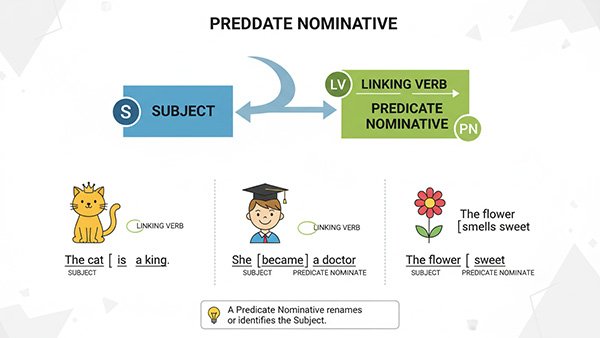
The predicate nominative, also known as a subject complement, is a powerful tool in the English language. It provides essential information about the subject of a sentence, offering a new perspective or further defining its identity.
Grasping this concept will significantly enhance your ability to construct clear, grammatically sound sentences. Whether you’re a student, writer, or simply someone looking to improve their English skills, this article will equip you with the knowledge and practice needed to confidently use predicate nominatives.
Definition of Predicate Nominative
A predicate nominative is a noun or pronoun that follows a linking verb and renames or identifies the subject of the sentence. It provides additional information about the subject, essentially stating that the subject is the predicate nominative. Understanding its function is key to differentiating it from other sentence elements like direct objects or predicate adjectives.
Classification
The predicate nominative belongs to the broader category of subject complements. Subject complements are words or groups of words that follow a linking verb and describe or identify the subject.
While a predicate nominative is specifically a noun or pronoun, a predicate adjective is an adjective that describes the subject. Both serve to complete the meaning of the linking verb and provide information about the subject.
Function
The primary function of a predicate nominative is to rename or define the subject. It answers the question “what?” or “who?” about the subject.
This renaming provides clarity and deeper understanding. Without the predicate nominative, the sentence would be incomplete or lack essential information about the subject’s identity or nature.
Contexts
Predicate nominatives are commonly found in sentences that define roles, identities, or states of being. They often appear in sentences using linking verbs such as is, are, was, were, be, being, been, seem, become, appear, look, feel, taste, smell, and sound. Recognizing these linking verbs is crucial for identifying predicate nominatives within sentences. They are used across all types of writing, from academic papers to casual conversation.
Structural Breakdown
The typical structure of a sentence containing a predicate nominative follows a consistent pattern: Subject + Linking Verb + Predicate Nominative. This pattern helps in identifying the predicate nominative within a sentence. Let’s examine each component in detail.
Subject
The subject is the noun or pronoun that performs the action or is being described in the sentence. It’s the main focus of the sentence.
The predicate nominative provides further information about this subject, clarifying its identity or role. The subject usually comes before the linking verb.
Linking Verb
A linking verb connects the subject to the predicate nominative. Unlike action verbs that describe actions, linking verbs express a state of being or a connection between the subject and its complement. Common linking verbs include forms of “to be” (is, are, was, were, am, be, being, been), as well as verbs like seem, become, appear, look, feel, taste, smell, and sound when they describe a state rather than an action.
Predicate Nominative
The predicate nominative is the noun or pronoun that follows the linking verb and renames or identifies the subject. It must agree in number with the subject.
This means that if the subject is singular, the predicate nominative must also be singular; if the subject is plural, the predicate nominative must be plural. This agreement ensures grammatical correctness and clarity.
Types and Categories
While the core function remains the same, predicate nominatives can be categorized based on their specific form and the type of information they convey. Understanding these categories can further refine your ability to identify and use them effectively.
Noun as Predicate Nominative
This is the most common type, where the predicate nominative is a noun or a noun phrase. It directly renames or identifies the subject.
For example, in the sentence “My favorite sport is basketball,” the noun “basketball” is the predicate nominative, renaming the subject “My favorite sport.”
Pronoun as Predicate Nominative
In this case, the predicate nominative is a pronoun. This is less common than using a noun, but it’s still grammatically correct. For example, in the sentence “The winner is she,” the pronoun “she” is the predicate nominative, renaming the subject “The winner.” Note that the subjective case pronoun (e.g., he, she, they, I, we) is used, not the objective case (e.g., him, her, them, me, us).
Compound Predicate Nominative
A compound predicate nominative consists of two or more nouns or pronouns that rename or identify the subject. These elements are typically joined by a coordinating conjunction such as “and” or “or.” For example, “Her hobbies are reading and painting” illustrates a compound predicate nominative: “reading and painting.”
Examples of Predicate Nominative
To solidify your understanding, let’s examine a variety of examples, categorized for clarity. These examples will demonstrate how predicate nominatives function in different sentence structures and contexts.
To further illustrate predicate nominatives in varied contexts, consider additional sentences such as: “Her role is coordinator,” “The final outcome is success,” and “Their favorite pastime is hiking.” These examples reinforce how nouns and pronouns rename or define the subject, making the concept easier to identify in both spoken and written English.
Examples with Nouns
The following table provides examples of sentences where the predicate nominative is a noun. Each sentence demonstrates how the noun renames or identifies the subject.
| Sentence | Subject | Linking Verb | Predicate Nominative |
|---|---|---|---|
| My favorite food is pizza. | My favorite food | is | pizza |
| The capital of France is Paris. | The capital of France | is | Paris |
| His dream is a successful career. | His dream | is | a successful career |
| Her job is a teacher. | Her job | is | a teacher |
| The movie was a comedy. | The movie | was | a comedy |
| Their goal is world peace. | Their goal | is | world peace |
| The problem is lack of communication. | The problem | is | lack of communication |
| The solution is more funding. | The solution | is | more funding |
| My sister is an engineer. | My sister | is | an engineer |
| That sound is a bird. | That sound | is | a bird |
| The best approach is collaboration. | The best approach | is | collaboration |
| The result was a victory. | The result | was | a victory |
| Our intention is improvement. | Our intention | is | improvement |
| His passion is photography. | His passion | is | photography |
| The feeling was nostalgia. | The feeling | was | nostalgia |
| The main ingredient is love. | The main ingredient | is | love |
| The key is perseverance. | The key | is | perseverance |
| The answer is silence. | The answer | is | silence |
| The cause was negligence. | The cause | was | negligence |
| The effect is happiness. | The effect | is | happiness |
| The country’s leader is the president. | The country’s leader | is | the president |
| That animal is a raccoon. | That animal | is | a raccoon |
| This dessert is chocolate cake. | This dessert | is | chocolate cake |
| My biggest fear is spiders. | My biggest fear | is | spiders |
| Her greatest strength is determination. | Her greatest strength | is | determination |
| The final decision is the committee’s choice. | The final decision | is | the committee’s choice |
Examples with Pronouns
The following table provides examples of sentences where the predicate nominative is a pronoun. Remember to use the subjective case pronouns (I, he, she, it, we, they, you).
| Sentence | Subject | Linking Verb | Predicate Nominative |
|---|---|---|---|
| The winner is she. | The winner | is | she |
| It is I who called. | It | is | I |
| The culprit was he. | The culprit | was | he |
| The leaders are they. | The leaders | are | they |
| The best students are we. | The best students | are | we |
| The person in charge is he. | The person in charge | is | he |
| The ones responsible are they. | The ones responsible | are | they |
| The representative is she. | The representative | is | she |
| The loudest person was he. | The loudest person | was | he |
| The only survivor was she. | The only survivor | was | she |
| The real heroes are they. | The real heroes | are | they |
| The smartest one is she. | The smartest one | is | she |
| The organizers were they. | The organizers | were | they |
| The true believers are we. | The true believers | are | we |
| The instigators were they. | The instigators | were | they |
| The applicants are we. | The applicants | are | we |
| The detectives were they. | The detectives | were | they |
| The comedians are they. | The comedians | are | they |
| The doctors are we. | The doctors | are | we |
| The instructors are they. | The instructors | are | they |
| The negotiators are they. | The negotiators | are | they |
| The administrators are they. | The administrators | are | they |
| The defendants are they. | The defendants | are | they |
| The plaintiffs are we. | The plaintiffs | are | we |
| The advocates are they. | The advocates | are | they |
| The enthusiasts are we. | The enthusiasts | are | we |
Examples with Compound Predicate Nominatives
The following table provides examples of sentences where the predicate nominative is compound, consisting of two or more nouns or pronouns joined by a coordinating conjunction.
| Sentence | Subject | Linking Verb | Predicate Nominative |
|---|---|---|---|
| His favorite sports are football and basketball. | His favorite sports | are | football and basketball |
| Her hobbies are reading and writing. | Her hobbies | are | reading and writing |
| The suspects are John and Mary. | The suspects | are | John and Mary |
| My best friends are Tom and Susan. | My best friends | are | Tom and Susan |
| The ingredients are flour, sugar, and eggs. | The ingredients | are | flour, sugar, and eggs |
| Possible outcomes are success or failure. | Possible outcomes | are | success or failure |
| The choices are coffee, tea, or juice. | The choices | are | coffee, tea, or juice |
| The winners are she and he. | The winners | are | she and he |
| The organizers are they and I. | The organizers | are | they and I |
| The teachers are Mrs. Smith and Mr. Jones. | The teachers | are | Mrs. Smith and Mr. Jones |
| The pets are a cat and a dog. | The pets | are | a cat and a dog |
| The courses are math and science. | The courses | are | math and science |
| The destinations are Italy and France. | The destinations | are | Italy and France |
| The tools are a hammer and a screwdriver. | The tools | are | a hammer and a screwdriver |
| The colors are red and blue. | The colors | are | red and blue |
| The tasks are cleaning and organizing. | The tasks | are | cleaning and organizing |
| The languages are English and Spanish. | The languages | are | English and Spanish |
| The responsibilities are planning and executing. | The responsibilities | are | planning and executing |
| The subjects are history and geography. | The subjects | are | history and geography |
| The values are honesty and integrity. | The values | are | honesty and integrity |
| The skills are leadership and communication. | The skills | are | leadership and communication |
| The benefits are health and happiness. | The benefits | are | health and happiness |
| The challenges are time and resources. | The challenges | are | time and resources |
| The opportunities are growth and development. | The opportunities | are | growth and development |
| The requirements are experience and education. | The requirements | are | experience and education |
Usage Rules
Proper usage of predicate nominatives requires adherence to specific grammatical rules. Understanding these rules is essential for constructing grammatically correct and clear sentences.
Agreement with Subject
The predicate nominative must agree in number with the subject. If the subject is singular, the predicate nominative must be singular; if the subject is plural, the predicate nominative must be plural.
This agreement ensures that the sentence is grammatically sound and easy to understand.
Correct: The book is my favorite. (Singular subject and singular predicate nominative)
Correct: The books are my favorites. (Plural subject and plural predicate nominative)
Incorrect: The book are my favorite.
Incorrect: The books is my favorite.
Subjective Case Pronouns
When the predicate nominative is a pronoun, it must be in the subjective case (I, he, she, it, we, they, you). Using the objective case (me, him, her, us, them, you) is a common mistake that should be avoided.
This is because the pronoun is renaming the subject, and should therefore take the same case as the subject.
Correct: The singer is she.
Incorrect: The singer is her.
Linking Verbs Only
Predicate nominatives only follow linking verbs. They cannot follow action verbs.
If the verb is an action verb, the noun or pronoun that follows is likely a direct object or indirect object, not a predicate nominative. Identifying the verb as a linking verb is crucial for correctly identifying the predicate nominative.
Correct: He is a doctor. (“is” is a linking verb)
Incorrect: He kicked the ball a doctor. (“kicked” is an action verb, and “a doctor” makes no sense here)
Common Mistakes
Several common mistakes can occur when using predicate nominatives. Being aware of these errors can help you avoid them and improve the accuracy of your writing.
Using Objective Pronoun Case
One of the most frequent errors is using the objective case of a pronoun instead of the subjective case. Remember that the predicate nominative renames the subject, so it must be in the subjective case.
Incorrect: The winner is her.
Correct: The winner is she.
Subject-Verb Agreement Errors
Failing to ensure agreement between the subject and the predicate nominative is another common mistake. The predicate nominative must agree in number with the subject.
Incorrect: The problem are the costs.
Correct: The problem is the costs.
Correct: The problems are the costs.
Misidentifying Linking Verbs
Confusing linking verbs with action verbs can lead to misidentification of predicate nominatives. Predicate nominatives only follow linking verbs.
If you use an action verb, the following noun or pronoun is likely a direct object, not a predicate nominative.
Incorrect: She painted the house a masterpiece.
Correct: The painting became a masterpiece. (became is a linking verb here)
Practice Exercises
To reinforce your understanding of predicate nominatives, complete the following exercises. Identify the predicate nominative in each sentence, or correct the sentence if it contains an error.
Exercise 1: Identifying Predicate Nominatives
Identify the predicate nominative in each of the following sentences. If a sentence does not contain a predicate nominative, write “None.”
- The dog is a golden retriever.
- She is my best friend.
- They went to the store.
- The movie was a disaster.
- He became a lawyer.
- The flowers are roses.
- I like to read books.
- The answer is twenty-one.
- We are the champions.
- It smells like lavender.
Answer Key:
- golden retriever
- my best friend
- None
- a disaster
- a lawyer
- roses
- None
- twenty-one
- the champions
- lavender
Exercise 2: Correcting Errors
Correct the following sentences if they contain errors in the use of predicate nominatives. If the sentence is correct, write “Correct.”
- The winner is her.
- The problems is the economy.
- The solution are new ideas.
- The culprit was him.
- The best player is he.
- The leaders is them.
- That sound is a owl.
- The best students are us.
- The organizers were they.
- The true believer is I.
Answer Key:
- The winner is she.
- The problem is the economy.
- The solution is new ideas OR The solutions are new ideas.
- The culprit was he.
- Correct
- The leaders are they.
- That sound is an owl.
- The best students are we.
- Correct
- The true believer is me.
Exercise 3: Sentence Completion
Complete the following sentences with an appropriate predicate nominative.
- My favorite color is __________.
- The capital of Canada is __________.
- Her dream is to become __________.
- The movie was __________.
- Their goal is __________.
- The solution is __________.
- My sister is __________.
- That sound is __________.
- The best approach is __________.
- The result was __________.
Possible Answer Key: (Many answers are possible)
- My favorite color is blue.
- The capital of Canada is Ottawa.
- Her dream is to become a doctor.
- The movie was a comedy.
- Their goal is world peace.
- The solution is collaboration.
- My sister is a teacher.
- That sound is a bird.
- The best approach is teamwork.
- The result was a success.
Advanced Topics
For advanced learners, exploring more complex aspects of predicate nominatives can further enhance their understanding and usage.
Predicate Nominatives in Complex Sentences
Predicate nominatives can also appear in complex sentences, often within dependent clauses. Identifying them in these contexts requires careful analysis of the sentence structure.
The key is to identify the linking verb and determine which noun or pronoun is renaming the subject of that clause.
Example: The reason he is so successful is that he is a hard worker.
Formal vs. Informal Usage
In formal writing, it is generally preferred to use subjective pronouns as predicate nominatives. However, in informal speech, it is common to hear objective pronouns used.
While grammatically incorrect, this usage is often accepted in casual conversation. Understanding the context is crucial when deciding which form to use.
Formal: It is I who am responsible.
Informal: It’s me who’s responsible.
FAQ
Here are some frequently asked questions about predicate nominatives:
What is the difference between a predicate nominative and a direct object?
A predicate nominative renames or identifies the subject, following a linking verb. A direct object receives the action of an action verb. For example, in “She is a doctor,” “doctor” is a predicate nominative. In “She kicked the ball,” “ball” is a direct object.
How can I identify a linking verb?
Linking verbs connect the subject to a word that describes or renames it. Common linking verbs are forms of “to be” (is, are, was, were, am, be, being, been), as well as verbs like seem, become, appear, look, feel, taste, smell, and sound when they describe a state rather than an action. If you can replace the verb with a form of “to be” and the sentence still makes sense, it’s likely a linking verb.
Does the predicate nominative always come after the linking verb?
Yes, the predicate nominative always follows the linking verb. It completes the meaning of the verb by providing information about the subject.
Can a predicate nominative be a phrase?
Yes, a predicate nominative can be a noun phrase or a pronoun phrase. As long as it functions to rename or identify the subject, it qualifies as a predicate nominative.
What happens if the subject is compound?
If the subject is compound (two or more nouns joined by “and”), the predicate nominative must still agree in number. If the subject is plural, the predicate nominative should also be plural or able to describe multiple things. If the subject is singular, the predicate nominative should also be singular.
Why is it important to use the subjective case for pronouns as predicate nominatives?
Using the subjective case for pronouns ensures grammatical correctness and clarity. The predicate nominative is renaming the subject, therefore it should take the same case as the subject.
How does a predicate nominative differ from a predicate adjective?
A predicate nominative is a noun or pronoun that renames the subject, while a predicate adjective is an adjective that describes the subject. Both follow linking verbs, but their functions are different.
Are predicate nominatives used in all types of writing?
Yes, predicate nominatives are used in all types of writing, from formal academic papers to informal personal narratives. They are a fundamental part of English grammar and are essential for constructing clear and informative sentences.
Conclusion
Mastering the predicate nominative is an essential step in advancing your understanding of English grammar. By understanding its definition, structure, and usage rules, you can construct clearer, more precise sentences.
Remember to practice identifying predicate nominatives in various contexts and to avoid common mistakes such as using the objective case for pronouns. With consistent effort, you’ll be able to confidently and correctly use predicate nominatives in your writing and speech.