
Understanding the 12 English tenses is crucial for anyone aiming to achieve fluency and precision in the language. Each tense provides a specific framework for expressing when an action occurred, is occurring, or will occur, as well as its duration and completion.
This comprehensive guide is designed to equip you with the knowledge and skills necessary to confidently navigate the complexities of English tenses. Whether you’re a beginner or an advanced learner, this article will provide clear explanations, numerous examples, and practical exercises to solidify your understanding and enable you to communicate effectively in various contexts.
By mastering these tenses, you’ll be able to express yourself with accuracy and nuance, enhancing your overall communication skills.
This guide breaks down each tense, offering detailed explanations of their structures, usages, and common pitfalls. With plenty of examples and practice exercises, you’ll be able to solidify your knowledge and improve your ability to use English tenses correctly.
This article caters to learners of all levels, providing a structured approach to understanding and mastering this fundamental aspect of English grammar.
Table of Contents
- Introduction
- Definition of English Tenses
- Structural Breakdown of Tenses
- Types of English Tenses
- Examples of All 12 Tenses
- Usage Rules for English Tenses
- Common Mistakes with English Tenses
- Practice Exercises
- Advanced Topics in English Tenses
- FAQ: Frequently Asked Questions
- Conclusion
Definition of English Tenses
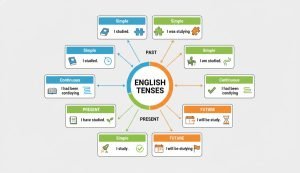
In English grammar, a tense is a category that expresses time reference. It indicates when an action or state occurs in relation to the moment of speaking or writing. English tenses are generally divided into three main categories: present, past, and future. Each of these categories has four aspects: simple, continuous (also known as progressive), perfect, and perfect continuous.
To fully master all English tenses, it helps to approach them as a complete system that covers past, present, and future actions in their various aspects. Studying the 12 tenses in english grammar systematically allows learners to understand both the structure and practical usage of each tense.
This approach ensures that students can confidently apply all English tenses in writing and speaking, while also identifying patterns that help prevent common mistakes. This combination results in the 12 tenses that form the core of English verb conjugation.
The function of tenses is to provide a temporal context for verbs, allowing speakers and writers to convey precise meanings about the timing of events. Understanding these tenses is crucial for constructing grammatically correct and coherent sentences.
The context in which a tense is used can vary widely, depending on the specific meaning the speaker or writer intends to convey. For example, the present simple tense can describe habitual actions, while the present continuous tense can describe actions happening now.
Structural Breakdown of Tenses
Each of the 12 English tenses has a specific structure that determines how the verb is formed. These structures involve auxiliary verbs (also known as helping verbs) such as be, have, and do, as well as the base form of the main verb and its various inflections (e.g., -ing, -ed). Understanding these structures is essential for forming grammatically correct sentences in each tense.
Below is a breakdown of the structural elements of each tense:
- Simple Tenses: These use the base form of the verb (present simple), the past form of the verb (past simple), or will + base form (future simple).
- Continuous Tenses: These use a form of be + the present participle (verb + -ing).
- Perfect Tenses: These use a form of have + the past participle (usually the -ed form for regular verbs).
- Perfect Continuous Tenses: These use a form of have been + the present participle (verb + -ing).
For quick reference, here is an overview of the 12 forms of tenses structure along with examples for each. This 12 tenses structure and examples guide allows learners to see both how each tense is formed and how it is used in context:
1. **Present Simple**: Base verb / verb + -s/-es | Example: She reads every morning.
2. **Present Continuous**: am/is/are + verb + -ing | Example: They are playing soccer.
3. **Present Perfect**: have/has + past participle | Example: I have finished my homework.
4. **Present Perfect Continuous**: have/has been + verb + -ing | Example: She has been working all day.
5. **Past Simple**: Past form of the verb | Example: He visited the museum.
6. **Past Continuous**: was/were + verb + -ing | Example: I was reading when you called.
7. **Past Perfect**: had + past participle | Example: They had left before we arrived.
8. **Past Perfect Continuous**: had been + verb + -ing | Example: He had been studying for hours.
9. **Future Simple**: will + base form | Example: She will travel tomorrow.
10. **Future Continuous**: will be + verb + -ing | Example: We will be attending the meeting.
11. **Future Perfect**: will have + past participle | Example: I will have completed the project.
12. **Future Perfect Continuous**: will have been + verb + -ing | Example: They will have been working for years by then.
By referencing this 12 tenses structure and examples guide, learners can practice forming sentences correctly and gain confidence in using all English tenses effectively.
Types of English Tenses
The English tenses are categorized into three main time frames: present, past, and future. Each of these time frames includes simple, continuous, perfect, and perfect continuous aspects, resulting in a total of twelve tenses.
Present Tenses
Present tenses describe actions or states that are happening now, happen regularly, or are generally true. There are four present tenses:
- Present Simple: Describes habits, general truths, and permanent situations.
- Present Continuous: Describes actions happening now or around now, and temporary situations.
- Present Perfect: Describes actions that started in the past and continue to the present, or actions completed at an unspecified time in the past.
- Present Perfect Continuous: Describes actions that started in the past and are still continuing now.
Past Tenses
Past tenses describe actions or states that happened in the past. There are four past tenses:
- Past Simple: Describes completed actions in the past.
- Past Continuous: Describes actions in progress at a specific time in the past.
- Past Perfect: Describes actions completed before another action in the past.
- Past Perfect Continuous: Describes actions that were in progress before another action in the past.
Future Tenses
Future tenses describe actions or states that will happen in the future. There are four future tenses:
- Future Simple: Describes predictions, spontaneous decisions, and future facts.
- Future Continuous: Describes actions that will be in progress at a specific time in the future.
- Future Perfect: Describes actions that will be completed before a specific time in the future.
- Future Perfect Continuous: Describes actions that will have been in progress for a period of time before a specific time in the future.
Examples of All 12 Tenses
This section provides detailed examples of each of the 12 English tenses, demonstrating their usage in various contexts. Each tense is illustrated with multiple sentences to provide a clear understanding of its meaning and structure.
Present Tenses Examples
The following table provides examples of the four present tenses:
| Tense | Structure | Examples |
|---|---|---|
| Present Simple | Base form of the verb (or verb + -s/-es for third-person singular) |
|
| Present Continuous | am/is/are + verb + -ing |
|
| Present Perfect | have/has + past participle |
|
| Present Perfect Continuous | have/has been + verb + -ing |
|
Past Tenses Examples
The following table provides examples of the four past tenses:
| Tense | Structure | Examples |
|---|---|---|
| Past Simple | Past form of the verb |
|
| Past Continuous | was/were + verb + -ing |
|
| Past Perfect | had + past participle |
|
| Past Perfect Continuous | had been + verb + -ing |
|
Future Tenses Examples
The following table provides examples of the four future tenses:
| Tense | Structure | Examples |
|---|---|---|
| Future Simple | will + base form of the verb |
|
| Future Continuous | will be + verb + -ing |
|
| Future Perfect | will have + past participle |
|
| Future Perfect Continuous | will have been + verb + -ing |
|
Usage Rules for English Tenses
Each tense has specific usage rules that dictate when and how it should be used. These rules are based on the time frame, aspect, and context of the action or state being described.
Understanding these rules is crucial for using tenses accurately and effectively.
- Present Simple: Use for habits, routines, general truths, and facts. Avoid using it for actions happening right now.
- Present Continuous: Use for actions happening now, temporary situations, and future plans. Be careful not to use it with stative verbs (e.g., know, believe).
- Present Perfect: Use for actions that started in the past and continue to the present, or actions completed at an unspecified time in the past. Avoid using it with specific past time expressions (e.g., yesterday, last week).
- Present Perfect Continuous: Use for actions that started in the past and are still continuing now, often emphasizing the duration of the action.
- Past Simple: Use for completed actions in the past at a specific time.
- Past Continuous: Use for actions in progress at a specific time in the past, often interrupted by another action.
- Past Perfect: Use for actions completed before another action in the past. It helps to establish the sequence of events.
- Past Perfect Continuous: Use for actions that were in progress before another action in the past, emphasizing the duration of the action.
- Future Simple: Use for predictions, spontaneous decisions, and future facts.
- Future Continuous: Use for actions that will be in progress at a specific time in the future.
- Future Perfect: Use for actions that will be completed before a specific time in the future.
- Future Perfect Continuous: Use for actions that will have been in progress for a period of time before a specific time in the future, emphasizing the duration of the action leading up to that point.
Common Mistakes with English Tenses
Many learners make common mistakes when using English tenses. Identifying and correcting these errors is an important step in mastering the language.
Here are some frequent errors and how to avoid them:
| Incorrect | Correct | Explanation |
|---|---|---|
| I am knowing the answer. | I know the answer. | Stative verbs like know are not typically used in the continuous form. |
| I have seen him yesterday. | I saw him yesterday. | The present perfect tense (have seen) is not used with specific past time expressions like yesterday. |
| I will going to the store. | I am going to the store. OR I will go to the store. | The structure will going is incorrect. Use am/is/are going to for future plans or will go for simple future. |
| She has been lived here for ten years. | She has lived here for ten years. OR She has been living here for ten years. | The past participle of live is lived. The present perfect continuous requires the -ing form (living). |
| I was eat dinner when you called. | I was eating dinner when you called. | The past continuous tense requires the -ing form of the verb (eating). |
| They will be finished the project by tomorrow. | They will have finished the project by tomorrow. | To indicate completion before a future time, use the future perfect tense (will have finished). |
| He is play soccer every weekend. | He plays soccer every weekend. | For habitual actions, use the present simple tense (plays). |
| I have been know her since 2010. | I have known her since 2010. | Use the present perfect with stative verbs like ‘know’ when describing a state that began in the past and continues to the present. |
| She will be graduated next year. | She will graduate next year. | Use the future simple for actions that will happen in the future. |
| He had been finished his work before I arrived. | He had finished his work before I arrived. | ‘Finished’ is a state that is completed before another, so Past Perfect is appropriate. Past Perfect Continuous is used to emphasize the duration of an activity before another activity in the past. |
Practice Exercises
Test your understanding of English tenses with these practice exercises. Choose the correct tense for each sentence and provide a brief explanation for your choice.
Exercise 1: Present Tenses
| Question | Answer | Explanation |
|---|---|---|
| 1. I (study) English every day. | I study English every day. | Present Simple: habitual action. |
| 2. She (work) on a new project right now. | She is working on a new project right now. | Present Continuous: action happening now. |
| 3. They (play) that game before. | They have played that game before. | Present Perfect: action completed at an unspecified time in the past. |
| 4. He (read) that book for weeks. | He has been reading that book for weeks. | Present Perfect Continuous: action started in the past and is still continuing. |
| 5. We (go) to the gym regularly. | We go to the gym regularly. | Present Simple: describes a routine or habit. |
| 6. The train (leave) at 9 AM every day. | The train leaves at 9 AM every day. | Present Simple: scheduled event. |
| 7. She (speak) English fluently. | She speaks English fluently. | Present Simple: general truth. |
| 8. They (live) in New York for five years. | They have lived in New York for five years. | Present Perfect: action started in the past and continues to the present. |
| 9. I (study) for my exams all week. | I have been studying for my exams all week. | Present Perfect Continuous: action started in the past and continues to the present, emphasizing duration. |
| 10. He (watch) TV every evening. | He watches TV every evening. | Present Simple: habitual action. |
Exercise 2: Past Tenses
| Question | Answer | Explanation |
|---|---|---|
| 1. I (eat) breakfast this morning. | I ate breakfast this morning. | Past Simple: completed action in the past. |
| 2. She (work) on her thesis all day yesterday. | She was working on her thesis all day yesterday. | Past Continuous: action in progress at a specific time in the past. |
| 3. They (play) soccer before it started raining. | They had played soccer before it started raining. | Past Perfect: action completed before another action in the past. |
| 4. He (read) that book for weeks before he finished it. | He had been reading that book for weeks before he finished it. | Past Perfect Continuous: action in progress before another action in the past, emphasizing duration. |
| 5. We (go) to the concert last night. | We went to the concert last night. | Past Simple: completed action in the past. |
| 6. The train (leave) before I arrived at the station. | The train had left before I arrived at the station. | Past Perfect: action completed before another action in the past. |
| 7. She (speak) to the manager yesterday. | She spoke to the manager yesterday. | Past Simple: completed action in the past. |
| 8. They (live) in London for a while. | They lived in London for awhile. | Past Simple: Completed action in the past. |
| 9. I (study) late last night. | I studied late last night. | Past Simple: Completed action in the past. |
| 10. He (watch) a movie on TV. | He was watching a movie on TV. | Past Continuous: action in progress at a specific time in the past. |
Exercise 3: Future Tenses
| Question | Answer | Explanation |
|---|---|---|
| 1. I (eat) breakfast tomorrow. | I will eat breakfast tomorrow. | Future Simple: prediction or intention. |
| 2. She (work) on that project all day tomorrow. | She will be working on that project all day tomorrow. | Future Continuous: action in progress at a specific time in the future. |
| 3. They (play) soccer by the time we arrive. | They will have played soccer by the time we arrive. | Future Perfect: action completed before a specific time in the future. |
| 4. He (read) that book for weeks by the time he finishes it. | He will have been reading that book for weeks by the time he finishes it. | Future Perfect Continuous: action in progress for a period of time leading to a specific time in the future. |
| 5. We (go) to the beach this summer. | We will go to the beach this summer. | Future Simple: prediction or intention. |
| 6. The train (leave) at 10 AM tomorrow. | The train will leave at 10 AM tomorrow. | Future Simple: scheduled event. |
| 7. She (speak) at the conference next week. | She will speak at the conference next week. | Future Simple: planned event. |
| 8. They (live) in a new city soon. | They will be living in a new city soon. | Future Continuous: action that will be in progress in the future. |
| 9. I (study) all weekend. | I will be studying all weekend. | Future Continuous: action that will be in progress in the future. |
| 10. He (watch) the game tonight. | He will watch the game tonight. | Future Simple: prediction or intention. |
Advanced Topics in English Tenses
For advanced learners, there are several nuances and complexities related to English tenses that can further enhance your understanding and usage. These include:
- Subjunctive Mood: The subjunctive mood is used to express wishes, suggestions, or hypothetical situations. It often involves using the base form of the verb, regardless of the subject. For example, “I suggest that he be on time.”
- Mixed Conditionals: Mixed conditionals combine different time frames in the if-clause and the main clause to express complex hypothetical scenarios. For example, “If I had studied harder (past), I would be working (present) in a better company now.”
- Emphasis and Intensification: Certain tenses can be used to emphasize or intensify the meaning of an action. For example, using the present continuous instead of the present simple can indicate that an action is temporary or unusual.
- Tense Agreement: Maintaining consistency in tense usage within a sentence or paragraph is crucial for clear communication. Pay attention to the sequence of events and ensure that your tenses accurately reflect the order in which they occurred.
FAQ: Frequently Asked Questions
Q: How can I improve my understanding of English tenses?
A: Practice regularly with exercises, read extensively to see tenses in context, and focus on understanding the specific usage rules for each tense. Pay attention to how native speakers use tenses in real-life conversations and writing.
Q: What is the most difficult tense to master?
A: Many learners find the perfect tenses (present perfect, past perfect, future perfect) challenging due to their complex structures and specific usage rules. Consistent practice and exposure to examples can help improve your understanding of these tenses.
Q: Are there any resources that can help me practice English tenses?
A: Yes, there are many online resources, textbooks, and language learning apps that offer practice exercises and explanations for English tenses. Look for resources that provide clear examples and opportunities for active practice.
Q: Can I use different tenses interchangeably?
A: No, each tense has specific usage rules and meanings. Using tenses interchangeably can lead to confusion and grammatical errors.
It’s important to understand the nuances of each tense and use them appropriately.
Q: How important is it to master all 12 tenses?
A: While it’s not always necessary to use all 12 tenses regularly, understanding them is crucial for comprehending and expressing a wide range of meanings. Mastering the tenses will significantly enhance your ability to communicate effectively in English.
Conclusion
Mastering the 12 English tenses is a significant step towards achieving fluency and accuracy in the language. By understanding the structure, usage rules, and common mistakes associated with each tense, you can improve your ability to communicate effectively in various contexts.
Consistent practice, exposure to real-life examples, and a focus on understanding the nuances of each tense will help you solidify your knowledge and build confidence in your English language skills. Remember to review the examples and exercises provided in this guide regularly to reinforce your learning and continue to enhance your understanding of English tenses.