
Dangling modifiers are a common pitfall in English grammar, leading to unintended humor or, more seriously, miscommunication. Understanding and correcting them is crucial for clear and effective writing.
This article provides a comprehensive guide to dangling modifiers, covering their definition, identification, correction, and usage. Whether you’re a student, professional writer, or simply someone looking to improve their grammar, this guide will equip you with the knowledge and skills to avoid these grammatical errors.
By the end of this article, you’ll be able to confidently identify and correct dangling modifiers, ensuring your writing is precise, professional, and easily understood. We’ll explore various types of dangling modifiers, provide numerous examples, and offer practical exercises to solidify your understanding.
Table of Contents
- Definition of Dangling Modifiers
- Structural Breakdown
- Types of Dangling Modifiers
- Examples of Dangling Modifiers
- Usage Rules
- Common Mistakes
- Practice Exercises
- Advanced Topics
- FAQ
- Conclusion
Definition of Dangling Modifiers
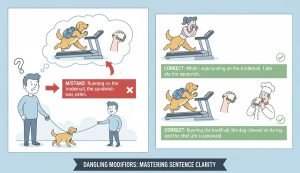
A dangling modifier is a word, phrase, or clause that doesn’t clearly and logically modify the word it’s intended to modify. In simpler terms, it’s a modifier that’s “dangling” because it doesn’t have a clear connection to the subject of the sentence.
In other words, if you’re searching for a “dangling modifier definition” or wondering “what is a dangling modifier,” it refers to a word, phrase, or clause that fails to clearly attach to the intended subject of the sentence.
This often leads to confusion or unintended humorous interpretations. Dangling modifiers typically occur at the beginning of a sentence but can also appear
later in a sentence.
Structural Breakdown
To understand dangling modifiers, it’s helpful to break down the structure of a sentence and identify the modifier and the intended subject. Many dangling modifiers with commas appear at the beginning of sentences, where the introductory phrase is separated from the main clause, emphasizing the need for precise subject placement.
Here’s a typical scenario:
- Modifier: This is the introductory phrase or clause.
- Comma: Separates the modifier from the main clause.
- Subject: The noun or pronoun that the modifier is supposed to describe.
- Verb: The action being performed by the subject.
A dangling modifier occurs when the subject following the comma doesn’t logically connect to the modifier.
Types of Dangling Modifiers
Dangling modifiers can come in several forms. Here are the most common types:
Participial Phrases
These begin with a participle (a verb form ending in -ing or -ed) and modify the subject of the sentence. When the subject is missing or unclear, the participial phrase dangles.
Infinitive Phrases
These phrases begin with “to” followed by a verb. Like participial phrases, they need a clear subject to modify.
Prepositional Phrases
While less common, prepositional phrases can also dangle if they don’t logically modify the subject. This usually happens when the phrase is intended to describe an action but is misplaced in the sentence.
Elliptical Clauses
These are clauses where some words are omitted, but the meaning is still understood. If the omitted subject is different from the subject of the main clause, a dangling modifier results.
Examples of Dangling Modifiers
Let’s look at some examples of each type of dangling modifier and how to correct them.
Below are several dangling modifier examples, demonstrating how these errors can distort meaning and how proper revision restores clarity.
Participial Phrase Examples
Incorrect: Walking through the park, the trees were beautiful.
Correct: Walking through the park, I noticed the beautiful trees.
Explanation: In the incorrect sentence, “the trees” are not walking. The corrected sentence clarifies that “I” was walking.
Incorrect: Having finished the assignment, the TV was turned on.
Correct: Having finished the assignment, I turned on the TV.
Explanation: The assignment didn’t finish itself; “I” finished it. The corrected sentence makes this clear.
Infinitive Phrase Examples
Incorrect: To get good grades, studying is essential.
Correct: To get good grades, you must study.
Explanation: “Studying” is not the one trying to get good grades. The corrected sentence clarifies that “you” must study.
Incorrect: To ভালোভাবে বুঝতে, the book was read carefully.
Correct: To ভালোভাবে বুঝতে, I read the book carefully.
Explanation: The book isn’t trying to understand; “I” am. The corrected sentence clarifies who is doing the understanding.
Prepositional Phrase Examples
Incorrect: After hours of deliberation, the decision was difficult.
Correct: After hours of deliberation, the committee found the decision difficult.
Explanation: The decision itself didn’t deliberate; the committee did. The corrected sentence clarifies who was deliberating.
Incorrect: At the age of ten, my family moved to a new city.
Correct: At the age of ten, I moved with my family to a new city.
Explanation: The family wasn’t ten years old; “I” was. The corrected sentence clarifies who was ten years old.
Elliptical Clause Examples
Incorrect: While baking the cookies, the phone rang.
Correct: While I was baking the cookies, the phone rang.
Explanation: The omitted subject of “baking” is “I.” The incorrect sentence implies the phone was baking the cookies.
Incorrect: When finished, the report should be submitted.
Correct: When the report is finished, it should be submitted.
Explanation: The omitted subject of “finished” is “the report.” The corrected sentence makes the meaning clear.
Dangling Sentences
A dangling sentence occurs when the main clause lacks a clear subject or action, leaving the sentence incomplete or ambiguous. While similar to dangling modifiers, which focus on unclear descriptive phrases, dangling sentences affect the overall grammatical integrity. For example:
Incorrect: After the rain stopped.
Correct: After the rain stopped, the children returned to play outside.
Understanding dangling sentences helps writers recognize incomplete thoughts and maintain sentence cohesion, further preventing miscommunication and awkward phrasing in professional writing.
Usage Rules
To avoid dangling modifiers, follow these rules:
- Ensure Clarity: Make sure the modifier clearly and logically refers to the subject of the main clause.
- Place Modifiers Correctly: Position the modifier as close as possible to the word it modifies.
- Revise the Sentence: If necessary, rewrite the sentence to make the relationship between the modifier and the subject clear.
- Check for Omitted Subjects: In elliptical clauses, ensure the omitted subject is the same as the subject of the main clause.
Common Mistakes
- Misplaced Modifiers: Placing the modifier too far from the word it modifies.
- Incorrect Subject: Using a subject that doesn’t logically connect to the modifier.
- Overlooking Elliptical Clauses: Failing to recognize and correct dangling modifiers in elliptical clauses.
- Assuming Understanding: Assuming the reader will understand the intended meaning, even if the sentence is grammatically incorrect.
Practice Exercises
Identify and correct the dangling modifiers in the following sentences.
Exercise 1
Instructions: Identify the dangling modifier in each sentence and rewrite the sentence to correct the error.
- Having been neglected for years, the house was in disrepair.
- To pass the exam, diligent study is required.
- After eating dinner, the dishes were washed.
- While watching TV, the dog started barking.
- At the age of five, my mother taught me to read.
Exercise 2
Instructions: Rewrite the following sentences to eliminate the dangling modifiers.
- Covered in chocolate sauce, I enjoyed the ice cream.
- To avoid being late, the alarm was set early.
- After a long day at work, a relaxing bath was taken.
- While driving to work, the rain started to fall.
- When only a child, my grandfather told me stories.
Advanced Topics
For a deeper understanding of modifiers, consider exploring:
- Squinting Modifiers: Modifiers that could modify either the word before or after them, creating ambiguity.
- Split Infinitives: The placement of adverbs between “to” and the verb in an infinitive phrase.
- Modifier Placement in Complex Sentences: The challenges of placing modifiers in sentences with multiple clauses.
FAQ
What is the difference between a dangling modifier and a misplaced modifier?
A dangling modifier doesn’t have a clear word to modify in the sentence, while a misplaced modifier is simply in the wrong position, making the sentence awkward or unclear.
Can a dangling modifier change the meaning of a sentence?
Yes, a dangling modifier can significantly alter the intended meaning of a sentence, often leading to humorous or confusing interpretations.
How can I easily identify dangling modifiers?
Look for introductory phrases or clauses followed by a comma. Then, check if the subject following the comma logically connects to the modifier.
Conclusion
Mastering the art of identifying and correcting dangling modifiers is essential for clear and effective communication. By understanding the different types of dangling modifiers, following usage rules, and practicing regularly, you can ensure your writing is precise, professional, and easily understood.
Keep this guide handy as a reference, and you’ll be well-equipped to avoid these common grammatical pitfalls.