
In English, “no problem” is a common response to a thank you, but it’s not the only option. Expanding your repertoire of responses not only makes your English sound more natural and nuanced but also allows you to better convey your intention and relationship with the speaker.
This article explores a wide range of alternatives to “no problem,” providing definitions, examples, and usage rules to help you master this essential aspect of English communication. Whether you’re a beginner or an advanced learner, this guide offers valuable insights and practical exercises to enhance your fluency and confidence.
Understanding these variations allows for more effective and appropriate communication in various social and professional settings. This article will provide a structured approach to learning these alternatives, complete with examples, common mistakes to avoid, and practice exercises.
Table of Contents
- Introduction
- Definition and Context
- Structural Breakdown
- Types and Categories
- Formal Responses
- Informal Responses
- Neutral Responses
- Emphatic Responses
- Examples
- Formal Examples
- Informal Examples
- Neutral Examples
- Emphatic Examples
- Usage Rules
- Formal Usage
- Informal Usage
- Avoiding Ambiguity
- Common Mistakes
- Practice Exercises
- Exercise 1: Choosing the Right Response
- Exercise 2: Rewriting Sentences
- Exercise 3: Completing Dialogues
- Advanced Topics
- Cultural Sensitivity
- Idiomatic Expressions
- FAQ
- Conclusion
Definition and Context
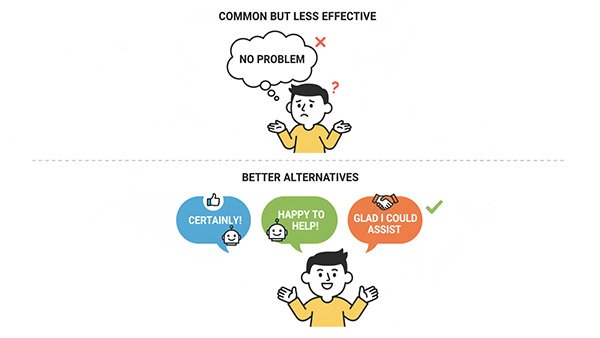
The phrase “no problem” is a common response to “thank you,” indicating that the speaker was happy to help or that a request was not burdensome. However, relying solely on this phrase can limit your ability to express a wider range of meanings and nuances.
Learning alternatives allows you to tailor your response to the specific situation, your relationship with the speaker, and the level of formality required.
The function of these alternatives is to acknowledge gratitude, reassure the speaker, and maintain a positive interaction. They serve as social lubricants, contributing to smooth and effective communication.
Choosing the right phrase can enhance your professionalism, friendliness, or sincerity, depending on the context.
Structural Breakdown
Alternatives to “no problem” can be categorized based on their grammatical structure and the type of message they convey. Some are simple phrases, while others are more complex sentences.
Understanding their structure helps in choosing the appropriate response.
Many alternatives are based on affirmative statements, such as “You’re welcome” or “It was my pleasure.” These structures explicitly acknowledge the speaker’s gratitude. Other alternatives focus on downplaying the effort involved, such as “It was nothing” or “Don’t mention it.” These structures imply that the action was not a burden.
The use of auxiliary verbs (e.g., “was,” “is”) and pronouns (e.g., “you,” “it,” “my”) contributes to the overall meaning and tone of the response. Pay attention to these structural elements when selecting the most appropriate alternative.
Types and Categories
Alternatives to “no problem” can be broadly classified into four categories based on their level of formality and the specific message they convey:
Formal Responses
These are appropriate for professional settings, interactions with superiors, or when addressing someone you don’t know well. They convey respect and professionalism.
Informal Responses
These are suitable for casual conversations with friends, family, or close colleagues. They convey friendliness and familiarity.
Neutral Responses
These are versatile and can be used in a variety of situations, striking a balance between formality and informality. They are generally safe and widely accepted.
Emphatic Responses
These convey a strong sense of willingness and enthusiasm. They are appropriate when you want to emphasize your helpfulness or sincerity.
Examples
The following tables provide examples of alternatives to “no problem,” categorized by formality level. Each table includes various options with slightly different connotations, allowing you to choose the most appropriate response for each situation.
Formal Examples
These phrases are best suited for professional environments or when interacting with someone you don’t know well. They convey respect and maintain a professional distance.
Here’s a table showcasing formal alternatives to “no problem.”
| Response | Explanation | Example Scenario |
|---|---|---|
| You’re welcome. | A classic and universally accepted formal response. | A customer thanks a salesperson for their assistance. |
| It was my pleasure. | Indicates that you enjoyed assisting the person. | A hotel concierge helps a guest with their luggage. |
| My pleasure. | A shortened, slightly less formal version of “It was my pleasure.” | An employee assists their manager with a task. |
| You’re very welcome. | Emphasizes your willingness to help. | A librarian helps a student find a research resource. |
| I’m happy to help. | Expresses your satisfaction in providing assistance. | A consultant provides advice to a client. |
| It was no trouble at all. | Indicates that the request was easy to fulfill. | An assistant completes a task for their supervisor. |
| Certainly. | A concise and professional affirmation. | A waiter responds to a customer’s request. |
| Of course. | Similar to “certainly,” but slightly less formal. | A receptionist answers a phone call and offers assistance. |
| I am glad I could assist. | A formal way of saying you were happy to help. | A customer service representative resolves a customer issue. |
| It was a privilege. | Indicates that you felt honored to help. | A volunteer assists a VIP guest at an event. |
| At your service. | A very formal and slightly old-fashioned expression. | A butler serves a guest in a grand hotel. |
| Delighted to be of service. | Expresses pleasure in assisting the person. | A high-end retail employee assists a customer. |
| Happy to oblige. | Formal and polite way of saying you were happy to help. | A government official responds to a request from a citizen. |
| It was the least I could do. | Implies that you were obligated to help. | A colleague helps a coworker finish a project. |
| I was happy to be of assistance. | A more elaborate version of “I’m happy to help.” | A technical support agent fixes a user’s computer issue. |
| Please don’t mention it. | A formal way of saying it was no trouble. | A lawyer provides pro bono services to a client. |
| You are most welcome. | A slightly more emphatic version of “You’re welcome.” | A university professor helps a student with their research. |
| It’s quite alright. | A polite reassurance that everything is fine. | An event organizer handles a last-minute change with ease. |
| I trust it was satisfactory. | Confirms that your help was sufficient. | A tailor presents a finished garment to a client. |
| We aim to please. | A professional expression of customer service. | A restaurant server ensures a pleasant dining experience. |
| I am pleased to have been of assistance. | A very formal and polite way to acknowledge their thanks. | A diplomat assists with an international negotiation. |
| It was a small matter. | Downplays the effort involved in helping. | An engineer fixes a minor issue in a complex system. |
| I am delighted to have helped. | Expresses genuine pleasure in assisting. | A doctor provides critical care to a patient. |
| Not at all. | A brief and formal way of saying it was no trouble. | A bank teller processes a customer’s transaction. |
Informal Examples
These phrases are best suited for casual conversations with friends, family, or close colleagues. They convey friendliness and familiarity.
Here’s a table showing informal alternatives to “no problem.”
| Response | Explanation | Example Scenario |
|---|---|---|
| No worries. | A casual and widely used alternative. | A friend helps another friend move furniture. |
| You got it. | Indicates that you were happy to fulfill the request. | A barista hands a customer their coffee. |
| Sure thing. | A friendly and informal affirmation. | A coworker agrees to cover a shift for another coworker. |
| Anytime. | Implies that you’re willing to help again in the future. | A neighbor helps another neighbor with yard work. |
| It’s all good. | A relaxed and reassuring response. | A roommate cleans up a shared living space. |
| Don’t sweat it. | Tells the person not to worry about it. | A sibling lends money to another sibling. |
| Happy to help! | Enthusiastic and friendly. | A volunteer assists at a community event. |
| Glad to be of service. | A lighthearted and playful way to acknowledge thanks. | A friend gives another friend a ride home. |
| Yup. | Very informal and brief affirmation. | A family member passes the salt at the dinner table. |
| No biggie. | Indicates that the task was not a significant undertaking. | A friend helps another friend fix a flat tire. |
| It was nothing. | Downplays the effort involved. | A classmate shares notes with another classmate. |
| Consider it done. | Implies that the task was completed easily. | A friend helps another friend with a computer problem. |
| Gotcha. | A casual way of saying “I understand” and “you’re welcome.” | A friend reminds another friend about an appointment. |
| Cool. | A very informal and brief affirmation. | A friend agrees to meet up later. |
| NP. | Short for “no problem,” used in texting or online chats. | A friend responds to a thank you message. |
| Sure thing, buddy. | Friendly and casual, using a term of endearment. | A close friend helps another friend move. |
| All good, man. | Relaxed and informal, using “man” as a friendly term. | A friend offers advice to another friend. |
| No prob. | A shortened version of “no problem.” | A friend helps another friend with a quick task. |
| It’s cool. | Indicates that everything is fine and you’re happy to help. | A friend covers for another friend at work. |
| Happy to do it. | Expresses pleasure in helping. | A colleague helps another colleague with a presentation. |
| Don’t even worry about it. | Reassures the person that it was no trouble at all. | A friend helps another friend through a difficult time. |
| Pleasure’s all mine. | A playful way to say that you enjoyed helping. | A family member helps with chores around the house. |
| You know it! | Enthusiastic and affirmative. | A friend helps another friend achieve a goal. |
| That’s what friends are for. | Emphasizes the importance of friendship and helping each other. | A friend supports another friend during a crisis. |
Neutral Examples
These phrases are versatile and can be used in various situations, striking a balance between formality and informality. They are generally safe and widely accepted.
Here’s a table providing neutral alternatives to “no problem.”
| Response | Explanation | Example Scenario |
|---|---|---|
| You’re most welcome. | A slightly more emphatic version of “You’re welcome.” | A store clerk helps a customer find an item. |
| Not a problem. | A straightforward alternative to “no problem.” | A waiter brings a customer their order. |
| It was nothing. | Downplays the effort involved. | A coworker helps another coworker with a minor task. |
| Don’t mention it. | Similar to “it was nothing,” implying it was no trouble. | A neighbor helps another neighbor carry groceries. |
| Happy to assist. | A polite and professional response. | A customer service representative answers a question. |
| Glad to help. | A shorter version of “happy to help.” | A colleague helps another colleague with a project. |
| Sure. | A simple and widely accepted affirmation. | A friend agrees to help another friend with a task. |
| Okay. | A neutral and widely understood response. | A family member agrees to run an errand. |
| Alright. | Similar to “okay,” but slightly more casual. | A friend agrees to meet up later. |
| Consider it done. | Implies that the task was completed easily. | A service provider completes a task for a client. |
| I am happy to have helped. | Expresses satisfaction in providing assistance. | A tutor helps a student understand a concept. |
| It was my pleasure to assist. | A more formal version of “it was my pleasure.” | A consultant provides advice to a client. |
| The pleasure was all mine. | A polite and gracious response. | A host thanks a guest for attending an event. |
| Any time. | Indicates willingness to help again in the future. | A volunteer helps at a community center. |
| No problem at all. | Emphasizes that it was no trouble to help. | A colleague reviews another colleague’s work. |
| It wasn’t a problem. | A straightforward way of saying it was no trouble. | A service technician fixes a customer’s appliance. |
| I’m always happy to help. | Expresses a general willingness to assist. | A mentor provides guidance to a mentee. |
| It’s all part of the service. | Indicates that helping is part of your job or role. | A hotel employee assists a guest with their luggage. |
| You’re welcome, of course. | Combines “you’re welcome” with a reassuring affirmation. | A librarian helps a patron find a book. |
| I was glad to be of assistance. | A polite and professional response. | A financial advisor provides advice to a client. |
| It’s quite alright. | Reassures the person that everything is fine. | A friend helps another friend through a difficult situation. |
| Think nothing of it. | Implies that the action was insignificant. | A neighbor helps another neighbor with a small task. |
| No need to thank me. | Downplays the need for gratitude. | A colleague shares valuable information with another colleague. |
| That’s what I’m here for. | Indicates that helping is part of your role or responsibility. | A teacher helps a student understand a concept. |
Emphatic Examples
These convey a strong sense of willingness and enthusiasm. They are appropriate when you want to emphasize your helpfulness or sincerity.
Here’s a table highlighting emphatic alternatives to “no problem.”
| Response | Explanation | Example Scenario |
|---|---|---|
| Absolutely! | Expresses strong agreement and willingness. | A friend enthusiastically agrees to help with a project. |
| Of course, anytime! | Combines “of course” with a willingness to help in the future. | A mentor offers ongoing support to a mentee. |
| It was absolutely my pleasure! | Emphasizes the enjoyment of helping. | A host expresses sincere gratitude to a guest. |
| I was thrilled to help! | Conveys excitement about providing assistance. | A volunteer expresses enthusiasm for their work. |
| Anything for you! | Expresses a strong willingness to help someone special. | A spouse offers unwavering support to their partner. |
| My pleasure entirely! | Emphasizes the enjoyment of helping the person. | A concierge goes above and beyond to assist a guest. |
| I’m always here for you! | Expresses a commitment to ongoing support. | A close friend offers unwavering support during a crisis. |
| It would be my honor! | Indicates a sense of privilege in providing assistance. | A veteran offers assistance to a fellow soldier. |
| You know I’m always happy to help! | Reiterates a consistent willingness to assist. | A trusted colleague offers ongoing support. |
| Don’t even mention it – I loved doing it! | Expresses genuine enjoyment in helping. | A family member enthusiastically helps with a holiday celebration. |
| I was delighted to assist! | Conveys a strong sense of pleasure in helping. | A museum docent shares their expertise with a visitor. |
| It’s the least I could do, and I loved doing it! | Downplays the effort while emphasizing enjoyment. | A firefighter rescues a family from a burning building. |
| I’m overjoyed to have helped! | Expresses extreme happiness in providing assistance. | A doctor celebrates a successful surgery. |
| It was my absolute pleasure to be of service! | Combines formality with strong enthusiasm. | A dedicated employee goes above and beyond for a customer. |
| Consider it a privilege to have helped you! | Indicates a sense of honor in providing assistance. | A mentor expresses gratitude for the opportunity to guide someone. |
| It was a joy to help! | Expresses genuine happiness in providing assistance. | A volunteer finds fulfillment in their work. |
| Seriously, anytime you need anything! | Emphasizes a strong willingness to help in the future. | A supportive friend offers unconditional assistance. |
| I was absolutely thrilled to be able to help! | Conveys strong excitement and satisfaction in helping. | A teacher celebrates a student’s success. |
| I wouldn’t have it any other way! | Expresses a strong preference for helping. | A parent supports their child’s dreams. |
| It’s always a pleasure to help you! | Reiterates consistent enjoyment in providing assistance. | A trusted advisor offers ongoing guidance. |
Usage Rules
Choosing the right alternative to “no problem” depends on several factors, including the context, your relationship with the speaker, and the level of formality required. Understanding these usage rules ensures that your response is appropriate and effective.
Formal Usage
In formal settings, it’s essential to use polite and respectful language. Phrases like “You’re welcome,” “It was my pleasure,” and “I’m happy to help” are generally appropriate.
Avoid using informal expressions like “No worries” or “You got it.”
Informal Usage
In casual conversations, you can use more relaxed and friendly expressions. Phrases like “No worries,” “You got it,” and “Anytime” are common and acceptable.
For casual conversations with friends or family, responses like “No problem anytime” or simply “No problem, thank you” can be friendly and affirming. These variations emphasize your willingness to assist again and can make the interaction feel warmer and more personal, reinforcing social bonds in informal settings.
However, avoid using overly formal language, as it may sound stiff or unnatural.
Avoiding Ambiguity
Some phrases, like “Sure,” can be ambiguous depending on the context. To avoid confusion, it’s often helpful to add a clarifying phrase, such as “Sure, no problem” or “Sure, I’m happy to help.”
Common Mistakes
One common mistake is using informal expressions in formal settings, which can be perceived as disrespectful or unprofessional. Another mistake is using overly formal language in casual conversations, which can sound awkward or insincere.
Additionally, failing to acknowledge the speaker’s gratitude at all can be seen as rude.
Here’s a table illustrating some common mistakes and their corrections:
| Incorrect | Correct | Context |
|---|---|---|
| No worries! (to your boss) | You’re welcome. | Formal work environment |
| It was my pleasure. (to a close friend) | No problem! / Anytime! | Casual conversation with a friend |
| Silence after being thanked. | You’re welcome. / No problem. | Any situation where someone expresses gratitude |
| Yup. (to a customer) | You’re welcome. / I’m happy to help. | Customer service interaction |
| Don’t mention it! (in response to a big favor) | I was glad to help. / It was my pleasure. | When someone expresses deep gratitude for a significant favor. |
| Cool. (to a client) | You’re welcome. / I’m happy to assist. | Professional client interaction |
| No biggie. (to a professor) | You’re welcome. / I’m happy to have helped. | Academic setting |
| Alright. (to a senior colleague) | You’re welcome. / Happy to assist. | Professional workplace |
| NP. (to a customer) | You’re welcome. / I’m happy to help. | Communicating with customers |
| Sure thing, buddy. (to a stranger) | You’re welcome. / I’m happy to help. | Interacting with strangers where formality is expected |
Practice Exercises
These exercises will help you practice choosing the appropriate alternative to “no problem” in different scenarios. Each exercise includes multiple questions with varying levels of difficulty.
Exercise 1: Choosing the Right Response
Choose the most appropriate response to “thank you” in each scenario.
| Scenario | Possible Responses | Correct Answer |
|---|---|---|
| Your boss thanks you for completing a report on time. | a) No worries. b) You’re welcome. c) You got it. | b) You’re welcome. |
| A friend thanks you for giving them a ride to the airport. | a) It was my pleasure. b) Anytime. c) Certainly. | b) Anytime. |
| A customer thanks you for helping them find a product in your store. | a) No biggie. b) You’re very welcome. c) Yup. | b) You’re very welcome. |
| Your neighbor thanks you for watering their plants while they were on vacation. | a) Don’t mention it. b) I’m happy to help. c) Sure thing. | a) Don’t mention it. |
| A client thanks you for your professional advice. | a) You got it. b) My pleasure. c) No sweat. | b) My pleasure. |
| Your roommate thanks you for cleaning the apartment. | a) It’s all good. b) I’m glad I could assist. c) You’re most welcome. | a) It’s all good. |
| A stranger thanks you for holding the door open for them. | a) No problem. b) Certainly. c) Cool. | b) Certainly. |
| A coworker thanks you for helping them with a difficult task. | a) No worries. b) Glad to help. c) It was a privilege. | b) Glad to help. |
| Your teacher thanks you for participating in class. | a) Sure thing. b) Not at all. c) You know it! | b) Not at all. |
| Your parents thank you for visiting them. | a) Happy to do it. b) I was happy to be of assistance. c) No prob. | a) Happy to do it. |
Exercise 2: Rewriting Sentences
Rewrite the following sentences using an alternative to “no problem” that is appropriate for the context.
| Original Sentence | Rewritten Sentence |
|---|---|
| “Thank you for your help!” “No problem.” (said to a close friend) | “Thank you for your help!” “Anytime!” |
| “Thank you for the presentation.” “No problem.” (said by an employee to their manager) | “Thank you for the presentation.” “You’re welcome.” |
| “Thank you for covering my shift.” “No problem.” (said between coworkers) | “Thank you for covering my shift.” “Sure thing.” |
| “Thank you for holding the door.” “No problem.” (said to a stranger) | “Thank you for holding the door.” “You’re welcome.” |
| “Thank you for your support.” “No problem.” (said to a family member) | “Thank you for your support.” “Happy to help.” |
| “Thank you for the advice.” “No problem.” (said by a client to a consultant) | “Thank you for the advice.” “My pleasure.” |
| “Thank you for the gift.” “No problem.” (said to a friend) | “Thank you for the gift.” “No worries!” |
| “Thank you for your time.” “No problem.” (said by a customer to a salesperson) | “Thank you for your time.” “I’m happy to help.” |
| “Thank you for your help with the project.” “No problem.” (said by a colleague.) | “Thank you for your help with the project.” “Glad to help.” |
| “Thank you for listening.” “No problem.” (said to a close friend offering support) | “Thank you for listening.” “Anytime, I’m always here for you.” |
Exercise 3: Completing Dialogues
Complete the following dialogues with an appropriate response to “thank you.”
| Dialogue | Your Response |
|---|---|
| A: “Thank you so much for helping me move!” B: “________________” | B: “Anytime! That’s what friends are for.” |
| A: “Thank you for your assistance, Doctor.” B: “________________” | B: “It was my pleasure.” |
| A: “Thank you for the delicious meal!” B: “________________” | B: “You’re most welcome!” |
| A: “Thank you for fixing my computer!” B: “________________” | B: “Glad to help!” |
| A: “Thank you for being such a great friend.” B: “________________” | B: “The pleasure’s all mine.” |
| A: “Thank you for your hard work on this project.” B: “________________” | B: “You’re welcome. I was happy to contribute.” |
| A: “Thank you for the ride!” B: “________________” | B: “Sure thing!” |
| A: “Thank you for your kindness.” B: “________________” | B: “It was nothing at all.” |
| A: “Thank you for understanding.” B: “________________” | B: “Of course, always.” |
| A: “Thank you for your patience.” B: “________________” | B: “You’re very welcome.” |
Advanced Topics
For advanced learners, exploring cultural nuances and idiomatic expressions related to responding to gratitude can further enhance their communication skills.
Cultural Sensitivity
In some cultures, directly acknowledging gratitude may be considered impolite or boastful. Understanding these cultural differences can help you avoid unintentional offense.
For example, in some Asian cultures, it’s common to downplay your contribution to avoid appearing arrogant.
Idiomatic Expressions
English includes several idiomatic expressions related to responding to gratitude. These expressions often convey a more nuanced or colorful meaning than standard phrases.
Examples include “Think nothing of it,” “Don’t give it a second thought,” and “It’s all in a day’s work.”
FAQ
Here are some
some frequently asked questions about alternatives to “no problem”:
Is “no problem” impolite?
While “no problem” is widely used and generally understood, some people consider it less polite than alternatives like “You’re welcome” or “It was my pleasure.” This is because it focuses on the lack of a problem rather than the willingness to help. However, in most casual situations, it is perfectly acceptable.
While “no problem” is widely understood, some learners seek a better response than “no problem” to convey sincerity and professionalism. In fact, many teachers advise against using “no problem” as a response in formal situations because it can unintentionally focus on the lack of difficulty rather than your willingness to help.
So, is “no problem” a good response to thank you? In casual contexts, it works fine, but in professional or highly polite settings, phrases like “You’re welcome” or “I was happy to help” communicate appreciation more effectively.
When should I avoid using “no problem”?
Avoid using “no problem” in formal settings, such as interactions with superiors, clients, or people you don’t know well. In these situations, opt for more formal and polite alternatives.
What is the most versatile alternative to “no problem”?
“You’re welcome” is the most versatile alternative, as it is appropriate in almost any situation. It is polite, professional, and widely accepted.
How can I make my response more sincere?
To make your response more sincere, use phrases that express your willingness to help, such as “I was happy to help” or “It was my pleasure.” You can also make eye contact and smile to convey genuine warmth.
Are there any regional differences in the use of these phrases?
Yes, there can be regional differences in the use of these phrases. For example, some expressions may be more common in certain parts of the United States or the United Kingdom.
Pay attention to how native speakers use these phrases in your area.
Can I use “no problem” in business emails?
It depends on the context and your relationship with the recipient. If it’s a formal business email, it’s better to use “You’re welcome” or “Happy to assist.” If it’s an informal email to a colleague you know well, “No problem” might be acceptable.
What if I accidentally use an informal phrase in a formal setting?
If you accidentally use an informal phrase in a formal setting, don’t worry too much. Simply correct yourself or follow up with a more formal expression.
For example, you could say, “No problem – or rather, you’re welcome.”
How do I respond if someone thanks me profusely for something small?
If someone thanks you profusely for something small, you can downplay your contribution by saying “It was nothing” or “Don’t mention it.” This helps to avoid appearing boastful or self-important.
Is it okay to combine phrases?
Yes, combining phrases can add emphasis or nuance to your response. For example, you could say “You’re very welcome!” or “Happy to help, anytime!”
How do I improve my understanding of these nuances?
The best way to improve your understanding of these nuances is to practice listening to and observing native speakers in various situations. Pay attention to the context, tone of voice, and body language to get a better sense of which phrases are most appropriate.
Conclusion
Mastering alternatives to “no problem” is an essential step in enhancing your English communication skills. By understanding the different types of responses, their usage rules, and common mistakes to avoid, you can confidently choose the most appropriate phrase for any situation.
Practice the exercises provided in this article to further improve your fluency and expressiveness. Remember, effective communication is not just about knowing the words, but also about understanding the nuances of social interaction.