Understanding the subtle differences between “apon” and “upon” can significantly enhance your command of the English language. While “apon” is largely archaic and rarely used in modern English, recognizing its historical context and occasional appearance in older texts is valuable.
This article provides a comprehensive guide to the usage of “upon,” exploring its various meanings, contexts, and common phrases. Whether you are an English language learner or a seasoned writer, this guide will equip you with the knowledge to use “upon” correctly and confidently, and to understand why “apon” is generally avoided.
This resource is structured to benefit learners of all levels, from beginners seeking a basic understanding to advanced speakers aiming for nuanced usage. By delving into definitions, structural breakdowns, usage rules, and practice exercises, you will gain a thorough grasp of these prepositions and their proper applications.
This exploration will improve your writing clarity and overall communication skills.
Table of Contents
- Introduction
- Definition of Upon
- Structural Breakdown of Upon
- Types and Categories of Usage
- Examples of Upon in Sentences
- Usage Rules for Upon
- Common Mistakes with Upon
- Practice Exercises
- Advanced Topics
- Frequently Asked Questions
- Conclusion
Definition of Upon
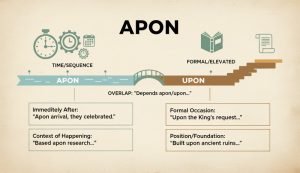
Upon is a preposition that functions similarly to “on,” but often carries a more formal or emphatic tone. It indicates a position, location, or condition. Although its meaning is very close to “on”, it is more frequently used in formal writing, literature, and idiomatic expressions. It can also suggest a sense of immediacy or impact.
While “apon” was once a variant spelling of “upon,” it is now considered archaic and is rarely used in modern English. Therefore, this article will primarily focus on the correct and contemporary usage of “upon.” Understanding “upon” involves recognizing its role in expressing various relationships between elements in a sentence.
These relationships include physical placement, dependence, consequence, and time.

Classification and Function
As a preposition, “upon” always precedes a noun or pronoun (the object of the preposition). It connects this object to another element in the sentence, often a verb or another noun, to provide additional information or context.
For instance, in the sentence “The book is upon the table,” “upon” connects the noun “table” to the verb “is,” indicating the location of the book.
The function of “upon” is versatile. It can denote:
- Location: Indicating where something is situated (e.g., “The cat sat upon the mat.”)
- Dependence: Showing reliance or contingency (e.g., “Success depends upon hard work.”)
- Time: Specifying when something occurs (e.g., “Upon arriving, they unpacked their bags.”)
- Impact: Emphasizing the force or effect of something (e.g., “The responsibility falls upon you.”)
Contexts of Usage
“Upon” is commonly found in various contexts, including:
- Formal Writing: Legal documents, academic papers, and official reports often use “upon” to maintain a formal tone.
- Literature: Novels, poems, and plays may employ “upon” for stylistic effect or to evoke a certain atmosphere.
- Idiomatic Expressions: Many common phrases include “upon,” such as “once upon a time,” “upon closer inspection,” and “insist upon.”
- Religious Texts: Traditional religious writings frequently use “upon” in phrases like “rest upon” or “have mercy upon.”
Structural Breakdown of Upon
The structure of “upon” is straightforward: it consists of the prefix “up-” and the preposition “on.” Understanding this simple composition can help clarify its meaning and usage. The prefix “up-” often implies a sense of direction or elevation, which can subtly influence the interpretation of “upon” in certain contexts.
Prepositional Phrases
“Upon” typically forms part of a prepositional phrase, which includes “upon” and its object (a noun or pronoun). This phrase then functions as an adjective or adverb within the sentence, modifying other elements and providing additional context.
For example, in the phrase “upon the hill,” “the hill” is the object of the preposition “upon,” and the entire phrase functions adverbially, indicating where something is located.
Here are some examples of prepositional phrases using “upon”:
- Upon the table
- Upon his arrival
- Upon closer examination
- Upon my word
- Upon the completion of the project
Sentence Placement
Prepositional phrases with “upon” can appear at the beginning, middle, or end of a sentence, depending on the desired emphasis and flow. When placed at the beginning, they often set the scene or introduce a condition.
In the middle, they provide additional information about the subject or verb. At the end, they offer a concluding detail or consequence.
Consider these variations:
- Beginning: Upon receiving the news, she burst into tears.
- Middle: The responsibility, upon his shoulders, felt heavy.
- End: They agreed upon a plan to move forward.
Types and Categories of Usage
“Upon” can be categorized based on the specific meaning it conveys within a sentence. These categories help illustrate the versatility of “upon” and its ability to express different types of relationships.
Location and Position
In this category, “upon” indicates the physical placement of something. It is often interchangeable with “on,” but can add a touch of formality or emphasis.
Examples:
- The vase sat upon the mantelpiece.
- The dust settled upon the furniture.
- The bird perched upon the branch.
Dependence and Reliance
Here, “upon” signifies that something is contingent on or reliant on something else. It highlights the connection between two elements, where one is dependent on the other for its existence or outcome.
Examples:
- Their success depended upon careful planning.
- The building’s stability relies upon a strong foundation.
- His argument rested upon faulty assumptions.
Time and Occurrence
“Upon” can also denote the timing of an event, indicating when something happens. It often introduces a clause or phrase that specifies the moment or condition under which an action occurs.
Examples:
- Upon arriving home, he immediately checked his messages.
- Upon hearing the news, she fainted.
- Upon completion of the project, everyone celebrated.
Impact and Effect
In this category, “upon” emphasizes the influence or consequence of something. It highlights the effect that one thing has on another, often with a sense of force or significance.
Examples:
- The decision weighed heavily upon his conscience.
- The responsibility fell upon her shoulders.
- Their words had a profound impact upon the community.
Examples of Upon in Sentences
To further illustrate the usage of “upon,” here are several examples categorized by the types discussed above. These examples demonstrate the 다양한 ways in which “upon” can be used to convey meaning and add nuance to your writing.
Examples: Location and Position
The following table provides examples of “upon” used to indicate location or position. Notice how “upon” can often be replaced with “on” without significantly changing the meaning, but it adds a more formal or emphatic tone.
| Sentence | Explanation |
|---|---|
| The book is upon the shelf. | Indicates the book’s location on the shelf. |
| The cat sat upon the windowsill. | Describes where the cat is sitting. |
| The statue stood upon a pedestal. | Specifies the statue’s position on the pedestal. |
| The painting hung upon the wall. | Indicates the painting’s location on the wall. |
| The village is situated upon a hill. | Describes the village’s location on the hill. |
| The ship sailed upon the sea. | Indicates the ship’s location on the sea. |
| The dew lay upon the grass. | Describes the dew’s location on the grass. |
| The snow piled upon the roof. | Specifies the snow’s position on the roof. |
| The spotlight shone upon the stage. | Indicates where the spotlight is directed. |
| The flag waved upon the flagpole. | Describes the flag’s location on the flagpole. |
| The leaves fell upon the ground. | Indicates where the leaves landed. |
| The spider crawled upon the ceiling. | Describes the spider’s location on the ceiling. |
| The dust settled upon the table. | Specifies where the dust landed. |
| The ornament sat upon the mantel. | Indicates the ornament’s position on the mantel. |
| The bird perched upon the wire. | Describes where the bird is perched. |
| The sign stood upon the corner. | Specifies the sign’s location on the corner. |
| The light reflected upon the water. | Indicates where the light is reflected. |
| The shadow fell upon the path. | Describes the shadow’s location on the path. |
| The flowers bloomed upon the vine. | Specifies where the flowers are blooming. |
| The ivy climbed upon the wall. | Describes the ivy’s location on the wall. |
| The picture hung upon the nail. | Indicates the picture’s location on the nail. |
| The clock rested upon the shelf. | Describes where the clock is resting. |
| The blanket lay upon the bed. | Specifies the blanket’s position on the bed. |
| The dishes stacked upon the counter. | Indicates the dishes’ location on the counter. |
| The tools lay upon the workbench. | Describes the tools’ location on the workbench. |
Examples: Dependence and Reliance
This table illustrates how “upon” is used to show dependence or reliance. In these cases, one thing is contingent on another.
| Sentence | Explanation |
|---|---|
| Our success depends upon your support. | Indicates that success is reliant on support. |
| The project’s completion hinges upon funding. | Specifies that completion is contingent on funding. |
| His argument rested upon a false premise. | Describes how the argument relies on a flawed premise. |
| The company’s future depends upon innovation. | Indicates that the future is reliant on innovation. |
| Their safety relies upon following the rules. | Specifies that safety is contingent on rule adherence. |
| The treaty’s effectiveness depends upon compliance. | Indicates that effectiveness is reliant on compliance. |
| The bridge’s stability rests upon its foundation. | Describes how stability relies on the foundation. |
| The outcome depends upon your decision. | Indicates that the outcome is reliant on the decision. |
| Their survival hinges upon finding water. | Specifies that survival is contingent on finding water. |
| The plan’s success depends upon good weather. | Indicates that success is reliant on good weather. |
| Our hopes rest upon your shoulders. | Describes how hopes rely on the person’s actions. |
| The agreement depends upon mutual trust. | Indicates that the agreement is reliant on trust. |
| The experiment’s validity hinges upon accurate data. | Specifies that validity is contingent on accurate data. |
| The team’s victory depends upon teamwork. | Indicates that victory is reliant on teamwork. |
| Her happiness relies upon her family’s well-being. | Specifies that happiness is contingent on family well-being. |
| The business’s growth depends upon investment. | Indicates that growth is reliant on investment. |
| The community’s progress hinges upon cooperation. | Specifies that progress is contingent on cooperation. |
| Our understanding rests upon careful analysis. | Describes how understanding relies on analysis. |
| The performance depends upon rehearsal. | Indicates that the performance is reliant on rehearsal. |
| The solution depends upon understanding the problem. | Specifies that the solution is contingent on understanding. |
| His health depends upon a balanced diet. | Indicates that his health is reliant on a balanced diet. |
| The ecosystem’s survival hinges upon biodiversity. | Specifies that the ecosystem’s survival is contingent on biodiversity. |
| The effectiveness of the medicine depends upon proper dosage. | Indicates that the medicine’s effectiveness is reliant on proper dosage. |
| The quality of the product depends upon the materials used. | Specifies that the product’s quality is contingent on the materials used. |
| The country’s stability rests upon its political system. | Indicates that the country’s stability is reliant on its political system. |
Examples: Time and Occurrence
This table provides examples of “upon” used to indicate the timing of an event. These phrases often introduce a clause that specifies when an action occurs.
| Sentence | Explanation |
|---|---|
| Upon arriving, they unpacked their bags. | Indicates that unpacking occurred after arriving. |
| Upon hearing the news, she started to cry. | Specifies that crying occurred after hearing the news. |
| Upon completing the exam, he felt relieved. | Indicates that relief occurred after completing the exam. |
| Upon entering the room, she noticed the silence. | Specifies that noticing the silence occurred after entering. |
| Upon finishing the book, he wrote a review. | Indicates that writing a review occurred after finishing the book. |
| Upon receiving the award, she gave a speech. | Specifies that giving a speech occurred after receiving the award. |
| Upon seeing the damage, he called the insurance company. | Indicates that calling the insurance company occurred after seeing the damage. |
| Upon learning of the opportunity, she applied immediately. | Specifies that applying occurred after learning of the opportunity. |
| Upon discovering the truth, he confronted her. | Indicates that confronting her occurred after discovering the truth. |
| Upon realizing his mistake, he apologized. | Specifies that apologizing occurred after realizing the mistake. |
| Upon reaching the summit, they celebrated their achievement. | Indicates that celebrating occurred after reaching the summit. |
| Upon graduating from college, he started his career. | Specifies that starting his career occurred after graduating. |
| Upon retiring, she traveled the world. | Indicates that traveling occurred after retiring. |
| Upon waking up, he checked his phone. | Specifies that checking his phone occurred after waking up. |
| Upon returning home, they found a surprise party. | Indicates that finding a surprise party occurred after returning home. |
| Upon opening the letter, she smiled. | Specifies that smiling occurred after opening the letter. |
| Upon tasting the soup, he added more salt. | Indicates that adding salt occurred after tasting the soup. |
| Upon hearing the music, she started to dance. | Specifies that dancing occurred after hearing the music. |
| Upon feeling the rain, they ran inside. | Indicates that running inside occurred after feeling the rain. |
| Upon seeing the sunrise, he felt inspired. | Specifies that feeling inspired occurred after seeing the sunrise. |
| Upon entering the forest, they heard the birds singing. | Indicates that hearing the birds singing occurred after entering the forest. |
| Upon reaching the destination, they set up camp. | Specifies that setting up camp occurred after reaching the destination. |
| Upon examining the evidence, the detective solved the case. | Indicates that solving the case occurred after examining the evidence. |
| Upon analyzing the data, the scientists drew conclusions. | Specifies that drawing conclusions occurred after analyzing the data. |
| Upon reviewing the documents, the lawyer found discrepancies. | Indicates that finding discrepancies occurred after reviewing the documents. |
Examples: Impact and Effect
This table showcases how “upon” is used to emphasize the impact or effect of something. These sentences highlight the influence one thing has on another.
| Sentence | Explanation |
|---|---|
| The decision weighed heavily upon his conscience. | Indicates that the decision had a significant impact on his conscience. |
| The responsibility fell upon her shoulders. | Specifies that the responsibility had a direct impact on her. |
| Their words had a profound impact upon the community. | Indicates that the words had a strong effect on the community. |
| The news cast a shadow upon their celebration. | Specifies that the news negatively affected their celebration. |
| The burden rested heavily upon his heart. | Indicates that the burden had a significant emotional impact. |
| The challenge weighed upon her mind. | Specifies that the challenge had a mental impact on her. |
| The crisis had a devastating impact upon the economy. | Indicates that the crisis had a strong negative effect on the economy. |
| The success had a transformative effect upon his life. | Specifies that the success positively changed his life. |
| The pressure weighed heavily upon the team. | Indicates that the pressure had a significant impact on the team. |
| The loss cast a pall upon their spirits. | Specifies that the loss negatively affected their spirits. |
| The criticism had a discouraging effect upon her efforts. | Indicates that the criticism negatively impacted her efforts. |
| The experience had a lasting impact upon his perspective. | Specifies that the experience changed his perspective. |
| The tragedy cast a dark cloud upon the town. | Indicates that the tragedy negatively affected the town. |
| The injustice weighed heavily upon their sense of fairness. | Specifies that the injustice had a significant impact on their sense of fairness. |
| The victory had a unifying effect upon the nation. | Indicates that the victory brought the nation together. |
| The secret weighed upon her soul. | Specifies that the secret had a deep emotional impact. |
| The failure cast a shadow upon their confidence. | Indicates that the failure negatively affected their confidence. |
| The responsibility settled upon his shoulders. | Specifies that he now had to carry the burden of responsibility. |
| The accusation weighed heavily upon his reputation. | Indicates the accusation had a significant impact on his reputation. |
| The illness had a debilitating effect upon his body. | Specifies that the illness negatively impacted his body. |
| The drought had a devastating impact upon the agriculture. | Indicates that the drought had a strong negative effect on agriculture. |
| The discovery had a revolutionary effect upon the scientific community. | Specifies that the discovery greatly changed the scientific community. |
| The scandal cast a stain upon his career. | Indicates that the scandal negatively affected his career. |
| The decision weighed heavily upon his heart. | Specifies that the decision had a deep emotional impact on his heart. |
| The advice had a positive impact upon her decision-making process. | Indicates that the advice improved her decision-making process. |
Usage Rules for Upon
While “upon” and “on” are often interchangeable, there are some nuances to consider when deciding which to use. Understanding these rules will help you use “upon” appropriately and effectively.
Formality
“Upon” generally carries a more formal tone than “on.” In formal writing, such as legal documents, academic papers, and official reports, “upon” is often preferred. In everyday conversation and informal writing, “on” is more common.
Emphasis
“Upon” can add emphasis to a statement. It can highlight the importance or impact of something, making it a stronger choice in certain contexts.
Idiomatic Expressions
Many idiomatic expressions use “upon” and cannot be replaced with “on.” These expressions have specific meanings and should be used as they are.
Examples:
- Once upon a time
- Upon closer inspection
- Insist upon
- Rely upon
Archaic Usage
As mentioned earlier, “apon” is an archaic form of “upon” and should generally be avoided in modern English. Stick to using “upon” for the intended meaning.
Exceptions and Special Cases
There are certain phrases and contexts where “upon” is more appropriate or preferred, even if “on” would technically be correct. These cases often involve a sense of immediacy or impact.
Examples:
- The decision was made upon careful consideration. (Emphasizes the thoroughness of the consideration)
- They acted upon receiving the information. (Highlights the immediacy of their action)
Common Mistakes with Upon
Even experienced English speakers sometimes make mistakes when using “upon.” Here are some common errors to watch out for, along with corrected examples.
Using “Apon”
Incorrect: The book was apon the table.
Correct: The book was upon the table.
Explanation: “Apon” is an archaic spelling and should not be used in modern English.
Incorrect Interchange with “On”
Incorrect: We insist on you attending the meeting.
Correct: We insist upon you attending the meeting.
Explanation: The idiomatic expression is “insist upon,” not “insist on.”
Overusing “Upon”
Incorrect: The cat sat upon the chair, and it looked very comfortable upon it.
Correct: The cat sat on the chair, and it looked very comfortable there.
Explanation: Overusing “upon” can make your writing sound overly formal or repetitive. Use “on” or other alternatives where appropriate.
Misunderstanding Idiomatic Expressions
Incorrect: Once on a time, there was a king.
Correct: Once upon a time, there was a king.
Explanation: The correct idiomatic expression is “once upon a time.”
Practice Exercises
Test your understanding of “upon” with these practice exercises. Choose the correct word or phrase to complete each sentence.
Exercise 1: Fill in the Blanks
Fill in the blanks with either “on” or “upon,” choosing the more appropriate option.
| Question | Answer |
|---|---|
| 1. The responsibility rests ______ your shoulders. | upon |
| 2. The book is ______ the table. | on |
| 3. They insisted ______ seeing the manager. | upon |
| 4. The cat jumped ______ the fence. | on |
| 5. ______ closer inspection, we found the error. | Upon |
| 6. The painting hung ______ the wall. | on |
| 7. Their success depends ______ hard work. | upon |
| 8. He relied ______ his friends for support. | on |
| 9. ______ arriving, he called his family. | Upon |
| 10. The bird perched ______ the branch. | on |
Exercise 2: Correct the Sentences
Correct the following sentences, which may contain errors in the use of “apon” or “upon.”
| Question | Answer |
|---|---|
| 1. The treasure was apon the island. | The treasure was upon the island. |
| 2. We rely on you to complete the task. | We rely upon you to complete the task. |
| 3. Once on a time, there lived a princess. | Once upon a time, there lived a princess. |
| 4. The decision weighed heavily on his mind. | The decision weighed heavily upon his mind. |
| 5. They insisted on an explanation. | They insisted upon an explanation. |
| 6. The cat sat upon the mat, and it purred on it. | The cat sat upon the mat, and it purred there. |
| 7. Upon hearing the noise, she went to see what happened. | Upon hearing the noise, she went to see what had happened. |
| 8. The dust settled on the furniture, covering it completely. | The dust settled upon the furniture, covering it completely. |
| 9. The spotlight shone on the stage. | The spotlight shone upon the stage. |
| 10. The leaves fell on the ground. | The leaves fell upon the ground. |
Advanced Topics
For advanced learners, here are some more complex aspects of “upon” to explore.
Subtleties of Emphasis
The choice between “upon” and “on” can subtly influence the emphasis of a sentence. “Upon” often draws more attention to the action or state being described, while “on” is more neutral.
Consider the desired effect when making your choice.
Literary Usage
In literature, “upon” can be used to create a particular tone or atmosphere. It can evoke a sense of tradition, formality, or even mystery.
Pay attention to how authors use “upon” to enhance their writing.
Historical Context
Understanding the historical context of “upon” can provide insights into its evolution and usage. Researching older texts and literary works can reveal how the meaning and connotations of “upon” have changed over time.
Understanding “Apon”: Meaning, Definition, and Spelling
Many learners search for “apon vs upon” or “upon vs apon” to clarify which form is correct. In modern English, “apon” is an archaic spelling of “upon” and is rarely used today. Understanding the apon meaning is straightforward: it functions exactly like “upon,” indicating position, time, dependence, or effect. However, its use is largely historical, appearing in older texts and literature.
For clarity, always use “upon” in contemporary writing. If you want the precise upon or apon definition, remember that “apon” is simply an old variant and “upon” is the accepted standard.
Finally, for those wondering how to spell “apon,” the answer is to write “upon” in all modern contexts. Using “apon” today may confuse readers or appear incorrect, so sticking to “upon” ensures your writing is clear, formal, and professional.
Frequently Asked Questions
Here are some frequently asked questions about the use of “upon.”
-
- Is “apon” ever correct to use?
No, “apon” is an archaic spelling and is not considered correct in modern English. Always use “upon” instead.
-
- When should I use “upon” instead of “on”?
Use “upon” when you want to add a more formal or emphatic tone to your writing. It is also necessary in certain idiomatic expressions.
-
- Can “upon” always be replaced with “on”?
While “upon” and “on” are often interchangeable, there are cases where “upon” is more appropriate due to formality or idiomatic usage. Always consider the context and desired tone.
-
- What are some common idiomatic expressions with “upon”?
Some common idiomatic expressions with “upon” include “once upon a time,” “upon closer inspection,” “insist upon,” and “rely upon.”
-
- Is it overuse of “upon” bad in writing?
Yes, overuse of “upon” can make your writing sound overly formal or repetitive. Use “on” or other alternatives where appropriate to maintain a natural flow.
-
- Does “upon” have a different meaning than “on”?
The core meaning of “upon” is very similar to “on,” but “upon” often carries a more formal or emphatic tone. The difference is subtle but can affect the overall feel of your writing.
-
- How can I improve my usage of “upon”?
Practice using “upon” in different contexts, paying attention to the tone and emphasis it adds. Read widely and observe how skilled writers use “upon” in their work.
Also, familiarize yourself with common idiomatic expressions that include “upon.”
-
- Is “upon” more common in British or American English?
“Upon” is used in both British and American English, but it tends to be slightly more common and accepted in formal British English. In both dialects, its usage imparts a sense of formality or emphasis.
Conclusion
Mastering the usage of “upon” involves understanding its subtle nuances and contexts. While “apon” is an archaic form to be avoided, “upon” itself offers a valuable tool for adding formality and emphasis to your writing.
By recognizing the different types of usage—location, dependence, time, and impact—and practicing with examples, you can confidently incorporate “upon” into your vocabulary.
Remember to consider the tone and context when choosing between “upon” and “on.” Overusing “upon” can make your writing sound stilted, so aim for a balance that enhances clarity and style. With practice and attention to detail, you can effectively use “upon” to elevate your English language skills.