
Brackets, often overlooked, are essential tools in the English language for adding clarity, providing extra information, and structuring complex sentences. Understanding how to use brackets correctly can significantly improve your writing and communication skills.
This article offers a comprehensive guide to brackets, covering their definition, types, usage rules, common mistakes, and advanced applications. Whether you’re a student, writer, or language enthusiast, this guide will equip you with the knowledge and skills to master the art of using brackets effectively.
Table of Contents
- Introduction
- Definition of Brackets
- Structural Breakdown
- Types of Brackets
- Examples of Brackets in Use
- Usage Rules for Brackets
- Common Mistakes with Brackets
- Practice Exercises
- Advanced Topics
- Frequently Asked Questions (FAQ)
- Conclusion
Introduction
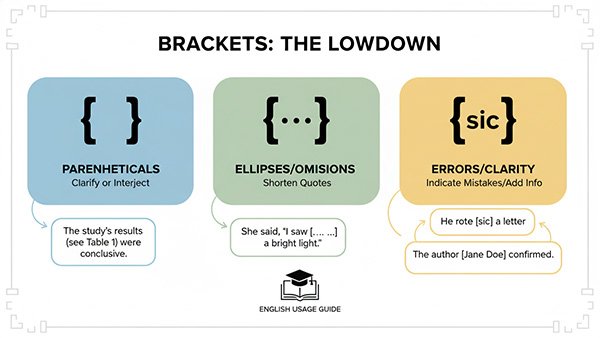
Brackets are punctuation marks that come in various forms, each serving a specific purpose in written communication. They are used to enclose supplementary information, clarify meaning, indicate changes or omissions, and organize complex expressions.
Mastering the use of brackets is crucial for achieving precision and clarity in writing, For effective use of brackets, always ensure that the enclosed information complements the main sentence without interrupting readability. Use them to provide clarifications, supplementary details, or context that enhances understanding. Overusing brackets can clutter the text, so limit their use to situations where additional information is truly helpful.
whether it’s academic papers, creative works, or professional documents. This article aims to provide a comprehensive understanding of brackets, making it easier for you to use them confidently and effectively in your writing.
Practical Applications of Brackets in Writing
Brackets serve multiple important purposes in written English. They are primarily used to provide additional information, clarify meaning, or insert editorial notes without disrupting the flow of a sentence. An effective way to use brackets is to enclose explanations, translations, or references that enhance understanding but are not essential to the main sentence.
For instance, when quoting a source, brackets can indicate added context or corrections, ensuring clarity for the reader. Brackets can also be employed to include optional information, abbreviations, or numerical examples, offering precision without cluttering the sentence. By using brackets thoughtfully, writers can maintain a smooth narrative while presenting supplementary details clearly and efficiently.
Definition of Brackets
In English grammar, brackets are punctuation marks used in pairs to set apart or enclose words or sentences within a larger sentence. They serve to add extra information, clarification, commentary, or to indicate editorial changes in quoted material. The primary function of brackets is to provide supplementary content without disrupting the flow of the main sentence. They allow writers to include additional details that might not be essential but are helpful for the reader’s understanding.
Understanding the use of brackets within writing involves recognizing their role in adding clarity, indicating optional elements, or providing explanatory information. They allow writers to insert content that supplements the main idea without altering the original sentence structure. Correct placement ensures that the information is both readable and grammatically accurate.
Brackets distinguish themselves from other punctuation marks like commas or dashes by the level of interruption they introduce. While commas and dashes can also set off parenthetical information, brackets typically indicate a more significant departure from the main line of thought or a more substantial addition of supplementary material.
Therefore, understanding the nuances of bracket usage ensures that your writing is precise, clear, and well-organized.
Structural Breakdown
The structural use of brackets involves understanding how they integrate within a sentence and the rules governing their placement. Brackets always come in pairs: an opening bracket and a closing bracket.
The material enclosed within the brackets is considered parenthetical and is intended to provide additional context or information. The sentence should still be grammatically correct and make sense if the bracketed information is removed.
When using brackets, it’s important to consider the surrounding punctuation. If the bracketed information is a complete sentence, the ending punctuation should be placed inside the closing bracket.
However, if the bracketed information is just a phrase or part of a sentence, the punctuation should be placed outside the closing bracket to maintain the flow of the main sentence. Consistency in bracket usage is key to maintaining clarity and readability in your writing.
Types of Brackets
There are several types of brackets, each with specific uses and conventions. The most common types are parentheses, square brackets, curly brackets, and angle brackets.
Understanding the differences between these types is essential for using them correctly in various contexts.
Parentheses ( )
Parentheses, also known as round brackets, are the most commonly used type of brackets. They are used to enclose supplementary information, explanations, or afterthoughts that are not essential to the main sentence but provide additional context or detail. Parentheses can also be used to indicate abbreviations or acronyms after the full term is initially introduced.
Square Brackets [ ]
Square brackets are typically used to enclose editorial comments, corrections, or clarifications within quoted material. They are also used to indicate changes made to a quote to fit grammatically into the surrounding sentence or to add context that was not originally present. In technical writing, square brackets can denote array indices or specific elements within a data structure.
Curly Brackets { }
Curly brackets are less commonly used in general writing but are prevalent in mathematics, computer programming, and formal logic. In mathematics, they are used to denote sets. In programming, they define code blocks or initialize arrays. In formal logic, they can represent specific conditions or sets of rules.
Angle Brackets < >
Angle brackets are primarily used in technical contexts, such as computer programming and markup languages like HTML and XML. In programming, they are often used to denote generic types or parameters. In markup languages, they enclose tags that define elements and attributes. They are rarely used in general writing.
Examples of Brackets in Use
To illustrate the different types of brackets and their uses, let’s explore a variety of examples in different contexts. These examples will demonstrate how each type of bracket can be used to add clarity, provide additional information, and structure complex sentences.
Parentheses Examples
Parentheses are versatile and widely used. The following table provides examples of how parentheses can be used to add extra information, explanations, or afterthoughts in a sentence.
| Example | Explanation |
|---|---|
| The capital of Australia is Canberra (not Sydney). | Provides a clarification. |
| Please purchase the necessary supplies (paper, pens, and folders) before the meeting. | Lists examples of supplies. |
| The study found a correlation (p < 0.05) between exercise and mental health. | Gives statistical significance. |
| Shakespeare’s Globe (reconstructed in 1997) is a popular tourist attraction. | Adds historical context. |
| The project is due on Friday (October 27th). | Specifies the date. |
| The patient was diagnosed with influenza (flu). | Provides an alternative name. |
| The company’s revenue increased significantly (by 20%) this quarter. | Quantifies the increase. |
| She decided to take a break (a well-deserved one) after finishing the project. | Adds a personal comment. |
| The conference will be held in Paris (France). | Specifies the country. |
| He mentioned his favorite book (Pride and Prejudice) during the interview. | Provides the title of the book. |
| The results were statistically significant (p < 0.01). | Indicates the p-value. |
| The lecture covered various topics (e.g., history, science, and art). | Gives examples of topics. |
| The new policy will take effect next month (July 1). | Specifies the start date. |
| The software update includes several improvements (bug fixes and new features). | Lists the improvements. |
| The athlete broke the world record (again!). | Adds an exclamation for emphasis. |
| The recipe calls for specific ingredients (organic if possible). | Adds a suggestion. |
| The museum is open daily (except Mondays). | Specifies exceptions. |
| The training program lasts for six weeks (42 days). | Provides an equivalent measurement. |
| The professor explained the theory (in detail). | Adds emphasis on the explanation. |
| The project was completed successfully (despite the challenges). | Acknowledges the challenges. |
| The survey included a wide range of questions (demographic, lifestyle, etc.). | Lists the question types. |
| The company launched a new product (an innovative gadget). | Describes the product. |
| The event was a great success (thanks to everyone’s efforts). | Acknowledges contributions. |
| The course covers advanced topics (machine learning, AI). | Lists the advanced topics. |
| The team celebrated their victory (with a party). | Describes the celebration. |
| The city is known for its landmarks (Eiffel Tower, Louvre). | Lists the landmarks. |
| The research focused on specific areas (climate change, sustainability). | Lists the research areas. |
| The government announced new measures (tax cuts, subsidies). | Lists the new measures. |
| The artist showcased her latest works (paintings, sculptures). | Lists the artworks. |
Square Brackets Examples
Square brackets are used to add editorial comments, corrections, or clarifications within quoted material. The following table provides examples of how square brackets can be used in this context.
| Example | Explanation |
|---|---|
| “He said that the issue was very important to them [the employees].” | Adds clarification to the pronoun “them.” |
| “The witness stated, ‘I saw him [the defendant] running from the scene.'” | Clarifies who the witness is referring to. |
| “The document stated, ‘The results were inconclusive’ [sic].” | Indicates that the error or unusual wording is in the original source. |
| “She wrote, ‘Their [sic] going to the park.'” | Points out a grammatical error in the original quote. |
| “The report mentioned a significant increase [of 20%] in sales.” | Adds a quantitative measure to the statement. |
| “As the author noted, ‘It was a difficult time’ [for everyone involved].” | Provides additional context to the quote. |
| “The article claimed, ‘The economy is improving’ [according to recent data].” | Adds a source for the claim. |
| “He exclaimed, ‘I can’t believe it’s happening’ [referring to the victory].” | Clarifies the subject of the exclamation. |
| “The email stated, ‘We need to address this issue immediately’ [the system outage].” | Specifies the issue being addressed. |
| “The witness testified, ‘I heard a loud noise’ [a gunshot].” | Identifies the type of noise heard. |
| The original text read, “The problem is obvious.” [The author likely meant ‘problem is solved’]. | Suggests a possible correction. |
| “The politician stated, ‘We will bring change’ [but did not specify how].” | Adds a critical observation. |
| “The study concluded, ‘More research is needed’ [on this specific topic].” | Clarifies the area of research. |
| “The instructions said, ‘Press the button’ [the red one].” | Provides additional detail for clarity. |
| “The speaker mentioned, ‘The future is bright’ [for the younger generation].” | Specifies who the future is bright for. |
| The document noted, “The project is on schedule” [as of July 15]. | Indicates the date of the assessment. |
| “She said, ‘I am happy to be here’ [at the conference].” | Clarifies the location. |
| The report stated, “The numbers are increasing” [due to the new policy]. | Explains the reason for the increase. |
| “He wrote, ‘This is the end’ [of the first chapter].” | Specifies the part of the book. |
| “The announcement said, ‘The event is postponed’ [due to weather conditions].” | Gives the reason for the postponement. |
| “The email read, ‘Please confirm your attendance’ [by Friday].” | Specifies the deadline. |
| “The sign stated, ‘No entry’ [without permission].” | Adds a condition for entry. |
| “The article mentioned, ‘The results were surprising’ [to the researchers].” | Specifies who was surprised. |
| “The contract stated, ‘The agreement is binding’ [under these conditions].” | Adds conditions to the agreement. |
| “The lecture covered complex topics [quantum physics, relativity].” | Lists the topics covered. |
| “The guidelines mentioned, ‘Follow these steps’ [for best results].” | Provides context to the instruction. |
| “The survey asked, ‘What is your opinion?’ [on this matter].” | Specifies the subject of the opinion. |
| “The policy stated, ‘All employees must comply’ [with these rules].” | Specifies who must comply. |
| “The presentation highlighted key points [data analysis, strategic planning].” | Lists the key points. |
Curly Brackets Examples
Curly brackets are primarily used in mathematics and computer programming. The following table provides examples of how curly brackets can be used in these contexts.
| Example | Explanation |
|---|---|
| Set A = {1, 2, 3, 4, 5} | Defines a set of numbers in mathematics. |
| if (x > 0) { console.log(“Positive”); } | Defines a code block in JavaScript. |
| array = { “name”: “John”, “age”: 30 } | Initializes an object in programming. |
| S = {x | x is an even number} | Defines a set using set-builder notation. |
| function myFunc() { // code block } | Indicates the start and end of a function definition in programming. |
| states = {“California”, “Texas”, “Florida”} | Represents a set of strings. |
| for (int i = 0; i < 10; i++) { // loop body } | Defines a loop’s code block. |
| dictionary = {“apple”: “red”, “banana”: “yellow”} | Represents a dictionary in Python. |
| list = {10, 20, 30, 40} | Represents a list of integers. |
| graph = { “nodes”: [], “edges”: [] } | Represents a graph data structure. |
| if condition { execute this code } | Basic conditional statement in some languages. |
| enum Days { Monday, Tuesday, Wednesday } | Defines an enumeration in C#. |
| class MyClass { // class definition } | Defines a class in object-oriented programming. |
| switch (variable) { case 1: // code; break; } | Switch statement in programming. |
| mySet = {item for item in iterable} | Set comprehension in Python. |
| result = {x * x for x in range(10)} | Creates a set of squares. |
| {a, b, c} | Represents a set of elements. |
| struct Person { string name; int age; } | Defines a structure in C++. |
| { P(x) | x ∈ A } | Mathematical notation for a set of elements satisfying a condition. |
| function(arg) { return arg * 2; } | Anonymous function definition. |
| hashTable = {key1: value1, key2: value2} | Creating a hash table in some scripting languages. |
| tuple = {1, “hello”, 3.14} | Declaring a tuple in some languages. |
| myArray = {0 for i in range(5)} | Initializing an array with a default value. |
| try { // risky code } catch (e) { // error handling } | Try-catch block for exception handling. |
| while (condition) { // loop body } | While loop in programming. |
| lambda x: {x * 2} | Lambda function returning a set. |
| { print(“Hello, world!”); } | Simple code block in a scripting language. |
| def my_function(): { // function body } | Defining a function (non-standard but illustrative). |
Angle Brackets Examples
Angle brackets are primarily used in computer programming and markup languages. The following table provides examples of how angle brackets are used in these contexts.
| Example | Explanation |
|---|---|
| <html><head><title>My Webpage</title></head><body><h1>Hello, World!</h1></body></html> | HTML tags defining the structure of a webpage. |
| List<String> myList = new ArrayList<String>(); | Declares a list of strings in Java using generics. |
| <input type=”text” name=”username”> | HTML input tag with attributes. |
| template <typename T> T max(T a, T b) { return (a > b) ? a : b; } | Defines a template function in C++. |
| <img src=”image.jpg” alt=”My Image”> | HTML tag for displaying an image. |
| vector<int> numbers; | Declares a vector of integers in C++. |
| <a href=”https://www.example.com”>Visit Example</a> | HTML anchor tag for creating a hyperlink. |
| Optional<Integer> value = Optional.of(5); | Using Optional with generics in Java. |
| <div class=”container”><p>This is some text.</p></div> | HTML div tag with a paragraph inside. |
| pair<string, int> person; | Declares a pair of string and integer in C++. |
| <script src=”script.js”></script> | HTML tag for including a JavaScript file. |
| unique_ptr<MyClass> ptr(new MyClass()); | Using smart pointers in C++. |
| <style> body { background-color: lightblue; } </style> | HTML style tag for defining CSS. |
| shared_ptr<int> sharedPtr = make_shared<int>(42); | Using shared pointers in C++. |
| <meta charset=”UTF-8″> | HTML meta tag for specifying character encoding. |
| std::array<int, 5> arr = {1, 2, 3, 4, 5}; | Using std::array in C++. |
| <form action=”/submit” method=”post”> </form> | HTML form tag for submitting data. |
| template <class T, int N> class MyArray { }; | Template with a non-type parameter in C++. |
| <link rel=”stylesheet” href=”style.css”> | HTML link tag for linking an external CSS file. |
| std::tuple<int, double, string> myTuple; | Using std::tuple in C++. |
| <header> <nav> </nav> </header> | HTML5 semantic tags for header and navigation. |
| std::function<int(int)> func = [](int x) { return x * 2; }; | Using std::function in C++. |
| <footer> <p> © 2024 </p> </footer> | HTML5 semantic tag for footer. |
| std::conditional<true, int, double>::type value = 5; | Using std::conditional in C++. |
| <article> <section> </section> </article> | HTML5 semantic tags for article and section. |
| std::enable_if<std::is_integral<T>::value, T>::type func(T x); | Using std::enable_if in C++. |
| <aside> </aside> | HTML5 semantic tag for aside content. |
Usage Rules for Brackets
Proper bracket usage involves adhering to specific rules to maintain clarity and grammatical correctness. These rules cover punctuation, nesting, and formal writing conventions.
Punctuation Inside or Outside Brackets
The placement of punctuation marks relative to brackets depends on whether the bracketed information is a complete sentence or part of a larger sentence. If the bracketed information is a complete sentence, the punctuation should be placed inside the closing bracket.
If it’s just a phrase or part of a sentence, the punctuation should be placed outside the closing bracket.
Example (Complete Sentence Inside): He went to the store. (He needed to buy milk.)
Example (Phrase Inside): He went to the store (to buy milk).
Brackets Within Brackets
Nesting brackets, or using brackets within brackets, should be avoided where possible as it can make the text confusing. If necessary, use different types of brackets to differentiate the levels of parenthetical information.
Typically, parentheses are used for the outer level, and square brackets for the inner level.
Example: He mentioned the book (which was a classic [first published in 1950]).
Brackets in Formal Writing
In formal writing, excessive use of brackets should be avoided as it can disrupt the flow of the text. It’s better to integrate the information directly into the sentence or use alternative punctuation marks like commas or dashes.
Brackets should be reserved for essential clarifications or supplementary information that cannot be easily incorporated into the main sentence.
Common Mistakes with Brackets
Several common mistakes can occur when using brackets. Recognizing and avoiding these mistakes can improve the clarity and accuracy of your writing.
Mistake 1: Using only one bracket instead of a pair.
Correct: He went to the store (to buy milk).
Incorrect: He went to the store (to buy milk.
Mistake 2: Incorrect punctuation placement.
Correct: He went to the store (he needed milk).
Incorrect: He went to the store. (He needed milk).
Mistake 3: Overusing brackets, making the text cluttered.
Correct: The project is due on Friday, October 27th.
Incorrect: The project is due on Friday (October 27th).
Mistake 4: Using the wrong type of bracket for the context.
Correct: “He said, ‘I saw him [the defendant] running.'”
Incorrect: “He said, ‘I saw him (the defendant) running.'”
Mistake 5: Nesting the same type of brackets, which reduces readability.
Correct: He mentioned the event (which was a success [despite the weather]).
Incorrect: He mentioned the event (which was a success (despite the weather)).
Practice Exercises
Test your understanding of bracket usage with these practice exercises. Fill in the blanks with the appropriate brackets and punctuation.
| Question | Answer |
|---|---|
| The meeting will be held on Tuesday ____ July 11th ____ | The meeting will be held on Tuesday (July 11th). |
| She said ____ I think it’s a good idea ____ that she would support the proposal. | She said (I think it’s a good idea) that she would support the proposal. |
| The report stated ____ the results were inconclusive ____ sic ____ | The report stated, “the results were inconclusive” [sic]. |
| Please bring the following items ____ pens, paper, and notebooks ____ to the workshop. | Please bring the following items (pens, paper, and notebooks) to the workshop. |
| He visited Paris ____ the capital of France ____ last summer. | He visited Paris (the capital of France) last summer. |
| The author wrote ____ Their going to present the findings next week ____ | The author wrote, “Their [sic] going to present the findings next week.” |
| The company’s profits increased by 15 percent ____ a significant improvement ____ | The company’s profits increased by 15 percent (a significant improvement). |
| The instructions said ____ Press the red button ____ for emergency stop. | The instructions said, “Press the red button” [for emergency stop]. |
| She completed her degree ____ a Bachelor of Arts ____ in 2020. | She completed her degree (a Bachelor of Arts) in 2020. |
| The scientist discovered a new element ____ Element X ____ in the lab. | The scientist discovered a new element (Element X) in the lab. |
Advanced Topics
Beyond the basic rules, brackets have specific applications in various technical fields, including mathematics, computer programming, and linguistics.
Brackets in Mathematics
In mathematics, brackets are used to denote order of operations, intervals, and sets. Different types of brackets have specific meanings, and their correct usage is essential for mathematical notation.
Parentheses are used for grouping terms, square brackets for closed intervals, and curly brackets for sets.
Example: 2 * (3 + 4) = 14 (Order of operations)
Example: [0, 1] (Closed interval from 0 to 1)
Example: {1, 2, 3} (Set containing 1, 2, and 3)
Brackets in Programming
In computer programming, brackets are used to define code blocks, array indices, and function parameters. The specific type of bracket used depends on the programming language and the context.
Curly brackets are commonly used to define code blocks in languages like C++ and Java, while square brackets are used for array indices in most languages.
Example (C++): if (x > 0) { cout << “Positive”; }
Example (Java): int[] array = {1, 2, 3};
Brackets in Linguistics
In linguistics, brackets are used to denote phonetic transcriptions and to indicate optional or omitted elements in a sentence. Square brackets are commonly used to enclose phonetic symbols, while parentheses are used to indicate optional elements.
Example (Phonetic Transcription): The word “cat” is transcribed as [kæt].
Example (Optional Element): The student (who was late) missed the lecture.
Frequently Asked Questions (FAQ)
Here are some frequently asked questions about bracket usage in English grammar:
Q1: What is the main purpose of using brackets in writing?
A: The main purpose of using brackets is to add supplementary information, clarification, or commentary to a sentence without disrupting its main flow. Brackets allow writers to include additional details that might not be essential but are helpful for the reader’s understanding.
Q2: How do I decide whether to use parentheses or square brackets?
A: Use parentheses for adding extra information, explanations, or afterthoughts that are not essential to the main sentence. Use square brackets for editorial comments, corrections, or clarifications within quoted material.
Q3: Can I use brackets within brackets?
A: It’s generally best to avoid nesting brackets of the same type, as it can reduce readability. If nesting is necessary, use different types of brackets (e.g., parentheses for the outer level and square brackets for the inner level).
Q4: Where should I place punctuation when using brackets?
A: If the bracketed information is a complete sentence, place the punctuation inside the closing bracket. If the bracketed information is just a phrase or part of a sentence, place the punctuation outside the closing bracket.
Q5: Are brackets appropriate for formal writing?
A: While brackets can be used in formal writing, excessive use should be avoided as it can disrupt the flow of the
text. Use them sparingly and only when necessary for clarity.
Conclusion
Mastering the use of brackets is essential for clear and effective writing. By understanding the different types of brackets, their specific uses, and the rules governing their placement, you can enhance the precision and clarity of your communication.
Whether you are writing academic papers, professional documents, or creative works, the ability to use brackets correctly will significantly improve your writing skills. Remember to practice regularly and pay attention to the context in which you are using brackets to ensure that your writing is both accurate and engaging.