Disjuncts, also known as sentence adverbs or attitudinal adverbs, are a crucial aspect of English grammar that adds nuance and perspective to sentences. They express the speaker’s or writer’s attitude, opinion, or evaluation of the information being conveyed.
Understanding disjuncts allows you to communicate more effectively and precisely, adding depth and sophistication to your writing and speech. This article provides a comprehensive guide to disjuncts, covering their definition, types, usage rules, common mistakes, examples, and practice exercises.
This guide is beneficial for English language learners, writers, editors, and anyone seeking to enhance their understanding of English grammar.
Table of Contents
- Definition of Disjuncts
- Structural Breakdown
- Types or Categories of Disjuncts
- Examples of Disjuncts
- Usage Rules of Disjuncts
- Common Mistakes with Disjuncts
- Practice Exercises
- Advanced Topics
- FAQ Section
- Conclusion
Definition of Disjuncts
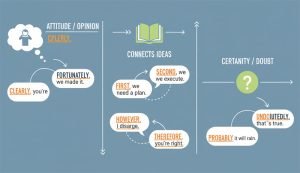
A disjunct is an adverbial that expresses the speaker’s or writer’s attitude or evaluation of the content of the sentence. Unlike adjuncts, which provide additional information about the verb or the sentence’s main idea, disjuncts comment on the entire clause. They are peripheral to the core meaning of the sentence and can often be removed without significantly altering the factual information conveyed.
Disjuncts provide a subjective layer, reflecting the speaker’s perspective, certainty, or manner of speaking. Disjuncts are sometimes also referred to as sentence adverbs or attitudinal adverbs, each term highlighting a different aspect of their function.
In simple terms, the disjunct meaning in grammar refers to how a speaker or writer signals their attitude toward an entire statement rather than contributing factual information. To define disjunct clearly, it is an optional adverbial element that comments on the sentence as a whole, often expressing certainty, doubt, evaluation, or manner of expression.
When learners ask, “what is a disjunct?” or “what is disjunct used for,” they are typically seeking to understand how these words shape interpretation rather than content. Disjuncts operate outside the core clause structure, allowing speakers to guide how a message should be understood without altering its basic facts.
Disjuncts can be classified based on their function. Some express the speaker’s certainty or doubt (e.g., certainly, probably), while others indicate their manner of speaking (e.g., frankly, honestly). The context in which a disjunct is used can also influence its meaning.
For example, the disjunct “obviously” can convey certainty or sarcasm, depending on the tone and situation. Recognizing disjuncts is crucial for understanding the subtleties of communication and interpreting the speaker’s intended message accurately. Disjuncts play a crucial role in conveying not just information, but also the speaker’s stance towards that information.
Structural Breakdown
Disjuncts are typically adverbs or adverbial phrases, and their position in a sentence is relatively flexible. They can appear at the beginning, middle, or end of a sentence, often set off by commas to indicate their separateness from the core sentence structure.
The punctuation helps to signal that the disjunct modifies the entire sentence rather than a specific element within it. The most common positions for disjuncts are at the beginning or in the middle of a clause.
When a disjunct appears at the beginning of a sentence, it is usually followed by a comma. For example: “Fortunately, the weather cleared up.” In the middle of a sentence, it is typically enclosed by commas: “The project, surprisingly, was completed on time.” At the end of a sentence, a comma usually precedes the disjunct: “She passed the exam, undoubtedly.” The choice of position can sometimes affect the emphasis placed on the disjunct. Initial position often gives the disjunct greater prominence, while medial or final positions may make it feel more integrated into the sentence flow. Understanding the structural flexibility of disjuncts allows you to use them effectively to add nuance and emphasis to your writing.
Types or Categories of Disjuncts
Disjuncts can be broadly categorized into two main types: content disjuncts and style disjuncts. These categories reflect the different kinds of attitudes or evaluations that disjuncts can express.
Content Disjuncts
Content disjuncts express the speaker’s or writer’s attitude toward the truth or probability of the sentence’s content. They comment on the factual information being conveyed, indicating the speaker’s degree of certainty, doubt, or belief. Common examples of content disjuncts include certainly, probably, possibly, undoubtedly, evidently, clearly, apparently, truthfully, honestly, and obviously. These disjuncts help to qualify the information, providing context about how the speaker views its validity.
For instance, in the sentence “Certainly, he will succeed,” the disjunct “certainly” indicates the speaker’s strong belief in the subject’s success. In contrast, “Possibly, it will rain tomorrow” conveys a lower degree of certainty. Content disjuncts are essential for conveying the speaker’s perspective on the factual accuracy or likelihood of events. They help to shape the reader’s or listener’s interpretation of the information by adding a layer of subjective evaluation. Understanding and using content disjuncts effectively can greatly enhance clarity and precision in communication.
Style Disjuncts
Style disjuncts, on the other hand, express the speaker’s or writer’s attitude toward the manner of speaking or writing. They comment on how the information is being presented, rather than the information itself. Common examples of style disjuncts include frankly, honestly, confidentially, seriously, briefly, generally, personally, strictly speaking, and in conclusion. These disjuncts provide information about the speaker’s approach or intention in communicating the message.
For example, in the sentence “Frankly, I disagree with your proposal,” the disjunct “frankly” indicates that the speaker is being direct and open about their disagreement. In contrast, “Generally, the feedback has been positive” suggests that the speaker is providing a broad overview of the feedback received. Style disjuncts help to manage the interaction between the speaker and the audience, clarifying the speaker’s communicative intentions.
They add a level of transparency to the communication process, allowing the audience to better understand the speaker’s approach and perspective. Using style disjuncts effectively can enhance the clarity and impact of your communication.
Together, content disjunct and style disjunct categories account for most disjunct usage in English. While a content disjunct evaluates the truth, likelihood, or reliability of what is being said, a style disjunct signals how the speaker chooses to present that information. Understanding the distinction between a content disjunct and a style disjunct helps writers control both interpretation and tone, ensuring that meaning and manner work together rather than causing ambiguity.
Examples of Disjuncts
The following tables provide a variety of examples of disjuncts, categorized by type and position, to illustrate their usage in different contexts. These examples will help you to identify and understand disjuncts in both written and spoken English.
Content Disjuncts Examples
The following table provides examples of content disjuncts used in sentences. These disjuncts express the speaker’s attitude toward the truth or probability of the sentence’s content.
| Disjunct | Example Sentence |
|---|---|
| Certainly | Certainly, he will arrive on time. |
| Probably | Probably, it will rain this afternoon. |
| Possibly | Possibly, she will attend the meeting. |
| Undoubtedly | Undoubtedly, he is the best candidate for the job. |
| Evidently | Evidently, there was a misunderstanding. |
| Clearly | Clearly, the situation is improving. |
| Apparently | Apparently, the flight has been delayed. |
| Truthfully | Truthfully, I don’t know the answer. |
| Honestly | Honestly, I didn’t expect this outcome. |
| Obviously | Obviously, the project needs more funding. |
| Surely | Surely, you must be mistaken. |
| Presumably | Presumably, they have already left. |
| In all likelihood | In all likelihood, the deal will go through. |
| Assuredly | Assuredly, the quality will improve. |
| No doubt | No doubt, she will excel in her new role. |
| Conceivably | Conceivably, the technology could revolutionize the industry. |
| Understandably | Understandably, they were disappointed with the results. |
| Logically | Logically, this is the next step. |
| Predictably | Predictably, the stock market reacted negatively. |
| Remarkably | Remarkably, he recovered quickly from the illness. |
| Significantly | Significantly, the data shows an increase in sales. |
| Surprisingly | Surprisingly, the event was well-attended. |
| Unfortunately | Unfortunately, we have to cancel the event. |
| Happily | Happily, the team has reached its goal. |
| Sadly | Sadly, the company is closing its doors. |
Style Disjuncts Examples
The following table provides examples of style disjuncts used in sentences. These disjuncts express the speaker’s attitude toward the manner of speaking or writing.
| Disjunct | Example Sentence |
|---|---|
| Frankly | Frankly, I don’t think it’s a good idea. |
| Honestly | Honestly, I haven’t finished the report yet. |
| Confidentially | Confidentially, the company is planning layoffs. |
| Seriously | Seriously, we need to address this issue immediately. |
| Briefly | Briefly, I’d like to introduce the speaker. |
| Generally | Generally, the feedback has been positive. |
| Personally | Personally, I prefer the other option. |
| Strictly speaking | Strictly speaking, this isn’t within my job description. |
| In conclusion | In conclusion, we need to take action now. |
| Broadly speaking | Broadly speaking, the economy is improving. |
| Technically | Technically, the contract is still valid. |
| Officially | Officially, the results will be announced tomorrow. |
| Put simply | Put simply, we don’t have enough resources. |
| To be precise | To be precise, the meeting will start at 2:30 PM. |
| More specifically | More specifically, we need to focus on marketing. |
| In other words | In other words, we need a new strategy. |
| So to speak | He’s a fish out of water, so to speak. |
| To put it mildly | To put it mildly, the project is behind schedule. |
| In short | In short, we need to cut costs. |
| To summarize | To summarize, the report highlights key areas for improvement. |
| Incidentally | Incidentally, I saw John at the store yesterday. |
| By the way | By the way, did you remember to bring the documents? |
| In passing | In passing, I heard about a new opportunity. |
| Parenthetically | Parenthetically, this is just my opinion. |
| As a matter of fact | As a matter of fact, I did know about that. |
Disjuncts by Position Examples
The following table illustrates how the position of a disjunct can vary within a sentence, along with example sentences.
| Position | Disjunct | Example Sentence |
|---|---|---|
| Beginning | Fortunately | Fortunately, the rain stopped before the game. |
| Middle | Surprisingly | The event, surprisingly, was a great success. |
| End | Undoubtedly | She will win the competition, undoubtedly. |
| Beginning | Clearly | Clearly, more research is needed. |
| Middle | Honestly | I, honestly, didn’t mean to offend you. |
| End | Frankly | I don’t like his attitude, frankly. |
| Beginning | Probably | Probably, we should leave early to avoid traffic. |
| Middle | Generally | The product, generally, has received positive reviews. |
| End | Seriously | Are you seriously considering that offer? |
| Beginning | Technically | Technically, the deadline has already passed. |
| Middle | In conclusion | We, in conclusion, recommend further investigation. |
| End | Officially | The meeting has been cancelled, officially. |
| Beginning | Predictably | Predictably, the market reacted negatively. |
| Middle | Understandably | They were, understandably, upset by the news. |
| End | Happily | The issue has been resolved, happily. |
| Beginning | In all likelihood | In all likelihood, the project will be approved. |
| Middle | Assuredly | The quality will, assuredly, improve over time. |
| End | Sadly | The store is closing, sadly. |
| Beginning | No doubt | No doubt, she will succeed in this role. |
| Middle | Remarkably | He recovered, remarkably, quickly from the injury. |
| End | Conceivably | The plan might work, conceivably. |
| Beginning | Significantly | Significantly, the company’s profits have increased. |
| Middle | Put simply | The problem is, put simply, a lack of resources. |
| End | To be precise | The event will begin at 7:00 PM, to be precise. |
Usage Rules of Disjuncts
Using disjuncts correctly involves understanding their meaning, placement, and punctuation. Here are some key rules to follow:
- Punctuation: Disjuncts are usually set off by commas. When a disjunct appears at the beginning or end of a sentence, it is typically separated by a single comma. When it appears in the middle of a sentence, it is usually enclosed by commas.
- Placement: While disjuncts can appear in various positions, placing them at the beginning of a sentence often emphasizes their meaning. Placing them in the middle can create a smoother flow, while placing them at the end can add a subtle emphasis.
- Meaning: Ensure that the disjunct accurately reflects your intended attitude or evaluation. Using the wrong disjunct can change the meaning of the sentence and potentially confuse the reader.
- Clarity: Avoid overuse of disjuncts, as this can make your writing sound repetitive or cluttered. Use them sparingly and strategically to add nuance and emphasis where needed.
- Formality: Be aware of the level of formality associated with different disjuncts. Some disjuncts, such as “frankly” or “honestly,” may be more appropriate in informal contexts, while others, such as “undoubtedly” or “significantly,” may be suitable for more formal writing.
Understanding these rules will help you to use disjuncts effectively and appropriately in your writing and speech. Paying attention to punctuation, placement, meaning, clarity, and formality will ensure that your use of disjuncts enhances your communication rather than detracting from it.
Common Mistakes with Disjuncts
Several common mistakes can occur when using disjuncts. Being aware of these errors can help you avoid them and use disjuncts more effectively.
- Incorrect Punctuation: Failing to use commas correctly is a common mistake. Ensure that disjuncts are always set off by commas to indicate their separateness from the core sentence structure.
- Misunderstanding Meaning: Using a disjunct that does not accurately reflect your intended attitude or evaluation can change the meaning of the sentence.
- Overuse: Using too many disjuncts can make your writing sound repetitive and cluttered. Use them sparingly and strategically.
- Inappropriate Formality: Using disjuncts that are not appropriate for the context can make your writing sound out of place.
- Confusion with Adjuncts: Confusing disjuncts with adjuncts can lead to incorrect sentence structure and meaning. Remember that disjuncts modify the entire sentence, while adjuncts modify specific elements within it.
The table below provides examples of common mistakes with disjuncts, along with corrections.
| Incorrect | Correct | Explanation |
|---|---|---|
| Honestly I don’t know. | Honestly, I don’t know. | Missing comma after the disjunct. |
| The project surprisingly was successful. | The project, surprisingly, was successful. | Missing commas around the disjunct in the middle of the sentence. |
| Clearly, I think it’s a good idea. | Clearly, it’s a good idea. (expressing certainty) or Personally, I think it’s a good idea. (expressing opinion) | Using “clearly” to express a personal opinion instead of certainty. |
| He used undoubtedly disjuncts in his essay. | He used disjuncts in his essay. (Remove ‘undoubtedly’ as it’s redundant) | Overusing disjuncts, making the sentence sound awkward. |
| He spoke quick, frankly. | He spoke quickly, frankly. | Using an adjective (“quick”) instead of an adverb (“quickly”) before the disjunct. |
| He finished the work yesterday, honestly. | He finished the work yesterday. (Remove ‘honestly’ if it adds no value) | Unnecessary use of ‘honestly’ at the end of the sentence. |
| Serious, we need to talk. | Seriously, we need to talk. | Using an adjective (“serious”) instead of an adverb (“seriously”). |
| General the feedback was positive. | Generally, the feedback was positive. | Using an adjective (“general”) instead of an adverb (“generally”). |
| Strict speaking, this is not allowed. | Strictly speaking, this is not allowed. | Using an adjective (“strict”) instead of an adverb (“strictly”). |
| Conclusion, we need to act now. | In conclusion, we need to act now. | Missing the preposition “in” to form the correct adverbial phrase. |
Practice Exercises
Test your understanding of disjuncts with the following exercises. Identify the disjunct in each sentence and indicate whether it is a content disjunct or a style disjunct.
- Fortunately, the weather was perfect for the picnic.
- Frankly, I don’t agree with your decision.
- The project, undoubtedly, will be a success.
- Honestly, I forgot to buy milk.
- Clearly, more research is needed.
- Generally, the students perform well on the exam.
- Possibly, she will be late for the meeting.
- In conclusion, we need to implement these changes.
- Apparently, the store is closed today.
- Seriously, you need to focus on your studies.
Answers:
- Fortunately (Content Disjunct)
- Frankly (Style Disjunct)
- Undoubtedly (Content Disjunct)
- Honestly (Style Disjunct)
- Clearly (Content Disjunct)
- Generally (Style Disjunct)
- Possibly (Content Disjunct)
- In conclusion (Style Disjunct)
- Apparently (Content Disjunct)
- Seriously (Style Disjunct)
Exercise 2: Fill in the blanks with appropriate disjuncts from the list below:
(honestly, certainly, generally, surprisingly, frankly, obviously, possibly, in conclusion, seriously, fortunately)
- ________, I don’t have time for this.
- ________, the weather held up for the outdoor event.
- ________, the results were better than expected.
- ________, the meeting will be held next week.
- ________, I think we should consider all options.
- ________, this is a matter of great importance.
- ________, the company’s performance has been improving.
- ________, I didn’t expect to see you here.
- ________, we must take immediate action.
- ________, I can’t tell you the truth.
Answers:
- Frankly, I don’t have time for this.
- Fortunately, the weather held up for the outdoor event.
- Surprisingly, the results were better than expected.
- Possibly, the meeting will be held next week.
- Generally, I think we should consider all options.
- Seriously, this is a matter of great importance.
- Generally, the company’s performance has been improving.
- Honestly, I didn’t expect to see you here.
- In conclusion, we must take immediate action.
- Honestly, I can’t tell you the truth.
Exercise 3: Rewrite the following sentences by adding a suitable disjunct to each. Make sure to use correct punctuation.
- The project was completed on time.
- I disagree with your proposal.
- The team achieved its goals.
- She will pass the exam.
- The situation is improving.
- The flight has been delayed.
- I don’t know the answer.
- I didn’t expect this outcome.
- The project needs more funding.
- You must be mistaken.
Possible Answers:
- The project, surprisingly, was completed on time.
- Frankly, I disagree with your proposal.
- Happily, the team achieved its goals.
- She will, undoubtedly, pass the exam.
- Clearly, the situation is improving.
- Apparently, the flight has been delayed.
- Truthfully, I don’t know the answer.
- Honestly, I didn’t expect this outcome.
- Obviously, the project needs more funding.
- Surely, you must be mistaken.
Advanced Topics
For advanced learners, it is important to understand the subtle nuances and complexities of disjunct usage. This includes recognizing how disjuncts can interact with other adverbials and how their meaning can shift depending on the context.
For example, a disjunct like “obviously” can be used to express genuine certainty, but it can also be used sarcastically to convey the opposite meaning. The intonation and surrounding context provide crucial clues to the speaker’s true intention.
Another advanced topic is the use of disjuncts in different registers and genres. Formal writing often favors more precise and objective disjuncts, while informal speech may include more subjective and expressive disjuncts.
Understanding these variations allows you to tailor your language to suit the specific communication context. Furthermore, exploring the historical development of disjuncts and their usage in different dialects of English can provide deeper insights into their function and meaning.
Advanced learners should also pay attention to how disjuncts are translated across languages, as their equivalents may not always have the same connotations or usage patterns.
FAQ Section
Here are some frequently asked questions about disjuncts:
What is the difference between a disjunct and an adjunct?
A disjunct modifies the entire sentence, expressing the speaker’s attitude or evaluation of the content. An adjunct, on the other hand, provides additional information about the verb or other elements within the sentence, such as time, place, or manner. Disjuncts are peripheral to the core meaning, while adjuncts are more integrated into the sentence structure.
Can a word be both a disjunct and an adjunct?
Yes, the same word can function as either a disjunct or an adjunct depending on its role in the sentence. For example, “honestly” can be a disjunct expressing the speaker’s sincerity (“Honestly, I didn’t take it”) or an adjunct describing how an action is performed (“He answered honestly”).
How do I identify a disjunct in a sentence?
Look for adverbs or adverbial phrases that express the speaker’s attitude, opinion, or evaluation of the entire sentence. Disjuncts are often set off by commas and can be removed without significantly altering the factual information conveyed.
What is the difference between content and style disjuncts?
Content disjuncts express the speaker’s attitude toward the truth or probability of the sentence’s content (e.g., certainly, possibly). Style disjuncts express the speaker’s attitude toward the manner of speaking or writing (e.g., frankly, generally).
Is it okay to start every sentence with a disjunct?
No, overuse of disjuncts can make your writing sound repetitive and cluttered. Use them sparingly and strategically to add nuance and emphasis where needed.
Are disjuncts only adverbs?
While most disjuncts are adverbs or adverbial phrases, they can also take other forms, such as prepositional phrases (e.g., “In conclusion,“) or even clauses (although this is less common).
Do all languages have disjuncts?
Many languages have similar constructions that express the speaker’s attitude or evaluation, but the specific forms and usage patterns may vary. Translation of disjuncts across languages can be complex and require careful attention to nuance.
How can I improve my use of disjuncts?
Pay attention to how disjuncts are used in various texts and contexts. Practice identifying and using them in your own writing and speech. Get feedback from others on your usage and be mindful of the effect that disjuncts have on your communication.
Conclusion
Disjuncts are powerful tools for adding nuance, emphasis, and perspective to your writing and speech. By understanding their definition, types, usage rules, and common mistakes, you can effectively incorporate them into your communication to enhance clarity and impact.
Remember to use disjuncts strategically, paying attention to punctuation, placement, meaning, and formality. Practice identifying and using disjuncts in various contexts to master their usage.
Mastering disjuncts will not only improve your grammatical accuracy but also enhance your ability to express your thoughts and ideas with greater precision and sophistication. Continue to explore the subtleties of English grammar and language to become a more effective and confident communicator.
With consistent practice and attention to detail, you can harness the power of disjuncts to elevate your writing and speech to new heights. Keep practicing, and you’ll find that using disjuncts becomes second nature, adding depth and richness to your communication.