
The word “however” is a versatile conjunctive adverb that adds nuance and sophistication to writing and speech. While commonly used at the beginning of sentences, its placement mid-sentence can create smoother transitions and more effectively contrast ideas.
Understanding how to correctly position and punctuate “however” within a sentence is crucial for clear and professional communication. For those wondering how to use however in the middle of a sentence, it is important to remember that the word functions as an interrupter, and commas are essential to preserve clarity. Using however in the middle of a sentence allows writers to emphasize contrast smoothly, and it can appear after the subject, verb, or other key elements depending on the intended emphasis.
When considering grammar using however in middle of sentence, always check whether the clause before and after could stand alone as independent clauses, especially if you choose to use a semicolon. Sentences with however in the middle provide a polished, professional tone, showing precise control over contrast and nuance. Many writers also ask: can however be used in middle of sentence? The answer is yes, provided punctuation rules are followed. Similarly, understanding the position of however in a sentence and how to type a sentence with however in the middle ensures correct and effective usage in both formal and informal contexts.
This article provides a comprehensive guide to mastering the mid-sentence use of “however,” covering its definition, structural rules, various applications, common mistakes, and practice exercises.
This guide is designed for English language learners, students, and professionals seeking to refine their grammar skills and enhance their writing proficiency.
By the end of this article, you will be able to confidently use “however” in the middle of sentences, adding depth and clarity to your communication.
Table of Contents
- Introduction
- Definition of “However”
- Structural Breakdown
- Types of Contrast Signaled by “However”
- Examples of “However” in Mid-Sentence
- Usage Rules for “However”
- Common Mistakes
- Practice Exercises
- Advanced Topics
- FAQ
- Conclusion
Definition of “However”
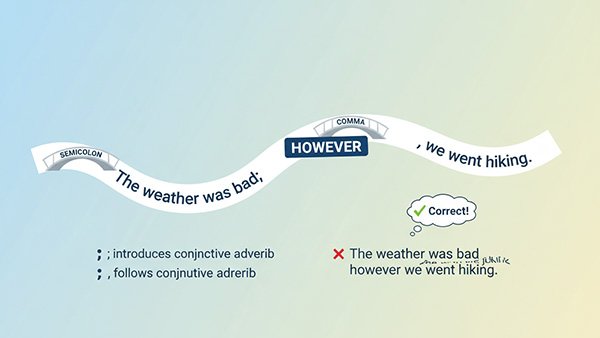
“However” is a conjunctive adverb (also known as an adverbial conjunction). Conjunctive adverbs connect two independent clauses or sentences.
They provide a transition between ideas and indicate a relationship between them. “However” specifically signals a contrast, contradiction, qualification, or concession.
In simpler terms, “however” means “despite that,” “nevertheless,” or “in spite of what has just been said.” It introduces a statement that contrasts with or modifies a previous statement. When placed in the middle of a sentence, “however” functions as an interrupter, briefly pausing the flow of the sentence to highlight the contrasting element.
Classification: Conjunctive Adverb (Adverbial Conjunction)
Function: To indicate contrast, contradiction, qualification, or concession.
Contexts: Formal and informal writing, academic essays, business reports, everyday conversation.
Structural Breakdown
When “however” appears in the middle of a sentence, it is typically set off by commas. The basic structure is:
[Independent Clause], however, [rest of the independent clause].
The commas are essential because they indicate that “however” is an interrupter, adding a parenthetical element to the sentence. Without the commas, the sentence can become confusing or grammatically incorrect.
For example:
- Incorrect: The team played well however they lost the game.
- Correct: The team played well, however, they lost the game.
The position of “however” within the independent clause can vary slightly, but it should always be placed in a way that maintains the sentence’s clarity and flow. It’s often placed after the subject or verb for emphasis.
Consider these variations:
- The results, however, were inconclusive.
- The results were, however, inconclusive.
Both sentences are grammatically correct, but the placement of “however” affects the emphasis. In the first sentence, the contrast is focused on the “results,” while in the second, it’s more generally on the entire statement.
Types of Contrast Signaled by “However”
“However” is a versatile word that can signal several types of contrast. Understanding these nuances can help you use it more precisely.
Direct Contradiction
This is the most straightforward use of “however,” where the second part of the sentence directly contradicts the first.
Example: The weather forecast predicted sunshine, however, it rained all day.
Qualification
In this case, “however” introduces a statement that limits or modifies the previous one, providing a nuanced perspective.
Example: He is a talented musician, however, he lacks formal training.
Concession
Here, “however” acknowledges a point before presenting a contrasting or overriding idea. This shows awareness of different perspectives.
Example: She admitted the task was difficult, however, she was determined to complete it.
Unexpected Result
This usage indicates that the outcome was different from what was expected or logical based on the preceding information.
Example: They invested a lot of money in the project, however, it failed to generate profits.
Examples of “However” in Mid-Sentence
The following tables provide extensive examples of “however” used in the middle of sentences, categorized by the type of contrast they signal. Each example demonstrates the correct punctuation and placement of “however.”
Table 1: Direct Contradiction
This table illustrates how “however” introduces a direct contradiction to the first part of the sentence. Notice the clear contrast between the two clauses.
| Example |
|---|
| She said she was busy, however, she spent the entire afternoon shopping. |
| The restaurant claimed to have the best pizza, however, the taste was disappointing. |
| He promised to be on time, however, he arrived an hour late. |
| The instructions were clear, however, nobody seemed to understand them. |
| The car was advertised as fuel-efficient, however, it consumed a lot of gas. |
| They expected a warm welcome, however, they were met with hostility. |
| The book was highly recommended, however, I found it quite boring. |
| The event was supposed to be free, however, they charged an entrance fee. |
| The candidate seemed confident, however, his answers were vague. |
| The weather report predicted sunshine, however, it rained all day. |
| The product was guaranteed to work, however, it broke after a week. |
| The team had practiced diligently, however, they lost the championship game. |
| She insisted she knew the way, however, she quickly got lost. |
| He claimed to be an expert, however, his knowledge was superficial. |
| The project was well-funded, however, it failed to achieve its goals. |
| The evidence suggested his guilt, however, the jury acquitted him. |
| The company promised job security, however, they laid off employees. |
| The medicine was supposed to cure the illness, however, it had no effect. |
| The plan seemed foolproof, however, unexpected problems arose. |
| The presentation was well-prepared, however, the audience was uninterested. |
| The software was user-friendly, however, many people found it difficult to navigate. |
| The research was thorough, however, the conclusions were questionable. |
| The directions were precise, however, he still managed to take the wrong turn. |
Table 2: Qualification
This table demonstrates how “however” introduces a qualification, limiting or modifying the previous statement. It adds a layer of nuance and provides a more balanced perspective.
| Example |
|---|
| She is a talented writer, however, she struggles with deadlines. |
| The house is beautiful, however, it’s located far from the city. |
| He is a skilled athlete, however, he lacks discipline. |
| The plan is ambitious, however, it may be too expensive to implement. |
| The movie was entertaining, however, the plot was predictable. |
| The food was delicious, however, the service was slow. |
| The car is reliable, however, it’s not very stylish. |
| The job is challenging, however, it offers good opportunities for growth. |
| The theory is interesting, however, it lacks empirical evidence. |
| The product is innovative, however, it’s not very practical. |
| The project was successful, however, it took longer than expected. |
| He is a good leader, however, he sometimes lacks empathy. |
| The software is powerful, however, it can be difficult to learn. |
| The research is promising, however, more studies are needed. |
| The neighborhood is safe, however, it lacks amenities. |
| The book is well-written, however, the story is slow-paced. |
| The design is creative, however, it’s not very functional. |
| The presentation was informative, however, it was too long. |
| The solution is elegant, however, it’s not very efficient. |
| The proposal is well-researched, however, the budget is unrealistic. |
| The actor is versatile, however, he often chooses poor roles. |
| The argument is logical, however, it fails to consider the emotional aspect. |
Table 3: Concession
This table illustrates how “however” introduces a concession, acknowledging a point before presenting a contrasting or overriding idea. This shows awareness of different perspectives and adds credibility to the argument.
| Example |
|---|
| She admitted she was wrong, however, she refused to apologize. |
| He acknowledged the difficulties, however, he remained optimistic. |
| They understood the risks, however, they decided to proceed. |
| I recognize your concerns, however, I believe this is the best course of action. |
| We appreciate your feedback, however, we are unable to implement your suggestions at this time. |
| She conceded that he had a point, however, she still disagreed with his conclusion. |
| He acknowledged the limitations of the study, however, he maintained that the results were significant. |
| They understood the potential consequences, however, they felt it was worth the risk. |
| I admit that I was mistaken, however, I acted in good faith. |
| We recognize that this is a complex issue, however, we must find a solution. |
| She acknowledged her lack of experience, however, she was eager to learn. |
| He admitted he was nervous, however, he delivered a confident presentation. |
| They understood the challenges, however, they were committed to success. |
| I recognize your frustration, however, I am doing my best to help. |
| We appreciate your patience, however, we are still working on the problem. |
| She conceded that the task was difficult, however, she was determined to complete it. |
| He acknowledged the criticism, however, he defended his decision. |
| They understood the potential drawbacks, however, they believed the benefits outweighed them. |
| I admit that the situation is complicated, however, we must remain calm. |
| We recognize that this is a controversial topic, however, we need to discuss it openly. |
| She acknowledged the possibility of failure, however, she remained hopeful. |
| He admitted he had made mistakes, however, he had learned from them. |
Table 4: Unexpected Result
This table shows how “however” can introduce an unexpected result, indicating that the outcome was different from what was expected or logical based on the preceding information.
| Example |
|---|
| They invested a lot of money in the project, however, it failed to generate profits. |
| He studied hard for the exam, however, he failed it. |
| She followed the recipe carefully, however, the cake didn’t turn out well. |
| They worked tirelessly on the campaign, however, they lost the election. |
| He took all the necessary precautions, however, he still got sick. |
| She practiced every day, however, she didn’t improve. |
| They implemented the new system, however, it created more problems than it solved. |
| He followed the doctor’s orders, however, his condition worsened. |
| She tried her best to be friendly, however, she was met with hostility. |
| They put a lot of effort into the presentation, however, the audience was bored. |
| He saved money diligently, however, unexpected expenses arose. |
| She planned the trip meticulously, however, everything went wrong. |
| They built the house to code, however, it had structural problems. |
| He maintained the car meticulously, however, it broke down frequently. |
| She watered the plants regularly, however, they withered. |
| They advertised the product extensively, however, sales remained low. |
| He secured all the doors and windows, however, the house was burglarized. |
| She wore a helmet while biking, however, she still suffered a head injury. |
| They backed up the data regularly, however, they lost everything in a system crash. |
| He locked the bicycle securely, however, it was stolen. |
| The security was tight, however, someone managed to sneak in. |
| The bridge was built to withstand earthquakes, however, it collapsed during a minor tremor. |
Usage Rules for “However”
Using “however” correctly involves understanding its grammatical function and following specific punctuation rules. Here’s a breakdown of the key rules:
Rule 1: Commas are Essential
When “however” is used in the middle of a sentence, it is almost always set off by commas. These commas act like parentheses, indicating that “however” is an interrupter.
Correct: The movie, however, was not as good as the book.
Incorrect: The movie however was not as good as the book.
Rule 2: Placement Matters
The placement of “however” can affect the emphasis of the sentence. While there is some flexibility, it should always be placed in a way that maintains clarity.
Emphasis on the subject: The results, however, were inconclusive.
General emphasis: The results were, however, inconclusive.
Awkward: The, however, results were inconclusive. (Avoid this placement)
Rule 3: Avoid Overuse
Overusing “however” can make your writing sound repetitive and monotonous. Vary your sentence structure and use other transitional words and phrases to create a more engaging style.
Synonyms for “however” include “nevertheless,” “nonetheless,” “yet,” “still,” “on the other hand,” and “in contrast.”
Rule 4: Semicolons and “However”
“However” can also be used to connect two independent clauses, with a semicolon preceding it. In this case, a comma still follows “however.”
Correct: The team played well; however, they lost the game.
This structure is particularly useful when the two clauses are closely related and you want to emphasize the contrast.
Rule 5: Beginning of Sentence
While this article focuses on mid-sentence usage, it’s important to note that “however” can also begin a sentence. When used this way, it is followed by a comma.
Correct: However, the results were inconclusive.
Common Mistakes
Even experienced writers sometimes make mistakes when using “however.” Here are some common errors and how to avoid them:
Mistake 1: Missing Commas
Incorrect: The data however suggested a different conclusion.
Correct: The data, however, suggested a different conclusion.
Explanation: Always use commas to set off “however” when it’s in the middle of a sentence.
Mistake 2: Incorrect Conjunction Usage
Incorrect: The sun was shining, but, however, it was cold.
Correct: The sun was shining, but it was cold. OR The sun was shining; however, it was cold.
Explanation: Avoid using “however” redundantly with other conjunctions like “but.” Choose one or the other.
Mistake 3: Run-on Sentences
Incorrect: The project was late however it was still approved.
Correct: The project was late; however, it was still approved. OR The project was late, but it was still approved.
Explanation: “However” cannot join two independent clauses without proper punctuation (semicolon or comma with a conjunction).
Mistake 4: Awkward Placement
Awkward: The, however, decision was made quickly.
Better: The decision, however, was made quickly.
Explanation: Place “however” in a position that maintains the natural flow of the sentence.
Table 5: Correct vs. Incorrect Examples
This table summarizes common mistakes and provides corrected examples to help you avoid these errors in your own writing.
| Mistake | Incorrect Example | Correct Example |
|---|---|---|
| Missing Commas | She studied hard however she failed the test. | She studied hard, however, she failed the test. |
| Redundant Conjunction | He was tired, but, however, he kept working. | He was tired, but he kept working. OR He was tired; however, he kept working. |
| Run-on Sentence | The car was expensive however it was worth it. | The car was expensive; however, it was worth it. OR The car was expensive, but it was worth it. |
| Awkward Placement | The, however, meeting was productive. | The meeting, however, was productive. |
| Incorrect Punctuation with a Semicolon | He tried his best; however the outcome was still undesirable. | He tried his best; however, the outcome was still undesirable. |
| Overuse of “However” | The plan was risky. However, we proceeded. However, things went wrong. | The plan was risky. Nevertheless, we proceeded. Unfortunately, things went wrong. |
Practice Exercises
Test your understanding of “however” with these practice exercises. Fill in the blanks with “however” and add commas where necessary.
Exercise 1: Fill in the Blanks
Complete the following sentences by inserting “however” in the most appropriate location and adding the necessary commas.
| Question | Answer |
|---|---|
| 1. The team played well ____ they lost the game. | 1. The team played well, however, they lost the game. |
| 2. She studied hard ____ she didn’t get a good grade. | 2. She studied hard, however, she didn’t get a good grade. |
| 3. The food was delicious ____ the service was slow. | 3. The food was delicious, however, the service was slow. |
| 4. He promised to be on time ____ he was late. | 4. He promised to be on time, however, he was late. |
| 5. The movie was long ____ it was enjoyable. | 5. The movie was long, however, it was enjoyable. |
| 6. The instructions were clear ____ nobody understood them. | 6. The instructions were clear, however, nobody understood them. |
| 7. The car is old ____ it still runs well. | 7. The car is old, however, it still runs well. |
| 8. The project was difficult ____ we completed it successfully. | 8. The project was difficult, however, we completed it successfully. |
| 9. The weather forecast predicted sunshine ____ it rained all day. | 9. The weather forecast predicted sunshine, however, it rained all day. |
| 10. She tried her best ____ she failed. | 10. She tried her best, however, she failed. |
Exercise 2: Correct the Sentences
Identify and correct any errors in the following sentences related to the use of “however.”
| Question | Answer |
|---|---|
| 1. He was tired but however he kept working. | 1. He was tired, but he kept working. OR He was tired; however, he kept working. |
| 2. The data, however suggested a different conclusion. | 2. The data, however, suggested a different conclusion. |
| 3. The project was late however, it was approved. | 3. The project was late; however, it was approved. OR The project was late, but it was approved. |
| 4. The, however, results were promising. | 4. The results, however, were promising. |
| 5. She studied hard however she still failed. | 5. She studied hard, however, she still failed. |
| 6. It was a difficult challenge, however we succeeded. | 6. It was a difficult challenge; however, we succeeded. |
| 7. The book was long, however I enjoyed it. | 7. The book was long; however, I enjoyed it. OR The book was long, but I enjoyed it. |
| 8. He tried his best; however the outcome was still undesirable. | 8. He tried his best; however, the outcome was still undesirable. |
| 9. The security was tight however someone managed to sneak in. | 9. The security was tight; however, someone managed to sneak in. OR The security was tight, but someone managed to sneak in. |
| 10. The bridge was built to withstand earthquakes, however it collapsed during a minor tremor. | 10. The bridge was built to withstand earthquakes; however, it collapsed during a minor tremor. OR The bridge was built to withstand earthquakes, but it collapsed during a minor tremor. |
Exercise 3: Sentence Combining
Combine the following pairs of sentences using “however” in the middle of the new sentence and add commas where necessary.
| Question | Answer |
|---|---|
| 1. The weather was terrible. We still went for a walk. | 1. The weather was terrible, however, we still went for a walk. |
| 2. She was very tired. She finished the project. | 2. She was very tired, however, she finished the project. |
| 3. The task was challenging. They completed it successfully. | 3. The task was challenging, however, they completed it successfully. |
| 4. He had little experience. He got the job. | 4. He had little experience, however, he got the job. |
| 5. The restaurant was expensive. The food was excellent. | 5. The restaurant was expensive, however, the food was excellent. |
| 6. The car was old. It still ran smoothly. | 6. The car was old, however, it still ran smoothly. |
| 7. She didn’t like the movie. She watched it until the end. | 7. She didn’t like the movie, however, she watched it until the end. |
| 8. He lost his wallet. He managed to get home. | 8. He lost his wallet, however, he managed to get home. |
| 9. The test was difficult. Most students passed. | 9. The test was difficult, however, most students passed. |
| 10. The problem was complex. They found a simple solution. | 10. The problem was complex, however, they found a simple solution. |
Advanced Topics
For advanced learners, understanding the subtleties of “however” and its alternatives can further refine your writing skills.
Subtleties of Placement
As mentioned earlier, the precise placement of “however” can subtly change the emphasis of the sentence. Experiment with different positions to achieve the desired effect.
Consider:
- The data, however, is inconclusive. (Emphasis on the data itself)
- The data is, however, inconclusive. (General statement with contrast)
- The data is inconclusive, however. (Less formal, emphasizes the inconclusiveness)
Alternatives to “However”
To avoid repetition and add variety to your writing, explore synonyms and related phrases:
- Nevertheless: Similar to “however,” but often used to introduce a stronger contrast.
- Nonetheless: Like “nevertheless,” emphasizing that something is true despite what has been said.
- Yet: A simple and direct way to introduce a contrast.
- Still: Indicates that something is happening despite an obstacle.
- On the other hand: Introduces a contrasting point of view.
- In contrast: Highlights a clear difference between two things.
- Despite this/that: Emphasizes that something is true regardless of what has been mentioned.
Using “However” in Complex Sentences
“However” can also be used within more complex sentence structures, but care must be taken to maintain clarity. For example, it can be used within a dependent clause:
Example: Although the initial results were promising, the subsequent analysis, however, revealed significant flaws.
FAQ
Here are some frequently asked questions about using “however” in the middle of a sentence:
Is it always necessary to use commas with “however” in the middle of a sentence?
Yes, in almost all cases, commas are necessary to set off “however” as an interrupter. The absence of commas can make the sentence grammatically incorrect and difficult to read.
Can I start a sentence with “However?”
Yes, you can start a sentence with “However.” When used at the beginning of a sentence, it is followed by a comma: “However, the results were inconclusive.”
What’s the difference between “however,” “nevertheless,” and “nonetheless?”
These words are all synonyms and can be used to indicate contrast. “Nevertheless” and “nonetheless” often suggest a stronger or more emphatic contrast than “however.”
Can I use “however” with other conjunctions like “but” or “and?”
It’s generally best to avoid using “however” redundantly with other conjunctions. Choose either “but” or “however” to connect contrasting ideas. For example, instead of “He was tired, but, however, he kept working,” use either “He was tired, but he kept working” or “He was tired; however, he kept working.”
Where is the best place to put “however” in the middle of a sentence?
The best placement depends on the emphasis you want to create. Placing it after the subject emphasizes the subject, while placing it later in the sentence provides a more general contrast. Always prioritize clarity and natural flow.
Is it okay to use “however” frequently in my writing?
While “however” is a useful word, overusing it can make your writing sound repetitive. Vary your sentence structure and use synonyms to create a more engaging and sophisticated style.
What punctuation should I use before “however” when connecting two independent clauses?
You should use a semicolon before “however” when connecting two independent clauses: “The team played well; however, they lost the game.” You can also use a comma and a coordinating conjunction like “but”: “The team played well, but they lost the game.”
Can “however” ever be used without commas?
In very rare cases, “however” can be used as a simple adverb meaning “in whatever way” or “to whatever extent” without commas, but this usage is infrequent and usually occurs at the end of a clause. For example: “However you do it, just get it done.” In these instances, the meaning is different from the conjunctive adverbial use which requires commas.
Conclusion
Mastering the use of “however” in the middle of a sentence is an essential skill for effective communication. By understanding its definition, structural rules, and various applications, you can add nuance and sophistication to your writing and speech.
Remember to use commas correctly, avoid overuse, and consider the placement of “however” to achieve the desired emphasis.
Practice the exercises provided in this article and pay attention to how “however” is used in well-written texts. By consistently applying these guidelines, you will confidently and accurately incorporate “however” into your communication, enhancing its clarity and impact.
Continue to explore advanced topics and consider the subtle nuances of language to further refine your grammar skills and become a more proficient communicator.