
Indefinite adjectives are essential for expressing quantity and nonspecificity in English. They provide a way to describe nouns without stating an exact number or specifying a particular item.
Understanding indefinite adjectives enhances your ability to communicate accurately and effectively, adding nuance to your sentences. This article is designed for English language learners of all levels who want to improve their grammar skills and gain a deeper understanding of how to use indefinite adjectives correctly.
Whether you’re a beginner or an advanced learner, this guide will provide you with the knowledge and practice you need to master this important aspect of English grammar.
Table of Contents
- Definition of Indefinite Adjectives
- Structural Breakdown
- Types and Categories of Indefinite Adjectives
- Examples of Indefinite Adjectives
- Usage Rules for Indefinite Adjectives
- Common Mistakes with Indefinite Adjectives
- Practice Exercises
- Advanced Topics
- Frequently Asked Questions (FAQ)
- Conclusion
Definition of Indefinite Adjectives
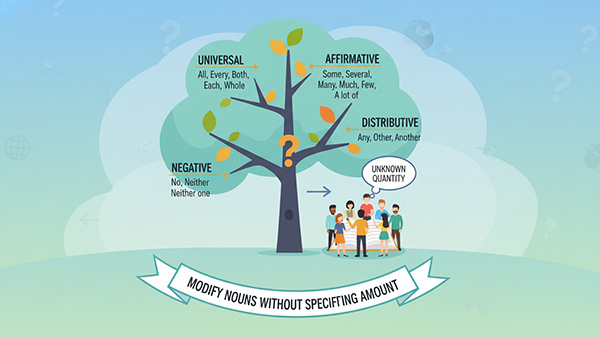
An indefinite adjective is a type of adjective that modifies a noun without specifying a definite quantity or identity. Unlike definite adjectives (such as “the” or “this”), indefinite adjectives do not point to a particular noun. Instead, they indicate an approximate amount, existence, or nonspecific nature of the noun they modify. They are used to express ideas like “some,” “many,” “few,” “any,” “every,” and “no.” These adjectives play a crucial role in making generalizations, expressing uncertainty, or indicating a lack of specific information about the noun.
Indefinite adjectives are classified as determiners, which are words that introduce and modify nouns. Clarifying Note in Definition: Sometimes learners search for “what is a indefiniteadjective in English” without spaces. Regardless of spacing, the term refers to adjectives that indicate nonspecific quantity or identity, such as some, many, few, and any. Recognizing these variations helps learners connect their search intent with the correct grammatical concept.
They function by providing information about the quantity, distribution, or nonspecificity of the noun. For example, in the sentence “I have some books,” the word “some” is an indefinite adjective that modifies the noun “books,” indicating an unspecified quantity of books. The context in which these adjectives are used often determines their specific meaning. The word ‘some’ might mean ‘a few’ or ‘several’ depending on the context.
Indefinite adjectives can appear before both countable and uncountable nouns, although some are restricted to only one or the other. Understanding this distinction is key to using them correctly.
For example, “many” is used with countable nouns (e.g., “many cars”), while “much” is used with uncountable nouns (e.g., “much water”). Recognizing the different types of indefinite adjectives and their appropriate usage will significantly improve your English grammar and communication skills.
Structural Breakdown
The structural use of indefinite adjectives is relatively straightforward. They typically precede the noun they modify. The basic structure is: Indefinite Adjective + Noun. For instance, in the phrase “several students,” “several” is the indefinite adjective and “students” is the noun. This structure is consistent across most uses of indefinite adjectives.
However, it’s important to note that indefinite adjectives function within the broader structure of a sentence. They contribute to the meaning of the noun phrase, which in turn functions as a subject, object, or complement within the sentence. Consider the sentence: “Few people attended the meeting.” Here, “few people” is the subject of the sentence, with “few” acting as the indefinite adjective modifying “people.” The noun phrase then dictates the verb agreement; because “people” is plural, the verb “attended” is also plural.
The position of the indefinite adjective can sometimes change slightly depending on the sentence structure, especially when using constructions like “of.” For example, in the phrase “Some of the students,” the structure is: Indefinite Adjective + of + Definite Article (the) + Noun. This construction is common when referring to a subset of a larger group. The indefinite adjective still modifies the noun (“students”), but the “of” phrase provides additional context.
Types and Categories of Indefinite Adjectives
Indefinite adjectives can be categorized based on the type of information they convey about the noun. The three main categories are adjectives of quantity, adjectives of distribution, and adjectives of nonspecificity.
Adjectives of Quantity
Adjectives of quantity indicate the amount or number of the noun. These adjectives can express a large quantity (e.g., many, much), a small quantity (e.g., few, little), or an indefinite quantity (e.g., some, any). It is important to distinguish between those used with countable nouns and those used with uncountable nouns. For example, ‘many’ is used with countable nouns, while ‘much’ is used with uncountable nouns.
Adjectives of Distribution
Adjectives of distribution refer to how something is spread out or allocated among members of a group. Common examples include each, every, either, and neither. These adjectives often imply that something applies to individual members of a group or that a choice exists between two options. For instance, “Each student received a certificate” indicates that every single student received a certificate.
Adjectives of Nonspecificity
Adjectives of nonspecificity indicate that the noun is not being identified in a specific or particular way. Examples include any, another, and other. These adjectives are used when the speaker or writer does not have a particular noun in mind or when the specific identity of the noun is not important. For instance, “Do you have any questions?” suggests that the speaker is open to any question, without specifying a particular one.
Examples of Indefinite Adjectives
To fully understand indefinite adjectives, it’s helpful to examine them in context. The following sections provide examples of each category of indefinite adjective, illustrating their usage in various sentences.
Examples of Adjectives of Quantity
Adjectives of quantity specify the amount of a noun without giving an exact number. They are essential for expressing general quantities and proportions.
The table below provides examples of adjectives of quantity used with both countable and uncountable nouns.
| Indefinite Adjective | Countable Noun Example | Uncountable Noun Example |
|---|---|---|
| Many | Many students attended the lecture. | N/A (Not typically used with uncountable nouns) |
| Much | N/A (Not typically used with countable nouns) | There isn’t much time left. |
| Few | Few people understand the complexity of the issue. | N/A (Not typically used with uncountable nouns) |
| Little | N/A (Not typically used with countable nouns) | There is little hope for a positive outcome. |
| Some | I have some friends coming over tonight. | I need some water. |
| Any | Are there any questions? | Is there any milk in the fridge? |
| Several | Several people have complained about the noise. | N/A (Not typically used with uncountable nouns) |
| All | All the books are on the shelf. | All the water has been used. |
| Enough | Do we have enough chairs for everyone? | Do we have enough sugar for the recipe? |
| No | There are no tickets available. | There is no time to waste. |
| A lot of | A lot of people came to the party. | A lot of effort was put into this project. |
| Lots of | Lots of children were playing in the park. | Lots of rain fell last night. |
| A number of | A number of students failed the exam. | N/A (Not typically used with uncountable nouns) |
| A great deal of | N/A (Not typically used with countable nouns) | A great deal of money was spent on the project. |
| Plenty of | There are plenty of opportunities for growth here. | There is plenty of food for everyone. |
| More | I need more pencils. | I need more information. |
| Most | Most students enjoyed the field trip. | Most of the snow has melted. |
| Fewer | Fewer cars are on the road today. | N/A (Not typically used with uncountable nouns) |
| Less | N/A (Not typically used with countable nouns) | There is less traffic in the evening. |
| Some | Some birds fly south for the winter. | Some advice is better than none. |
| Substantial | Substantial donations came from alumni. | Substantial progress was made. |
| Numerous | Numerous studies support this conclusion. | N/A (Not typically used with uncountable nouns) |
| Considerable | Considerable effort was required. | Considerable time was needed to complete the project. |
| Sufficient | We have sufficient funds for the project. | We have sufficient resources for the task. |
| Limited | There are a limited quantity of tickets. | There is a limited amount of food. |
| Abundant | Abundant opportunities exist for graduates. | Abundant sunshine poured into the room. |
| Negligible | A negligible amount of errors was found. | A negligible amount of water was lost. |
Examples of Adjectives of Distribution
Adjectives of distribution specify how something is allocated or divided among members of a group. They help to indicate whether something applies to each individual, a select few, or none at all.
The following table provides examples illustrating the use of these adjectives.
| Indefinite Adjective | Example Sentence |
|---|---|
| Each | Each student must submit their own assignment. |
| Every | Every citizen has the right to vote. |
| Either | You can choose either option. |
| Neither | Neither candidate is suitable for the job. |
| Any | Any member can propose a new rule. |
| Another | Can I have another piece of cake? |
| Other | Are there other solutions we should consider? |
| Certain | Certain individuals are exempt from the tax. |
| Various | Various methods can be used to solve this problem. |
| Several | Several members expressed their concerns. |
| Each and every | Each and every participant will receive a prize. |
| One | One person from each team will be selected. |
| No | No student is allowed to leave early. |
| Both | Both parents attended the meeting. |
| Single | Not a single person knew the answer. |
| Individual | Individual attention will be given to each student. |
| Particular | Are there any particular issues we need to address? |
| Specific | Do you have any specific requests? |
| Separate | Separate rooms will be used for the interviews. |
| Distinct | Each country has distinct customs. |
| Respective | The students went to their respective classrooms. |
| Alternate | We need an alternate plan. |
| Occasional | There are occasional showers in the afternoon. |
| Periodical | They conduct periodical reviews of the system. |
| Sporadic | There was sporadic gunfire in the distance. |
| Random | Random checks are performed regularly. |
Examples of Adjectives of Nonspecificity
Adjectives of nonspecificity indicate that the noun is not being identified in a specific or particular way. They are used when the speaker or writer does not have a particular noun in mind or when the specific identity of the noun is not important.
The following table provides examples.
| Indefinite Adjective | Example Sentence |
|---|---|
| Any | Do you have any spare change? |
| Another | Would you like another cup of coffee? |
| Other | Are there other options available? |
| Some | Some people prefer tea over coffee. |
| Certain | Certain conditions must be met. |
| A | I saw a bird in the garden. |
| An | She is an excellent teacher. |
| Such | I have never seen such beauty. |
| What | What book are you reading? |
| Which | Which way should we go? |
| Whatever | Whatever decision you make is fine with me. |
| Whichever | Whichever option you choose, I will support you. |
| Every | Every dog has its day. |
| Each | Each member is responsible for their own actions. |
| Either | You can use either door. |
| Neither | Neither answer is correct. |
| Some other | We should consider some other alternatives. |
| Any other | Do you have any other questions? |
| Another | Let’s try another approach. |
| One more | I need one more chance. |
| Last | I want to see last movie. |
| First | He was first person to arrive. |
| Second | She was second person to leave. |
| Next | What is next step. |
| Previous | The previous owner was great. |
| Following | The following statement is true. |
Usage Rules for Indefinite Adjectives
Using indefinite adjectives correctly involves understanding several key rules, including the distinction between countable and uncountable nouns, singular and plural nouns, and the context of positive and negative sentences. These rules help ensure grammatical accuracy and clarity in communication.
Countable vs. Uncountable Nouns
One of the most important rules for using indefinite adjectives is understanding the difference between countable and uncountable nouns. Countable nouns are those that can be counted and have a plural form (e.g., books, cars, students). Uncountable nouns, also known as mass nouns, cannot be counted and do not typically have a plural form (e.g., water, time, information). Certain indefinite adjectives are exclusively used with either countable or uncountable nouns, while others can be used with both.
For countable nouns, common indefinite adjectives include many, few, several, a number of, and each. For example, “Many students attended the lecture” and “Few cars are parked on the street.” For uncountable nouns, common indefinite adjectives include much, little, a great deal of, and a bit of. For example, “There isn’t much time left” and “I need a little water.” Adjectives like some, any, all, and enough can be used with both countable and uncountable nouns, depending on the context. For example, “I have some books” (countable) and “I need some water” (uncountable).
Singular vs. Plural Nouns
The number of the noun (singular or plural) also affects the choice of indefinite adjective. Some indefinite adjectives are used exclusively with singular nouns, while others are used with plural nouns. Each, every, another, and either are typically used with singular nouns. For example, “Each student has a book” and “Every dog has its day.” Many, few, several, and various are typically used with plural nouns. For example, “Many people attended the event” and “Several options are available.” Some indefinite adjectives, like some and any, can be used with both singular and plural nouns, depending on the context. For example, “Do you have any questions?” (plural) and “Is there any milk?” (singular, uncountable).
Positive vs. Negative Sentences
The type of sentence (positive, negative, or interrogative) influences the choice of indefinite adjective. Some is generally used in positive sentences, while any is generally used in negative sentences and questions. For example, “I have some apples” (positive) and “I don’t have any apples” (negative). In questions, any is commonly used to inquire about the existence or quantity of something. For example, “Do you have any questions?” However, some can be used in questions when offering something or expecting a positive answer. For example, “Would you like some coffee?”
Common Mistakes with Indefinite Adjectives
Even advanced learners sometimes make mistakes with indefinite adjectives. Here are some common errors and how to correct them:
| Incorrect | Correct | Explanation |
|---|---|---|
| I have much books. | I have many books. | “Much” is used with uncountable nouns; “many” is used with countable nouns like “books.” |
| There is many water in the bottle. | There is much water in the bottle. | “Many” is used with countable nouns; “much” is used with uncountable nouns like “water.” |
| Few water is needed. | Little water is needed. | “Few” is used with countable nouns; “little” is used with uncountable nouns like “water.” |
| I don’t have some questions. | I don’t have any questions. | “Some” is generally used in positive sentences; “any” is used in negative sentences. |
| Do you have some money to lend me? | Do you have any money to lend me? | “Some” is generally used in positive sentences; “any” is used in questions. |
| Each students should bring their own books. | Each student should bring their own book. | “Each” is used with singular nouns; therefore, “student” should be singular and the pronoun should also be singular (“their own” would be “his or her own” in formal writing, “their own” is commonly accepted in informal writing). |
| Every students are responsible for their actions. | Every student is responsible for their actions. | “Every” is used with singular nouns; therefore, “student” should be singular. |
| I need a few sugar for my tea. | I need a little sugar for my tea. | “Few” is used with countable nouns; “little” is used with uncountable nouns like “sugar.” |
| Much people attended the concert. | Many people attended the concert. | “Much” is used with uncountable nouns; “many” is used with countable nouns like “people.” |
| There are few information available. | There is little information available. | “Few” is used with countable nouns; “little” is used with uncountable nouns like “information.” |
| I have less friends than I used to. | I have fewer friends than I used to. | “Less” is used with uncountable nouns; “fewer” is used with countable nouns like “friends.” |
| There is fewer water in the pool than yesterday. | There is less water in the pool than yesterday. | “Fewer” is used with countable nouns; “less” is used with uncountable nouns like “water.” |
Practice Exercises
The best way to master indefinite adjectives is through practice. The following exercises will help you reinforce your understanding of the rules and usage patterns.
Exercise 1: Fill in the Blanks
Fill in the blanks with the appropriate indefinite adjective (many, much, few, little, some, any).
| Question | Answer |
|---|---|
| 1. How ______ money do you need? | much |
| 2. I don’t have ______ time to waste. | any |
| 3. There are ______ people who understand the issue. | few |
| 4. I need ______ sugar for my coffee. | some/little |
| 5. ______ students attended the lecture. | Many/Some |
| 6. Is there ______ milk in the fridge? | any |
| 7. I have ______ friends coming over tonight. | some |
| 8. There is ______ hope for a positive outcome. | little |
| 9. Do we have ______ chairs for everyone? | enough |
| 10. There are ______ tickets available. | no |
Exercise 2: Error Correction
Identify and correct the errors in the following sentences.
| Incorrect Sentence | Correct Sentence |
|---|---|
| 1. I have much books. | I have many books. |
| 2. There is many water in the bottle. | There is much water in the bottle. |
| 3. Few water is needed. | Little water is needed. |
| 4. I don’t have some questions. | I don’t have any questions. |
| 5. Do you have some money to lend me? | Do you have any money to lend me? |
| 6. Each students should bring their own books. | Each student should bring their own book. |
| 7. Every students are responsible for their actions. | Every student is responsible for their actions. |
| 8. I need a few sugar for my tea. | I need a little sugar for my tea. |
| 9. Much people attended the concert. | Many people attended the concert. |
| 10. There are few information available. | There is little information available. |
Exercise 3: Sentence Construction
Create sentences using the following indefinite adjectives:
| Indefinite Adjective | Example Sentence |
|---|---|
| 1. Many | Many birds fly south for the winter. |
| 2. Much | There isn’t much snow this year. |
| 3. Few | Few people understand the importance of conservation. |
| 4. Little | There is little time left to complete the project. |
| 5. Some | Some students prefer to study in the library. |
| 6. Any | Do you have any questions about the assignment? |
| 7. Each | Each participant will receive a certificate of completion. |
| 8. Every | Every effort was made to ensure the success of the event. |
| 9. Another | Could I have another piece of cake, please? |
| 10. Other | Are there any other options we should consider? |
Advanced Topics
For advanced learners, there are more nuanced aspects of indefinite adjective usage to explore, including their use in formal writing and idiomatic expressions.
Indefinite Adjectives in Formal Writing
In formal writing, the choice of indefinite adjectives can significantly impact the tone and precision of your language. It’s important to select adjectives that convey the intended meaning accurately and avoid ambiguity.
For instance, instead of using vague terms like “a lot of,” opt for more precise alternatives such as “a significant number of” or “a considerable amount of,” depending on whether you’re referring to countable or uncountable nouns. Similarly, be mindful of the connotations associated with different adjectives.
“Few” and “little” can imply a negative sentiment, while “several” and “some” are more neutral.
In academic or professional contexts, it’s often necessary to provide specific data or evidence to support your claims. While indefinite adjectives can be useful for making general statements, they should be supplemented with concrete details whenever possible.
For example, instead of saying “Many studies have shown…”, you could provide specific citations or references to support your assertion. This will enhance the credibility and persuasiveness of your writing.
Indefinite Adjectives in Idiomatic Expressions
Indefinite adjectives are frequently used in idiomatic expressions, where their meaning may not be immediately obvious from their literal definitions. These expressions often have figurative meanings that are culturally specific and can be challenging for non-native speakers to understand.
For example, the phrase “a few bad apples” refers to a small number of individuals who negatively impact a larger group or organization. Similarly, the expression “every cloud has a silver lining” suggests that even in difficult situations, there is always some positive aspect to be found.
Learning these idiomatic expressions can enrich your understanding of the English language and enhance your ability to communicate effectively in informal settings. However, it’s important to use them appropriately and be aware of their potential cultural connotations.
Misusing idiomatic expressions can lead to misunderstandings or misinterpretations. Therefore, it’s advisable to study common idioms in context and practice using them in conversation or writing before incorporating them into your everyday vocabulary.
Frequently Asked Questions (FAQ)
Here are some frequently asked questions about indefinite adjectives:
What is a “what is a indefinite adjective in English” search referring to?
This search query, often typed without spaces, refers to the same concept as an indefinite adjective. In English grammar, an indefinite adjective modifies a noun without specifying a particular quantity or identity. Essentially, whether the query is spaced correctly or not, it points to the usage of words like some, many, few, any, and several that provide nonspecific information about nouns.
What is the difference between ‘some’ and ‘any’?
‘Some’ is generally used in positive sentences, while ‘any’ is generally used in negative sentences and questions. However, ‘some’ can be used in questions when offering something or expecting a positive answer.
When should I use ‘much’ versus ‘many’?
‘Much’ is used with uncountable nouns (e.g., water, time), while ‘many’ is used with countable nouns (e.g., books, cars).
What is the difference between ‘few’ and ‘little’?
‘Few’ is used with countable nouns (e.g., people, cars), while ‘little’ is used with uncountable nouns (e.g., water, time).
Can ‘some’ be used in questions?
Yes, ‘some’ can be used in questions when offering something or expecting a positive answer, such as “Would you like some coffee?”
Is it correct to say “a lot of informations”?
No, it is incorrect. “Information” is an uncountable noun, so you should say “a lot of information.”
How do I know if a noun is countable or uncountable?
Countable nouns can be counted and have a plural form (e.g., one book, two books). Uncountable nouns cannot be counted and do not typically have a plural form (e.g., water, which you cannot say “one water, two waters”).
Can I use ‘each’ with plural nouns?
No, ‘each’ is used with singular nouns. For example, “Each student has a book,” not “Each students have a book.”
What is the difference between “less” and “fewer?”
“Fewer” is used with countable nouns (e.g., fewer cars), while “less” is used with uncountable nouns (e.g., less water).
Is it okay to use “a lot” in formal writing?
While “a lot” is commonly used in spoken English, it is generally better to use more formal alternatives in writing, such as “many,” “much,” “a significant amount,” or “a considerable number,” depending on the context.
Can indefinite adjectives be used with proper nouns?
Generally, indefinite adjectives are not used with proper nouns because proper nouns refer to specific, named entities. However, there can be exceptions in certain idiomatic or informal contexts.
How can I improve my usage of indefinite adjectives?
Practice is key! Pay attention to how native speakers use indefinite adjectives in various contexts, and try to incorporate them into your own writing and speaking. Review grammar rules and guidelines regularly to reinforce your understanding.
Conclusion
Mastering indefinite adjectives is crucial for effective communication in English. By understanding the different types of indefinite adjectives, their usage rules, and common mistakes to avoid, you can significantly improve your grammar skills and express yourself more accurately and confidently.
Remember to pay attention to the distinction between countable and uncountable nouns, singular and plural nouns, and the context of positive, negative, and interrogative sentences. With consistent practice and attention to detail, you can become proficient in using indefinite adjectives and enhance your overall command of the English language.