Understanding the correct usage of “in front” and “infront” is crucial for clear and accurate communication in English. While “in front” is a common prepositional phrase used to indicate the position of something relative to another, “infront” is generally considered a misspelling.
This article will delve into the nuances of using “in front” correctly, exploring its definition, structural breakdown, usage rules, common mistakes, and providing ample examples and practice exercises. This comprehensive guide is designed for English language learners of all levels, from beginners seeking to avoid common errors to advanced speakers aiming to refine their understanding of spatial prepositions.
Mastering this distinction will improve your writing and speaking skills, ensuring your message is conveyed precisely and professionally. By the end of this article, you’ll be able to confidently and accurately use “in front” in various contexts, avoiding the common pitfall of “infront.”
Table of Contents
- Definition of “In Front”
- Structural Breakdown
- Types and Categories of Usage
- Examples of “In Front” in Use
- Usage Rules and Guidelines
- Common Mistakes: “In Front” vs. “Infront”
- Practice Exercises
- Advanced Topics
- Frequently Asked Questions (FAQ)
- Conclusion
Definition of “In Front”
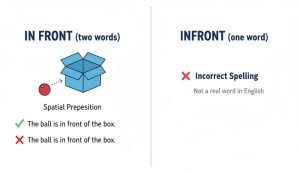
“In front” is a prepositional phrase that indicates the position of something or someone being ahead of or before someone or something else. It specifies spatial relationships, indicating that one object or person is situated nearer to the observer or point of reference than another.
The phrase consists of the preposition “in” and the noun “front,” functioning together as a single unit to express location or position.
It’s worth noting that “in front” functions as a prepositional phrase, where “in” is the preposition and “front” is its object. This confirms that questions like “is in front a preposition?” are slightly misleading—while “in front” contains a preposition, the phrase itself is a prepositional unit rather than a single preposition.
The key characteristic of “in front” is that it always involves a comparison of positions along a line of sight or direction. It implies a sense of being ahead, either literally in physical space or figuratively in terms of order or sequence.
For example, “The car is in front of the house” means the car is positioned closer to the observer than the house. Similarly, “She is in front of me in line” means she is ahead of me in a queue. It is essential to note that “in front” is written as two separate words.
A simple way to remember the difference is that “in front” is always two words, functioning as a prepositional phrase. Questions such as “is it infront or in front?” or “infront vs in front” reflect common confusion among learners. Remember: if you are describing position, order, or sequence, always use the two-word version. “In front” is never written as a single word, and “in front” also answers queries like “is in front one word?”—it is not.
The single-word form, “infront,” is generally considered incorrect and should be avoided in formal writing and speech.
Structural Breakdown
The phrase “in front” comprises two distinct components, each contributing to its overall meaning and function:
- “In”: This is a preposition that typically indicates location or containment. In the context of “in front,” it acts as a preposition of place, establishing a spatial relationship.
- “Front”: This is a noun referring to the forward part or surface of something. It serves as the object of the preposition “in,” specifying the area or direction to which the preposition relates.
The combination of “in” and “front” creates a prepositional phrase that modifies a noun or pronoun, providing information about its location relative to something else. The structure follows a standard prepositional phrase pattern: preposition + noun.
Understanding the individual roles of “in” and “front” helps to clarify why the phrase is written as two separate words. “Front” functions as a noun, and “in” specifies the relationship to that noun.
Combining them into a single word, “infront,” disrupts this grammatical structure and obscures the intended meaning.
Types and Categories of Usage
“In front” is primarily used to indicate spatial relationships, but it can also extend to other contexts, such as order or sequence. Here are the main categories of usage:
Spatial Position
This is the most common usage of “in front,” referring to the physical location of something relative to another object or person. It indicates that one thing is closer to the observer than another.
Order or Sequence
“In front” can also denote position in a line, queue, or series. This usage implies a sequential arrangement where one item precedes another.
Figurative Usage
In some cases, “in front” can be used figuratively to express being ahead in terms of progress, achievement, or visibility. This usage extends the spatial concept to abstract ideas.
Examples of “In Front” in Use
To illustrate the various uses of “in front,” here are several examples categorized by type:
Spatial Position Examples
The following table shows examples of “in front” used to describe spatial positions. Notice how it indicates the relative locations of objects or people.
| Sentence | Explanation |
|---|---|
| The car is parked in front of the garage. | The car is positioned between the observer and the garage. |
| The tree stands in front of the house. | The tree is located closer to the viewer than the house. |
| She sat in front of me at the movie theater. | Her seat was closer to the screen than mine. |
| The podium was placed in front of the audience. | The podium was positioned so the speaker faced the audience. |
| There’s a small garden in front of their office building. | The garden is situated between the entrance and the street. |
| The statue was erected in front of the museum. | The statue’s location is between the viewer and the museum entrance. |
| The restaurant is located in front of the shopping mall. | The restaurant’s position is closer to the street than the mall. |
| He stood in front of the mirror, adjusting his tie. | He was positioned so that he could see his reflection. |
| The protesters gathered in front of the government building. | The building was their focal point, with protesters located closer. |
| The security guard stood in front of the door. | The guard’s position was between the door and anyone approaching it. |
| The children lined up in front of the school bus. | They formed a line positioned before the bus. |
| A large oak tree grows in front of the historic church. | The tree’s location is between the viewer and the church. |
| The construction crew parked their trucks in front of the site. | The trucks are positioned between the site and the road. |
| The banner was hung in front of the stage. | The banner’s location was between the audience and the stage. |
| The family posed for a photo in front of the Eiffel Tower. | Their position was between the photographer and the Eiffel Tower. |
| The cyclist stopped in front of the red light. | The cyclist’s location was between the viewer and the traffic light. |
| The dog sat patiently in front of the treat jar. | The dog’s position was between the viewer and the jar. |
| The artist set up his easel in front of the landscape. | The easel’s location was between the artist and the landscape. |
| The bride and groom stood in front of the altar. | Their position was between the congregation and the altar. |
| The detective stood in front of the suspect, questioning him. | The detective’s location was between the viewer and the suspect. |
Order or Sequence Examples
This table provides examples of “in front” used to denote order or sequence, indicating a position in a line or queue.
| Sentence | Explanation |
|---|---|
| She is in front of me in the ticket line. | She is ahead of me in the queue for tickets. |
| The letter ‘A’ comes in front of ‘B’ in the alphabet. | ‘A’ precedes ‘B’ in alphabetical order. |
| He finished in front of the other runners in the race. | He crossed the finish line before the other runners. |
| The speaker before me covered some of my points. | The previous speaker presented before I did. |
| In this recipe, add the dry ingredients in front of the wet ones. | Add the dry ingredients before adding the wet ingredients. |
| She ranked in front of all her classmates on the exam. | Her score was higher than that of all her classmates. |
| The movie sequel is set to be released in front of the original on DVD. | The sequel will be available on DVD before the original movie. |
| He placed the appetizers in front of the main course on the buffet table. | The appetizers came first in the buffet line. |
| In the race to develop new technologies, our company is in front of the competition. | Our company is leading the competition. |
| In the list of priorities, securing funding comes in front of starting production. | Securing funding is the first priority. |
| She always arrives in front of everyone else for meetings. | She is the first to arrive. |
| The first chapter of the book comes in front of the second chapter. | The first chapter precedes the second. |
| In the historical timeline, the Roman Empire comes in front of the Byzantine Empire. | The Roman Empire existed earlier than the Byzantine Empire. |
| The opening act will perform in front of the headliner. | The opening act will perform before the main performer. |
| In the queue, the elderly woman was in front of the young family. | The elderly woman was positioned earlier in the queue. |
| In the list of candidates, his name appeared in front of hers. | His name was listed before hers. |
| The preface is placed in front of the main content in academic books. | The preface comes at the beginning of the book. |
| The introduction comes in front of the body paragraphs in an essay. | The introduction is the initial part of an essay. |
| In the lineup, the tallest player stood in front of the shortest player. | The tallest player was positioned at the beginning of the line. |
| The first course is served in front of the second course at formal dinners. | The first course is served before the second course. |
Figurative Usage Examples
The following table illustrates the figurative usage of “in front,” where it expresses being ahead in terms of progress or visibility.
| Sentence | Explanation |
|---|---|
| She is always in front when it comes to new ideas. | She consistently generates innovative concepts. |
| The company is in front of the competition in terms of innovation. | The company leads its competitors in innovative advancements. |
| He put his family in front of his career. | He prioritized his family over his professional pursuits. |
| The politician wanted to put the country’s interests in front of his own. | The politician aimed to prioritize national interests. |
| The athlete put in the extra training to stay in front. | The athlete worked hard to maintain his leading position. |
| She always keeps the customer’s needs in front of everything else. | She prioritizes customer satisfaction above all other considerations. |
| The organization put the needs of the community in front of profits. | They prioritized community welfare. |
| The team’s strategy is to stay in front of the game by anticipating their opponents’ moves. | The team plans to remain ahead. |
| The artist strives to stay in front of the curve by experimenting with new techniques. | The artist aims to be innovative and cutting-edge. |
| The company put safety in front of efficiency in their manufacturing process. | Safety was their top priority. |
| The teacher put the students’ well-being in front of academic performance. | The teacher prioritized student well-being. |
| The organization put environmental protection in front of short-term economic gains. | They prioritized environmental preservation. |
| The government put public health in front of political considerations during the pandemic. | Public health was their primary concern. |
| The charity puts the needs of the homeless in front of administrative costs. | They prioritize helping the homeless. |
| The researcher put ethical considerations in front of scientific advancement. | The researcher prioritized ethics. |
| The writer put authenticity in front of popularity in their work. | The writer prioritized being genuine. |
| The musician put artistic integrity in front of commercial success. | The musician prioritized artistic values. |
| The coach put teamwork in front of individual achievements. | The coach prioritized collaboration. |
| The leader put transparency in front of secrecy in their administration. | The leader prioritized openness. |
| The scientist put accuracy in front of speculation in their research. | The scientist prioritized precision. |
Usage Rules and Guidelines
Using “in front” correctly involves adhering to a few key rules:
- Always use two words: The correct form is always “in front,” with a space between the words. “Infront” is generally considered a misspelling.
- Specify a reference point: “In front” always implies a reference point. Ensure it’s clear what the subject is positioned in front of.
- Consider the context: The meaning of “in front” can vary slightly depending on the context. Pay attention to whether it’s referring to spatial position, order, or a figurative concept.
It’s also important to distinguish “in front” from similar phrases like “before” or “ahead.” While these words can sometimes be used interchangeably, they often have slightly different nuances. “Before” can refer to time as well as position, while “ahead” often implies movement or progress.
Common Mistakes: “In Front” vs. “Infront”
The most common mistake is writing “in front” as one word: “infront.” This error is frequently seen in informal writing and speech, but it should be avoided in formal contexts.
Here are some examples of correct and incorrect usage:
| Incorrect | Correct | Explanation |
|---|---|---|
| The car is infront of the house. | The car is in front of the house. | “In front” should be two separate words. |
| She stood infront of the class. | She stood in front of the class. | “In front” is a prepositional phrase, not a single word. |
| He placed the chair infront of the desk. | He placed the chair in front of the desk. | Remember to keep “in” and “front” as distinct words. |
Another common mistake is using “in front” without a clear reference point. For example, saying “The book is in front” is ambiguous.
It’s necessary to specify what the book is in front of, such as “The book is in front of the laptop.”
Understanding “Infront”: Meaning and Status
Many learners often wonder about the meaning of “infront” and whether it is an acceptable word in English. In reality, “infront” has no independent meaning separate from “in front.” It is simply a common misspelling or typographical error that occurs when writing quickly or informally. Unlike established prepositions or phrases, “infront” does not appear in reputable dictionaries and is not recognized in formal grammar.
Using “infront” in essays, reports, or professional communication can create confusion, as readers may pause to interpret it. Always replace “infront” with the correct two-word form, “in front,” to maintain clarity. Remember, while it may be seen in casual messages, social media posts, or informal notes, it is never standard English.
Practice Exercises
Test your understanding of “in front” with these practice exercises. Choose the correct phrase (“in front” or “infront”) to complete each sentence.
Exercise 1: Choose the Correct Phrase
| Question | Answer |
|---|---|
| 1. The grocery store is ______ of the bank. | in front |
| 2. She parked her bicycle ______ of the library. | in front |
| 3. The children lined up ______ of the movie theater. | in front |
| 4. He always sits ______ of me in class. | in front |
| 5. The flowers were arranged ______ of the painting. | in front |
| 6. The podium was placed ______ of the audience for the speech. | in front |
| 7. A tall tree grows ______ of their house, providing shade. | in front |
| 8. The statue was erected ______ of the town hall to honor the war heroes. | in front |
| 9. The protesters gathered ______ of the parliament building to voice their concerns. | in front |
| 10. The security guard stood ______ of the museum’s entrance to control access. | in front |
Exercise 2: Fill in the Blanks
Fill in the blanks with the correct prepositional phrase (“in front of”).
| Question | Answer |
|---|---|
| 1. The teacher stood ______ the students. | in front of |
| 2. The cat sat ______ the fireplace, enjoying the warmth. | in front of |
| 3. The restaurant is located ______ the post office. | in front of |
| 4. The band played ______ a large crowd. | in front of |
| 5. The child hid ______ his mother. | in front of |
| 6. The speaker paused ______ the microphone before beginning. | in front of |
| 7. The artist positioned the model ______ the canvas. | in front of |
| 8. The lifeguard sat ______ the pool, watching the swimmers. | in front of |
| 9. The gardener planted the flowers ______ the fence. | in front of |
| 10. The tourists posed ______ the famous landmark. | in front of |
Exercise 3: Correct the Errors
Identify and correct the errors in the following sentences.
| Incorrect Sentence | Corrected Sentence |
|---|---|
| 1. The stage was infront. | The stage was in front. |
| 2. The dog sat infront of the door. | The dog sat in front of the door. |
| 3. She is infront of me in the line. | She is in front of me in the line. |
| 4. The flag waved infront of the building. | The flag waved in front of the building. |
| 5. The podium was placed infront of the audience. | The podium was placed in front of the audience. |
| 6. The restaurant is located infront of the train station. | The restaurant is located in front of the train station. |
| 7. The children were playing infront of the fountain. | The children were playing in front of the fountain. |
| 8. The couple stood infront of the altar during the wedding. | The couple stood in front of the altar during the wedding. |
| 9. The painter set up his easel infront of the landscape. | The painter set up his easel in front of the landscape. |
| 10. The security guard stood infront of the entrance. | The security guard stood in front of the entrance. |
Advanced Topics
For advanced learners, it’s useful to consider the nuances of “in front” in more complex sentences and idiomatic expressions. For example, “in front of one’s eyes” is an idiom meaning “in plain sight” or “while someone is watching.” Understanding these idiomatic uses requires a deeper familiarity with English vocabulary and cultural context.
Another advanced topic is the use of “in front” in formal writing. While it’s generally acceptable in most contexts, there may be situations where a more precise or sophisticated prepositional phrase is preferred.
For example, instead of saying “The report is in front of you,” you might say “The report is before you” or “The report is presented for your consideration.”
Frequently Asked Questions (FAQ)
Here are some frequently asked questions about “in front” and “infront”:
- Is “infront” ever correct?
No, “infront” is generally considered a misspelling of “in front.” It should be avoided in formal writing and speech. - What is the difference between “in front” and “before”?
While both can indicate position, “before” can also refer to time. “In front” primarily refers to spatial position or order in a line. For example, “I’ve seen this movie before” refers to time, whereas “The car is in front of the house” refers to location. - Can “in front” be used figuratively?
Yes, “in front” can be used figuratively to mean “prioritizing” or “giving precedence to.” For example, “He put his family in front of his career.” - What part of speech is “in front”?
“In front” is a prepositional phrase. It consists of the preposition “in” and the noun “front,” functioning together to modify another word or phrase. - How do I remember to write “in front” as two words?
Think of “front” as a noun referring to the forward part of something. The preposition “in” specifies the relationship to that noun. Separating the words helps to maintain this grammatical structure. - Is it ever correct to use a hyphen with “in front”? For example, “in-front”?
No, it is generally not correct to use a hyphen with “in front,” creating “in-front.” The correct form is always two separate words. Hyphenation is typically employed to combine words into a single adjective before a noun, but “in front” functions as a prepositional phrase, not a compound adjective. - Are there regional differences in the usage of “in front”?
While the correct spelling and usage of “in front” are consistent across different English-speaking regions, there may be slight variations in colloquial speech. However, for formal writing and standard English, “in front” is universally accepted. - What are some alternatives to using “in front”?
Depending on the context, you can use alternatives such as “ahead of,” “before,” “facing,” “at the head of,” or “preceding.” The best alternative will depend on the specific nuance you want to convey. For example, instead of “The leader stood in front of the crowd,” you could say “The leader stood at the head of the crowd.”
Conclusion
Mastering the correct usage of “in front” is essential for clear and precise communication in English. Remember that “in front” is a prepositional phrase consisting of two separate words, while “infront” is generally considered a misspelling.
By understanding the structural breakdown, usage rules, and common mistakes associated with this phrase, you can confidently and accurately express spatial relationships, order, and even figurative concepts in your writing and speech.
Continue practicing with the exercises provided and pay attention to how “in front” is used in various contexts. With consistent effort, you’ll avoid the common pitfall of “infront” and enhance your overall command of English grammar.
Remember, clear and accurate communication is the key to success in both personal and professional settings.