Understanding the difference between “open” and “opened” is crucial for effective communication in English. These words, though closely related, serve distinct grammatical functions.
Misusing them can lead to confusion and grammatical errors. This article provides a comprehensive guide to the correct usage of “open” and “opened,” covering their definitions, structural roles, usage rules, and common mistakes.
Whether you’re a beginner or an advanced learner, this detailed exploration will help you master these tricky words and enhance your overall command of the English language.
This guide will benefit English language learners, students preparing for exams, and anyone looking to refine their writing and speaking skills. By the end of this article, you will clearly understand the nuances between “open” and “opened” and confidently use them in your daily communication.
Table of Contents
- Introduction
- Definition of Open and Opened
- Structural Breakdown
- Types and Categories
- Examples of Open and Opened
- Usage Rules
- Common Mistakes
- Practice Exercises
- Advanced Topics
- FAQ
- Conclusion
Definition of Open and Opened
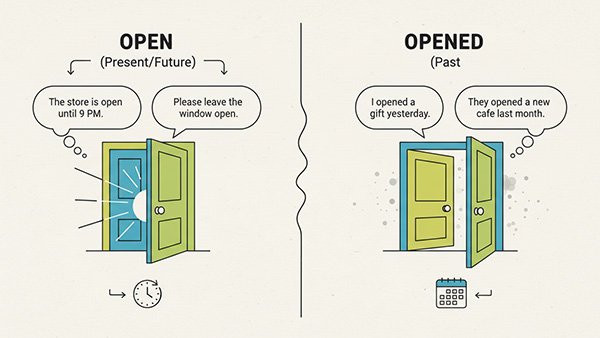
To effectively differentiate between “open” and “opened,” we must first understand their individual definitions and grammatical roles within a sentence. When learners ask about the open or open meaning distinction, they are often trying to identify whether the word describes a state or an action.
In simple terms, “open” describes a condition or general action, while opened emphasizes that the action has already taken place. This difference becomes clearer when comparing open vs opened meaning in context:
“The door is open” focuses on its current state, whereas The door was opened highlights the completed act that caused that state. Each word carries distinct meanings and functions, dictating when and how they should be used.
Definition of Open
“Open” can function as an adjective, a verb, or even a noun, each with its specific meaning. As an adjective, “open” describes something that is not closed, locked, or obstructed.
It can also mean receptive to new ideas or willing to share information. As a verb, “open” means to make something accessible or to begin something.
As a noun, it can refer to an open space or an event that is accessible to the public.
Definition of Opened
“Opened” is the past tense and past participle form of the verb “open.” It indicates that the action of opening has already occurred. Therefore, “opened” is primarily used in past tense sentences or in perfect tenses (e.g., “has opened,” “had opened”).
It signifies a completed action of making something accessible or starting an event.
Structural Breakdown
The structural roles of “open” and “opened” within a sentence dictate their grammatical functions. Understanding these roles helps in constructing grammatically correct sentences.
Structure of Open
When “open” functions as an adjective, it typically precedes the noun it modifies. For example, “an open door” or “an open mind.”
Learners are often unsure whether to write an open or an opened noun phrase. The choice depends on whether “open” functions as an adjective or “opened” acts as a past participle modifying the noun. For example, “an open door” describes a condition, while “a newly opened door” highlights the action that occurred.
Similarly, questions about open or opens grammatically arise in present tense usage, where “open” changes to “opens” only in the third-person singular, such as “She opens the shop every morning.”
When used as a verb, “open” is the base form, used in the present tense (except for the third-person singular, which uses “opens”) or with modal verbs like “will,” “can,” or “should.” As a noun, it functions as a subject or object in a sentence, like “the open” in a golf tournament.
Structure of Opened
“Opened” appears in sentences that describe completed actions. It follows auxiliary verbs such as “have,” “has,” “had,” “was,” or “were” to form perfect tenses or passive voice constructions. For example, “The store has opened” (present perfect) or “The package was opened” (passive voice). It can also stand alone as the simple past tense of the verb “open,” such as “She opened the window.”
Types and Categories
The words “open” and “opened” can be categorized based on their grammatical function, which influences their usage in various contexts.
Types of Open
- Adjective: Describing a state of being not closed or accessible (e.g., open window, open arms).
- Verb: Indicating the action of making something accessible (e.g., Please open the door).
- Noun: Referring to an open space or competitive event (e.g., the open sea, a golf open).
Types of Opened
- Past Tense Verb: Indicating a completed action in the past (e.g., He opened the book).
- Past Participle: Used in perfect tenses (e.g., She has opened the gift) and passive voice (e.g., The letter was opened).
Examples of Open and Opened
Concrete examples are essential for grasping the correct usage of “open” and “opened.” The following tables provide numerous examples across different contexts.
Examples of Open
The following table showcases various uses of “open” as an adjective, verb, and noun, providing clear context for each grammatical role.
| Category | Example Sentence | Explanation |
|---|---|---|
| Adjective | The store has an open door policy. | Describes the policy as accessible. |
| Adjective | She has an open mind when it comes to new ideas. | Describes her as receptive to new ideas. |
| Adjective | The park is open to the public until sunset. | Describes the park as accessible. |
| Adjective | Keep an open dialogue with your team members. | Suggests maintaining accessible communication. |
| Adjective | The gallery has an open call for artists. | Describes the call as accessible to all artists. |
| Verb | Please open the window; it’s stuffy in here. | Imperative verb asking someone to make the window accessible. |
| Verb | They open their business every day at 9 AM. | Describes the regular action of starting their business. |
| Verb | We will open the meeting with a brief introduction. | Describes the action of starting the meeting. |
| Verb | The CEO plans to open a new branch next year. | Describes the future action of starting a new branch. |
| Verb | Let’s open our hearts to those in need. | Figurative verb suggesting compassion and generosity. |
| Noun | He enjoys playing golf in the open. | Refers to an open space. |
| Noun | She won the US Open last year. | Refers to a specific sports tournament. |
| Noun | They discussed the issue out in the open. | Means publicly or frankly. |
| Noun | The company held an open house for potential investors. | An event that is accessible to the public. |
| Noun | There’s plenty of open land for development. | Refers to unoccupied or undeveloped land. |
| Adjective | The detective kept an open mind during the investigation. | Describes the detective’s willingness to consider all possibilities. |
| Verb | Can you open the jar for me? | A request to make the jar accessible. |
| Verb | The flower will open in the morning. | Describes the natural process of the flower becoming accessible. |
| Noun | The discussion was conducted in the open, with everyone present. | Indicates that the discussion was held publicly and transparently. |
| Adjective | The open sea stretched out before them. | Describes a sea that is not enclosed or obstructed. |
Examples of Opened
This table provides examples of “opened” used in the past tense, present perfect, and passive voice, illustrating its role in describing completed actions.
| Tense/Voice | Example Sentence | Explanation |
|---|---|---|
| Past Tense | She opened the door and walked inside. | Simple past tense, indicating a completed action. |
| Past Tense | The company opened a new office in Tokyo last year. | Describes a past action of opening an office. |
| Past Tense | He opened his heart to her and shared his feelings. | Figurative use indicating a past action of sharing emotions. |
| Past Tense | The concert opened with a lively performance. | Describes the beginning of the concert. |
| Past Tense | They opened the package with great anticipation. | Describes a past action of opening a package. |
| Present Perfect | The bank has opened a new account for me. | Present perfect tense, indicating a completed action with present relevance. |
| Present Perfect | The museum has opened a new exhibit on ancient Egypt. | Describes a recently completed action with ongoing relevance. |
| Present Perfect | She has opened many doors for young entrepreneurs. | Figurative use indicating past actions that have had a lasting impact. |
| Present Perfect | The store has just opened for the day. | Indicates a recently completed action. |
| Present Perfect | He has opened up about his struggles in therapy. | Indicates a completed action of sharing personal information. |
| Passive Voice | The letter was opened by the secretary. | Passive voice, indicating that the action was performed on the subject. |
| Passive Voice | The new hospital was opened by the mayor. | Describes an action performed on the hospital. |
| Passive Voice | The debate was opened with a statement from the moderator. | Describes how the debate was started. |
| Passive Voice | The investigation was opened after the incident. | Describes when the investigation began. |
| Passive Voice | The floodgates were opened to relieve pressure on the dam. | Describes an action taken to alleviate pressure. |
| Past Perfect | By the time we arrived, the show had already opened. | Indicates an action completed before another point in the past. |
| Past Tense | The chef opened a new restaurant downtown. | Describes a past action of starting a new business. |
| Past Tense | The curtains opened to reveal the stage. | Describes the unveiling of the stage. |
| Present Perfect | The company has opened its doors to new investors. | Indicates a current state resulting from a past action. |
| Passive Voice | The bridge was officially opened to traffic. | Describes the action of making the bridge accessible to traffic. |
This table provides additional examples for better understanding.
| Category | Example Sentence | Explanation |
|---|---|---|
| Past Tense | The store opened early for the Black Friday sale. | Describes a specific event in the past. |
| Present Perfect | Our minds have been opened to new possibilities. | Indicates a change in perspective resulting from a past experience. |
| Passive Voice | The investigation was opened following the discovery of new evidence. | Describes the initiation of an investigation. |
| Past Tense | He carefully opened the antique box. | Describes an action performed with care. |
| Present Perfect | She has opened her own business after years of planning. | Indicates the culmination of planning into a completed action. |
| Past Tense | The book opened with a captivating prologue. | Describes the beginning of the book. |
| Present Perfect | The company has opened up new avenues for growth. | Indicates the creation of new opportunities. |
| Passive Voice | The event was officially opened by the mayor’s speech. | Describes the formal commencement of the event. |
| Past Tense | The door opened automatically as I approached. | Describes the action of the door without a specific actor. |
| Present Perfect | The new policy has opened doors for more inclusive hiring practices. | Indicates the creation of opportunities for more inclusive practices. |
Usage Rules
Understanding the rules governing the use of “open” and “opened” is crucial for avoiding grammatical errors.
Rules for Using Open
- Use “open” as an adjective to describe something that is not closed or obstructed: “The open window let in fresh air.”
- Use “open” as a verb in the present tense to indicate the action of making something accessible: “I open the door every morning.”
- Use “open” as a noun to refer to an open space or a public event: “He enjoys playing golf in the open.”
- Remember that “open” does not change form in the present tense except for the third-person singular (“opens”).
Rules for Using Opened
- Use “opened” as the past tense form of the verb “open” to describe a completed action in the past: “She opened the letter yesterday.”
- Use “opened” as the past participle form in perfect tenses (present perfect, past perfect, future perfect): “The store has opened for business,” “The package had been opened before I received it.”
- Use “opened” in passive voice constructions to indicate that the action was performed on the subject: “The vault was opened by a professional.”
Open vs. Opened in State and Action Sentences
The contrast between open opened often becomes confusing when sentences describe results rather than actions. This confusion is especially common in structures like was opened or was open. Although both may refer to the same object, they express different grammatical ideas.
“Was open” describes a state or condition. For example, “The shop was open all night” tells us about its status during a specific period. In contrast, “was opened” focuses on the action performed on the subject, as in “The shop was opened by the manager at dawn.” Here, the emphasis is not on how long the shop remained accessible, but on the act that made it accessible.
Choosing between these forms depends on what the speaker wants to highlight. If the result or condition matters, “open” is usually correct. If the event or action itself is important, “opened” is the better choice. Recognizing this distinction helps avoid tense-related errors and improves clarity in both spoken and written English.
Common Mistakes
One of the most common mistakes is using “open” instead of “opened” when referring to a past action. Conversely, using “opened” when the present tense or adjectival form is required is also a frequent error.
| Incorrect | Correct | Explanation |
|---|---|---|
| She open the door. | She opened the door. | “Opened” is the correct past tense form. |
| The door is opened. | The door is open. | “Open” is the correct adjective here. |
| They have open the store. | They have opened the store. | “Opened” is the correct past participle form. |
| Please opened the window. | Please open the window. | “Open” is the correct base form of the verb in this context. |
| The gift was open by her. | The gift was opened by her. | “Opened” is the correct past participle form in the passive voice. |
Practice Exercises
These exercises will help you reinforce your understanding of “open” and “opened.”
Exercise 1
Fill in the blanks with the correct form of “open” or “opened.”
| Question | Answer |
|---|---|
| 1. The shop will _____ at 9 AM tomorrow. | open |
| 2. She _____ the letter as soon as she received it. | opened |
| 3. The door is always _____ to new opportunities. | open |
| 4. They have _____ a new branch in London. | opened |
| 5. Please _____ your books to page 25. | open |
| 6. The museum _____ its doors to the public last year. | opened |
| 7. He has an _____ mind about the issue. | open |
| 8. The box was _____ with a key. | opened |
| 9. They plan to _____ a new business next month. | open |
| 10. The gate is _____ during the day. | open |
Exercise 2
Choose the correct word (open or opened) in each sentence.
| Question | Answer |
|---|---|
| 1. The store is (open/opened) until 9 PM. | open |
| 2. She (open/opened) the bottle of wine. | opened |
| 3. The package has been (open/opened). | opened |
| 4. Can you (open/opened) the window, please? | open |
| 5. The exhibition (open/opened) last week. | opened |
| 6. He always tries to keep an (open/opened) mind. | open |
| 7. The letter was (open/opened) by mistake. | opened |
| 8. They will (open/opened) the ceremony with a speech. | open |
| 9. The door (open/opened) automatically. | opened |
| 10. The possibilities are (open/opened) to him. | open |
Advanced Topics
For advanced learners, it’s beneficial to understand the nuances of “open” and “opened” in more complex sentence structures and idiomatic expressions.
Consider the use of “open” in idiomatic expressions like “open to interpretation,” meaning something can be understood in multiple ways, or “out in the open,” meaning publicly or frankly. Similarly, “opened” can be part of phrases like “opened up,” meaning to become more communicative or revealing of one’s feelings.
Additionally, advanced learners can explore the historical evolution of these words and their usage in literature and formal writing. Understanding these advanced concepts can enhance one’s appreciation and mastery of the English language.
FAQ
Here are some frequently asked questions about the usage of “open” and “opened.”
When should I use “open” as an adjective versus “opened”?
Use “open” as an adjective to describe the current state of something (e.g., “The door is open”). Use “opened” as an adjective (though less common) when you want to emphasize the action of opening that led to the current state (e.g., “The newly opened store”).
Can “open” be used in the past tense?
No, “open” is the base form of the verb. The past tense form is “opened” (e.g., “She opened the window”).
How do I know when to use “opened” in the passive voice?
Use “opened” in the passive voice when the subject of the sentence receives the action of opening (e.g., “The letter was opened by the secretary”). In passive constructions, the focus is on the object acted upon, rather than the actor.
What’s the difference between “open” and “opening”?
“Open” is the base form of the verb and can also be an adjective or a noun. “Opening” is the present participle or gerund form of the verb. It can be used in continuous tenses (e.g., “She is opening the door”) or as a noun (e.g., “The opening of the store was a success”).
Is it correct to say “The store is opening soon” or “The store will open soon”?
Both are correct, but they have slightly different connotations. “The store is opening soon” suggests that preparations are underway and the opening is imminent. “The store will open soon” is a more general statement about a future event.
When can “open” be used as a noun?
“Open” can be used as a noun to refer to an open space (e.g., “He likes to hike in the open”) or to a specific type of sporting event (e.g., “the U.S. Open”).
Can “open” be used figuratively?
Yes, “open” can be used figuratively to describe a state of mind or attitude (e.g., “She has an open mind”). “Opened” can also be used figuratively to describe emotional revelation (e.g., “He opened up about his past”).
What is the difference in meaning between “open up” and “opened up”?
“Open up” is a phrasal verb meaning to become more communicative or revealing (e.g., “He needs to open up about his feelings”). “Opened up” is the past tense of this phrasal verb (e.g., “She opened up about her childhood trauma”).
Conclusion
Mastering the distinction between “open” and “opened” is essential for clear and accurate communication in English. While these words are closely related, their grammatical roles and usage contexts differ significantly.
“Open” functions as an adjective, verb, or noun, describing a state of being not closed, an action of making accessible, or an open space, respectively. “Opened,” on the other hand, is the past tense and past participle form of the verb “open,” indicating a completed action.
By understanding the structural rules, types, and examples provided in this article, you can confidently use “open” and “opened” in various contexts. Remember to pay attention to the tense and voice of the sentence, and be mindful of common mistakes.
Consistent practice and careful attention to detail will solidify your understanding and improve your overall command of the English language.
Continue to practice with different examples and exercises to reinforce your learning. With dedication and attention to the nuances of these words, you’ll enhance your writing and speaking skills, ensuring clarity and precision in your communication.