Understanding the nuances of language involves not just knowing what words mean, but also grasping their opposites. The concept of frustration, a common human experience, has a wide array of antonyms that reflect different states of mind and being.
This article delves into the various antonyms of “frustrated,” exploring their meanings, contexts, and proper usage. Whether you’re an English language learner, a writer seeking precision, or simply curious about expanding your vocabulary, this guide offers a comprehensive look at the positive alternatives to frustration.
Table of Contents
- Introduction
- Defining Frustration and Its Antonyms
- Structural Breakdown of Antonyms
- Types and Categories of Antonyms
- Examples of Antonyms in Use
- Usage Rules and Considerations
- Common Mistakes to Avoid
- Practice Exercises
- Advanced Topics: Nuances and Context
- Frequently Asked Questions
- Conclusion
Introduction
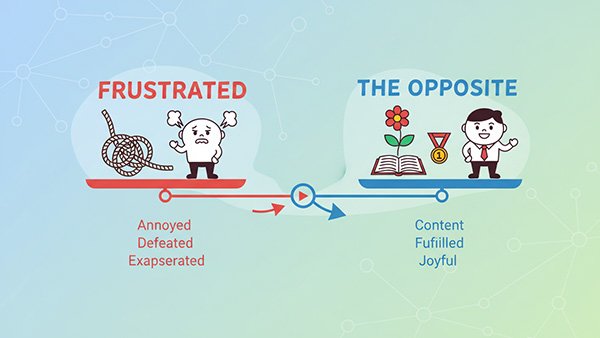
The English language is rich with synonyms and antonyms, allowing for precise expression and a deep understanding of concepts. When we feel frustrated, we experience a sense of irritation, disappointment, and helplessness, often stemming from being unable to achieve a goal or fulfill a desire.
The antonyms of “frustrated,” however, represent a spectrum of positive emotions and states that counter this negative feeling. Understanding these antonyms not only enriches our vocabulary but also provides us with a more nuanced way to describe our experiences and emotions.
This article aims to explore these antonyms in detail, providing definitions, examples, and practical guidance on their usage, making it a valuable resource for anyone looking to improve their communication skills.
In simple terms, the opposite of frustration encompasses emotions and states such as contentment, satisfaction, calmness, and relief. Whenever we are free from obstacles or have achieved a desired outcome, these feelings naturally arise, providing a positive counterbalance to frustration.
Defining Frustration and Its Antonyms
Frustration is the feeling of being upset or annoyed as a result of being unable to change or achieve something. It often arises when there’s a perceived obstacle preventing us from reaching our goals. This feeling can range from mild irritation to intense anger and disappointment. The antonyms of “frustrated” represent the opposite end of this emotional spectrum, encompassing feelings of satisfaction, contentment, and peace. These antonyms are not simply the absence of frustration but rather positive states of being in their own right.
Antonyms, also known as opposites, are words with meanings that are contrary to each other. They play a crucial role in language, enabling us to express contrasting ideas and to understand the full scope of a word’s meaning.
In the case of “frustrated,” the antonyms offer a variety of ways to describe the absence of this negative emotion, each with its own unique connotation and context. Understanding these nuances allows for more precise and effective communication.
Structural Breakdown of Antonyms
Antonyms can be categorized based on their relationship to the original word. Here are a few types:
- Complementary Antonyms: These are pairs where the presence of one implies the absence of the other. For example, alive/dead. One MUST be true.
- Graded Antonyms: These represent points on a scale. Hot/cold, easy/difficult. There are degrees in between.
- Relational Antonyms: These are pairs where one word implies the other. Teacher/student, doctor/patient.
When considering the antonyms of “frustrated,” many fall into the category of graded antonyms, representing different degrees of positive emotional states. For example, “content” and “ecstatic” are both antonyms of “frustrated,” but they represent different levels of satisfaction.
Others, like “calm,” might represent a more neutral state that simply lacks the agitation associated with frustration.
Types and Categories of Antonyms
The opposite of “frustrated” can manifest in various ways, each representing a distinct emotional or situational state. Here are some key categories and examples:
Contentment
Contentment is a state of happiness and satisfaction. It implies a sense of ease and acceptance with one’s current situation. It’s not necessarily about achieving great success, but rather about appreciating what one already has.
Satisfaction
Satisfaction is the feeling of pleasure that comes from achieving a goal or fulfilling a need or desire. It’s often linked to a specific accomplishment or experience.
Fulfillment
Fulfillment is a sense of completeness and satisfaction with one’s life. It goes beyond simple satisfaction and suggests a deeper sense of purpose and meaning.
Calmness
Calmness is a state of tranquility and peace. It implies the absence of agitation, stress, or anxiety. It’s a neutral state that contrasts sharply with the heightened emotional state of frustration.
Patience
Patience is the ability to tolerate delays, problems, or suffering without becoming annoyed or anxious. It’s a key attribute in overcoming potential sources of frustration.
Ease
Ease refers to a state of comfort and lack of difficulty. When things are easy, there is less potential for frustration to arise.
Success
Success is the achievement of a desired outcome. When we succeed in our endeavors, we naturally avoid the frustration that comes with failure.
Relief
Relief is the feeling of reassurance and relaxation following the removal of stress or anxiety. It’s often experienced after successfully overcoming a challenge that was causing frustration.
Happiness
Happiness is a general state of well-being and pleasure. While it’s a broad term, it certainly encompasses the absence of frustration and the presence of positive emotions.
Peace
Peace is a state of tranquility and harmony. It can refer to inner peace (a sense of calm and contentment) or external peace (the absence of conflict and disturbance).
Examples of Antonyms in Use
The following tables provide examples of how these antonyms can be used in sentences to express the opposite of frustration. Each table focuses on a specific category of antonyms, illustrating the subtle differences in their meaning and usage.
The table below illustrates the use of “contentment” and its related forms as antonyms of “frustrated.” Notice how the sentences emphasize satisfaction with the current situation.
| Sentence | Explanation |
|---|---|
| Despite the challenges, she felt a deep sense of contentment with her life. | Highlights an overall satisfaction despite difficulties. |
| He was content to spend his evening reading a book by the fire. | Indicates a peaceful and satisfied state. |
| The artist found contentment in the simple act of creating. | Focuses on the joy derived from a specific activity. |
| After years of searching, she finally found contentment in her small town. | Shows a resolution of previous dissatisfaction. |
| He was content with his modest salary, as long as he enjoyed his work. | Demonstrates prioritizing job satisfaction over monetary gain. |
| She felt a surge of contentment wash over her as she watched the sunset. | Describes a moment of profound peace and satisfaction. |
| The old man was content with his simple life, surrounded by his family. | Emphasizes the importance of relationships for contentment. |
| Finding contentment in the present moment is a key to happiness. | Suggests a philosophical approach to finding contentment. |
| She realized that true contentment came from within, not from external possessions. | Highlights that contentment is an internal feeling. |
| He was content knowing he had done his best, regardless of the outcome. | Illustrates contentment with effort rather than results. |
| A sense of contentment settled over the room as the family gathered for the holidays. | Describes a shared feeling of peace and satisfaction. |
| She strived to live a life of contentment, free from unnecessary desires. | Focuses on minimizing desires to achieve contentment. |
| Even though he faced setbacks, he remained content with his progress. | Highlights an overall satisfaction despite difficulties. |
| She cultivated contentment by practicing gratitude every day. | Indicates a peaceful and satisfied state. |
| The writer found contentment in crafting stories that resonated with readers. | Focuses on the joy derived from a specific activity. |
| After a long journey, they finally found contentment in their new home. | Shows a resolution of previous dissatisfaction. |
| He was content with his simple meal, savoring each bite. | Demonstrates prioritizing job satisfaction over monetary gain. |
| She felt a deep sense of contentment listening to the birds sing in the morning. | Describes a moment of profound peace and satisfaction. |
| The child was content playing quietly by himself for hours. | Emphasizes the importance of relationships for contentment. |
| Finding contentment in the small joys of life is a valuable skill. | Suggests a philosophical approach to finding contentment. |
| She realized that true contentment was a state of mind, not a destination. | Highlights that contentment is an internal feeling. |
| He was content knowing he had made a positive impact on others. | Illustrates contentment with effort rather than results. |
This table focuses on “satisfaction” and its related terms, emphasizing the fulfillment of needs or desires.
| Sentence | Explanation |
|---|---|
| She felt a great sense of satisfaction after completing the project ahead of schedule. | Highlights the pleasure of achieving a specific goal. |
| The customer expressed his satisfaction with the excellent service. | Indicates fulfillment of expectations. |
| He derived satisfaction from helping others in need. | Focuses on the rewarding feeling of altruism. |
| The chef took pride in the satisfaction his food brought to his customers. | Shows the impact of one’s work on others’ happiness. |
| She found satisfaction in her career as a teacher, shaping young minds. | Demonstrates fulfillment through meaningful work. |
| A wave of satisfaction washed over him as he crossed the finish line. | Describes the joy of achieving a long-term goal. |
| The company aimed to ensure complete customer satisfaction. | Emphasizes the importance of meeting customer needs. |
| He expressed his satisfaction with the outcome of the negotiations. | Indicates a positive resolution to a complex situation. |
| Her genuine satisfaction was evident in her radiant smile. | Highlights that satisfaction is an internal feeling. |
| He found satisfaction in knowing he had overcome a difficult challenge. | Illustrates satisfaction with effort rather than results. |
| A sense of satisfaction filled the room as the team celebrated their victory. | Describes a shared feeling of achievement. |
| She strived to live a life of satisfaction, pursuing her passions and goals. | Focuses on following passions to achieve satisfaction. |
| Even though he faced setbacks, he maintained satisfaction with his progress. | Highlights an overall satisfaction despite difficulties. |
| She cultivated satisfaction by acknowledging her accomplishments, no matter how small. | Indicates a peaceful and satisfied state. |
| The musician found satisfaction in creating music that moved people. | Focuses on the joy derived from a specific activity. |
| After a difficult journey, they finally found satisfaction in their new life. | Shows a resolution of previous dissatisfaction. |
| He was satisfied with his simple meal, enjoying the flavors. | Demonstrates prioritizing job satisfaction over monetary gain. |
| She felt a deep sense of satisfaction watching her children thrive. | Describes a moment of profound peace and satisfaction. |
| The child was satisfied playing with his toys for hours. | Emphasizes the importance of relationships for contentment. |
| Finding satisfaction in the small joys of life is a valuable skill. | Suggests a philosophical approach to finding contentment. |
| She realized that true satisfaction was a result of her hard work and dedication. | Highlights that contentment is an internal feeling. |
| He was satisfied knowing he had made a difference in the world. | Illustrates contentment with effort rather than results. |
This table showcases “calmness” and its related terms, indicating a state of tranquility and peace.
| Sentence | Explanation |
|---|---|
| The yoga session helped her find a sense of calmness and inner peace. | Highlights the benefit of relaxation techniques. |
| He remained calm despite the chaotic situation around him. | Indicates an ability to maintain composure. |
| The gentle music brought a feeling of calmness to the room. | Focuses on the effect of environment on mood. |
| She found calmness in nature, away from the stresses of city life. | Shows the benefits of connecting with nature. |
| His calm demeanor helped de-escalate the conflict. | Demonstrates the positive impact of a calm presence. |
| A wave of calmness washed over her as she meditated. | Describes the feeling of relaxation during meditation. |
| The therapist helped him develop strategies for maintaining calmness under pressure. | Emphasizes the importance of coping mechanisms. |
| He expressed his calmness with a slow, deliberate breath. | Indicates a physical manifestation of inner peace. |
| Her genuine calmness was contagious, putting everyone at ease. | Highlights that satisfaction is an internal feeling. |
| He found calmness in knowing he had done everything he could. | Illustrates satisfaction with effort rather than results. |
| A sense of calmness settled over the room as the storm passed. | Describes a shared feeling of relief and peace. |
| She strived to live a life of calmness, avoiding unnecessary drama. | Focuses on minimizing stress to achieve calmness. |
| Even though he faced challenges, he remained calm and collected. | Highlights an overall satisfaction despite difficulties. |
| She cultivated calmness by practicing mindfulness every day. | Indicates a peaceful and satisfied state. |
| The writer found calmness in escaping to his quiet study. | Focuses on the joy derived from a specific activity. |
| After a hectic day, they finally found calmness in their peaceful home. | Shows a resolution of previous dissatisfaction. |
| He was calm while waiting for the test results, trusting in his preparation. | Demonstrates prioritizing job satisfaction over monetary gain. |
| She felt a deep sense of calmness listening to the sounds of the forest. | Describes a moment of profound peace and satisfaction. |
| The child was calm snuggling up with his favorite blanket. | Emphasizes the importance of relationships for contentment. |
| Finding calmness in the present moment is a valuable skill. | Suggests a philosophical approach to finding contentment. |
| She realized that true calmness was a state of mind, not a place. | Highlights that contentment is an internal feeling. |
| He was calm knowing he had made a positive impact on the world. | Illustrates contentment with effort rather than results. |
The table below showcases “success” and related terms, highlighting the achievement of desired outcomes.
| Sentence | Explanation |
|---|---|
| The company celebrated its unprecedented success in the market. | Highlights a significant achievement. |
| He achieved success through hard work and dedication. | Indicates the importance of effort. |
| The project was a success due to the team’s collaboration. | Focuses on the role of teamwork. |
| She defined success as making a positive impact on her community. | Shows a personal definition of achievement. |
| His success story inspired many to pursue their dreams. | Demonstrates the motivational power of achievement. |
| A wave of success washed over him as he received the award. | Describes the feeling of accomplishment. |
| The organization aimed to promote success for all its members. | Emphasizes inclusivity in achievement. |
| His genuine success was evident in his confident demeanor. | Highlights that success is an internal feeling. |
| He found success in knowing he had overcome a difficult challenge. | Illustrates satisfaction with effort rather than results. |
| A sense of success filled the room as the team celebrated their victory. | Describes a shared feeling of achievement. |
| She strived to live a life of success, achieving her goals and dreams. | Focuses on following passions to achieve success. |
| Even though he faced setbacks, he remained successful in his pursuits. | Highlights an overall satisfaction despite difficulties. |
| She cultivated success by setting clear goals and working hard to achieve them. | Indicates a peaceful and satisfied state. |
| The artist found success in creating art that moved people. | Focuses on the joy derived from a specific activity. |
| After a difficult journey, they finally found success in their new venture. | Shows a resolution of previous dissatisfaction. |
| He was successful in his career, reaching new heights. | Demonstrates prioritizing job satisfaction over monetary gain. |
| She felt a deep sense of success watching her children grow. | Describes a moment of profound peace and satisfaction. |
| The child was successful in learning to ride his bike. | Emphasizes the importance of relationships for contentment. |
| Finding success in the small achievements of life is a valuable skill. | Suggests a philosophical approach to finding contentment. |
| She realized that true success was not just about money, but about making a difference. | Highlights that contentment is an internal feeling. |
| He was successful in helping others, making a positive impact on their lives. | Illustrates contentment with effort rather than results. |
| The success of the mission depended on the team’s ability to work together. | Highlights the importance of collaboration in achieving success. |
| They measured their success not just by profits, but by the positive impact on the environment. | Demonstrates a holistic approach to defining success. |
The table below highlights “peace” and related terms, indicating a state of tranquility and harmony, both internal and external.
| Sentence | Explanation |
|---|---|
| She found peace in the quiet solitude of the mountains. | Highlights the importance of nature in finding inner peace. |
| He longed for peace after years of conflict and turmoil. | Indicates a desire for an end to strife. |
| The treaty brought peace to the warring nations. | Focuses on the external peace that ends conflict. |
| She defined peace as a state of harmony within herself and with the world. | Shows a personal definition of peace. |
| His peaceful demeanor calmed the agitated crowd. | Demonstrates the calming effect of a peaceful presence. |
| A wave of peace washed over her as she forgave those who had wronged her. | Describes the feeling of relief and liberation through forgiveness. |
| The community aimed to promote peace and understanding amongst its residents. | Emphasizes community and harmony. |
| His genuine peace was evident in his serene expression. | Highlights that peace is an internal feeling. |
| He found peace in knowing he had lived a life of integrity and kindness. | Illustrates peace derived from a life well-lived. |
| A sense of peace settled over the room as the family shared a quiet moment together. | Describes a shared feeling of tranquility. |
| She strived to live a life of peace, free from anger and resentment. | Focuses on minimizing negative emotions to achieve peace. |
| Even though he faced challenges, he remained peaceful in his approach. | Highlights an overall tranquility despite difficulties. |
| She cultivated peace by practicing meditation and mindfulness. | Indicates a peaceful lifestyle through practices. |
| The artist found peace in expressing his emotions through his art. | Focuses on the therapeutic nature of creative expression. |
| After a long and difficult journey, they finally found peace in their new home. | Shows a resolution of previous turmoil. |
| He was peaceful while waiting for the storm to pass, trusting in its eventual end. | Demonstrates patience and trust in the face of adversity. |
| She felt a deep sense of peace listening to the gentle sounds of the rain. | Describes a moment of profound tranquility. |
| The child was peaceful sleeping soundly in his mother’s arms. | Emphasizes the comfort and security that fosters peace. |
| Finding peace in the present moment is a valuable skill for navigating life’s challenges. | Suggests mindfulness as a tool for achieving inner peace. |
| She realized that true peace began within herself, and radiated outward. | Highlights that peace is an internal quality that influences external interactions. |
| He was peaceful knowing he had done his best to help others. | Illustrates peace derived from acts of service and kindness. |
| The peace treaty ensured stability and fostered cooperation between the nations. | Highlights the positive outcomes of achieving peace on a global scale. |
| They sought peace not just for themselves, but for future generations. | Demonstrates a long-term vision for the benefits of peace. |
Usage Rules and Considerations
When choosing an antonym for “frustrated,” it’s important to consider the specific context and the nuance you want to convey. For example, if you want to emphasize the achievement of a goal, “satisfied” or “successful” might be appropriate.
If you want to highlight a state of inner tranquility, “calm” or “peaceful” would be more fitting. The key is to select the word that best captures the specific positive state you wish to describe.
It’s also important to be aware of the connotations of different words. “Contentment” often implies a sense of acceptance and appreciation, while “satisfaction” suggests a more active achievement.
Consider the emotional tone you want to create and choose your words accordingly.
Common Mistakes to Avoid
One common mistake is using a synonym of “happy” as a direct antonym of “frustrated” without considering the specific context. While happiness can certainly be the opposite of frustration, it’s a broad term that doesn’t always capture the specific nuance you might be looking for.
For example, saying “He was happy that he failed the test” doesn’t make sense. A better opposite in this case might be “He was *relieved* that he failed the test, because it meant he didn’t have to move across the country”.
Another mistake is using words that are simply the absence of frustration, rather than positive states in their own right. For example, saying “He was not frustrated” doesn’t convey the same positive feeling as saying “He was content.”
Here are some examples of common mistakes and their corrections:
| Incorrect | Correct | Explanation |
|---|---|---|
| She was happy that she couldn’t solve the problem. | She was relieved that she didn’t have to solve the problem. | “Relieved” better conveys the specific positive emotion. |
| He was not frustrated with his job. | He was content with his job. | “Content” expresses a positive state, not just the absence of a negative one. |
| They were glad to be stuck in traffic. | They were patient while stuck in traffic. | “Patient” conveys the ability to tolerate the situation without frustration. |
| She was joyful that she lost the game. | She was gracious in defeat after losing the game. | Gracious better fits the situation. |
Practice Exercises
Test your understanding of the antonyms of “frustrated” with these exercises. Choose the best antonym for “frustrated” in each sentence.
Exercise 1: Fill in the Blanks
| Question | Answer |
|---|---|
| 1. Despite the long wait, she remained __________. | patient |
| 2. After completing the challenging task, he felt a sense of __________. | satisfaction |
| 3. She found __________ in the simple things in life. | contentment |
| 4. The negotiator remained __________ throughout the tense discussions. | calm |
| 5. He achieved __________ in his career through dedication and hard work. | success |
| 6. After the stressful ordeal, they felt a wave of __________. | relief |
| 7. She found __________ in her volunteer work, helping those in need. | fulfillment |
| 8. The team celebrated their __________ after winning the championship. | success |
| 9. He felt at __________ knowing he had done his best. | peace |
| 10. The problem was solved with __________, thanks to their expertise. | ease |
Exercise 2: Sentence Completion
| Question | Answer |
|---|---|
| 1. Instead of feeling frustrated by the delay, he chose to remain __________, knowing that things would eventually work out. | patient |
| 2. The artist’s greatest __________ came from seeing his work displayed in a prestigious gallery. | satisfaction |
| 3. She discovered __________ in her garden, tending to her plants and watching them grow. | contentment |
| 4. Even in the face of adversity, he maintained a __________ demeanor, inspiring those around him. | calm |
| 5. The entrepreneur attributed her __________ to her unwavering belief in her product and her dedication to her customers. | success |
| 6. After the intense storm passed, the community felt a collective sense of __________, knowing they had weathered the crisis together. | relief |
| 7. The social worker found true __________ in making a positive difference in the lives of underprivileged children. | fulfillment |
| 8. The project was a __________ because of the team’s collaborative efforts and innovative ideas. | success |
| 9. He found __________ in the quiet solitude of the forest, away from the noise and chaos of the city. | peace |
| 10. With __________ and precision, the surgeon performed the delicate operation, saving the patient’s life. | ease |
Exercise 3: Multiple Choice
| Question | Answer |
|---|---|
1. Which word best describes the opposite of feeling frustrated after achieving a long-term goal?
|
b. Satisfaction |
2. Which of the following best describes a state of being free from frustration and worry?
|
b. Calmness |
3. Which word suggests the opposite of frustration when referring to achieving a desired outcome?
|
b. Success |
4. What word describes the feeling of being at ease and not bothered by delays?
|
b. Patience |
5. Which word best describes the opposite of feeling frustrated when appreciating the simple things in life?
|
b. Contentment |
6. What feeling is most closely associated with the end of a frustrating and difficult period?
|
b. Relief |
Answer Key:
Exercise 3
- b
- b
- b
- b
- b
- b
Advanced Topics: Nuances and Context
Understanding the nuances of antonyms goes beyond simple definitions. The context in which a word is used can significantly alter its meaning and impact.
For example, “complacency” can be seen as a negative form of “contentment” if it implies a lack of motivation or a resistance to improvement. Similarly, “ease” can be positive when it refers to efficiency and skill, but negative if it suggests laziness or a lack of effort.
These subtle distinctions highlight the importance of considering the broader context and potential connotations when choosing an antonym for “frustrated.”
Furthermore, the cultural and personal background of the speaker and audience can influence the perception of these words. What one person considers “success,” another might view as “adequate” or even “failure.” Being mindful of these subjective interpretations can help ensure clear and effective communication.
Opposite of Anxiety
While frustration often relates to blocked goals, anxiety is tied to worry and apprehension about future events. The antonyms of anxiety are states that convey tranquility, reassurance, and confidence. Words such as calmness, peace, ease, and contentment serve as effective opposites, representing emotional stability and comfort.
For example, practicing mindfulness or reflecting on accomplishments can cultivate these positive states, allowing one to navigate challenges without being overwhelmed by stress. Understanding the antonyms of anxiety not only enriches vocabulary but also provides practical strategies for emotional regulation, helping individuals approach situations with composure and clarity.
Frequently Asked Questions
What is the difference between “contentment” and “satisfaction”?
“Contentment” is a state of happiness and acceptance with one’s current situation, while “satisfaction” is the feeling of pleasure that comes from achieving a goal or fulfilling a need or desire. Contentment is more about appreciating what you have, while satisfaction is more about achieving something.
Can “apathy” be considered an antonym of “frustrated”?
While “apathy” represents a lack of emotion, it is not a true antonym of “frustrated.” Frustration is an active negative emotion, while apathy is a lack of emotion altogether. Antonyms typically represent opposing emotions or states, not the absence of emotion.
How can I improve my vocabulary of antonyms?
Read widely, use a thesaurus, and pay attention to the context in which words are used. Practice using new words in your writing and speaking.
Consider using flashcards or vocabulary-building apps to reinforce your learning.
Is it always necessary to use an antonym of “frustrated”?
No, it is not always necessary. Sometimes, simply avoiding the use of “frustrated” and describing the situation in neutral terms is sufficient.
However, using an antonym can add nuance and express a more positive or contrasting emotion.
Are there any situations where feeling frustrated can be beneficial?
Yes, frustration can sometimes be a motivator. It can signal that something needs to change or that you need to try a different approach.
In this sense, frustration can drive innovation and problem-solving.
Conclusion
Understanding the antonyms of “frustrated” allows for more precise and nuanced communication. By exploring words like contentment, satisfaction, calmness, and success, we can better express the positive states that contrast with frustration.
This comprehensive guide has provided definitions, examples, and practical exercises to enhance your understanding and usage of these antonyms. Whether you are a writer, a student, or simply someone looking to expand your vocabulary, mastering these words will undoubtedly enrich your ability to express yourself and connect with others.