

Misplaced modifiers can be a common source of confusion and unintentional humor in writing. They occur when a descriptive word, phrase, or clause is positioned in a sentence in such a way that it seems to modify the wrong word or phrase, leading to ambiguity or nonsensical statements.
Understanding how to identify and correct misplaced modifiers is crucial for clear and effective communication. This article provides a comprehensive guide to misplaced modifiers, covering their definition, types, common mistakes, and strategies for avoiding them.
Whether you’re a student, a professional writer, or simply someone looking to improve your grammar skills, this guide will help you master the art of precise and unambiguous writing.
Table of Contents
- Definition of Misplaced Modifiers
- Structural Breakdown of Misplaced Modifiers
- Types of Misplaced Modifiers
- Examples of Misplaced Modifiers
- Usage Rules for Misplaced Modifiers
- Common Mistakes with Misplaced Modifiers
- Practice Exercises
Definition of Misplaced Modifiers
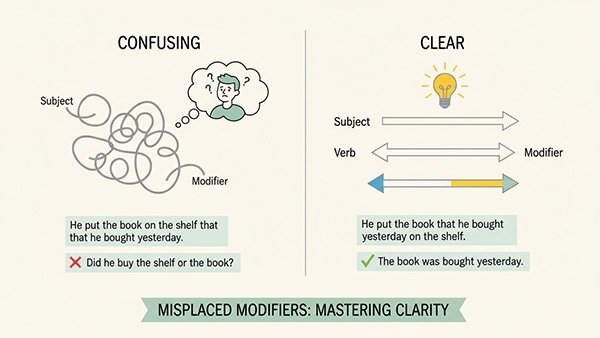
A misplaced modifier is a word, phrase, or clause that is located too far from the word it intends to modify or describe. This incorrect placement can lead to confusion, ambiguity, or unintended humor because the modifier appears to modify a different element in the sentence.
Correcting misplaced modifiers involves repositioning them to clearly link them to the intended word or phrase.
Misplaced: I saw a dog running down the street with a long tail.
Corrected: I saw a dog with a long tail running down the street.
Explanation: In the misplaced sentence, it sounds like the street has a long tail. The corrected sentence clarifies that the dog has the long tail.
Structural Breakdown of Misplaced Modifiers
Understanding the structure of a sentence is essential for identifying and correcting misplaced modifiers. Here’s a breakdown:
- Modifier: The descriptive word, phrase, or clause.
- Modified Element: The word or phrase that the modifier should be describing.
- Misplacement: The incorrect position of the modifier that causes ambiguity.
To avoid misplacements, ensure the modifier is as close as possible to the element it modifies.
Types of Misplaced Modifiers
Misplaced modifiers can take several forms, each requiring careful attention to sentence structure.
Single-Word Modifiers
Single-word modifiers, such as adverbs (e.g., “only,” “nearly,” “simply”), can easily be misplaced, leading to unintended meanings. Their placement often dictates the scope of their modification.
Misplaced: He nearly drove the car into the lake.
Corrected: He drove the car nearly into the lake.
Explanation: The misplaced sentence suggests he almost drove the car, but didn’t. The corrected sentence indicates he drove the car very close to the lake.
Phrase Modifiers
Phrase modifiers include participial phrases, prepositional phrases, and infinitive phrases. Misplacement can create confusion about what the phrase is describing.
Misplaced: Covered in chocolate sauce, I ate the ice cream.
Corrected: I ate the ice cream covered in chocolate sauce.
Explanation: The misplaced sentence humorously suggests that “I” am covered in chocolate sauce. The corrected sentence clarifies that the ice cream is covered in chocolate sauce.
Clause Modifiers
Clause modifiers are dependent clauses that add extra information to the main clause. Their placement is crucial for maintaining clarity.
Misplaced subordinate clauses are a specific type of clause modifier where a dependent clause is incorrectly positioned, leading to confusion. For example: “While walking to the store, the rain soaked my coat.” This sentence humorously suggests that the rain was walking to the store. Correcting the placement clarifies the meaning: “While walking to the store, I got soaked by the rain.”
Misplaced: I bought a car from a dealer that had a faulty engine.
Corrected: I bought a car that had a faulty engine from a dealer.
Explanation: The misplaced sentence implies that the dealer had a faulty engine. The corrected sentence clarifies that the car had a faulty engine.
Examples of Misplaced Modifiers
Let’s explore more examples of each type of misplaced modifier to reinforce your understanding.
Single-Word Modifier Examples
- Misplaced: She almost found her missing keys.
Corrected: She found her missing keys almost immediately.
- Misplaced: I only ate one slice of pizza.
Corrected: I ate only one slice of pizza.
- Misplaced: He simply wants to understand the problem.
Corrected: He wants simply to understand the problem.
Phrase Modifier Examples
Another way to think about misplaced modifiers is to focus on the modifying elements themselves. For instance, in the sentence “She handed out brownies to children wrapped in foil,” the modifying element “wrapped in foil” is misplaced, suggesting that the children are wrapped in foil rather than the brownies. Correctly positioning the modifier clarifies the meaning: “She handed out brownies wrapped in foil to children.”
- Misplaced: Walking through the park, the flowers smelled wonderful.
Corrected: Walking through the park, I smelled the wonderful flowers.
- Misplaced: To bake a cake, the oven must be preheated.
Corrected: To bake a cake, you must preheat the oven.
- Misplaced: With great enthusiasm, the project was started.
Corrected: With great enthusiasm, they started the project.
Clause Modifier Examples
- Misplaced: The report was submitted by the intern that was full of errors.
Corrected: The report that was full of errors was submitted by the intern.
- Misplaced: I saw a bird in my garden that I had never seen before.
Corrected: I saw a bird that I had never seen before in my garden.
- Misplaced: She returned the sweater to the store that was too small.
Corrected: She returned the sweater that was too small to the store.
Famous Example of a Misplaced Modifier
One of the most widely cited examples of a misplaced modifier comes from a newspaper headline: “Squad Helps Dog Bite Victim.” Humorously, it reads as if the squad is assisting the dog in biting someone. The intended meaning is: “Squad Helps Dog, Bites Victim,” clarifying that the squad is helping a victim who was bitten by a dog.
This example highlights how critical modifier placement is for clarity, especially in journalism, where ambiguity can lead to unintended humor or misinterpretation. Observing famous examples reinforces the importance of careful sentence construction and provides a memorable illustration for learners aiming to master proper modifier placement.
Usage Rules for Misplaced Modifiers
Follow these rules to avoid misplaced modifiers:
- Place modifiers as close as possible to the words they modify.
- Ensure the modifier clearly refers to the intended word or phrase.
- Avoid separating the modifier from its intended target with other words or phrases that could cause confusion.
- When using introductory phrases, make sure the subject of the sentence immediately follows the phrase.
Common Mistakes with Misplaced Modifiers
- Separating a modifier from the word it modifies: This is the most frequent error.
- Misplacing adverbs of frequency: Adverbs like “often,” “always,” and “rarely” should be placed carefully.
- Using dangling modifiers: These are modifiers that don’t have a clear word to modify in the sentence.
Practice Exercises
Test your understanding with these exercises.
Exercise 1: Identifying Misplaced Modifiers
Identify the misplaced modifier in each sentence:
- I ate the cold pizza that was in the fridge.
- Covered in syrup, he enjoyed the pancakes.
- She nearly completed the project on time.
Exercise 2: Correcting Misplaced Modifiers
Rewrite the following sentences to correct the misplaced modifiers:
- Walking down the street, the buildings looked impressive.
- He only wants to improve his writing skills.
- I found a wallet on the sidewalk that was full of money.
- Having finished the game, the pizza was ordered.
Note: Answers to the exercises will be provided separately to allow for self-assessment.
Corrected Sentences:
-
Walking down the street, the buildings looked impressive.
Corrected: Walking down the street, I found the buildings looked impressive.
Explanation: The original sentence humorously implies the buildings were walking. Adding “I” clarifies the subject. -
He only wants to improve his writing skills.
Corrected: He wants to improve only his writing skills.
Explanation: The placement of “only” determines what is being limited—here, it’s his writing skills, not his desire to improve. -
I found a wallet on the sidewalk that was full of money.
Corrected: I found a wallet that was full of money on the sidewalk.
Explanation: This ensures it’s the wallet, not the sidewalk, that was full of money. -
Having finished the game, the pizza was ordered.
Corrected: Having finished the game, we ordered the pizza.
Explanation: The original sentence humorously suggests the pizza finished the game. Adding “we” corrects the subject.
Tips for Avoiding Misplaced Modifiers
-
Read your sentences aloud: If a sentence sounds confusing or humorous in an unintended way, check your modifier placement.
-
Identify the target word: Always ask, “What is this modifier describing?” before finalizing a sentence.
-
Keep modifiers close: Place adjectives, adverbs, phrases, or clauses next to the word they modify.
-
Check introductory phrases: Ensure the subject immediately follows introductory phrases or clauses to avoid dangling modifiers.
-
Review for clarity: After writing, read sentences critically and revise any modifier that could cause ambiguity.
Summary
Misplaced modifiers are a common source of ambiguity, confusion, and unintended humor in writing. By learning to identify single-word, phrase, and clause modifiers, you can dramatically improve clarity and readability. Key strategies include placing modifiers close to their target words, correcting dangling modifiers, and carefully positioning adverbs.
Remember, even a small shift in word placement can change the meaning of a sentence. Clear writing is precise writing, and mastering modifier placement is an essential skill for effective communication.
Quick Reference Table of Misplaced Modifiers
| Type | Example of Misplacement | Corrected Version |
|---|---|---|
| Single-word | He nearly drove the car into the lake. | He drove the car nearly into the lake. |
| Phrase | Covered in chocolate sauce, I ate the ice cream. | I ate the ice cream covered in chocolate sauce. |
| Clause | I bought a car from a dealer that had a faulty engine. | I bought a car that had a faulty engine from a dealer. |
| Dangling | Having finished the game, the pizza was ordered. | Having finished the game, we ordered the pizza. |
FAQ: Misplaced Modifiers
Q1: What is a misplaced modifier?
A misplaced modifier is a word, phrase, or clause that is placed too far from the word it is intended to describe, creating confusion or ambiguity. Correct placement ensures the modifier clearly refers to the intended word.
Q2: How can I identify a misplaced modifier?
Ask yourself: “What is this word or phrase describing?” If the sentence could imply a different meaning than intended, the modifier is likely misplaced. Reading sentences aloud can also help spot awkward or confusing constructions.
Q3: What is the difference between a misplaced modifier and a dangling modifier?
A misplaced modifier is too far from the word it modifies. A dangling modifier lacks a clear target altogether.
Example:
-
Misplaced: “I found a wallet on the sidewalk that was full of money.” (Misplaced because “that was full of money” is too far from “wallet”)
-
Dangling: “Having finished the game, the pizza was ordered.” (Dangling because “having finished the game” doesn’t have a clear subject)
Q4: Can single words be misplaced?
Yes. Adverbs like only, nearly, or simply can be misplaced, changing the meaning of a sentence.
Example:
-
Misplaced: “He only wants to improve his writing skills.”
-
Corrected: “He wants to improve only his writing skills.”
Q5: Are misplaced modifiers common in everyday writing?
Absolutely. Misplaced modifiers frequently appear in emails, essays, news articles, and even casual writing. Being aware of them improves clarity and prevents unintentional humor or confusion.
Q6: How can I avoid misplaced modifiers?
-
Place modifiers as close as possible to the word they describe.
-
Identify the target word before adding modifiers.
-
Carefully position introductory phrases.
-
Proofread sentences for clarity and unintended meanings.
Q7: Why are misplaced modifiers considered problematic?
Misplaced modifiers can:
-
Change the intended meaning of a sentence
-
Cause confusion for readers
-
Lead to humor or misunderstanding in professional writing
Q8: Can a sentence have more than one misplaced modifier?
Yes. Sentences with multiple modifiers need careful placement to ensure each modifier clearly refers to the correct word or phrase.
Q9: Are all modifiers words, or can phrases and clauses be modifiers too?
Modifiers can be:
-
Single words: adjectives or adverbs
-
Phrases: participial, infinitive, prepositional
-
Clauses: subordinate or relative clauses
Q10: Is correcting misplaced modifiers important for ESL learners?
Definitely. Misplaced modifiers are a common source of mistakes for English learners. Correct placement helps convey meaning clearly, improves fluency, and makes writing more professional and natural.
Conclusion
Understanding and correcting misplaced modifiers is crucial for clear, effective, and professional writing. By paying attention to modifier placement, you prevent ambiguity, avoid unintended humor, and convey your intended meaning with precision. Whether you’re writing academic papers, professional emails, or creative stories, mastering modifier placement ensures your sentences are sharp, concise, and easy to understand.
Clear communication starts with attention to detail—making modifier placement a small but powerful step toward writing mastery.