
Understanding antonyms is crucial for building a robust vocabulary and mastering effective communication. While we often focus on finding solutions to problems, it’s equally important to understand the words that represent the opposite of a solution.
This article delves into the various antonyms of “solution,” exploring their nuances, contexts, and proper usage. This guide will benefit students, writers, and anyone looking to enhance their understanding of English vocabulary and grammar.
By exploring words like “problem,” “failure,” “impasse,” and many others, we’ll expand our ability to articulate challenges, setbacks, and unresolved issues. This knowledge will not only improve our writing and speaking skills but also deepen our comprehension of complex situations and concepts.
Let’s embark on this journey to unravel the diverse landscape of antonyms related to “solution.”
Table of Contents
- Definition of “Solution”
- Structural Breakdown
- Types of Antonyms
- Examples of Antonyms
- Usage Rules
- Common Mistakes
- Practice Exercises
- Advanced Topics
- FAQ
- Conclusion
Definition of “Solution”
Recommended Products


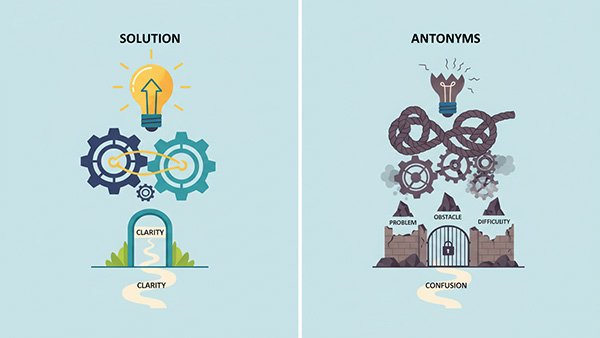
A solution is a means of solving a problem or dealing with a difficult situation. It represents a way out of a predicament, an answer to a question, or a method for achieving a desired outcome. A solution can be concrete, such as a chemical solution in a lab, or abstract, such as a solution to a social problem. The word “solution” functions primarily as a noun, but it can also be used as part of a compound adjective (e.g., solution-oriented).
In mathematics, a solution is a value or set of values that satisfies an equation. In chemistry, it refers to a homogeneous mixture of two or more substances.
In a broader sense, a solution signifies resolution, remedy, or the act of untangling a complex issue. Understanding the various facets of “solution” is crucial for appreciating the breadth of its antonyms.
For those wondering what is a antonym for solution or what is the opposite of solution, it’s important to note that multiple words can serve as opposites depending on context. While “problem” is the most straightforward choice, terms like “failure,” “impasse,” and “obstacle” can also act as antonyms, reflecting nuances such as lack of progress, inability to resolve an issue, or barriers to resolution. In scientific contexts, understanding science solution antonyms is particularly crucial, as a chemical or mathematical solution may have specific opposing states, such as unsolvability or a failed reaction.
Science Solution Antonyms
In scientific disciplines, the concept of a solution can be more precise, making its antonyms context-dependent. For example, in chemistry, a solution refers to a homogeneous mixture of substances. Its antonym might be an insoluble mixture or a suspension where components do not fully integrate. In mathematics, a solution is a value that satisfies an equation.
The antonym here is often “no solution” or “unsolvable,” indicating that no value meets the equation’s requirements. Understanding these science solution antonyms is essential for students and professionals working in technical fields, as it clarifies situations where a problem remains unresolved or a method fails to produce results.
Structural Breakdown
The word “solution” is derived from the Latin word solutio, meaning “a loosening, a dissolving, a solution.” This etymological root hints at the core meaning of the word: the act of freeing something from a constraint or resolving a complication. Structurally, “solution” is a noun, typically countable (e.g., “several solutions”) but can sometimes be uncountable (e.g., “a solution of salt in water”).
The word “solution” can be modified by adjectives to provide further detail (e.g., “a simple solution,” “an effective solution”). It can also be used with verbs to describe the process of finding or implementing a solution (e.g., “to find a solution,” “to implement a solution”).
Understanding these structural elements helps us to identify and use antonyms of “solution” more accurately.
Types of Antonyms
Antonyms are words with opposite meanings. However, “opposite” can mean different things, leading to various types of antonyms.
Understanding these types is essential for choosing the most appropriate antonym for “solution” in any given context.
Contradictory Antonyms
Contradictory antonyms are pairs of words where one word’s meaning directly negates the other. If one word is true, the other must be false.
For example, “on” and “off” are contradictory antonyms. For “solution,” a contradictory antonym might be “unsolvability” or “impossibility” in certain contexts, suggesting that a problem simply cannot be solved.
Complementary Antonyms
Complementary antonyms are pairs of words where there are only two possibilities, and they are mutually exclusive. For instance, “alive” and “dead” are complementary antonyms.
While harder to pinpoint for “solution,” consider a scenario where a problem either *has* a solution or *lacks* a solution. In this case, “lack of solution” could be seen as a complementary antonym.
Relational Antonyms
Relational antonyms are pairs of words that describe a relationship from opposite perspectives. For example, “teacher” and “student” are relational antonyms.
In the context of “solution,” relational antonyms might describe the relationship between a problem and its solver. However, this is less direct than other types of antonyms.
Reversals
Reversals are antonyms that imply movement in opposite directions. Examples include “enter” and “exit” or “increase” and “decrease.” This type of antonym is less directly applicable to “solution” itself, but could be relevant when considering the *process* of solving something versus the process of making it more complicated.
Examples of Antonyms
Let’s explore various antonyms of “solution” with detailed examples, categorized for clarity. These examples will illustrate how each antonym functions in different contexts.
“Problem” as an Antonym
“Problem” is perhaps the most direct and common antonym of “solution.” It represents the situation that requires a solution. The existence of a problem necessitates the search for a solution.
The following table provides examples of “problem” used as an antonym of “solution” in various contexts.
| Sentence with “Solution” | Sentence with “Problem” |
|---|---|
| The solution to the equation was x = 5. | The problem with the equation was that it had no real roots. |
| We found a solution to the traffic congestion. | The traffic congestion remains a significant problem. |
| The new software offers a solution to our data management issues. | Our data management issues continue to be a major problem. |
| The doctor prescribed a solution for his skin condition. | His skin condition is a persistent problem. |
| Mediation provided a solution to their dispute. | Their ongoing dispute is a serious problem. |
| The engineer devised a solution to the structural flaw. | The structural flaw presented a significant problem. |
| The politician proposed a solution to the economic crisis. | The economic crisis remains a complex problem. |
| The scientist discovered a solution to the energy shortage. | The energy shortage is a pressing problem. |
| The teacher offered a solution to the student’s confusion. | The student’s confusion was a genuine problem. |
| The company implemented a solution to improve customer service. | Poor customer service was a major problem for the company. |
| The team developed a solution to the security vulnerability. | The security vulnerability was a serious problem. |
| The artist found a solution to the creative block. | The creative block was a frustrating problem. |
| The negotiator presented a solution to the deadlock. | The deadlock was a difficult problem to overcome. |
| The innovator created a solution to the environmental challenge. | The environmental challenge is a global problem. |
| The programmer wrote a solution to the software bug. | The software bug was a critical problem. |
| The activist advocated for a solution to social inequality. | Social inequality is a pervasive problem. |
| The inventor patented a solution to the manufacturing inefficiency. | The manufacturing inefficiency was a costly problem. |
| The therapist suggested a solution to the patient’s anxiety. | The patient’s anxiety was a debilitating problem. |
| The consultant proposed a solution to the organizational dysfunction. | The organizational dysfunction was a complex problem. |
| The government implemented a solution to the healthcare crisis. | The healthcare crisis is a national problem. |
| The community developed a solution to the local issue. | The local issue was a community problem. |
| The family found a solution to their financial difficulties. | Their financial difficulties were a significant problem. |
| The school adopted a solution to address bullying. | Bullying was a persistent problem at the school. |
“Failure” as an Antonym
“Failure” signifies the lack of success or the inability to achieve a desired outcome. It can be an antonym of “solution” when a proposed solution does not work or when efforts to find a solution are unsuccessful.
The following table provides examples of “failure” used as an antonym of “solution” in various contexts.
| Sentence with “Solution” | Sentence with “Failure” |
|---|---|
| The proposed solution proved effective. | The proposed solution resulted in complete failure. |
| We hoped for a solution, but the experiment yielded none. | Our attempts to find a solution ended in failure. |
| The company’s solution increased profits. | The company’s proposed solution was a complete failure and decreased profits. |
| The treatment provided a solution to the ailment. | The treatment proved to be a failure in alleviating the ailment. |
| Negotiations led to a peaceful solution. | Negotiations ended in failure, escalating the conflict. |
| The innovative approach provided a solution to the challenge. | The innovative approach was a failure and didn’t address the challenge. |
| The plan offered a solution to the budget deficit. | The plan was a failure and the budget deficit remained. |
| The new strategy provided a solution to the marketing problem. | The new strategy was a failure and made the marketing problem worse. |
| The intervention provided a solution to the crisis. | The intervention was a failure and the crisis deepened. |
| The fix provided a solution to the software glitch. | The fix was a failure and the software glitch persisted. |
| The compromise provided a solution to the disagreement. | The compromise was a failure and the disagreement continued. |
| The adjustment provided a solution to the imbalance. | The adjustment was a failure and the imbalance remained. |
| The revision provided a solution to the error. | The revision was a failure and the error was still present. |
| The adaptation provided a solution to the environmental issue. | The adaptation was a failure and the environmental issue worsened. |
| The upgrade provided a solution to the performance issue. | The upgrade was a failure and the performance issue still existed. |
| The method provided a solution to the calculation error. | The method was a failure and the calculation error persisted. |
| The repair was a solution to the damage. | The repair was a failure, the damage was still there. |
| The remedy was a solution to the disease. | The remedy was a failure, the disease got worse. |
| The adjustment was a solution to the misalignment. | The adjustment was a failure, the misalignment remained. |
| The resolution was a solution to the conflict. | The resolution was a failure, the conflict continued. |
| The breakthrough was a solution to the scientific mystery. | The breakthrough was a failure, the mystery remained unsolved. |
| The turnaround was a solution to the business decline. | The turnaround was a failure, the business continued to decline. |
“Impasse” as an Antonym
“Impasse” refers to a situation in which no progress is possible, especially because of disagreement; a deadlock. It represents a complete standstill in finding a solution.
The following table provides examples of “impasse” used as an antonym of “solution” in various contexts.
| Sentence with “Solution” | Sentence with “Impasse” |
|---|---|
| Negotiations led to a solution acceptable to both parties. | Negotiations reached an impasse, with neither side willing to compromise. |
| The committee found a solution to the funding dispute. | The committee reached an impasse over the funding dispute. |
| Mediation provided a solution to the contract negotiations. | Contract negotiations reached an impasse. |
| The diplomats worked towards a solution to the international crisis. | Diplomatic efforts reached an impasse, escalating the international crisis. |
| The discussion resulted in a solution for the project’s challenges. | The discussion resulted in an impasse, halting the project. |
| The arbitration process offered a solution to the labor dispute. | The arbitration process reached an impasse, prolonging the labor dispute. |
| The dialogue led to a solution resolving the conflict. | The dialogue reached an impasse, failing to resolve the conflict. |
| The conference produced a solution to the environmental problem. | The conference reached an impasse on the environmental problem. |
| The legal proceedings concluded with a solution to the case. | The legal proceedings reached an impasse, leaving the case unresolved. |
| The council proposed a solution to the community issue. | The council reached an impasse on the community issue. |
| The debate generated a solution that addressed the concerns. | The debate reached an impasse without addressing any concerns. |
| The collaboration led to a solution to the technical difficulty. | The collaboration resulted in an impasse on the technical difficulty. |
| The investigation provided a solution to the mystery. | The investigation reached an impasse, the mystery remained. |
| The talks yielded a solution to the political standoff. | The talks reached an impasse, the political standoff persisted. |
| The workshop produced a solution to the design challenge. | The workshop reached an impasse on the design challenge. |
| The summit resulted in a solution to the global issue. | The summit reached an impasse on the global issue. |
| The session provided a solution to the creative block. | The session reached an impasse, the creative block continued. |
| The review offered a solution to the quality control problem. | The review reached an impasse on the quality control problem. |
| The meeting resolved the issue with a solution. | The meeting ended in an impasse, the issue unresolved. |
| The consultation offered a solution to the client’s problem. | The consultation reached an impasse on the client’s problem. |
“Obstacle” as an Antonym
“Obstacle” represents something that blocks one’s way or prevents progress. While not a direct antonym of “solution,” it signifies the presence of something hindering the attainment of a solution.
The following table provides examples of “obstacle” related to “solution” in various contexts.
| Sentence implying a “Solution” is possible, but difficult | Sentence highlighting the “Obstacle” |
|---|---|
| Finding a solution to climate change is a global imperative. | Political resistance remains a significant obstacle to climate action. |
| The team sought a solution to the technical glitch. | The complex code presented a major obstacle to resolving the glitch. |
| Negotiators aimed for a solution to the trade dispute. | Protectionist policies proved to be an obstacle to reaching a trade agreement. |
| Researchers pursued a solution to the disease. | Lack of funding was a critical obstacle to the research. |
| The company worked towards a solution to the supply chain issues. | Logistical challenges presented an obstacle to improving the supply chain. |
| The community strived for a solution to the housing crisis. | Zoning regulations were a significant obstacle to building affordable housing. |
| The activists campaigned for a solution to social inequality. | Entrenched power structures were a formidable obstacle to achieving equality. |
| The government sought a solution to the economic downturn. | High unemployment remained a persistent obstacle to economic recovery. |
| The engineers tried to find a solution to the structural weakness. | The unstable foundation was a significant obstacle to fixing the structural weakness. |
| The educators looked for a solution to the learning gap. | Limited resources presented a major obstacle to closing the learning gap. |
| The organization sought a solution to the humanitarian crisis. | Political instability was a critical obstacle to delivering aid. |
| The developers tried to find a solution to the software vulnerability. | The outdated system was a significant obstacle to correcting the vulnerability. |
| The artists searched for a solution to the creative block. | Self-doubt was a major obstacle to overcoming the creative block. |
| The mediators worked toward a solution to the conflict. | Deep-seated mistrust was a formidable obstacle to reconciliation. |
| The scientists pursued a solution to the environmental problem. | Public apathy was a critical obstacle to addressing the environmental problem. |
| The programmers attempted to find a solution to the coding error. | The complex algorithm was a major obstacle to debugging the code. |
| The advocates pushed for a solution to the healthcare crisis. | Bureaucratic red tape was a significant obstacle to healthcare reform. |
| The inventors looked for a solution to the manufacturing inefficiency. | The outdated equipment was a critical obstacle to improving efficiency. |
| The therapists sought a solution to the mental health issues. | Social stigma was a major obstacle to seeking mental health treatment. |
| The consultants searched for a solution to the organizational problem. | Resistance to change was a significant obstacle to improving the organization. |
“Stalemate” as an Antonym
“Stalemate” describes a situation in which neither side in a contest or dispute can gain an advantage or achieve a resolution. It’s similar to “impasse” but often implies a more prolonged period of deadlock.
The following table provides examples of “stalemate” used in contrast to “solution”.
| Sentence with “Solution” | Sentence with “Stalemate” |
|---|---|
| After intense negotiations, a solution was reached, ending the conflict. | The negotiations reached a stalemate after weeks of disagreement. |
| The intervention provided a solution, breaking the deadlock in the talks. | The talks remained in a stalemate, with no progress being made. |
| The compromise offered a solution to the ongoing dispute. | The dispute resulted in a stalemate, with both sides unwilling to budge. |
| The new policy offered a solution to the gridlock in the legislature. | The legislature remained in a stalemate over the controversial bill. |
| The innovative approach provided a solution, resolving the long-standing problem. | The problem remained in a stalemate, despite numerous attempts to resolve it. |
| The breakthrough provided a solution, ending the impasse. | The situation reached a stalemate, with no clear path forward. |
| The agreement offered a solution, settling the contentious issue. | The issue remained in a stalemate, causing ongoing tension. |
| The mediation provided a solution, ending the standoff. | The standoff resulted in a stalemate, with neither side backing down. |
| The arbitration provided a solution, resolving the labor dispute. | The labor dispute reached a stalemate, with no resolution in sight. |
| The intervention provided a solution, breaking the impasse in the negotiations. | The negotiations remained in a stalemate, despite international pressure. |
| The council proposed a solution, ending the long-running debate. | The debate reached a stalemate, with no consensus being reached. |
| The collaboration provided a solution, resolving the technical hurdle. | The project reached a stalemate due to technical difficulties. |
| The investigation provided a solution, solving the mystery. | The investigation reached a stalemate, the mystery remained unsolved. |
| The talks yielded a solution, breaking the political deadlock. | The talks remained in a stalemate, the political deadlock persisted. |
| The workshop produced a solution, ending the creative block. | The project reached a stalemate due to a creative block. |
| The summit resulted in a solution, ending the global crisis. | The summit reached a stalemate, the global crisis continued. |
| The review offered a solution, fixing the quality control issue. | The quality control process reached a stalemate, the issue remained unresolved. |
| The meeting resolved the issue with a solution, ending the disagreement. | The meeting ended in a stalemate, the disagreement remained. |
| The consultation offered a solution, resolving the client’s problem. | The consultation reached a stalemate, the client’s problem persisted. |
| The innovation provided a solution, overcoming the technical challenge. | The project reached a stalemate due to technical challenges. |
Usage Rules
When using antonyms of “solution,” it’s important to select the word that best fits the context and conveys the intended meaning accurately. Consider the specific nature of the situation you are describing.
For example, if you want to emphasize the lack of progress, “impasse” or “stalemate” might be more appropriate than “problem.” If you want to highlight the ineffectiveness of an attempted solution, “failure” would be the better choice.
Pay attention to the connotations of each antonym. “Problem” is a relatively neutral term, while “failure” carries a more negative connotation.
“Obstacle” suggests a challenge that can potentially be overcome, while “impasse” implies a more intractable situation. Choosing the right antonym requires careful consideration of these nuances.
Common Mistakes
One common mistake is using “solution” and its antonyms interchangeably without considering their specific meanings. For example, using “problem” when “failure” is more accurate, or vice versa.
Another common mistake is using an antonym that is too general or vague. For example, using “bad” as an antonym for “solution” when a more specific word like “ineffective” or “unworkable” would be more appropriate.
Here are some examples of common mistakes and their corrections:
| Incorrect | Correct | Explanation |
|---|---|---|
| The solution resulted in a good problem. | The solution resulted in a significant failure. | “Failure” is more accurate when describing an unsuccessful outcome. |
| We tried to find a solution, but we only found good. | We tried to find a solution, but we only encountered obstacles. | “Obstacles” is more specific and relevant to the context of finding a solution. |
| The negotiations reached a good solution. | The negotiations reached a frustrating stalemate. | “Stalemate” better conveys the sense of deadlock in negotiations. |
| The solution was a big thing. | The proposed solution caused a new problem. | “Problem” clearly defines the negative outcome caused by the attempted solution. |
| The solution was not very nice. | The solution was a complete failure. | “Failure” emphasizes the lack of success of the attempted solution. |
Practice Exercises
Test your understanding of the antonyms of “solution” with these practice exercises. Choose the best antonym for “solution” in each sentence.
- The team worked tirelessly to find a solution, but ultimately faced ______.
- success
- failure
- progress
- Despite their best efforts, the negotiations reached a(n) ______.
- agreement
- solution
- impasse
- The new policy was intended to be a solution, but it created more ______.
- harmony
- problems
- success
- The path to a solution was blocked by a series of ______.
- opportunities
- obstacles
- advantages
- The conflict remained in a state of ______ despite numerous attempts at resolution.
- harmony
- stalemate
- progress
- The proposed solution was not effective and resulted in ______.
- improvement
- failure
- success
- The project was halted due to a(n) ______ in funding.
- solution
- obstacle
- agreement
- The discussions ended in a(n) ______, with neither side willing to compromise.
- resolution
- impasse
- agreement
- The attempted solution proved to be a complete ______ and the situation worsened.
- success
- failure
- improvement
- Despite their efforts, the situation remained in a ______, with no progress in sight.
- solution
- stalemate
- agreement
Answer Key:
- b
- c
- b
- b
- b
- b
- b
- b
- b
- b
Exercise 2: Fill in the Blanks
Fill in the blanks with the most appropriate antonym of “solution” from the list provided: (problem, failure, impasse, obstacle, stalemate)
- The proposed plan, instead of being a solution, turned out to be a complete __________.
- Despite the mediator’s efforts, the negotiation reached a(n) __________ with no progress made.
- Lack of funding became a major __________ to the successful implementation of the project.
- The situation remained in a(n) __________ , as neither party was willing to compromise.
- Instead of providing a solution, the new policy created more __________.
- The experiment, rather than providing a solution, ended in utter __________.
- The ongoing dispute reached an __________ with both sides unwilling to negotiate further.
- The complex regulations became a significant __________ to small businesses.
- The talks stalled and resulted in a disheartening __________.
- The attempted remedy was a __________, exacerbating the patient’s condition.
Answer Key:
- failure
- impasse
- obstacle
- stalemate
- problem
- failure
- impasse
- obstacle
- stalemate
- failure
Advanced Topics
At an advanced level, you can explore the philosophical implications of “solution” and its antonyms. Consider the concept of unsolvable problems and the limitations of human knowledge.
Explore the role of perspective in determining whether something is a solution or a problem. For example, what one person considers a solution, another might see as a problem.
Further delve into the specific jargon used in different fields. For example, in mathematics, the term “no solution” has a very specific meaning.
Similarly, in computer science, the concept of an “unsolvable” algorithm is a crucial topic. Understanding these field-specific nuances will enrich your understanding of “solution” and its antonyms.
FAQ
Here are some frequently asked questions about the antonyms of “solution”:
- Q: Is “problem” always the best antonym for “solution”?
- A: Not always. While “problem” is a common and direct antonym, other words like “failure,” “impasse,” “obstacle,” and “stalemate” may be more appropriate depending on the specific context.
- Q: How do I choose the right antonym for “solution”?
- A: Consider the specific meaning you want to convey. Do you want to emphasize the lack of success, the lack of progress, or the presence of a hindrance? Choose the antonym that best reflects the situation you are describing.
- Q: Can a situation have multiple antonyms of “solution” simultaneously?
- A: Yes, it’s possible. For example, a project might face both obstacles and ultimately end in failure. Or negotiations might reach an impasse due to various underlying problems.
- Q: Are there any positive antonyms of “solution”?
- A: Not directly. Antonyms of “solution” typically describe negative states or outcomes. However, words like “challenge” can be seen as a more neutral or even positive framing of a situation that requires a solution.
- Q: How can understanding antonyms improve my writing?
- A: Understanding antonyms expands your vocabulary and allows you to express yourself more precisely and effectively. It also helps you to create contrast and nuance in your writing.
Conclusion
Occasionally, readers search for misspelled terms like “what is a antonym of soultion.” It’s important to clarify that this refers to the same question as “what is a antonym for solution,” with possible answers including problem, failure, impasse, or obstacle.
In summary, understanding the antonyms of “solution” is essential for effective communication and critical thinking. While “problem” is a common antonym, words like “failure,” “impasse,” “obstacle,” and “stalemate” offer more nuanced perspectives on situations where solutions are lacking or unsuccessful.
By carefully considering the context and connotations of each antonym, you can enhance your vocabulary and express yourself with greater precision. Embrace the challenge of mastering these words, and you’ll unlock new levels of clarity and sophistication in your writing and speaking.