

Mastering diverse ways to introduce examples is crucial for clear and engaging communication. Using only “for example” repeatedly can make your writing and speech monotonous.
This article explores a wide range of alternatives, enhancing your ability to illustrate points effectively and maintain audience interest. Whether you’re an English language learner, a student, or a professional seeking to improve your communication skills, this guide provides the knowledge and practice needed to confidently use varied expressions for “for example.”
Table of Contents
- Introduction
- Definition and Purpose
- Structural Breakdown
- Types and Categories
- Extensive Examples
- Usage Rules and Guidelines
- Common Mistakes to Avoid
- Practice Exercises
- Advanced Topics
- Frequently Asked Questions
- Conclusion
Introduction
Recommended Products



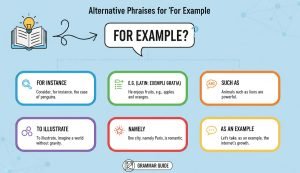
The phrase “for example” is a common tool used to clarify and illustrate a point. However, relying solely on this phrase can make your writing or speech sound repetitive and less engaging.
A rich vocabulary includes a variety of ways to introduce examples, each with its own nuance and level of formality. This article provides a comprehensive guide to expanding your repertoire of expressions for “for example,” enabling you to communicate more effectively and dynamically.
By mastering these alternatives, you can enhance the clarity, flow, and overall impact of your communication.
Writers and learners often look for different ways to say for example in order to make their English sound more natural and less repetitive. While “for example” is perfectly correct, relying on it too frequently can weaken style and reduce reader engagement. Exploring alternatives to for example allows you to vary sentence rhythm and better match tone, especially in longer pieces of writing.
There are many other ways to say for example depending on context. In formal situations, expressions such as “for instance,” “namely,” or “as a case in point” provide clarity and precision. In more relaxed settings, speakers may prefer “like,” “say,” or “such as,” which sound conversational and approachable. Choosing among these different ways to say for example helps signal whether you are introducing a single illustration or a broader set of possibilities.
By consciously practicing alternatives to for example, you gain greater control over emphasis and flow. Over time, using other ways to say for example becomes intuitive, resulting in clearer, more engaging English communication.
Definition and Purpose
The phrase “for example” and its alternatives are used to introduce specific instances or illustrations that support a general statement or idea. These expressions serve to clarify abstract concepts, provide concrete evidence, and make your arguments more persuasive.
They act as bridges between general principles and tangible instances, helping your audience understand and connect with your message. Choosing the right expression depends on the context, the level of formality, and the specific type of example you are presenting.
In essence, using alternatives to “for example” is about diversifying your language to avoid monotony and to add subtle shades of meaning to your communication. It demonstrates a command of the English language and enhances the overall quality of your writing and speaking.
Structural Breakdown
The structure of sentences introducing examples typically involves a general statement followed by an introductory phrase and then the specific example(s). Here’s a breakdown:
- General Statement: This sets the context or introduces the concept you want to illustrate.
- Introductory Phrase: This signals that you are about to provide an example. This is where you would use “for example” or one of its alternatives.
- Specific Example(s): This provides concrete instances that support the general statement.
The introductory phrase can be placed at the beginning of the example or integrated within the sentence. The choice depends on the desired emphasis and flow of the sentence.
Example: (General Statement) Many fruits are rich in vitamins. (Introductory Phrase) For instance, (Specific Example) oranges are an excellent source of Vitamin C.
In discussions about usage, many learners specifically ask how “for example in English” functions across different contexts. The phrase “for example in English” is acceptable in both spoken and written communication, but style guides often recommend variety to avoid repetition. Understanding how “for example in English” compares with alternatives such as “for instance” or “such as” helps writers choose expressions that sound natural, polished, and contextually appropriate. This distinction is especially important in academic writing, professional communication, and English proficiency exams.
Types and Categories
Alternatives to “for example” can be categorized based on their level of formality and the type of example they introduce. Understanding these categories allows you to choose the most appropriate expression for any given situation.
Formal Alternatives
Formal alternatives are suitable for academic writing, business communication, and other professional contexts. They convey a sense of authority and precision.
Examples of formal alternatives include: for instance, to illustrate, as an illustration, namely, in particular, specifically, consider, as a case in point.
Informal Alternatives
Informal alternatives are appropriate for casual conversations, personal writing, and situations where a more relaxed tone is desired. They make your communication more approachable and relatable.
Examples of informal alternatives include: like, such as, for one, say, take, to name a few, e.g. (abbreviation of exempli gratia).
Introducing Specific Examples
These phrases are used to introduce a particular instance or case that directly supports the general statement.
Examples include: for example, for instance, specifically, in particular, namely.
Introducing General Examples
These phrases are used to introduce a range of examples or a category of instances that illustrate the general statement.
Examples include: such as, like, including, for example, e.g.
Extensive Examples
Here are several tables containing examples of various ways to say “for example” in different contexts. Each table provides numerous sentences demonstrating the usage of these alternatives.
Formal Examples
The following table illustrates the use of formal alternatives to ‘for example’ in sentences. These alternatives are suitable for academic and professional settings.
| Alternative | Example Sentence |
|---|---|
| For instance | Many countries have implemented stricter environmental regulations; for instance, Germany has invested heavily in renewable energy. |
| To illustrate | The concept of cognitive dissonance can be difficult to grasp. To illustrate, consider a smoker who knows smoking is harmful but continues to smoke. |
| As an illustration | The company’s commitment to sustainability is evident. As an illustration, they have reduced their carbon footprint by 30% in the last year. |
| Namely | The report identified several key challenges facing the industry, namely, increasing competition and rising production costs. |
| In particular | The study focused on the effects of social media on teenagers, in particular, its impact on their self-esteem. |
| Specifically | The new policy addresses several issues, specifically, employee compensation and benefits. |
| Consider | The challenges of climate change are multifaceted. Consider the impact on coastal communities. |
| As a case in point | The importance of early childhood education cannot be overstated. As a case in point, studies have shown that children who attend preschool perform better in later grades. |
| For instance | Certain programming languages are better suited for data analysis; for instance, Python is widely used in the field of data science. |
| To illustrate | The principles of supply and demand govern market prices. To illustrate, an increase in demand without a corresponding increase in supply will lead to higher prices. |
| As an illustration | The museum’s collection includes a diverse range of artifacts. As an illustration, it features pottery from ancient Greece. |
| Namely | The company plans to expand its operations in several key areas, namely, Asia and South America. |
| In particular | The research team is focusing on the development of new vaccines, in particular, vaccines for emerging infectious diseases. |
| Specifically | The grant will be used to fund several research projects, specifically, those focused on renewable energy. |
| Consider | The ethical implications of artificial intelligence are far-reaching. Consider the potential impact on employment. |
| As a case in point | The effectiveness of the new marketing strategy is evident. As a case in point, sales have increased by 20% since its implementation. |
| For instance | Many historical events have shaped modern political landscapes; for instance, the French Revolution influenced democratic movements worldwide. |
| To illustrate | The power of compound interest can significantly grow investments over time. To illustrate, consider investing a small amount regularly over several decades. |
| As an illustration | The novel explores themes of identity and belonging. As an illustration, the protagonist struggles to find their place in society. |
| Namely | The organization supports several charitable causes, namely, education and healthcare. |
| In particular | The conference will address a range of environmental issues, in particular, climate change and deforestation. |
| Specifically | The new software update includes several enhancements, specifically, improved security and performance. |
| Consider | The challenges of global poverty are complex and interconnected. Consider the role of education and access to resources. |
| As a case in point | The importance of mentorship in career development is well-documented. As a case in point, many successful individuals attribute their achievements to having had a mentor. |
Informal Examples
The following table provides examples of how to use informal alternatives to ‘for example’ in sentences. These are suitable for everyday conversations and less formal writing.
| Alternative | Example Sentence |
|---|---|
| Like | I enjoy outdoor activities, like hiking and camping. |
| Such as | Many animals hibernate during the winter, such as bears and squirrels. |
| For one | There are many reasons to learn a new language. For one, it can improve your cognitive skills. |
| Say | You could try different strategies, say, breaking the task into smaller steps. |
| Take | Consider various factors, take the weather into account when planning your trip. |
| To name a few | She has a wide range of hobbies, to name a few, painting, gardening, and reading. |
| e.g. | Many fruits are good for you (e.g., apples, bananas, oranges). |
| Like | I love listening to different genres of music, like jazz and blues. |
| Such as | Several vegetables are rich in vitamins, such as spinach and carrots. |
| For one | Learning a musical instrument has numerous benefits. For one, it can improve your memory. |
| Say | You can approach the problem in different ways, say, by brainstorming with colleagues. |
| Take | Think about various aspects, take the cost into consideration before making a decision. |
| To name a few | He is skilled in various sports, to name a few, basketball, soccer, and tennis. |
| e.g. | Many countries in Europe are popular tourist destinations (e.g., France, Italy, Spain). |
| Like | I enjoy watching classic movies, like “Casablanca” and “The Godfather.” |
| Such as | Several types of exercise are beneficial for your health, such as running and swimming. |
| For one | Traveling to new places can broaden your perspective. For one, you can learn about different cultures. |
| Say | You could try different techniques, say, using visual aids to improve your presentation. |
| Take | Consider various factors, take the time of year into account when planning your garden. |
| To name a few | She is interested in various scientific fields, to name a few, biology, chemistry, and physics. |
| e.g. | Many types of desserts are popular (e.g., cake, ice cream, cookies). |
| Like | I love reading different genres of books, like science fiction and fantasy. |
| Such as | Several types of renewable energy are becoming more common, such as solar and wind power. |
| For one | Volunteering in your community has many rewards. For one, you can make a positive impact on others. |
Specific Examples
This table showcases phrases used to introduce particular instances or cases that directly support a general statement.
| Alternative | Example Sentence |
|---|---|
| For example | Many countries have unique cultural traditions. For example, Japan has elaborate tea ceremonies. |
| For instance | Certain plants thrive in specific environments. For instance, cacti are well-suited to desert climates. |
| Specifically | The project aims to address several key issues. Specifically, it focuses on reducing poverty and improving education. |
| In particular | The study examined the effects of stress on the body. In particular, it looked at its impact on the immune system. |
| Namely | The company plans to launch several new products. Namely, a new smartphone and a smartwatch. |
| For example | Many cities are implementing sustainable transportation initiatives. For example, Copenhagen is known for its extensive bike lanes. |
| For instance | Certain types of music can evoke strong emotions. For instance, classical music can be calming and relaxing. |
| Specifically | The new policy aims to improve employee well-being. Specifically, it provides access to mental health resources. |
| In particular | The research focused on the impact of technology on education. In particular, it examined the use of online learning platforms. |
| Namely | The organization supports several environmental causes. Namely, conservation and sustainable development. |
| For example | Many animals exhibit complex social behaviors. For example, ants form highly organized colonies. |
| For instance | Certain foods are known for their health benefits. For instance, blueberries are rich in antioxidants. |
| Specifically | The project aims to improve access to healthcare in rural areas. Specifically, it will establish mobile clinics. |
| In particular | The study examined the effects of exercise on mental health. In particular, it looked at its impact on anxiety and depression. |
| Namely | The company plans to expand its operations in several key markets. Namely, China and India. |
| For example | Many historical figures have made significant contributions to science. For example, Marie Curie discovered radium and polonium. |
| For instance | Certain types of art can be very thought-provoking. For instance, surrealist paintings often challenge conventional perspectives. |
| Specifically | The new initiative aims to promote sustainable agriculture. Specifically, it will provide training and resources to farmers. |
| In particular | The research focused on the impact of climate change on biodiversity. In particular, it examined the effects on endangered species. |
| Namely | The organization supports several social justice causes. Namely, human rights and equality. |
General Examples
This table demonstrates the use of phrases used to introduce general examples or a category of instances that illustrate the general statement.
| Alternative | Example Sentence |
|---|---|
| Such as | Many types of fruit are rich in vitamins, such as oranges, apples, and bananas. |
| Like | I enjoy various outdoor activities, like hiking, biking, and swimming. |
| Including | The museum features artifacts from various cultures, including Egypt, Greece, and Rome. |
| e.g. | Many countries in Europe are popular tourist destinations (e.g., France, Italy, Spain). |
| For example | There are many ways to improve your health. For example, you could exercise regularly. |
| Such as | Several types of renewable energy are becoming more common, such as solar, wind, and hydro power. |
| Like | I enjoy listening to different genres of music, like jazz, blues, and classical. |
| Including | The conference will cover a wide range of topics, including climate change, sustainability, and renewable energy. |
| e.g. | Many types of desserts are popular (e.g., cake, ice cream, cookies). |
| For example | There are many ways to improve your communication skills. For example, you could practice public speaking. |
| Such as | Several types of exercise are beneficial for your health, such as running, swimming, and cycling. |
| Like | I enjoy reading different genres of books, like science fiction, fantasy, and historical fiction. |
| Including | The museum’s collection includes artifacts from various historical periods, including ancient times, the Middle Ages, and the Renaissance. |
| e.g. | Many countries in Asia are known for their rich cultural heritage (e.g., China, Japan, India). |
| For example | There are many ways to improve your productivity. For example, you could prioritize your tasks. |
| Such as | Several types of vegetables are rich in vitamins, such as spinach, carrots, and broccoli. |
| Like | I enjoy watching different types of movies, like action, comedy, and drama. |
| Including | The organization supports various charitable causes, including education, healthcare, and environmental conservation. |
| e.g. | Many types of pets are popular (e.g., dogs, cats, birds). |
| For example | There are many ways to improve your mental health. For example, you could practice mindfulness. |
Usage Rules and Guidelines
Using alternatives to “for example” effectively requires understanding some basic rules and guidelines. These rules help ensure clarity, accuracy, and appropriateness in your communication.
- Choose the Right Level of Formality: Consider your audience and the context of your communication. Use formal alternatives in academic or professional settings and informal alternatives in casual conversations.
- Use “Such As” and “Like” Correctly: “Such as” introduces a list of examples that are representative of a larger category. “Like” can be used similarly but is often considered less formal.
- Use “e.g.” Appropriately: “e.g.” (exempli gratia) means “for example” and is typically used in parentheses or footnotes. It is more common in writing than in speech.
- Avoid Redundancy: Do not use multiple introductory phrases in the same sentence. Choose the one that best fits the context.
- Ensure Clarity: Make sure the example you provide clearly supports the general statement. The connection should be obvious to your audience.
Common Mistakes to Avoid
Even experienced writers and speakers can make mistakes when using alternatives to “for example.” Being aware of these common errors can help you avoid them.
| Incorrect | Correct | Explanation |
|---|---|---|
| Such as, I like apples and bananas. | Such as apples and bananas. | “Such as” should not be followed by a comma when introducing a list directly. |
| For example, like apples and oranges. | For example, apples and oranges. | Do not combine “for example” with other introductory phrases like “like.” |
| Including, for example, apples and pears. | Including apples and pears. | Avoid redundancy by using only one introductory phrase. |
| The company has many departments, i.e., marketing and sales. | The company has many departments, e.g., marketing and sales. | “i.e.” means “that is” (id est), not “for example.” Use “e.g.” instead. |
| For instance such as apples and bananas. | For instance, apples and bananas. | Avoid using two introductory phrases together. |
| Like, for example, I enjoy hiking. | Like hiking. | “Like” is sufficient and doesn’t need “for example.” |
| The company has many products, such as, computers and phones. | The company has many products, such as computers and phones. | Avoid placing a comma after “such as.” |
| For example; apples and oranges are fruits. | For example, apples and oranges are fruits. | Use a comma, not a semicolon, after “for example.” |
| In particular, such as, climate change is a global issue. | In particular, climate change is a global issue. | Choose a single introductory phrase. |
Practice Exercises
Test your understanding of alternatives to “for example” with these practice exercises. Fill in the blanks with the most appropriate phrase from the options provided.
Exercise 1: Choose the best alternative to ‘for example’
| Question | Options | Answer |
|---|---|---|
| Many countries have unique cultural traditions. ____, Japan has elaborate tea ceremonies. | a) Such as, b) For instance, c) Like | b) For instance |
| I enjoy various outdoor activities, ____ hiking, biking, and swimming. | a) Including, b) Namely, c) Like | c) Like |
| The museum features artifacts from various cultures, ____ Egypt, Greece, and Rome. | a) e.g., b) Including, c) For example | b) Including |
| Several types of fruit are rich in vitamins, ____ oranges, apples, and bananas. | a) Such as, b) For instance, c) Like | a) Such as |
| The company plans to launch several new products, ____ a new smartphone and a smartwatch. | a) Namely, b) Such as, c) Like | a) Namely |
| Many cities are implementing sustainable transportation initiatives. ____, Copenhagen is known for its extensive bike lanes. | a) Like, b) For example, c) Including | b) For example |
| I enjoy listening to different genres of music, ____ jazz, blues and classical. | a) Such as, b) Like, c) Namely | b) Like |
| The conference will cover a wide range of topics, ____ climate change, sustainability and renewable energy. | a) For example, b) Including, c) Such as | b) Including |
| There are many ways to improve your health. ____, you could exercise regularly. | a) Such as, b) Namely, c) For example | c) For example |
| Certain plants thrive in specific environments. ____, cacti are well-suited to desert climates. | a) For instance, b) Such as, c) Like | a) For instance |
Exercise 2: Rewrite the sentences using alternatives to ‘for example’.
| Question | Answer |
|---|---|
| Many animals hibernate during the winter, for example, bears and squirrels. | Many animals hibernate during the winter, such as bears and squirrels. |
| I enjoy various hobbies, for example, reading, painting and gardening. | I enjoy various hobbies, like reading, painting, and gardening. |
| The company offers several benefits, for example, health insurance and paid time off. | The company offers several benefits, including health insurance and paid time off. |
| Certain foods are rich in antioxidants, for example, blueberries and strawberries. | Certain foods are rich in antioxidants, for instance, blueberries and strawberries. |
| The project aims to improve education, for example, by providing scholarships and resources. | The project aims to improve education, specifically by providing scholarships and resources. |
| Many countries have unique festivals, for example, the Carnival in Brazil and the Day of the Dead in Mexico. | Many countries have unique festivals, such as the Carnival in Brazil and the Day of the Dead in Mexico. |
| The study focused on environmental issues, for example, climate change and deforestation. | The study focused on environmental issues, in particular, climate change and deforestation. |
| The organization supports several causes, for example, poverty reduction and human rights. | The organization supports several causes, namely, poverty reduction and human rights. |
| Many types of renewable energy exist, for example, solar and wind power. | Many types of renewable energy exist, such as solar and wind power. |
| I enjoy watching certain sports, for example, basketball and soccer. | I enjoy watching certain sports, like basketball and soccer. |
Advanced Topics
For advanced learners, exploring more nuanced aspects of using alternatives to “for example” can further enhance their communication skills.
- Varying Sentence Structure: Experiment with placing the introductory phrase at different points in the sentence for emphasis.
- Combining Phrases: While avoiding redundancy within a single sentence, you can use a series of sentences, each with a different introductory phrase, to provide a comprehensive set of examples.
- Using Analogies: Employ analogies or metaphors to illustrate complex concepts. This can be a powerful way to make your communication more engaging and memorable.
How to Say “For Example”
Many learners search for guidance on how to say for example in a way that sounds natural and fluent. Understanding how to say for example begins with recognizing that English offers multiple choices depending on tone and context. In formal writing, speakers often replace it with phrases like “for instance” or “namely,” while casual conversation may rely on “like” or “say.”
Knowing how to say for example also involves placement. Starting a sentence with an example phrase creates emphasis, whereas placing it mid-sentence often improves flow. By practicing how to say for example using different structures, writers develop flexibility and avoid repetition. Over time, choosing the right expression becomes intuitive, resulting in clearer and more engaging English communication.
Frequently Asked Questions
Here are some frequently asked questions about using alternatives to “for example,” along with detailed answers to help clarify any remaining points.
Is it always necessary to use alternatives to “for example”?
While it’s not strictly necessary, using alternatives to “for example” enhances your writing and speaking by making it more varied and engaging. It demonstrates a broader command of the English language and prevents your communication from sounding monotonous.
What’s the difference between “such as” and “like”?
“Such as” and “like” are often used interchangeably in informal contexts. However, “such as” is generally considered more formal and introduces examples that are representative of a larger category. “Like” can be used similarly but is sometimes seen as less precise.
When should I use “e.g.”?
“e.g.” (exempli gratia) means “for example” and is typically used in parentheses or footnotes in written text. It’s less common in spoken English. Ensure that the examples provided are just a few of many possibilities.
Can I use multiple introductory phrases in the same sentence?
It’s generally best to avoid using multiple introductory phrases in the same sentence, as it can sound redundant and awkward. Choose the single phrase that best fits the context and conveys your intended meaning.
How do I know which alternative is the most appropriate?
Consider the context, your audience, and the level of formality required. Formal alternatives are suitable for academic and professional settings, while informal alternatives are appropriate for casual conversations.
What if I can’t think of any alternatives to “for example”?
Keep a list of alternatives handy and refer to it when writing or speaking. Practice using these alternatives in your daily communication to become more comfortable with them.
Is it okay to use “i.e.” instead of “e.g.”?
No, “i.e.” and “e.g.” have different meanings. “i.e.” (id est) means “that is” and is used to provide a clarification or definition. “e.g.” (exempli gratia) means “for example” and is used to provide examples.
Are there any regional differences in the use of these phrases?
While the basic meanings of these phrases are consistent across different regions, there may be slight variations in usage and preference. Pay attention to how native speakers in your region use these phrases to ensure your communication sounds natural.
Conclusion
Mastering alternatives to “for example” is a valuable skill for anyone seeking to improve their communication. By diversifying your language, you can make your writing and speaking more engaging, clear, and impactful.
Understanding the nuances of each alternative, from formal expressions like “for instance” to informal options like “like,” allows you to tailor your communication to different contexts and audiences. Remember to practice using these alternatives regularly to build confidence and fluency.
Continue to explore and experiment with different ways to introduce examples, and you’ll find that your ability to communicate effectively will grow exponentially. With practice and attention to detail, you can confidently use a rich vocabulary to illustrate your points and captivate your audience.