
Understanding the difference between “many” and “more” is crucial for accurate and effective communication in English. These words, both related to quantity, are used in distinct contexts and with different types of nouns.
Mastering their usage will significantly improve your grammatical precision and clarity. This article provides a comprehensive guide to “many” and “more,” explaining their definitions, structural rules, usage guidelines, common mistakes, and offering plenty of practice exercises.
Whether you’re a beginner or an advanced learner, this guide will help you confidently navigate the nuances of quantity in English.
This guide is particularly beneficial for English language learners of all levels, students preparing for language proficiency exams (such as TOEFL, IELTS, and Cambridge exams), and anyone who wants to refine their understanding of English grammar. Careful study of the examples and exercises will lead to improved fluency and accuracy in both spoken and written English.
Table of Contents
- Introduction
- Definitions of Many and More
- Structural Breakdown
- Types and Categories
- Examples of Many and More
- Usage Rules
- Common Mistakes
- Practice Exercises
- Advanced Topics
- Frequently Asked Questions
- Conclusion
Definitions of Many and More
To effectively use “many” and “more,” it’s essential to understand their specific meanings and grammatical functions. These words relate to quantity but are applied in different contexts.
Definition of Many
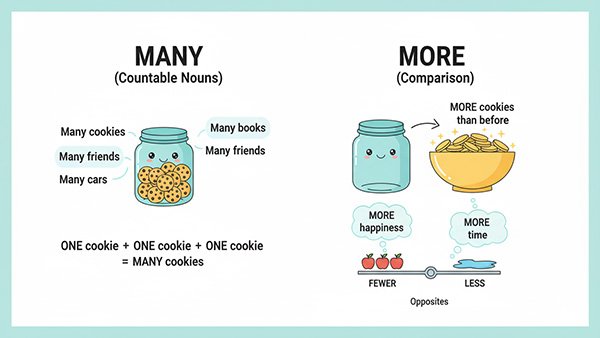
“Many” is a determiner and quantifier used to indicate a large number of something. It is specifically used with countable nouns, which are nouns that can be counted as individual units. “Many” expresses a definite but unspecified large quantity.
For example, you can say “many books,” “many students,” or “many cars” because books, students, and cars can be counted individually. “Many” implies a significant quantity, more than just a few, but not necessarily an overwhelming amount.
Definition of More
“More” is a versatile word that can function as a determiner, pronoun, adverb, or quantifier. It is used in several contexts:
- With Uncountable Nouns: To indicate a greater quantity of something that cannot be counted individually (e.g., more water, more time, more money).
- With Countable Nouns: To indicate a greater number (e.g., more apples than oranges).
- To form Comparative Adjectives and Adverbs: To express a higher degree of a quality (e.g., more beautiful, more quickly).
The flexibility of “more” makes it a frequently used word in English. Understanding its various roles is crucial for proper usage.
Structural Breakdown
The correct usage of “many” and “more” depends on the grammatical structure of the sentence. Understanding these structures will help you use these words accurately.
Structure with Many
The typical structure using “many” is as follows:
Many + Countable Noun (plural) + Verb
For example:
- Many people attended the concert.
- Many students are studying for the exam.
- Many cars were parked on the street.
Note that the countable noun must be in its plural form when used with “many.” The verb must agree with the plural noun.
Structure with More
“More” has several structural patterns depending on its function:
- More + Uncountable Noun + Verb (e.g., More water is needed.)
- More + Countable Noun (plural) + Than + Noun (e.g., More books than magazines were sold.)
- Verb + More + Adjective/Adverb (e.g., She is more intelligent than her brother. He runs more quickly than I do.)
When “more” is used with uncountable nouns, the verb is usually in the singular form. When used with countable nouns, the verb agrees with the noun.
When forming comparative adjectives/adverbs, “more” precedes the adjective or adverb.
Types and Categories
The use of “many” and “more” is closely tied to the type of noun they modify. Understanding the distinction between countable and uncountable nouns is essential.
Countable Nouns
Countable nouns are nouns that can be counted individually. They have a singular and plural form.
Examples include: book, chair, student, car, apple, etc.
“Many” is exclusively used with countable nouns in the plural form. For example:
- Many books are on the shelf.
- Many chairs are in the room.
- Many students are in the class.
It is incorrect to use “many” with uncountable nouns or singular countable nouns.
Uncountable Nouns
Uncountable nouns (also known as mass nouns) are nouns that cannot be counted as individual units. They typically refer to substances, concepts, or abstract ideas.
Examples include: water, time, money, information, advice, etc.
“More” is used with uncountable nouns to indicate a greater quantity. For example:
- More water is needed.
- More time is required to finish the project.
- More money is necessary to buy the house.
It is incorrect to use “many” with uncountable nouns. You would not say “many water” or “many time.”
Comparative Adjectives
“More” is also used to form comparative adjectives and adverbs. Comparative adjectives are used to compare two things, indicating which has a greater degree of a particular quality.
For adjectives with two or more syllables, “more” is typically used to form the comparative. For example:
- More beautiful: She is more beautiful than her sister.
- More interesting: This book is more interesting than that one.
- More expensive: This car is more expensive than I thought.
For one-syllable adjectives, the “-er” suffix is usually used (e.g., taller, faster), but “more” can be used for emphasis or stylistic reasons, although it’s less common.
Examples of Many and More
To solidify your understanding, let’s look at extensive examples of “many” and “more” used in various contexts.
Examples with Many
The following table provides examples of “many” used with countable nouns. Each example demonstrates correct grammatical structure and usage.
Table 1: Examples of “Many” with Countable Nouns
| Sentence | Explanation |
|---|---|
| Many people attended the conference. | “People” is a countable noun in plural form. |
| There are many trees in the forest. | “Trees” is a countable noun in plural form. |
| How many books did you read this year? | “Books” is a countable noun in plural form. |
| Many students are studying English. | “Students” is a countable noun in plural form. |
| I have many friends in this city. | “Friends” is a countable noun in plural form. |
| She has many dresses in her closet. | “Dresses” is a countable noun in plural form. |
| Many cars were damaged in the accident. | “Cars” is a countable noun in plural form. |
| He received many gifts for his birthday. | “Gifts” is a countable noun in plural form. |
| Many birds fly south for the winter. | “Birds” is a countable noun in plural form. |
| There are many houses on this street. | “Houses” is a countable noun in plural form. |
| Many countries participated in the Olympics. | “Countries” is a countable noun in plural form. |
| Many songs were played on the radio. | “Songs” is a countable noun in plural form. |
| She faced many challenges in her career. | “Challenges” is a countable noun in plural form. |
| Many opportunities arose during the project. | “Opportunities” is a countable noun in plural form. |
| Many problems need to be addressed. | “Problems” is a countable noun in plural form. |
| Many questions remained unanswered. | “Questions” is a countable noun in plural form. |
| Many ideas were discussed in the meeting. | “Ideas” is a countable noun in plural form. |
| Many people volunteered to help. | “People” is a countable noun in plural form. |
| Many animals live in the forest. | “Animals” is a countable noun in plural form. |
| Many flowers bloom in the spring. | “Flowers” is a countable noun in plural form. |
| Many cakes were baked for the party. | “Cakes” is a countable noun in plural form. |
| Many balloons floated into the sky. | “Balloons” is a countable noun in plural form. |
| Many presents were under the Christmas tree. | “Presents” is a countable noun in plural form. |
| Many computers are used in the office. | “Computers” is a countable noun in plural form. |
| Many phones have touch screens now. | “Phones” is a countable noun in plural form. |
Examples with More
The following table provides examples of “more” used with uncountable nouns and countable nouns in comparative contexts.
Table 2: Examples of “More” with Uncountable and Countable Nouns
| Sentence | Explanation |
|---|---|
| I need more water. | “Water” is an uncountable noun. |
| We need more time to finish the project. | “Time” is an uncountable noun. |
| She wants more money to buy a new car. | “Money” is an uncountable noun. |
| He needs more information about the topic. | “Information” is an uncountable noun. |
| They require more advice from their mentor. | “Advice” is an uncountable noun. |
| There are more apples than oranges in the basket. | Comparing countable nouns. |
| I have more books than you do. | Comparing countable nouns. |
| She has more friends than her sister. | Comparing countable nouns. |
| He drank more milk this morning. | “Milk” is an uncountable noun. |
| We need more space in the office. | “Space” is an uncountable noun. |
| They have more experience in this field. | “Experience” is an uncountable noun. |
| He needs more patience to deal with the situation. | “Patience” is an uncountable noun. |
| She wants more freedom to make her own choices. | “Freedom” is an uncountable noun. |
| We need more evidence to support our claim. | “Evidence” is an uncountable noun. |
| He has more knowledge about the subject. | “Knowledge” is an uncountable noun. |
| There are more people here than I expected. | Comparing countable nouns. |
| She has more cars than her neighbor. | Comparing countable nouns. |
| He bought more tickets for the concert. | Comparing countable nouns. |
| We need more chairs for the guests. | Comparing countable nouns. |
| They have more houses than we do. | Comparing countable nouns. |
| I need more sugar in my coffee. | “Sugar” is an uncountable noun. |
| She needs more salt in her soup. | “Salt” is an uncountable noun. |
| They need more energy to finish the race. | “Energy” is an uncountable noun. |
| He needs more luck to win the lottery. | “Luck” is an uncountable noun. |
| She needs more support from her family. | “Support” is an uncountable noun. |
Examples with Comparative Adjectives
The following table provides examples of “more” used to form comparative adjectives.
Table 3: Examples of “More” with Comparative Adjectives
| Sentence | Explanation |
|---|---|
| She is more beautiful than her sister. | “Beautiful” is a multi-syllable adjective. |
| This book is more interesting than that one. | “Interesting” is a multi-syllable adjective. |
| This car is more expensive than I thought. | “Expensive” is a multi-syllable adjective. |
| He is more intelligent than his brother. | “Intelligent” is a multi-syllable adjective. |
| She is more dedicated to her work than anyone else. | “Dedicated” is a multi-syllable adjective. |
| This movie is more entertaining than the last one. | “Entertaining” is a multi-syllable adjective. |
| The project is more complicated than we anticipated. | “Complicated” is a multi-syllable adjective. |
| The situation is more serious than it appears. | “Serious” is a multi-syllable adjective. |
| He is more optimistic about the future. | “Optimistic” is a multi-syllable adjective. |
| She is more confident in her abilities. | “Confident” is a multi-syllable adjective. |
| This solution is more effective than the previous one. | “Effective” is a multi-syllable adjective. |
| The new policy is more efficient than the old one. | “Efficient” is a multi-syllable adjective. |
| This approach is more sustainable in the long term. | “Sustainable” is a multi-syllable adjective. |
| The design is more innovative than the others. | “Innovative” is a multi-syllable adjective. |
| The presentation was more engaging than I expected. | “Engaging” is a multi-syllable adjective. |
| The atmosphere is more relaxed here than in the city. | “Relaxed” is a multi-syllable adjective. |
| The food is more delicious at this restaurant. | “Delicious” is a multi-syllable adjective. |
| This method is more convenient for everyone. | “Convenient” is a multi-syllable adjective. |
| The results are more significant than we thought. | “Significant” is a multi-syllable adjective. |
| The impact is more noticeable now. | “Noticeable” is a multi-syllable adjective. |
Usage Rules
To use “many” and “more” correctly, you need to follow specific grammatical rules. These rules ensure that your sentences are clear and accurate.
Rules for Using Many
The key rule for using “many” is that it must be followed by a plural countable noun. The verb in the sentence must agree with the plural noun.
- Correct: Many students are present.
- Incorrect: Many student is present.
- Incorrect: Many water is needed.
In negative sentences and questions, “many” is often used with “not” or in interrogative structures to inquire about quantity.
- Negative: There aren’t many options available.
- Question: How many tickets do you need?
Rules for Using More
“More” can be used with both uncountable nouns and countable nouns. When used with uncountable nouns, the verb is typically in the singular form.
- Uncountable: More water is needed.
- Countable: More people are coming than expected.
When forming comparative adjectives, “more” precedes the adjective. The word “than” is often used to make the comparison explicit.
- Comparative: She is more intelligent than her brother.
Exceptions and Special Cases
There are a few exceptions and special cases to consider:
- “Much” vs. “Many”: “Much” is generally used with uncountable nouns in affirmative statements, but “more” is often preferred. In questions and negative statements, “much” is common (e.g., “How much water do you need?”).
- “A lot of” and “Lots of”: These phrases can be used with both countable and uncountable nouns and are more informal alternatives to “many” and “much” (e.g., “A lot of people,” “A lot of water”).
Understanding these nuances will help you choose the most appropriate word or phrase in different situations.
Common Mistakes
Learners often make mistakes when using “many” and “more.” Recognizing these common errors can help you avoid them.
Common Mistakes with Many
One of the most frequent mistakes is using “many” with uncountable nouns. For example:
Incorrect: Many water is needed.
Correct: More water is needed.
Another common mistake is using “many” with a singular countable noun.
Incorrect: Many student is absent.
Correct: Many students are absent.
Common Mistakes with More
A common mistake with “more” is omitting the word “than” when making a comparison.
Incorrect: She is more intelligent her brother.
Correct: She is more intelligent than her brother.
Another mistake is using “more” with short adjectives that typically take the “-er” suffix, especially in informal contexts.
Less Common/Stylistic: He is more tall than his sister. (While grammatically correct, “taller” is more common.)
Correct: He is taller than his sister.
Practice Exercises
These exercises will help you practice using “many” and “more” correctly. Each exercise focuses on different aspects of usage.
Exercise 1: Fill in the Blanks
Fill in the blanks with “many” or “more” to complete the sentences correctly.
Table 4: Practice Exercise 1 – Fill in the Blanks
| Question | Answer |
|---|---|
| 1. There aren’t __________ apples left in the basket. | many |
| 2. I need __________ coffee to stay awake. | more |
| 3. How __________ books have you read this year? | many |
| 4. She has __________ patience than I do. | more |
| 5. There are __________ students in the library today. | many |
| 6. He wants __________ money to buy a new house. | more |
| 7. __________ people attended the concert last night. | Many |
| 8. We need __________ information about the project. | more |
| 9. How __________ cars are parked on the street? | many |
| 10. She is __________ intelligent than her classmates. | more |
Exercise 2: Error Correction
Identify and correct the errors in the following sentences. If the sentence is correct, write “Correct.”
Table 5: Practice Exercise 2 – Error Correction
| Question | Answer |
|---|---|
| 1. Many water is needed for the plants. | More water is needed for the plants. |
| 2. There are more student in the class today. | There are more students in the class today. |
| 3. How much people are coming to the party? | How many people are coming to the party? |
| 4. She is more taller than her brother. | She is taller than her brother. |
| 5. I have many friend in this city. | I have many friends in this city. |
| 6. Correct | Correct |
| 7. He needs more advice from his teacher. | Correct |
| 8. Many time is wasted on social media. | More time is wasted on social media. |
| 9. There are more books than magazines in the store. | Correct |
| 10. She is more happier now than before. | She is happier now than before. |
Exercise 3: Sentence Completion
Complete the following sentences using “many” or “more” along with appropriate nouns.
Table 6: Practice Exercise 3 – Sentence Completion
| Question | Answer |
|---|---|
| 1. I don’t have __________ __________ to finish the task. | more time |
| 2. There are __________ __________ in the park today. | many children |
| 3. She wants __________ __________ to travel the world. | more money |
| 4. He has __________ __________ than his colleagues. | more experience |
| 5. How __________ __________ do you need for the project? | many computers |
| 6. We need __________ __________ to solve the problem. | more information |
| 7. There are __________ __________ in the garden. | many flowers |
| 8. She has __________ __________ than her sister. | more books |
| 9. He requires __________ __________ to complete the assignment. | more effort |
| 10. There are __________ __________ at the meeting than expected. | many people |
Advanced Topics
For advanced learners, there are more complex aspects of “many” and “more” to explore. These nuances can further refine your understanding and usage.
Advanced Usage of Many
In formal contexts, “a great many” can be used to emphasize a large quantity. This phrase is more emphatic than simply using “many.”
- A great many people attended the event.
The phrase “many a” followed by a singular countable noun and a singular verb is an archaic construction, but it can still be found in literature and formal writing. It emphasizes the individual instances rather than the overall quantity.
- Many a soldier has died in battle.
Advanced Usage of More
“More often than not” is an idiomatic expression meaning “usually” or “frequently.”
- More often than not, he arrives late to the meeting.
“The more, the merrier” is a common expression indicating that a larger number of people will make an event more enjoyable.
- “Can I bring a friend to the party?” “Of course, the more, the merrier!”
The structure “the more…the more…” is used to show a proportional relationship between two things. For example, “The more you study, the more you learn.”
Numbers and quantity are not limited to language—they are central in science as well. For example, chemistry uses the concept of a mole to count atoms. You may ask, “How many atoms in a mole of carbon?” The answer is Avogadro’s number, approximately 6.022 × 10²³ atoms. Similarly, calculating “how many atoms in a mole of iron carbonate” or “how many atoms in a mole of iron in water” requires understanding molecular composition and chemical formulas. These examples demonstrate the importance of quantifying things accurately.
Moreover, understanding the number of components in a system, such as “how many elements in periodic table,” provides a basis for logical categorization. Currently, there are 118 known chemical elements, each with unique properties. By comparing these scientific quantities, learners can relate the concept of “many” and “more” to concrete data, reinforcing the same counting principles emphasized in grammar.
Frequently Asked Questions
Here are some frequently asked questions about “many” and “more” to address common points of confusion.
Q: Can “many” be used with uncountable nouns?
A: No, “many” is exclusively used with countable nouns in the plural form. For uncountable nouns, use “more” or “much.”
Q: Is it correct to say “many of the water”?
A: No, this is incorrect. “Many” should be used with countable nouns. You could say “much of the water” or “most of the water” depending on the context.
Q: When should I use “much” instead of “many”?
A: “Much” is generally used with uncountable nouns. In affirmative sentences, “more” is often preferred. “Much” is common in questions and negative statements (e.g., “How much time do we have?”).
Q: Can “more” be used with singular countable nouns?
A: “More” is typically used with plural countable nouns or uncountable nouns. With singular countable nouns, you would usually use “another” or rephrase the sentence.
Q: What is the difference between “more” and “most”?
A: “More” is used for comparative adjectives and adverbs (comparing two things), while “most” is used for superlative adjectives and adverbs (indicating the highest degree among three or more things). For example, “She is more intelligent than her brother” (comparative), and “She is the most intelligent student in the class” (superlative).
Q: Is it always necessary to use “than” after “more” in a comparison?
A: While “than” is commonly used to make the comparison explicit (e.g., “She is more intelligent than her brother”), it is not always necessary if the context makes the comparison clear. However, including “than” generally improves clarity.
Q: Can “a lot of” be used instead of “many” and “more”?
A: Yes, “a lot of” and “lots of” can be used as informal alternatives to both “many” and “much.” They can be used with both countable and uncountable nouns (e.g., “A lot of people,” “A lot of water”).
Q: What does “more or less” mean?
A: “More or less” means “approximately” or “almost.” For example, “The project is more or less finished.”
Conclusion
Mastering the use of “many” and “more” is essential for clear and accurate communication in English. “Many” is used with countable nouns, while “more” is versatile and used with uncountable nouns, countable nouns in comparative contexts, and to form comparative adjectives.
Understanding the structural rules, recognizing common mistakes, and practicing regularly will significantly improve your grammatical accuracy.
For learners expanding their English vocabulary, understanding the scope of the language can help contextualize quantity expressions. For instance, consider the English alphabet. Knowing how many letters in the English alphabet there are—26 in total—provides a foundation for counting, spelling, and constructing words accurately.
Remember to pay attention to the type of noun you are using (countable or uncountable) and whether you are making a comparison. By following the guidelines and examples provided in this article, you can confidently use “many” and “more” in your everyday English.
Consistent practice and attention to detail will help you avoid common errors and communicate more effectively.
In practical contexts, the concept of “many” or “more” can extend beyond grammar into everyday situations. For example, homeowners often ask, “How many air purifiers do I need for my house?” Determining the correct quantity depends on the number of rooms, square footage, and air quality requirements, illustrating how quantity assessment applies outside language exercises.
When discussing quantities in everyday life, precise measurements are essential. For example, one might ask, “How many ounces in a fifth of alcohol?” The answer is 25.6 ounces, which shows how exact numerical understanding complements general concepts of “many” and “more.”