
Learning to express the same idea in multiple ways is crucial for effective communication in English. Understanding synonyms, paraphrases, and idioms allows you to add nuance, clarity, and sophistication to your speech and writing.
This article explores various techniques for finding “another way to say” something, providing you with the tools to diversify your language skills. This guide is perfect for English language learners of all levels, from beginners looking to expand their vocabulary to advanced speakers aiming to refine their communication style.
By mastering these techniques, you’ll be able to communicate more effectively, engage your audience, and avoid repetitive language.
This article provides a comprehensive overview of alternative expressions, including definitions, structural breakdowns, examples, usage rules, common mistakes, practice exercises, advanced topics, and frequently asked questions. By mastering the concepts presented here, you will significantly enhance your ability to express yourself in English.
Table of Contents
- Definition: What Does “Another Way to Say” Mean?
- Structural Breakdown
- Types and Categories of Alternative Expressions
- Examples of Alternative Expressions
- Usage Rules for Alternative Expressions
- Common Mistakes When Using Alternative Expressions
- Practice Exercises
- Advanced Topics in Alternative Expressions
- Frequently Asked Questions (FAQ)
- Conclusion
Definition: What Does “Another Way to Say” Mean?
Recommended Products

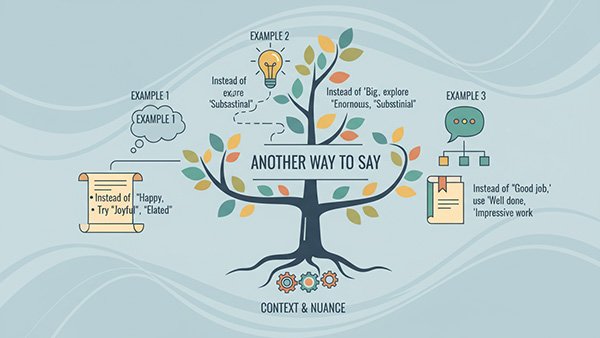
The phrase “another way to say” refers to the ability to express the same idea or concept using different words, phrases, or grammatical structures. This skill involves understanding the nuances of language and being able to choose the most appropriate expression for a given context.
It is a fundamental aspect of effective communication and is essential for avoiding repetition, clarifying meaning, and engaging your audience.
In everyday learning contexts, students often ask, “what’s another way to say” a particular phrase when their original wording feels repetitive or unclear. This question highlights the flexible nature of language, where a single expression can often be reshaped without changing its meaning. Recognizing that an idea is not tied to one fixed form makes it easier to adapt an expression to different audiences, tones, or writing styles.
The concept encompasses a range of linguistic techniques, including using synonyms, paraphrasing, employing idioms, rephrasing with different grammatical structures, and even leveraging antonyms with negation. Each of these techniques provides a unique approach to conveying the same message in a fresh and compelling way.
Mastering these techniques enhances your ability to communicate effectively in both spoken and written English.
Structural Breakdown
The structure of finding an alternative expression involves several key steps. First, you need to identify the core meaning of the original statement. What is the central idea being conveyed? Once you understand the core meaning, you can then explore different ways to express that meaning using different vocabulary and grammatical structures.
Many writers think of this skill as finding a better way to say things when their original phrasing sounds awkward, repetitive, or overly simple. Refining an expression without altering its meaning helps improve clarity and makes communication feel more natural. Over time, this habit leads to stronger writing and more confident spoken English, particularly in academic and professional settings.
Next, consider the context. Who is your audience? What is the purpose of your communication? The context will help you choose the most appropriate alternative expression. For example, a formal context might require more sophisticated vocabulary, while an informal context might allow for more casual language.
Finally, evaluate your alternative expression. Does it accurately convey the original meaning? Is it clear and concise? Is it appropriate for the context? If the answer to any of these questions is no, then you need to refine your alternative expression until it meets these criteria. The process often involves adjusting sentence structure, word choice, and overall tone to achieve the desired effect.
Types and Categories of Alternative Expressions
Synonyms
Synonyms are words that have similar meanings. Using synonyms is one of the most straightforward ways to find an alternative expression.
However, it’s important to remember that synonyms are not always interchangeable. They often have subtle differences in meaning or connotation that can affect the overall message.
For example, the words “happy” and “joyful” are synonyms, but “joyful” often implies a deeper, more intense feeling of happiness. Similarly, “big” and “large” are synonyms, but “large” is generally considered more formal.
Considering these nuances will allow you to choose the most appropriate synonym for your needs.
Alternative expression synonyms are words or phrases that can replace an existing expression while preserving its central meaning. These alternatives may range from simple word substitutions to short phrases that fit naturally within a sentence. Selecting the most suitable synonym depends on context, tone, and formality, since similar expressions often carry subtle differences in emphasis or implication.
Using alternative expression synonyms effectively helps reduce repetition and improves precision. A stronger synonym can add emphasis, while a softer one may make a statement sound more polite or neutral. Developing sensitivity to these distinctions is especially valuable in academic writing, professional communication, and advanced language study.
Paraphrasing
Paraphrasing involves restating someone else’s ideas in your own words. This is a more complex technique than simply using synonyms, as it requires you to understand the original meaning and then re-express it using different sentence structures and vocabulary.
Paraphrasing is essential for academic writing and for avoiding plagiarism.
Effective paraphrasing involves more than just changing a few words. It requires a complete restructuring of the sentence or paragraph while preserving the original meaning.
This may involve changing the order of ideas, breaking down complex sentences into simpler ones, or combining several short sentences into a single, more complex one. The goal is to present the information in a new way that is both accurate and original.
Idioms and Figurative Language
Idioms are expressions whose meanings cannot be understood from the literal meanings of the individual words. Using idioms can add color and personality to your language, but it’s important to use them correctly and in appropriate contexts.
Figurative language, such as metaphors and similes, can also be used to create alternative expressions that are more vivid and engaging.
For example, instead of saying “It’s raining heavily,” you could say “It’s raining cats and dogs.” Or, instead of saying “He’s very angry,” you could say “He’s seeing red.” These idiomatic expressions add a layer of imagery and emotion to your communication, making it more memorable and impactful.
Rephrasing with Different Grammatical Structures
Often, you can express the same idea using different grammatical structures. For example, you can change an active sentence into a passive sentence, or you can use a different type of clause to express the same relationship between ideas.
This technique can be particularly useful for avoiding repetition and for emphasizing different aspects of the message.
For instance, the active sentence “The dog chased the cat” can be rephrased as the passive sentence “The cat was chased by the dog.” While both sentences convey the same information, the passive sentence emphasizes the cat’s experience rather than the dog’s action. Similarly, you can change a simple sentence into a complex sentence by adding a subordinate clause, or vice versa.
This allows you to fine-tune the structure of your sentences to better suit your communication goals.
Using Antonyms with Negation
Another technique for finding alternative expressions is to use antonyms with negation. An antonym is a word that has the opposite meaning of another word.
By using the antonym and negating it, you can express the same idea in a different way.
For example, instead of saying “The movie was good,” you could say “The movie was not bad.” Or, instead of saying “He is tall,” you could say “He is not short.” This technique can be particularly useful for adding nuance and subtlety to your communication. However, it’s important to use it carefully, as it can sometimes sound awkward or unnatural if not used properly.
Examples of Alternative Expressions
This section provides a variety of examples illustrating different ways to express the same idea. These examples are organized by the techniques discussed above, including synonyms, paraphrasing, idioms, rephrasing with different grammatical structures, and using antonyms with negation.
The following tables provide comprehensive examples that will help you understand how to find alternative expressions in various contexts. Each example includes the original sentence and several alternative ways to express the same idea.
Synonym Examples
This table demonstrates how to use synonyms to create alternative expressions. Keep in mind the slight differences in connotation and formality between synonyms.
| Original Sentence | Alternative Expression 1 | Alternative Expression 2 | Alternative Expression 3 |
|---|---|---|---|
| The house is big. | The house is large. | The house is huge. | The house is enormous. |
| She is happy. | She is joyful. | She is cheerful. | She is delighted. |
| The task is difficult. | The task is challenging. | The task is hard. | The task is arduous. |
| He is a brave man. | He is a courageous man. | He is a valiant man. | He is a fearless man. |
| The food is delicious. | The food is tasty. | The food is flavorful. | The food is scrumptious. |
| The car is fast. | The car is quick. | The car is speedy. | The car is rapid. |
| The answer is correct. | The answer is right. | The answer is accurate. | The answer is precise. |
| The movie was interesting. | The movie was engaging. | The movie was captivating. | The movie was fascinating. |
| The weather is cold. | The weather is chilly. | The weather is freezing. | The weather is icy. |
| He is a smart student. | He is an intelligent student. | He is a clever student. | He is a bright student. |
| The book is long. | The book is lengthy. | The book is extensive. | The book is prolonged. |
| The problem is simple. | The problem is easy. | The problem is straightforward. | The problem is uncomplicated. |
| The room is clean. | The room is tidy. | The room is spotless. | The room is immaculate. |
| She is a kind person. | She is a compassionate person. | She is a caring person. | She is a benevolent person. |
| The story is old. | The story is ancient. | The story is historic. | The story is aged. |
| The project is new. | The project is novel. | The project is innovative. | The project is modern. |
| The music is loud. | The music is noisy. | The music is boisterous. | The music is deafening. |
| The flower is pretty. | The flower is beautiful. | The flower is lovely. | The flower is attractive. |
| He is rich. | He is wealthy. | He is affluent. | He is prosperous. |
| The decision is important. | The decision is significant. | The decision is crucial. | The decision is vital. |
Paraphrasing Examples
This table illustrates how to paraphrase sentences by changing both the words and the structure, while maintaining the original meaning.
| Original Sentence | Alternative Expression 1 | Alternative Expression 2 | Alternative Expression 3 |
|---|---|---|---|
| The meeting will be held on Monday. | The scheduled gathering is set for Monday. | Monday is when we will convene for the meeting. | The meeting is planned to take place on Monday. |
| She enjoys reading books in her free time. | Reading is one of her favorite leisure activities. | She likes to spend her spare time with a good book. | Books are a source of pleasure for her during her downtime. |
| The company reported a significant increase in profits. | The company’s earnings rose substantially. | There was a notable profit surge for the company. | The company saw a large gain in their financial results. |
| He is responsible for managing the project. | He has the task of overseeing the project. | The project’s management falls under his purview. | His job involves the project’s supervision. |
| The weather is expected to be sunny tomorrow. | Clear skies are forecast for the next day. | Tomorrow’s weather is predicted to be bright and sunny. | We anticipate sunny conditions for tomorrow. |
| The new policy will affect all employees. | The new regulation will impact every staff member. | All employees will be influenced by the new policy. | The new policy is set to have an effect on the entire workforce. |
| The experiment yielded unexpected results. | The experiment’s outcome was not what was predicted. | The results of the experiment were surprising. | The experiment produced unforeseen findings. |
| The teacher explained the concept clearly. | The teacher provided a lucid explanation of the concept. | The concept was explained in an easy-to-understand manner by the teacher. | The teacher clarified the concept effectively. |
| The website provides useful information. | The website offers helpful details. | You can find valuable information on the website. | The website is a source of practical knowledge. |
| The store is located near the park. | The store is situated in proximity to the park. | You can find the store close to the park. | The park is near the location of the store. |
| She completed the project on time. | She finished the project by the deadline. | The project was completed by her punctually. | She managed to finish the project within the allotted time. |
| The event was a great success. | The event was highly successful. | The event turned out to be a triumph. | The event achieved a high level of success. |
| He apologized for his mistake. | He expressed regret for his error. | He said sorry for what he did wrong. | He offered an apology for his oversight. |
| The company is planning to expand its operations. | The company intends to grow its business. | There are plans for the company to extend its reach. | The company is looking to scale up its activities. |
| The problem is very complex. | The problem is highly complicated. | The problem is quite intricate. | The problem presents a lot of complexity. |
| The solution is quite simple. | The solution is fairly straightforward. | The solution is not too difficult to understand. | The solution is rather uncomplicated. |
| The book is very interesting. | The book is quite captivating. | The book really grabs your attention. | The book is truly fascinating. |
| She is a very talented musician. | She is a highly skilled musician. | She possesses great musical talent. | She is a musician of exceptional ability. |
| The course is designed for beginners. | The course is aimed at novices. | The course is intended for those new to the subject. | The course is tailored for people just starting out. |
| The government is working to improve the economy. | The government is striving to boost the economy. | Efforts are being made by the government to enhance the economy. | The government aims to make the economy better. |
Idiom Examples
This table demonstrates how to use idioms to create alternative expressions. Note that idioms should be used in informal contexts.
| Original Sentence | Alternative Expression 1 | Alternative Expression 2 | Alternative Expression 3 |
|---|---|---|---|
| He is very busy. | He is swamped. | He has a lot on his plate. | He is up to his ears in work. |
| She is very happy. | She is on cloud nine. | She is over the moon. | She is as happy as a clam. |
| It’s raining heavily. | It’s raining cats and dogs. | It’s pouring. | It’s coming down in buckets. |
| He made a mistake. | He dropped the ball. | He goofed up. | He slipped up. |
| She is very angry. | She is seeing red. | She is fuming. | She is hopping mad. |
| He is very nervous. | He has butterflies in his stomach. | He is on edge. | He is a bundle of nerves. |
| It’s very easy. | It’s a piece of cake. | It’s a walk in the park. | It’s a breeze. |
| She revealed a secret. | She let the cat out of the bag. | She spilled the beans. | She blurted it out. |
| He is avoiding the issue. | He is beating around the bush. | He is dodging the question. | He is skirting the issue. |
| They agreed completely. | They saw eye to eye. | They were on the same page. | They were in accord. |
| He is procrastinating. | He is dragging his feet. | He is putting it off. | He is stalling. |
| She is working hard. | She is burning the midnight oil. | She is giving it her all. | She is going the extra mile. |
| He is very talented. | He has a gift. | He is a natural. | He is born with it. |
| She is very lucky. | She has a charmed life. | She was born under a lucky star. | She is fortunate. |
| He is taking a risk. | He is skating on thin ice. | He is playing with fire. | He is pushing his luck. |
| She is telling a lie. | She is pulling my leg. | She is stretching the truth. | She is fibbing. |
| He is very stubborn. | He is hardheaded. | He is as stubborn as a mule. | He won’t budge. |
| She is very tired. | She is beat. | She is wiped out. | She is pooped. |
| He is very wealthy. | He is rolling in dough. | He is loaded. | He is well-off. |
| She is being secretive. | She is keeping it close to her chest. | She is playing her cards close to her vest. | She is tight-lipped. |
Usage Rules for Alternative Expressions
When using alternative expressions, it’s crucial to consider several rules to ensure clarity, accuracy, and appropriateness. First, always ensure that the alternative expression accurately conveys the original meaning. A slight difference in connotation can significantly alter the intended message.
Second, be mindful of the context. Formal settings require different language than informal settings. Using idioms or slang in a formal presentation, for example, would be inappropriate. Similarly, using overly formal language in a casual conversation can sound stilted and unnatural.
Third, consider your audience. Are you communicating with native English speakers or English language learners? If your audience is not familiar with certain idioms or expressions, it’s best to avoid them. Clarity and understanding should always be your top priorities.
Finally, avoid overuse. While it’s good to vary your language, constantly using alternative expressions can sound forced or unnatural. Use them judiciously to enhance your communication, not to show off your vocabulary.
Common Mistakes When Using Alternative Expressions
One of the most common mistakes is using synonyms incorrectly. Not all synonyms are interchangeable, and using the wrong synonym can change the meaning of your sentence.
For example:
- Incorrect: “The enormous problem was easily solved.” (Enormous implies a very large problem, which contradicts “easily solved.”)
- Correct: “The simple problem was easily solved.”
Another common mistake is misusing idioms. Idioms have specific meanings, and using them incorrectly can lead to confusion.
For example:
- Incorrect: “He let the dog out of the bag.” (This doesn’t make sense; the correct idiom is “let the cat out of the bag.”)
- Correct: “He let the cat out of the bag.” (Meaning: He revealed a secret.)
A further mistake is improper paraphrasing, which can sometimes unintentionally change the original meaning. Always double-check that your paraphrased version accurately reflects the source material.
- Incorrect: Original: “The study showed a correlation between exercise and mental health.” Paraphrased: “Exercise causes mental health.” (This implies causation, which is a stronger claim than correlation.)
- Correct: Original: “The study showed a correlation between exercise and mental health.” Paraphrased: “The study found a link between physical activity and psychological well-being.”
Practice Exercises
These exercises will help you practice finding alternative expressions. For each sentence, provide at least two alternative ways to express the same idea.
Exercise 1: Synonyms
| Question | Answer 1 | Answer 2 |
|---|---|---|
| The movie was very good. | The movie was excellent. | The movie was superb. |
| He is a smart student. | He is an intelligent student. | He is a clever student. |
| The weather is very cold. | The weather is freezing. | The weather is chilly. |
| The task is very difficult. | The task is challenging. | The task is arduous. |
| The house is very big. | The house is large. | The house is huge. |
| She is very happy. | She is joyful. | She is delighted. |
| The food is very delicious. | The food is tasty. | The food is flavorful. |
| The car is very fast. | The car is quick. | The car is speedy. |
| The answer is correct. | The answer is right. | The answer is accurate. |
| The book is very long. | The book is lengthy. | The book is extensive. |
Exercise 2: Paraphrasing
| Question | Answer 1 | Answer 2 |
|---|---|---|
| The meeting will be held tomorrow. | The gathering is scheduled for tomorrow. | Tomorrow is when the meeting will take place. |
| She likes to read books in her free time. | Reading is one of her favorite pastimes. | She enjoys spending her spare time with books. |
| The company reported a significant increase in profits. | The company’s earnings rose substantially. | There was a notable surge in profits for the company. |
| He is responsible for managing the project. | He oversees the project. | He is in charge of the project. |
| The weather is expected to be sunny. | Clear skies are predicted. | Sunny conditions are forecast. |
| The new policy will affect all employees. | The new policy will impact all staff. | All employees will be affected by the new policy. |
| The experiment yielded unexpected results. | The experiment’s outcome was surprising. | The results of the experiment were unforeseen. |
| The teacher explained the concept clearly. | The teacher provided a lucid explanation. | The concept was explained in an easy-to-understand way. |
| The website provides useful information. | The website offers helpful details. | You can find valuable information on the website. |
| The store is located near the park. | The store is situated in proximity to the park. | You can find the store close to the park. |
Exercise 3: Idioms
| Question | Answer 1 | Answer 2 |
|---|---|---|
| He is very busy. | He is swamped. | He has a lot on his plate. |
| She is very happy. | She is on cloud nine. | She is over the moon. |
| It’s raining heavily. | It’s raining cats and dogs. | It’s pouring. |
| He made a mistake. | He dropped the ball. | He goofed up. |
| She is very angry. | She is seeing red. | She is fuming. |
| He is very nervous. | He has butterflies in his stomach. | He is on edge. |
| It’s very easy. | It’s a piece of cake. | It’s a walk in the park. |
| She revealed a secret. | She let the cat out of the bag. | She spilled the beans. |
| He is avoiding the issue. | He is beating around the bush. | He is dodging the question. |
| They agreed completely. | They saw eye to eye. | They were on the same page. |
Advanced Topics in Alternative Expressions
For advanced learners, exploring more nuanced aspects of alternative expressions can further refine their communication skills. This includes understanding the subtle differences between seemingly similar words, mastering the art of conveying complex ideas in simple language, and effectively using figurative language to create vivid and memorable images.
Additionally, advanced learners can benefit from studying different registers of English, such as formal, informal, and technical language. Each register has its own set of vocabulary and grammatical structures, and being able to switch between registers seamlessly is a hallmark of advanced proficiency.
Understanding the cultural context of language use is also important, as some expressions may be appropriate in one culture but not in another.
Frequently Asked Questions (FAQ)
Q: Why is it important to know “another way to say” something?
A: Knowing alternative expressions allows you to avoid repetition, add nuance to your communication, and engage your audience more effectively. It also demonstrates a strong command of the English language and can help you adapt to different contexts and audiences.
Q: How can I improve my ability to find alternative expressions?
A: Read widely, pay attention to how native speakers use language, and practice using different words and phrases in your own speech and writing. Use a thesaurus to find synonyms, and try paraphrasing sentences and paragraphs to get comfortable with rephrasing ideas. Consider keeping a vocabulary journal where you record new words and their alternative expressions.
Q: Are synonyms always interchangeable?
A: No, synonyms are not always interchangeable. They often have subtle differences in meaning or connotation that can affect the overall message. Always consider the context and your audience when choosing a synonym.
Q: What is the difference between paraphrasing and summarizing?
A: Paraphrasing involves restating someone else’s ideas in your own words while maintaining the same length and level of detail. Summarizing, on the other hand, involves condensing the main ideas into a shorter form.
Q: How can I avoid misusing idioms?
A: Learn the meanings of idioms and practice using them in context. Pay attention to how native speakers use idioms, and don’t be afraid to ask for clarification if you’re unsure about the meaning of an idiom. When in doubt, it’s better to avoid using idioms altogether.
Q: What are some resources for finding alternative expressions?
A: A thesaurus is a valuable tool for finding synonyms. Online dictionaries can also provide definitions, examples, and synonyms. Additionally, reading widely and paying attention to how native speakers use language can help you expand your vocabulary and improve your ability to find alternative expressions.
Q: How do I know if an alternative expression is appropriate for a given context?
A: Consider the formality of the situation, your audience, and the purpose of your communication. Formal settings require different language than informal settings, and certain expressions may be more appropriate for some audiences than others. If you’re unsure, it’s always best to err on the side of caution and use clear, straightforward language.
Q: How important is cultural context when using alternative expressions?
A: Cultural context is very important. Some expressions may be perfectly acceptable in one culture but offensive or confusing in another. It’s essential to be aware of these nuances to communicate effectively and respectfully.
Conclusion
Mastering the art of finding “another way to say” something is a valuable skill for any English language learner. By understanding synonyms, paraphrasing, idioms, rephrasing techniques, and antonym-based expressions, you can significantly enhance your communication abilities.
Remember to consider the context, audience, and potential nuances in meaning when choosing alternative expressions.
Practice regularly and pay close attention to how native speakers use language. With consistent effort, you’ll be able to express yourself more effectively, engage your audience, and avoid repetitive language.
The journey to linguistic versatility is ongoing, so embrace every opportunity to expand your vocabulary and refine your communication skills. By incorporating these strategies into your language learning routine, you’ll be well-equipped to navigate the complexities of English communication with confidence and clarity.