
Understanding how to use ‘as if’ and ‘as though’ correctly is crucial for expressing hypothetical situations, comparisons, and assumptions in English. These phrases add nuance and sophistication to your writing and speech, allowing you to convey subtle shades of meaning.
This article provides a comprehensive guide to ‘as if’ and ‘as though,’ covering their definitions, structures, usage rules, common mistakes, and advanced applications. Whether you are a beginner or an advanced learner, this guide will equip you with the knowledge and practice you need to master these essential expressions.
This guide is designed for English language learners of all levels, from beginners to advanced speakers. It will also be helpful for native English speakers who want to refresh their understanding of these commonly used phrases.
By the end of this article, you will be able to confidently use ‘as if’ and ‘as though’ in a variety of contexts, enhancing your overall fluency and accuracy.
Table of Contents
- 1. Definition of ‘As If’ and ‘As Though’
- 2. Structural Breakdown
- 3. Types and Categories
- 4. Examples
- 5. Usage Rules
- 6. Common Mistakes
- 7. Practice Exercises
- 8. Advanced Topics
- 9. Frequently Asked Questions (FAQ)
- 10. Conclusion
Definition of ‘As If’ and ‘As Though’
Recommended Products

‘As if’ and ‘as though’ are conjunctions used to introduce a subordinate clause that expresses a hypothetical or unreal condition. They indicate that something is being compared to something else, often implying that the comparison is not entirely true or accurate.
They function similarly and are often interchangeable, though subtle differences in usage may exist depending on context and regional preference.
In essence, ‘as if’ and ‘as though’ create a sense of pretense, supposition, or imagination. They allow us to describe situations or behaviors that are not factual but are presented as if they were.
This makes them powerful tools for adding depth and expressiveness to our communication.
They are classified as subordinating conjunctions, meaning they connect a subordinate (dependent) clause to a main (independent) clause. The subordinate clause introduced by ‘as if’ or ‘as though’ provides additional information or modifies the main clause.
Structural Breakdown
The basic structure involving ‘as if’ and ‘as though’ is as follows:
Main Clause + ‘as if’ / ‘as though’ + Subordinate Clause
The subordinate clause typically contains a verb in the past subjunctive form, especially when expressing something contrary to fact or highly improbable. However, the tense used in the subordinate clause can vary depending on the intended meaning and the relationship to the main clause.
Here’s a breakdown of the key elements:
- Main Clause: This part of the sentence can stand alone and expresses the primary idea.
- ‘as if’ / ‘as though’: These conjunctions introduce the hypothetical or comparative element.
- Subordinate Clause: This clause provides the hypothetical situation or comparison. The verb tense in this clause is crucial for conveying the intended meaning.
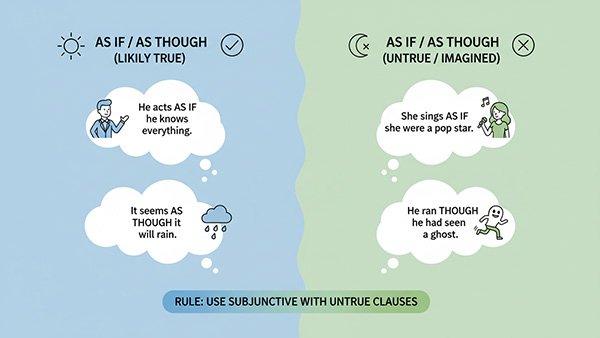
The verb in the subordinate clause often takes the past subjunctive form, which is identical to the simple past form except for the verb “to be,” where “were” is used for all persons (e.g., I were, he/she/it were, we were, you were, they were). This is particularly common when expressing something that is contrary to fact.
For example:
He acts as if he were the boss. (He is not the boss, but he acts like he is.)
However, if the situation is possible or likely, the verb in the subordinate clause may be in the same tense as the main clause, or in a tense that logically follows from it.
For example:
It looks as if it will rain soon. (It is likely to rain soon.)
3. Types and Categories
The use of ‘as if’ and ‘as though’ can be categorized based on the degree of unreality or hypotheticality they express. Here are the main categories:
3.1. Contrary-to-Fact Situations
This is the most common usage, where the subordinate clause describes a situation that is known to be untrue. In these cases, the past subjunctive is typically used.
Example: She talks as if she knew everything. (She doesn’t know everything.)
3.2. Possible or Likely Situations
When the subordinate clause describes a situation that is possible or likely, the verb tense often matches the tense in the main clause, or uses a future tense form.
Example: It seems as though it is going to be a long day. (It is likely to be a long day.)
3.3. Comparisons of Manner or Appearance
‘As if’ and ‘as though’ can also be used to simply compare the manner in which someone does something or the way something appears.
Example: He ran as if his life depended on it. (He ran very fast.)
3.4. Expressing Doubt or Uncertainty
These phrases can introduce a sense of doubt or uncertainty about a situation.
Example: He looked as though he hadn’t slept in days. (It was not certain if he had slept.)
4. Examples
The following tables provide a variety of examples illustrating the different uses of ‘as if’ and ‘as though.’
4.1. Contrary-to-Fact Examples
This table demonstrates the use of ‘as if’ and ‘as though’ to describe situations that are known to be untrue, often using the past subjunctive.
| Sentence | Explanation |
|---|---|
| He acts as if he were a king. | He is not a king, but he acts like one. |
| She speaks as though she had been there. | She was not there, but she speaks as if she were. |
| They behaved as if they owned the place. | They don’t own the place, but they acted like they did. |
| It seems as if nothing had happened. | Something happened, but it seems like it didn’t. |
| He looked as though he had seen a ghost. | He probably didn’t see a ghost, but he looked scared. |
| She smiled as if she knew a secret. | She probably doesn’t know a secret, but her smile suggests it. |
| They argued as if their lives depended on it. | Their lives did not depend on it, but they argued intensely. |
| He treated her as if she were a child. | She is not a child, but he treats her like one. |
| She ignored him as though he didn’t exist. | He exists, but she ignored him. |
| He walked as if he were injured. | He wasn’t injured, but he walked with a limp. |
| She sang as though she were an opera star. | She’s not an opera star, but she sang beautifully. |
| He danced as if he had no bones in his body. | He has bones, but he danced very fluidly. |
| She painted as if she were a master artist. | She’s not a master artist, but her painting is excellent. |
| He wrote as though he were a famous author. | He’s not a famous author, but his writing is impressive. |
| She cooked as if she were a professional chef. | She’s not a professional chef, but her cooking is delicious. |
| He spoke as though he had all the answers. | He doesn’t have all the answers, but he spoke confidently. |
| She laughed as if she hadn’t a care in the world. | She does have cares, but she laughed freely. |
| He cried as if his heart were breaking. | His heart might not be breaking, but he cried deeply. |
| She slept as though she were dead. | She’s not dead, but she slept very soundly. |
| He ate as if he hadn’t eaten in days. | He had eaten recently, but he ate voraciously. |
| She dressed as if she were going to a ball. | She wasn’t going to a ball, but she dressed elegantly. |
| He worked as if he were trying to save the world. | He’s not saving the world, but he worked diligently. |
4.2. Possible or Likely Situations Examples
This table illustrates the use of ‘as if’ and ‘as though’ to describe situations that are possible or likely, often using tenses that reflect the likelihood.
| Sentence | Explanation |
|---|---|
| It looks as if it is going to rain. | It is likely to rain soon. |
| It seems as though he will arrive soon. | He is expected to arrive shortly. |
| She looks as if she needs a break. | It seems likely that she needs a break. |
| He sounds as though he is very busy. | It seems likely that he is busy. |
| It feels as if winter is coming. | Winter is likely to arrive soon. |
| She acts as if she knows what she’s doing. | It’s likely she knows what she’s doing. |
| He talks as if he has a plan. | It’s possible he has a plan. |
| It appears as though the meeting is about to start. | The meeting is likely to start soon. |
| She seems as if she is happy. | It appears that she is happy. |
| He looks as though he is tired. | It appears that he is tired. |
| She acts as if she wants to help. | It seems she wants to help. |
| He speaks as if he is in charge. | It appears he is in charge. |
| It feels as though spring is in the air. | Spring seems to be arriving. |
| She looks as if she is expecting someone. | It seems she is waiting for someone. |
| He acts as if he is the only one who knows. | It seems he thinks he’s the only one who knows. |
| She talks as if she is an expert. | It seems she considers herself an expert. |
| He looks as though he has been working hard. | It appears he has been working hard. |
| She seems as if she has a secret. | It appears she has a secret. |
| He acts as if he is always right. | It seems he thinks he’s always right. |
| She speaks as if she is telling the truth. | It appears she is telling the truth. |
| He looks as though he is going to cry. | It appears he is about to cry. |
| She acts as if she is afraid. | It seems she is scared. |
| He talks as if he is very important. | It appears he thinks he is very important. |
4.3. Comparisons of Manner or Appearance Examples
This table provides examples of ‘as if’ and ‘as though’ used to compare the manner in which someone does something or the way something appears.
| Sentence | Explanation |
|---|---|
| He ran as if his life depended on it. | He ran very fast. |
| She sang as though her heart was breaking. | She sang with great emotion. |
| He ate as if he were starving. | He ate very quickly and greedily. |
| She danced as though she had wings. | She danced gracefully and lightly. |
| He worked as if he were possessed. | He worked with great energy and focus. |
| She spoke as if she were reciting a poem. | She spoke with rhythm and elegance. |
| He walked as if he were on a mission. | He walked purposefully and quickly. |
| She laughed as though she had heard the funniest joke. | She laughed heartily. |
| He cried as if he had lost everything. | He cried deeply and sorrowfully. |
| She smiled as though she had won the lottery. | She smiled broadly and happily. |
| He slept as if he were dead to the world. | He slept soundly and deeply. |
| She dressed as if she were going to a party. | She dressed elegantly and festively. |
| He argued as if he were defending his honor. | He argued passionately and fiercely. |
| She listened as though she were hearing the most important news. | She listened attentively and intently. |
| He watched as if he were seeing a miracle. | He watched with amazement and wonder. |
| She painted as if she were capturing a dream. | She painted expressively and imaginatively. |
| He wrote as if he were composing a symphony. | He wrote meticulously and artistically. |
| She cooked as if she were creating a masterpiece. | She cooked with skill and creativity. |
| He spoke as if he were giving a speech. | He spoke formally and eloquently. |
| She moved as if she were floating on air. | She moved gracefully and effortlessly. |
| He worked as if he were building a legacy. | He worked diligently and purposefully. |
| She danced as if she were telling a story. | She danced expressively and meaningfully. |
| He sang as if he were pouring out his soul. | He sang emotionally and passionately. |
5. Usage Rules
The correct usage of ‘as if’ and ‘as though’ involves several key rules:
5.1. Subjunctive Mood
When expressing something contrary to fact or highly improbable, use the past subjunctive in the subordinate clause. This is most noticeable with the verb “to be,” where “were” is used for all persons.
Example: If I were you, I would apologize. (I am not you.)
In ‘as if’ and ‘as though’ clauses:
He acts as if he were rich. (He is not rich.)
5.2. Tense Consistency
Ensure that the tense in the subordinate clause logically relates to the tense in the main clause. If the action in the subordinate clause happened before the action in the main clause, use the past perfect.
Example: He spoke as though he had known her for years. (He knew her before he spoke.)
5.3. Real vs. Unreal Conditions
If the situation is possible or likely, the subjunctive mood is not necessary. Use the appropriate indicative tense.
Example: It looks as if it will rain later. (It is likely to rain.)
5.4. Interchangeability
In most cases, ‘as if’ and ‘as though’ are interchangeable. However, ‘as though’ is sometimes considered more formal.
Example: He looked as if/as though he was tired.
When choosing between these phrases, it can be helpful to think of them in pairs: *as if as though*, *as though vs as if*, and *as if vs as though*. While they are often interchangeable, subtle differences can appear depending on formality, tone, or regional usage. For instance, in formal writing, ‘as though’ may be preferred, whereas casual speech often favors ‘as if.’
5.5. Avoiding Double Subjunctives
Do not use a subjunctive form in the main clause when ‘as if’ or ‘as though’ introduces the subordinate clause. The subjunctive mood is only required in the subordinate clause when expressing something contrary to fact.
Incorrect: I wish he were as if he were rich.
Correct: I wish he were rich. or He acts as if he were rich.
6. Common Mistakes
Several common mistakes can occur when using ‘as if’ and ‘as though.’ Understanding these errors can help you avoid them.
6.1. Incorrect Tense Usage
Using the wrong tense in the subordinate clause is a frequent error. For example, using the present tense when the past subjunctive is required.
Incorrect: He acts as if he is the boss. (when he is not the boss)
Correct: He acts as if he were the boss.
6.2. Omitting the Subjunctive
Failing to use the past subjunctive when expressing something contrary to fact is another common mistake.
Incorrect: She talks as if she was there. (when she wasn’t there)
Correct: She talks as if she had been there.
6.3. Using ‘Like’ Instead of ‘As If’ or ‘As Though’
Using ‘like’ instead of ‘as if’ or ‘as though’ to introduce a clause is grammatically incorrect in formal writing.
Incorrect: He acted like he was the boss.
Correct: He acted as if he were the boss. or He acted as though he were the boss.
6.4. Double Subjunctives
Using a subjunctive in both the main and subordinate clauses is incorrect.
Incorrect: I wish he were as if he were rich.
Correct: I wish he were rich. or He acts as if he were rich.
6.5. Confusing with ‘If’ Clauses
While both ‘as if/as though’ and ‘if’ clauses can express hypothetical situations, ‘as if/as though’ implies a stronger sense of unreality or pretense. Be mindful of the nuance you want to convey.
Example with ‘if’: If I were rich, I would travel the world. (Hypothetical, but potentially possible)
Example with ‘as if’: He acts as if he were rich. (Implies he is definitely not rich)
7. Practice Exercises
Test your understanding of ‘as if’ and ‘as though’ with the following exercises.
7.1. Exercise 1: Fill in the Blanks
Complete the following sentences with the correct form of the verb in parentheses, using ‘as if’ or ‘as though.’
| Question | Answer |
|---|---|
| 1. He spends money ________ he (be) a millionaire. | as if he were a millionaire. |
| 2. She looked ________ she (see) a ghost. | as though she had seen a ghost. |
| 3. They talked ________ they (know) everything. | as if they knew everything. |
| 4. It seems ________ it (rain) soon. | as if it will rain soon. |
| 5. He behaved ________ he (own) the company. | as though he owned the company. |
| 6. She sings ________ she (be) an angel. | as if she were an angel. |
| 7. He walked ________ he (have) a limp. | as though he had a limp. |
| 8. She smiled ________ she (know) a secret. | as if she knew a secret. |
| 9. They argued ________ their lives (depend) on it. | as if their lives depended on it. |
| 10. He treated her ________ she (be) a child. | as if she were a child. |
7.2. Exercise 2: Correct the Errors
Identify and correct the errors in the following sentences.
| Question | Answer |
|---|---|
| 1. He acts like he is the boss. | He acts as if/as though he were the boss. |
| 2. She talks as if she was there, but she wasn’t. | She talks as if she had been there, but she wasn’t. |
| 3. They behave as if they own this place. | They behave as if/as though they owned this place. |
| 4. It seems as if it rain tomorrow. | It seems as if it will rain tomorrow. |
| 5. He looked as though he didn’t slept all night. | He looked as though he hadn’t slept all night. |
| 6. She sings as if she is a professional. | She sings as if/as though she were a professional. |
| 7. He walked as if he has an injury. | He walked as if/as though he had an injury. |
| 8. She smiled as if she knowed something. | She smiled as if/as though she knew something. |
| 9. They argued as if their lives are depending on it. | They argued as if/as though their lives depended on it. |
| 10. He treated her as if she is his daughter. | He treated her as if/as though she were his daughter. |
7.3. Exercise 3: Sentence Transformation
Rewrite the following sentences using ‘as if’ or ‘as though’ to express the same meaning.
| Question | Answer |
|---|---|
| 1. He is not rich, but he acts like it. | He acts as if/as though he were rich. |
| 2. She wasn’t there, but she speaks as if she experienced it. | She speaks as if/as though she had been there. |
| 3. They don’t own the house, but they behave like they do. | They behave as if/as though they owned the house. |
| 4. It is likely to rain soon, so it looks like it. | It looks as if/as though it will rain soon. |
| 5. He probably didn’t sleep, but he looks like he didn’t. | He looks as if/as though he hadn’t slept. |
| 6. She is not an artist, but she sings like one. | She sings as if/as though she were an artist. |
| 7. He wasn’t hurt, but he walked like he was. | He walked as if/as though he had been hurt. |
| 8. She knows a secret, or at least she smiles that way. | She smiles as if/as though she knew a secret. |
| 9. Their lives didn’t depend on it, but they argued intensely. | They argued as if/as though their lives depended on it. |
| 10. She is not a child, but he treats her that way. | He treats her as if/as though she were a child. |
8. Advanced Topics
For advanced learners, here are some more complex aspects of ‘as if’ and ‘as though’:
8.1. Inversion with ‘As If’ and ‘As Though’
In formal or literary contexts, inversion can be used with ‘as if’ and ‘as though’ for emphasis. This involves placing the auxiliary verb before the subject.
Example: He spoke as though were he a seasoned diplomat. (More formal than: He spoke as though he were a seasoned diplomat.)
8.2. Ellipsis in ‘As If’ and ‘As Though’ Clauses
Ellipsis, the omission of words that are understood from the context, is common in ‘as if’ and ‘as though’ clauses, especially when the subject and auxiliary verb are repeated from the main clause.
Example: He looked as though he might faint, and so he did. (Ellipsis: *as though he might faint*)
8.3. ‘As If’ and ‘As Though’ with Modal Verbs
‘As if’ and ‘as though’ can be used with modal verbs (e.g., could, would, should, might) to express varying degrees of possibility, ability, or obligation in the hypothetical situation.
Example: He acted as if he could do anything. (Implies he believes he is capable of anything.)
9. Frequently Asked Questions (FAQ)
Here are some common questions about ‘as if’ and ‘as though’:
Is there a difference between ‘as if’ and ‘as though’?
In most cases, ‘as if’ and ‘as though’ are interchangeable and have the same meaning. However, some people consider ‘as though’ to be slightly more formal than ‘as if.’ The choice between them often comes down to personal preference or stylistic considerations. In general, both are widely accepted and understood.
When should I use the subjunctive mood with ‘as if’ or ‘as though’?
Use the subjunctive mood when the subordinate clause expresses a situation that is contrary to fact or highly improbable. This is particularly important with the verb “to be,” where “were” is used for all persons (e.g., I were, he/she/it were, we were, you were, they were). This indicates that the situation is not true or is very unlikely to be true.
Can I use ‘like’ instead of ‘as if’ or ‘as though’?
In informal speech, ‘like’ is often used instead of ‘as if’ or ‘as though.’ However, in formal writing and more careful speech, it is generally considered grammatically incorrect to use ‘like’ to introduce a clause. Stick to ‘as if’ or ‘as though’ in these contexts to maintain accuracy and professionalism.
What tense should I use in the ‘as if’ or ‘as though’ clause?
The tense in the ‘as if’ or ‘as though’ clause depends on the relationship between the main clause and the hypothetical situation. If the situation is contrary to fact, use the past subjunctive. If the situation is possible or likely, use the appropriate indicative tense. If the action in the subordinate clause happened before the action in the main clause, use the past perfect.
How do I avoid common mistakes with ‘as if’ and ‘as though’?
To avoid common mistakes, pay close attention to tense consistency, use the subjunctive mood when necessary, and avoid using ‘like’ instead of ‘as if’ or ‘as though’ in formal contexts. Practice using these phrases in different contexts to solidify your understanding.
What are some advanced uses of ‘as if’ and ‘as though’?
Advanced uses include inversion for emphasis, ellipsis for conciseness, and using modal verbs to express varying degrees of possibility or obligation. These techniques can add nuance and sophistication to your writing and speech.
Can ‘as if’ and ‘as though’ be used in questions?
While less common, ‘as if’ and ‘as though’ can be used in questions, typically in rhetorical questions or questions expressing surprise or disbelief. For example: “Do you act as if you own the place?”
How can I improve my understanding of ‘as if’ and ‘as though’?
Practice, practice, practice! Read examples, do exercises, and try using these phrases in your own writing and speech. Pay attention to how native speakers use them and ask for feedback on your own usage. The more you practice, the more confident and accurate you will become.
Conclusion
Mastering ‘as if’ and ‘as though’ is a valuable step in enhancing your English grammar skills. These conjunctions allow you to express hypothetical situations, comparisons, and assumptions with precision and nuance.
By understanding their definitions, structures, usage rules, and common mistakes, you can confidently incorporate them into your writing and speech.
Remember to pay attention to tense consistency, use the subjunctive mood when necessary, and practice using these phrases in various contexts. With consistent effort, you will be able to use ‘as if’ and ‘as though’ effectively and accurately, adding depth and sophistication to your communication.
Continue to explore and practice these concepts to further refine your understanding of English grammar. Happy learning!