
Understanding the difference between “bright” and “brightly” is crucial for accurate and effective communication in English. These words, though closely related, serve distinct grammatical functions.
“Bright” is primarily used as an adjective to describe nouns, while “brightly” functions as an adverb, modifying verbs, adjectives, or other adverbs. Knowing when to use each form enhances the clarity and precision of your writing and speaking.
This guide provides a comprehensive overview of their usage, rules, and common pitfalls, suitable for English language learners of all levels.
This article will benefit anyone looking to refine their understanding of adjectives and adverbs. From students preparing for exams to professionals aiming for clearer communication, mastering “bright” and “brightly” will significantly improve your grasp of English grammar.
By exploring definitions, examples, and practice exercises, you will gain the confidence to use these words correctly in various contexts.
Table of Contents
- Definition of Bright and Brightly
- Structural Breakdown
- Types and Categories
- Examples of Bright and Brightly
- Usage Rules
- Common Mistakes
- Practice Exercises
- Advanced Topics
- FAQ
- Conclusion
Definition of Bright and Brightly
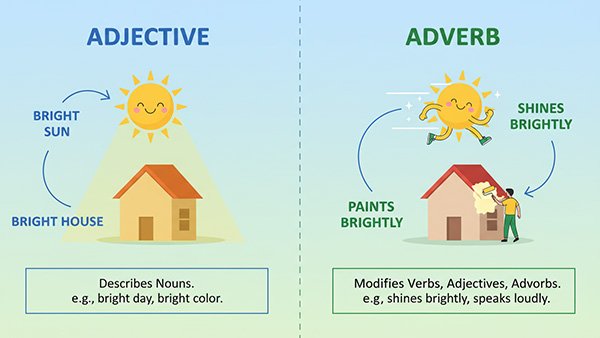
“Bright” and “brightly” are related words, but they have distinct grammatical roles. Understanding these roles is essential for using them correctly.
Bright (Adjective)
As an adjective, “bright” describes a noun. It indicates a quality of being luminous, intelligent, or cheerful.
It can refer to physical light, intellectual ability, or emotional disposition. The word “bright” generally means something that emits a lot of light, is intelligent, or is full of happiness.
It is used to describe the qualities or states of nouns.
Classification: Adjective
Function: Modifies nouns
Contexts: Physical descriptions (e.g., “a bright light”), intellectual descriptions (e.g., “a bright student”), emotional descriptions (e.g., “a bright smile”).
Brightly (Adverb)
As an adverb, “brightly” modifies a verb, adjective, or another adverb. It describes how something is done or to what extent something is.
It indicates the manner in which an action is performed or the degree to which a quality is present. The word “brightly” generally means in a way that is full of light, intelligent, or cheerful.
It is used to describe how actions are performed or to what extent qualities are present.
Classification: Adverb
Function: Modifies verbs, adjectives, or other adverbs
It is important to note that “brightly” is never used as a noun or a preposition. Its role in English grammar is strictly as an adverb, modifying verbs, adjectives, or other adverbs. While some learners might wonder if “brightly” could function as a noun or preposition due to its form, such uses do not exist in standard English. Remembering that “brightly” exclusively conveys how an action is performed or to what degree a quality is present will help prevent confusion.
Contexts: Describing actions (e.g., “The sun shone brightly”), modifying adjectives (e.g., “brightly colored”), modifying adverbs (e.g., “shining brightly”).
Structural Breakdown
Understanding the structural elements of “bright” and “brightly” can help you use them correctly in sentences. “Bright” is a base adjective, while “brightly” is formed by adding the suffix “-ly” to “bright.” This suffix transforms the adjective into an adverb.
Formation of “Brightly”
The adverb “brightly” is derived from the adjective “bright” by adding the suffix “-ly.” This is a common way to form adverbs in English, especially adverbs of manner. The process is straightforward: take the adjective and add “-ly” to the end.
Adjective + -ly = Adverb
Bright + -ly = Brightly
Placement in Sentences
The placement of “bright” and “brightly” in a sentence depends on their grammatical function. Adjectives typically precede the nouns they modify, while adverbs can appear in various positions, depending on what they modify.
- Adjective “Bright”: Usually placed before the noun (e.g., “a bright star”).
- Adverb “Brightly”: Can be placed before the verb it modifies, after the verb, or at the end of the sentence (e.g., “The star shone brightly.”).
Types and Categories
While “bright” and “brightly” primarily function as an adjective and adverb, respectively, they can be further categorized based on their specific usage.
Types of “Bright” (Adjective)
- Descriptive: Describes a physical quality (e.g., “The bright light hurt my eyes.”).
- Intellectual: Describes intelligence or mental capacity (e.g., “She is a bright student.”).
- Emotional: Describes a cheerful or optimistic disposition (e.g., “He has a bright outlook on life.”).
Types of “Brightly” (Adverb)
- Manner: Describes how an action is performed (e.g., “The sun shone brightly.”).
- Degree: Indicates the extent to which a quality is present (e.g., “The sign was brightly colored.”).
Examples of Bright and Brightly
The following examples illustrate the correct usage of “bright” and “brightly” in various contexts.
Examples of “Bright” (Adjective)
The following table provides multiple examples of “bright” used as an adjective, demonstrating its various applications in describing physical attributes, intelligence, and emotional states.
| Category | Example Sentence |
|---|---|
| Physical Description | The bright sun illuminated the field. |
| Physical Description | She wore a bright yellow dress. |
| Physical Description | The room was filled with bright sunlight. |
| Physical Description | He saw a bright flash of light. |
| Physical Description | The bright stars twinkled in the night sky. |
| Intellectual Description | He is a bright student with a promising future. |
| Intellectual Description | She has a bright mind and learns quickly. |
| Intellectual Description | The professor praised the bright ideas presented in the essay. |
| Intellectual Description | It was a bright decision to invest in the company. |
| Intellectual Description | The team needs a bright solution to this problem. |
| Emotional Description | She has a bright smile that lights up the room. |
| Emotional Description | He maintained a bright attitude despite the challenges. |
| Emotional Description | They shared a bright and cheerful conversation. |
| Emotional Description | The children’s laughter created a bright atmosphere. |
| Emotional Description | She has a bright personality and is always positive. |
| General Description | It was a bright morning, perfect for a walk. |
| General Description | The future looks bright for the graduates. |
| General Description | The city is known for its bright and colorful festivals. |
| General Description | The artist used bright colors in the painting. |
| General Description | The room was decorated with bright balloons for the party. |
| Figurative Description | She is a bright spark in the organization. |
| Figurative Description | He is a bright light in a dark world. |
| Figurative Description | The project has a bright future ahead. |
| Figurative Description | Her talent shone bright during the performance. |
| Figurative Description | The team’s performance was a bright spot in the season. |
Examples of “Brightly” (Adverb)
The following table provides multiple examples of “brightly” used as an adverb, demonstrating its role in modifying verbs, adjectives, and other adverbs. These examples showcase how “brightly” describes the manner in which actions are performed and the degree to which qualities are present.
| Modified Element | Example Sentence |
|---|---|
| Verb | The sun shone brightly. |
| Verb | The stars twinkled brightly in the clear sky. |
| Verb | The candles burned brightly throughout the night. |
| Verb | The lanterns glowed brightly, guiding the way. |
| Verb | The fire blazed brightly in the hearth. |
| Adjective | The room was brightly lit. |
| Adjective | The sign was brightly colored to attract attention. |
| Adjective | The posters were brightly designed. |
| Adjective | The children’s faces were brightly painted for the festival. |
| Adjective | The decorations were brightly arranged to create a festive atmosphere. |
| Adverb | The car’s headlights shone brightly ahead. |
| Adverb | The dancers moved brightly and energetically across the stage. |
| Adverb | The performer smiled brightly at the audience. |
| Adverb | The children laughed brightly as they played in the park. |
| Adverb | The artist portrayed the scene brightly and vividly. |
| General Use | She dressed brightly for the occasion. |
| General Use | The stage was brightly decorated. |
| General Use | The fireworks exploded brightly in the sky. |
| General Use | The city was brightly illuminated during the celebration. |
| General Use | The room was brightly furnished with modern decor. |
| Figurative Use | His future shone brightly after his success. |
| Figurative Use | Her talent shone brightly during the competition. |
| Figurative Use | The team’s prospects appeared brightly optimistic. |
| Figurative Use | The company’s performance was viewed brightly by investors. |
| Figurative Use | The new project was brightly anticipated by the community. |
Comparison of “Bright” and “Brightly”
This table offers a direct comparison of “bright” and “brightly,” highlighting their different functions and providing example sentences for each.
| Word | Grammatical Function | Example Sentence |
|---|---|---|
| Bright | Adjective (modifies a noun) | The bright moon illuminated the path. |
| Brightly | Adverb (modifies a verb) | The moon shone brightly on the path. |
| Bright | Adjective (modifies a noun) | She is a bright student. |
| Brightly | Adverb (modifies a verb) | She performed brightly in the exam. |
| Bright | Adjective (modifies a noun) | He has a bright future ahead. |
| Brightly | Adverb (modifies a verb) | His prospects shone brightly. |
Usage Rules
To use “bright” and “brightly” correctly, it’s essential to follow specific grammatical rules. These rules dictate when to use the adjective form and when to use the adverb form.
Rule 1: Use “Bright” to Describe Nouns
When you want to describe a noun, use the adjective “bright.” This includes physical objects, people, ideas, or any other noun.
Example: “The bright sun warmed the earth.” (Here, “bright” describes the noun “sun.”)
Rule 2: Use “Brightly” to Modify Verbs, Adjectives, or Adverbs
When you want to describe how an action is performed (modifying a verb) or to what extent a quality is present (modifying an adjective or another adverb), use the adverb “brightly.”
Example: “The stars shone brightly.” (Here, “brightly” describes how the verb “shone” was performed.)
Example: “The shirt was brightly colored.” (Here, “brightly” describes the adjective “colored.”)
Exceptions and Special Cases
While the rules are generally straightforward, there are a few exceptions and special cases to consider.
- Linking Verbs: After linking verbs (e.g., be, seem, appear, look, feel, become), use the adjective “bright” to describe the subject. For example, “The room looked bright.”
- Compound Adjectives: In compound adjectives, “bright” can be used before a noun to create a more descriptive term. For example, “bright-eyed children.”
Common Mistakes
One of the most common mistakes learners make is confusing “bright” and “brightly.” Here are some examples of common errors and their corrections.
The following table shows common mistakes made while using “bright” and “brightly” along with the correct usage and explanations.
| Incorrect | Correct | Explanation |
|---|---|---|
| The sun shone bright. | The sun shone brightly. | “Shone” is a verb, so it needs to be modified by the adverb “brightly.” |
| She has a brightly smile. | She has a bright smile. | “Smile” is a noun, so it needs to be described by the adjective “bright.” |
| The room was bright lit. | The room was brightly lit. | “Lit” is an adjective, so it needs to be modified by the adverb “brightly.” |
| He is a brightly student. | He is a bright student. | “Student” is a noun, so it needs to be described by the adjective “bright.” |
| The stars were bright shining. | The stars were brightly shining. | “Shining” is a verb, so it needs to be modified by the adverb “brightly.” |
| The future looks brightly. | The future looks bright. | “Looks” is a linking verb, requiring the adjective “bright” to describe the subject “future.” |
| She dressed bright for the party. | She dressed brightly for the party. | “Dressed” is a verb, so it needs to be modified by the adverb “brightly.” |
Practice Exercises
Test your understanding of “bright” and “brightly” with these practice exercises.
Exercise 1: Fill in the Blanks
Choose the correct word (“bright” or “brightly”) to fill in the blanks in the following sentences. This exercise helps reinforce the difference between using “bright” as an adjective and “brightly” as an adverb in various contexts.
| Question | Answer |
|---|---|
| 1. The ______ light of the lamp illuminated the room. | bright |
| 2. The stars twinkled ______ in the night sky. | brightly |
| 3. She has a ______ future ahead of her. | bright |
| 4. The children laughed ______ as they played. | brightly |
| 5. He is a ______ student in the class. | bright |
| 6. The sun shone ______ on the beach. | brightly |
| 7. She wore a ______ red dress. | bright |
| 8. The candles burned ______ throughout the evening. | brightly |
| 9. It was a ______ idea to start a business. | bright |
| 10. The room was ______ decorated for the party. | brightly |
Exercise 2: Correct the Sentences
Identify and correct the errors in the following sentences. This exercise tests your ability to recognize and fix common mistakes in the usage of “bright” and “brightly.”
| Question | Answer |
|---|---|
| 1. The moon shone bright on the water. | The moon shone brightly on the water. |
| 2. She has a brightly smile. | She has a bright smile. |
| 3. He performed bright in the competition. | He performed brightly in the competition. |
| 4. The lights were bright shining. | The lights were brightly shining. |
| 5. The future looks brightly for her. | The future looks bright for her. |
| 6. The room was bright lit. | The room was brightly lit. |
| 7. She is a brightly student. | She is a bright student. |
| 8. The stars twinkle bright in the sky. | The stars twinkle brightly in the sky. |
| 9. He answered the question bright. | He answered the question brightly. |
| 10. The painting was bright colored. | The painting was brightly colored. |
Exercise 3: Sentence Construction
Create your own sentences using “bright” and “brightly” in different contexts. This exercise encourages you to actively apply your understanding of “bright” and “brightly” by constructing your own sentences, ensuring correct usage in diverse scenarios.
Instructions: Write five sentences using “bright” as an adjective and five sentences using “brightly” as an adverb.
Example Sentences:
- Bright (Adjective): The bright sun made it a perfect day for a picnic.
- Brightly (Adverb): The children laughed brightly as they opened their presents.
Your Sentences: (Answers will vary)
- Bright (Adjective): _________________________________________________________
- Bright (Adjective): _________________________________________________________
- Bright (Adjective): _________________________________________________________
- Bright (Adjective): _________________________________________________________
- Bright (Adjective): _________________________________________________________
- Brightly (Adverb): _________________________________________________________
- Brightly (Adverb): _________________________________________________________
- Brightly (Adverb): _________________________________________________________
- Brightly (Adverb): _________________________________________________________
- Brightly (Adverb): _________________________________________________________
Advanced Topics
For advanced learners, exploring more nuanced aspects of “bright” and “brightly” can further refine their understanding.
Figurative Language
“Bright” and “brightly” are often used in figurative language to convey deeper meanings. For example, “a bright future” does not literally mean a future filled with light; it means a promising and successful future.
Examples:
- “She is a bright spark in the company.” (Metaphor for intelligence and innovation)
- “His talent shone brightly on the stage.” (Metaphor for exceptional performance)
Formal vs. Informal Usage
While both “bright” and “brightly” are acceptable in formal and informal contexts, the choice between them can subtly affect the tone of your writing or speech. “Brightly” can sometimes sound more formal or emphatic than “bright.”
Regional Variations
In some regional dialects, the usage of adverbs ending in “-ly” may vary. It’s important to be aware of these variations, but generally, adhering to standard English grammar rules will ensure clear communication.
FAQ
Here are some frequently asked questions about the usage of “bright” and “brightly.”
Q: When should I use “bright” instead of “brightly”?
A: Use “bright” when you want to describe a noun. “Bright” is an adjective, so it modifies nouns. For example, “a bright light,” “a bright student,” or “a bright future.”
Q: Can “brightly” be used to describe adjectives?
A: Yes, “brightly” can be used to modify adjectives. In such cases, it indicates the degree to which the quality described by the adjective is present. For example, “brightly colored.”
Q: Is it ever correct to say “the sun shone bright”?
A: While grammatically incorrect in standard English, phrases like “the sun shone bright” may occasionally appear in informal speech or literature for stylistic effect. However, the correct form is “the sun shone brightly.”
Q: What is the difference between “bright” and “shiny”?
A: “Bright” generally refers to emitting or reflecting a lot of light or being intelligent. “Shiny” specifically refers to reflecting light well, often implying a smooth surface. A diamond can be both bright and shiny, but a student can only be bright.
Q: Can “brightly” modify another adverb?
A: Yes, “brightly” can modify another adverb, though this usage is less common. It would describe the degree to which the other adverb applies. For example, “The stage was lit brightly enough.”
Q: How do I remember when to use “bright” vs. “brightly”?
A: Think of “bright” as a descriptor of things (nouns) and “brightly” as a descriptor of actions (verbs) or qualities (adjectives/adverbs). If you’re describing a noun, use “bright.” If you’re describing how something is done, use “brightly.”
Q: Are there any other words that follow the same rule as “bright” and “brightly”?
A: Yes, many adjectives can be turned into adverbs by adding “-ly” (e.g., quick/quickly, slow/slowly, loud/loudly). The same rules apply: use the adjective to describe nouns and the adverb to describe verbs, adjectives, or other adverbs.
Q: What are some common synonyms for “bright” and “brightly”?
A: Synonyms for “bright” include luminous, radiant, intelligent, and cheerful. Synonyms for “brightly” include luminously, radiantly, intelligently, and cheerfully.
Conclusion
Mastering the distinction between “bright” and “brightly” is essential for clear and accurate communication in English. “Bright” functions as an adjective, describing nouns, while “brightly” serves as an adverb, modifying verbs, adjectives, or other adverbs.
Understanding this fundamental difference allows you to express your ideas with precision and confidence.
By remembering the basic rules, recognizing common mistakes, and practicing with examples, you can significantly improve your command of these words. Keep in mind that “bright” describes qualities of nouns, whereas “brightly” describes how actions are performed or the degree to which qualities are present.
With consistent practice, you’ll be able to use “bright” and “brightly” correctly in any context, enhancing the clarity and effectiveness of your communication.