The modal verb ‘might’ is a cornerstone of English grammar, expressing possibility, politeness, and tentative suggestions. Understanding its nuances is crucial for effective communication, enabling you to convey uncertainty or make gentle requests.
This article provides an in-depth exploration of ‘might,’ covering its definition, structure, various uses, and common mistakes. Whether you’re a beginner or an advanced learner, this guide will equip you with the knowledge and practice to confidently use ‘might’ in your everyday language.
This comprehensive guide focuses on the complete use of “might” in English grammar. It is designed for English language learners, students, and anyone looking to refine their understanding and usage of modal verbs.
By the end of this article, you will have a solid grasp of how to use “might” correctly and effectively in various contexts.
Table of Contents
- Introduction
- Definition of ‘Might’
- Structural Breakdown
- Types and Categories of ‘Might’ Usage
- Examples of ‘Might’ in Use
- Usage Rules for ‘Might’
- Common Mistakes with ‘Might’
- Practice Exercises
- Advanced Topics
- Frequently Asked Questions (FAQ)
- Conclusion
Definition of ‘Might’
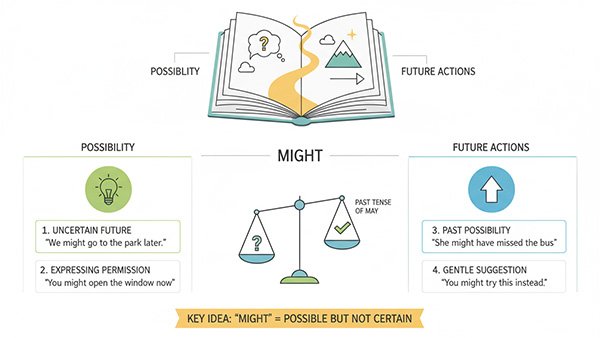
‘Might’ is a modal verb in English grammar. To clarify, ‘might’ is classified as a modal verb, a type of auxiliary verb used to modify the main verb by expressing possibility, politeness, or uncertainty. You use ‘might’ whenever you want to indicate that something is possible but not certain, to offer tentative suggestions, or to make very polite requests.
Choosing the right context is essential: for instance, in casual conversation, other modals like ‘may’ or ‘could’ might feel more natural, while ‘might’ is preferred in professional or formal settings. By understanding the situations where ‘might’ is appropriate, you can apply it confidently and accurately.
Modal verbs are auxiliary verbs that express modality, such as possibility, probability, permission, obligation, or necessity. ‘Might’ primarily expresses possibility, politeness, and tentative suggestions. Its strength lies in conveying a lower degree of certainty compared to other modal verbs like ‘will’ or ‘must’.
The function of ‘might’ is to modify the main verb in a sentence, adding a layer of meaning related to the likelihood or manner of the action. It can also be used to soften requests or suggestions, making them more courteous.
The contexts in which ‘might’ is used vary widely, from everyday conversations to formal writing, and its specific meaning is often determined by the surrounding words and the overall situation.
Structural Breakdown
Basic Structure
The basic structure for using ‘might’ in a sentence is as follows:
Subject + Might + Base Form of Verb
For example: I might go to the party. Here, ‘I’ is the subject, ‘might’ is the modal verb, and ‘go’ is the base form of the verb.
Negative Structure
To form a negative sentence with ‘might,’ we add ‘not’ after ‘might’. The contracted form ‘mightn’t’ is also acceptable, though less common in American English.
Subject + Might + Not + Base Form of Verb
or
Subject + Mightn’t + Base Form of Verb
For example: She might not come to the meeting. Or, She mightn’t come to the meeting.
Interrogative Structure
To form a question with ‘might,’ we invert the subject and ‘might’.
Might + Subject + Base Form of Verb?
For example: Might I borrow your pen? This structure is primarily used for very polite requests or formal inquiries.
Types and Categories of ‘Might’ Usage
Expressing Possibility
One of the most common uses of ‘might’ is to express possibility. It indicates that something is possible but not certain.
The degree of possibility is generally lower than when using ‘may’.
Example: It might rain tomorrow. This suggests that there is a chance of rain, but it is not a strong prediction.
The uses of the ‘might’ model encompass several key functions in English. It expresses possibility (“It might rain tomorrow”), indicates a polite or formal request (“Might I borrow your pen?”), suggests tentative actions (“You might want to review your plan”), and appears in conditional or reported speech contexts. Understanding these patterns, or models of usage, helps learners identify the most appropriate situations for employing ‘might’ effectively.
Making Polite Requests
‘Might’ can be used to make very polite requests, often in formal situations. This usage is considered more formal and tentative than using ‘can’ or ‘could’.
Example: Might I ask a question? This is a more formal and polite way of asking ‘Can I ask a question?’
Offering Tentative Suggestions
‘Might’ can also be used to offer suggestions in a tentative or hesitant manner. It softens the suggestion, making it less direct.
Example: You might want to consider this option. This suggests an option without being forceful.
Conditional Sentences
In conditional sentences, ‘might’ is often used in the main clause to express a possible result if the condition is met. This usually applies to second and third conditional sentences.
Example: If I had more time, I might learn to play the guitar. This suggests a possible outcome if the condition of having more time is fulfilled.
Reported Speech
When reporting what someone said, ‘may’ often changes to ‘might’ if the reporting verb is in the past tense.
Example: He said he might be late. This reports what someone said, where the original statement might have been ‘I may be late’.
Examples of ‘Might’ in Use
Examples of ‘Might’ Expressing Possibility
The following table provides examples of ‘might’ used to express possibility. Note the subtle difference in certainty compared to using ‘may’ or ‘will’.
| Sentence | Explanation |
|---|---|
| She might be at the library. | It’s possible she’s at the library, but it’s not certain. |
| The train might be delayed due to the weather. | There’s a possibility of a delay because of the weather conditions. |
| I might go for a walk later. | I’m considering going for a walk, but I haven’t decided yet. |
| They might decide to move to a new city. | It’s conceivable that they will move, but it’s not confirmed. |
| He might call you tonight. | There’s a chance he will call, but don’t expect it. |
| We might have enough time to finish the project. | It’s possible we’ll finish, but it’s going to be tight. |
| The store might be closed on Sunday. | It’s possible the store is closed, you should check. |
| She might not want to come with us. | It’s possible she doesn’t want to join. |
| The answer might be in the book. | The book potentially contains the answer. |
| He might have forgotten about the appointment. | It’s possible he forgot. |
| It might snow tomorrow. | There’s a chance of snow, but it’s not a strong forecast. |
| The meeting might be canceled. | It’s possible the meeting will be canceled. |
| I might need your help later. | I may require assistance later. |
| The bus might arrive late. | There’s a possibility the bus will be delayed. |
| She might be sleeping. | It’s possible she is currently sleeping. |
| They might not agree with our proposal. | It’s possible they will disagree. |
| The information might be outdated. | The information could be old. |
| He might have already left. | It’s possible he has departed. |
| We might go to the beach this weekend. | We’re considering a beach trip. |
| The project might be delayed. | There’s a chance of delay. |
| It might rain this evening. | There is a possibility of rain this evening. |
| She might not be home yet. | It is possible she has not arrived home. |
| The restaurant might be full. | The restaurant could be at capacity. |
Examples of ‘Might’ Making Polite Requests
The following table illustrates the use of ‘might’ in making polite requests. This is a more formal and deferential way of asking for something.
| Sentence | Explanation |
|---|---|
| Might I borrow your pen for a moment? | A very polite way of asking to borrow a pen. |
| Might I have a word with you in private? | A formal way of requesting a private conversation. |
| Might I suggest an alternative approach? | A courteous way of offering a suggestion. |
| Might I see the menu, please? | A polite way of asking for the menu in a restaurant. |
| Might I ask what you are working on? | A respectful way of inquiring about someone’s work. |
| Might I be excused? | A polite way of asking to leave. |
| Might I join you? | A courteous way of asking to join someone. |
| Might I have your attention, please? | A formal way of requesting attention. |
| Might I offer my assistance? | A polite way of offering help. |
| Might I inquire about the status of my application? | A formal way of asking about an application’s progress. |
| Might I have a glass of water? | A polite request for a glass of water. |
| Might I use your phone? | A courteous request to use someone’s phone. |
| Might I see your identification? | A formal request to see identification. |
| Might I ask for your opinion? | A respectful way to ask for an opinion. |
| Might I interrupt you for a moment? | A polite way to interrupt someone. |
| Might I add something to the discussion? | A courteous way to add to a conversation. |
| Might I take a seat here? | A polite way to ask to sit down. |
| Might I know your name? | A courteous way to ask someone’s name. |
| Might I see the manager? | A polite request to see the manager. |
| Might I have a moment of your time? | A courteous request for someone’s time. |
| Might I make a suggestion? | A polite way to offer a suggestion. |
| Might I ask for clarification? | A courteous request for clarification. |
| Might I offer some advice? | A polite way to offer advice. |
Examples of ‘Might’ Offering Tentative Suggestions
The following table demonstrates how ‘might’ can be used to offer suggestions in a tentative and non-forceful manner.
| Sentence | Explanation |
|---|---|
| You might want to try the new restaurant. | A gentle suggestion to try the restaurant. |
| He might consider taking a break. | A suggestion that he should think about taking a break. |
| She might find it helpful to talk to someone. | A suggestion that talking to someone could be beneficial. |
| We might want to look into alternative solutions. | A suggestion to explore other options. |
| They might benefit from attending the workshop. | A suggestion that the workshop could be helpful. |
| You might try turning it off and on again. | A common, gentle suggestion for troubleshooting. |
| He might want to reconsider his decision. | A suggestion that he should rethink his choice. |
| She might find the book interesting. | A suggestion that the book could be enjoyable. |
| We might want to start earlier tomorrow. | A suggestion to begin earlier the next day. |
| They might consider a different approach. | A suggestion to try a new method. |
| You might want to check the weather forecast. | A polite suggestion to check the forecast. |
| He might want to get a second opinion. | A tentative suggestion to seek a second opinion. |
| She might consider taking a different route. | A gentle suggestion to take an alternative route. |
| We might want to bring an umbrella. | A tentative suggestion to bring an umbrella. |
| They might want to arrive early. | A gentle suggestion to arrive early. |
| You might want to try a different setting. | A polite suggestion to try a different setting. |
| He might want to ask for help. | A tentative suggestion to ask for assistance. |
| She might consider joining a club. | A gentle suggestion to join a club. |
| We might want to review the instructions. | A tentative suggestion to review the instructions. |
| They might consider saving money. | A gentle suggestion to save money. |
Examples of ‘Might’ in Conditional Sentences
The following table provides examples of ‘might’ used in conditional sentences, specifically in the main clause to express a possible outcome.
| Sentence | Explanation |
|---|---|
| If I had studied harder, I might have passed the exam. | Expresses a possible past outcome based on a past condition. |
| If it stopped raining, we might go for a walk. | Expresses a possible future outcome based on a present condition. |
| If she knew the answer, she might tell us. | Expresses a possible present outcome based on a hypothetical condition. |
| If they had more money, they might buy a new car. | Expresses a possible outcome in the past if a condition had been met. |
| If I weren’t so tired, I might go to the party. | Expresses a possible present outcome based on a current condition. |
| If he had listened to my advice, he might not have made that mistake. | Indicates a possible alternative outcome in the past. |
| If she practiced more, she might become a better player. | Expresses a potential future outcome based on a condition. |
| If we left earlier, we might arrive on time. | Expresses a possible outcome if a different action were taken. |
| If they had known about the problem, they might have prevented it. | Indicates a possible outcome if they had been aware. |
| If I had the chance, I might travel the world. | Expresses a potential future outcome if the opportunity arose. |
| If he wasn’t so busy, he might help us. | Expresses a possible present outcome based on a current situation. |
| If she had followed the recipe, the cake might have turned out better. | Indicates a possible outcome if she had followed instructions. |
| If we had known about the sale, we might have bought more items. | Expresses a possible past action if we had been informed. |
| If they had taken the train, they might have arrived sooner. | Indicates a possible outcome if they had chosen a different mode of transport. |
| If I had saved more money, I might have bought a house. | Expresses a potential outcome if I had saved more money. |
| If he had studied harder, he might have gotten a better grade. | Indicates a possible outcome if he had studied more diligently. |
| If she hadn’t been so tired, she might have gone to the concert. | Expresses a possible alternative action if she hadn’t been tired. |
| If we hadn’t missed the bus, we might have arrived on time. | Indicates a possible alternative outcome if we hadn’t missed the bus. |
| If they had known about the traffic, they might have left earlier. | Expresses a possible alternative action if they had known about the traffic. |
| If I had taken the job, I might be living in a different city now. | Indicates a possible outcome if I had accepted the job. |
Examples of ‘Might’ in Reported Speech
The following table shows ‘might’ used in reported speech, where ‘may’ in the direct speech changes to ‘might’ in the indirect speech when the reporting verb is in the past tense.
| Direct Speech | Reported Speech | Explanation |
|---|---|---|
| She said, “I may go to the party.” | She said that she might go to the party. | ‘May’ changes to ‘might’ because ‘said’ is in the past tense. |
| He mentioned, “I may be late.” | He mentioned that he might be late. | ‘May’ becomes ‘might’ due to the past tense ‘mentioned’. |
| They told us, “We may visit you next week.” | They told us that they might visit us next week. | ‘May’ changes to ‘might’ as ‘told’ is in the past tense. |
| She thought, “I may need help with this.” | She thought that she might need help with this. | ‘May’ becomes ‘might’ because ‘thought’ is in the past tense. |
| He believed, “I may win the competition.” | He believed that he might win the competition. | ‘May’ changes to ‘might’ due to the past tense ‘believed’. |
| She explained, “I may not be able to come.” | She explained that she might not be able to come. | ‘May’ becomes ‘might’ as ‘explained’ is in the past tense. |
| He suggested, “I may try a different approach.” | He suggested that he might try a different approach. | ‘May’ changes to ‘might’ because ‘suggested’ is in the past tense. |
| She considered, “I may apply for the job.” | She considered that she might apply for the job. | ‘May’ becomes ‘might’ due to the past tense ‘considered’. |
| He wondered, “I may have made a mistake.” | He wondered if he might have made a mistake. | ‘May’ changes to ‘might’ as ‘wondered’ is in the past tense. |
| She guessed, “I may be wrong.” | She guessed that she might be wrong. | ‘May’ becomes ‘might’ because ‘guessed’ is in the past tense. |
| He assumed, “I may get the promotion.” | He assumed that he might get the promotion. | ‘May’ changes to ‘might’ as ‘assumed’ is in the past tense. |
| She imagined, “I may travel to Europe.” | She imagined that she might travel to Europe. | ‘May’ becomes ‘might’ because ‘imagined’ is in the past tense. |
| He predicted, “I may rain tomorrow.” | He predicted that it might rain tomorrow. | ‘May’ changes to ‘might’ as ‘predicted’ is in the past tense. |
| She speculated, “I may need to leave early.” | She speculated that she might need to leave early. | ‘May’ becomes ‘might’ because ‘speculated’ is in the past tense. |
| He acknowledged, “I may not be the best person for the job.” | He acknowledged that he might not be the best person for the job. | ‘May’ becomes ‘might’ because ‘acknowledged’ is in the past tense. |
| She admitted, “I may have been mistaken.” | She admitted that she might have been mistaken. | ‘May’ becomes ‘might’ because ‘admitted’ is in the past tense. |
| He realized, “I may have left my keys at home.” | He realized that he might have left his keys at home. | ‘May’ becomes ‘might’ because ‘realized’ is in the past tense. |
| She observed, “I may need to adjust my strategy.” | She observed that she might need to adjust her strategy. | ‘May’ becomes ‘might’ because ‘observed’ is in the past tense. |
| He considered, “I may change my mind.” | He considered that he might change his mind. | ‘May’ becomes ‘might’ because ‘considered’ is in the past tense. |
| She reflected, “I may have made the wrong decision.” | She reflected that she might have made the wrong decision. | ‘May’ becomes ‘might’ because ‘reflected’ is in the past tense. |
Usage Rules for ‘Might’
Sequence of Tenses
As seen in reported speech, the sequence of tenses is important when using ‘might’. If the main verb in the sentence is in the past tense, ‘may’ often changes to ‘might’.
Example: He said he may go (Direct speech). He said he might go (Reported speech).
Formal vs. Informal Usage
‘Might’ is generally considered more formal than ‘may’ or ‘could’, especially when making requests. In informal settings, ‘may’ or ‘could’ are often preferred.
However, in professional or official contexts, ‘might’ adds a layer of politeness.
Example: Might I ask a question? (Formal). Can I ask a question? (Informal).
Avoiding Double Modals
In standard English, it’s generally incorrect to use double modals. This means you shouldn’t use ‘might’ with another modal verb like ‘will’ or ‘can’.
Incorrect: I might could go. Correct: I might go or I could go.
Common Mistakes with ‘Might’
Incorrect Tense Usage
A common mistake is using the incorrect tense after ‘might’. Remember that ‘might’ is followed by the base form of the verb.
However, to refer to the past, use ‘might have’ + past participle.
Incorrect: I might went. Correct: I might go. Incorrect: I might went there yesterday. Correct: I might have gone there yesterday.
Confusion with ‘May’
‘Might’ and ‘may’ both express possibility, but ‘might’ generally indicates a lower degree of certainty. Understanding this subtle difference is crucial.
Incorrect: It might rain; I’m sure it will. Correct: It may rain; I’m sure it will. (Because ‘may’ expresses a higher degree of certainty).
Misuse in Conditionals
Ensure ‘might’ is used appropriately in conditional sentences. It typically appears in the main clause, not in the ‘if’ clause.
Incorrect: If it might rain, I will bring an umbrella. Correct: If it rains, I might bring an umbrella.
Practice Exercises
Exercise 1: Fill in the Blanks
Fill in the blanks with the appropriate form of ‘might’ and the verb in parentheses.
| Question | Answer |
|---|---|
| 1. She __________ (go) to the concert if she finishes her work. | She might go to the concert if she finishes her work. |
| 2. I __________ (visit) my parents this weekend. | I might visit my parents this weekend. |
| 3. They __________ (not come) to the party because they are busy. | They might not come to the party because they are busy. |
| 4. __________ I (borrow) your book for a week? | Might I borrow your book for a week? |
| 5. He __________ (be) late because of the traffic. | He might be late because of the traffic. |
| 6. We __________ (consider) moving to a new city next year. | We might consider moving to a new city next year. |
| 7. She __________ (have) the answer to your question. | She might have the answer to your question. |
| 8. I __________ (not know) the answer. | I might not know the answer. |
| 9. It __________ (rain) later today. | It might rain later today. |
| 10. They __________ (decide) to sell their house. | They might decide to sell their house. |
Exercise 2: Correct the Sentences
Correct the following sentences that contain errors in the use of ‘might’.
| Incorrect Sentence | Correct Sentence |
|---|---|
| 1. I might will go to the store later. | I might go to the store later. |
| 2. If it might rain, I will stay home. | If it rains, I might stay home. |
| 3. She might went to the park. | She might have gone to the park. |
| 4. Might I to ask a question? | Might I ask a question? |
| 5. He said that he may be late yesterday. | He said that he might be late yesterday. |
| 6. You might to try a new recipe. | You might want to try a new recipe. |
| 7. They might could come to the party. | They might come to the party. |
| 8. She might be have finished the project. | She might have finished the project. |
| 9. I might going to the beach. | I might go to the beach. |
| 10. He might not to attend the meeting. | He might not attend the meeting. |
Exercise 3: Rewrite using ‘Might’
Rewrite the following sentences using ‘might’ to express possibility or politeness.
| Original Sentence | Rewritten Sentence |
|---|---|
| 1. It is possible that she will be late. | She might be late. |
| 2. Can I borrow your car? | Might I borrow your car? |
| 3. Perhaps they will decide to move. | They might decide to move. |
| 4. It is possible that it will rain tomorrow. | It might rain tomorrow. |
| 5. Is it okay if I ask a question? | Might I ask a question? |
| 6. Maybe he will call you later. | He might call you later. |
| 7. It is possible that we will go to the beach. | We might go to the beach. |
| 8. Can I have a glass of water? | Might I have a glass of water? |
| 9. Perhaps she will want to come with us. | She might want to come with us. |
| 10. It is possible that they will not agree. | They might not agree. |
Advanced Topics
‘Might Have’ + Past Participle
‘Might have’ followed by the past participle expresses a possibility in the past that did not happen. It often implies regret or
remorse about a missed opportunity or a different outcome that could have occurred.
Structure: Subject + Might Have + Past Participle
I might have gone to the party, but I was too tired. (Suggests I had the opportunity but didn’t go.)
She might have become a doctor if she had studied medicine. (Indicates a past potential that was not realized.)
‘Might Be’ + -ing Form
‘Might be’ followed by the -ing form (present participle) expresses a possibility that something is happening now or around now. It suggests an ongoing action or state.
Structure: Subject + Might Be + Verb-ing
He might be working right now. (Suggests it’s possible he is currently working.)
They might be traveling in Europe. (Indicates a possibility that they are currently traveling.)
Frequently Asked Questions (FAQ)
Is ‘might’ stronger or weaker than ‘may’ in expressing possibility?
Generally, ‘might’ indicates a weaker possibility than ‘may’. ‘May’ suggests a higher probability, while ‘might’ implies a more remote chance.
Can ‘might’ be used to give permission?
No, ‘might’ is not typically used to give permission. ‘May’ or ‘can’ are more appropriate for granting permission.
Is it correct to say “might should” or “might ought to”?
No, using ‘might’ with ‘should’ or ‘ought to’ is incorrect. These are double modals.
Use either ‘might’ or ‘should/ought to’ separately.
How do I use ‘might’ in tag questions?
Using ‘might’ in tag questions is rare. Tag questions are typically formed using auxiliary verbs like ‘is’, ‘are’, ‘do’, ‘have’, etc., corresponding to the verb in the statement.
Can ‘might’ be used in direct questions other than polite requests?
Yes, ‘might’ can be used in direct questions to inquire about possibilities, although it’s less common than using ‘could’ or ‘may’. For example: “Might there be a solution to this problem?”
What is the difference between “might” and “could” in conditional sentences?
Both “might” and “could” are used in conditional sentences to express possibility, but “could” often implies more of a potential or ability, while “might” emphasizes uncertainty or a lower probability.
When should I use “might have” versus “could have”?
“Might have” suggests a possibility that something happened in the past (but you’re not sure), while “could have” suggests a past ability or opportunity that was not taken.
Is it ever appropriate to use “might” to express annoyance?
While it’s not a primary function, “might” can indirectly express annoyance through sarcasm or understatement. The tone and context are critical in conveying this meaning.
Conclusion
‘Might’ is a versatile modal verb that adds nuance and politeness to your English. By understanding its structure, usage categories, and common pitfalls, you can confidently incorporate ‘might’ into your speech and writing.
Whether you’re expressing a tentative possibility, making a polite request, or navigating conditional sentences, mastering ‘might’ will significantly enhance your communication skills and overall command of the English language. Keep practicing and refining your understanding, and you’ll find ‘might’ to be a valuable asset in your linguistic toolkit.