
The English language is rich with idioms – colorful expressions that add depth and nuance to our communication. Among these, the “couch potato” idiom stands out as a particularly vivid and widely understood term.
Understanding this idiom is crucial not only for comprehending everyday conversations and media but also for appreciating the cultural context it carries.
In simple terms, the couch potato meaning refers to a person who spends most of their time inactive, often sitting or lying on a couch while watching TV or engaging in other sedentary activities. Similarly, a couch potato meaning emphasizes habitual laziness and a preference for comfort over physical activity. Using these phrases can clarify the idiom’s significance when explaining it to learners or in educational materials.
This article provides a comprehensive exploration of the “couch potato” idiom, covering its definition, grammatical function, usage, and common pitfalls.
Whether you’re an English language learner or simply seeking to refine your understanding of idiomatic expressions, this guide will equip you with the knowledge and skills to confidently recognize and use the “couch potato” idiom.
Table of Contents
- Introduction
- Definition of “Couch Potato”
- Structural Breakdown
- Types and Categories of Couch Potato Behavior
- Examples of “Couch Potato” in Use
- Usage Rules of “Couch Potato”
- Common Mistakes When Using “Couch Potato”
- Practice Exercises
- Advanced Topics: Nuances and Variations
- Frequently Asked Questions
- Conclusion
Definition of “Couch Potato”
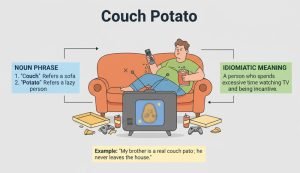
A “couch potato” is an idiom used to describe a person who spends a lot of time sitting or lying down, usually watching television or playing video games. They are generally considered to be inactive and lazy. The term carries a negative connotation, implying a lack of physical activity and a sedentary lifestyle. It’s a metaphorical expression, directly comparing a person to a potato, which is inert and immobile, combined with the setting of a couch, symbolizing relaxation and inactivity.
The idiom functions as a noun, specifically a compound noun, referring to a person. It can be used as a subject, object, or complement in a sentence. Its primary purpose is to convey a specific characteristic – habitual inactivity – in a concise and evocative way. The idiom is widely recognized and understood in English-speaking cultures, making it a powerful tool for communication. The term is often used informally and can be considered slightly humorous or derogatory, depending on the context and tone of voice.
The contexts in which “couch potato” is used are varied. It can be used in casual conversations, news articles, or even in self-deprecating humor.
For example, someone might jokingly refer to themselves as a “couch potato” after spending an entire weekend binge-watching a television series. Alternatively, a health article might use the term to describe the dangers of a sedentary lifestyle.
The flexibility of the idiom allows it to be applied to a wide range of situations, as long as the core meaning of inactivity is present.
Structural Breakdown
The idiom “couch potato” is a compound noun, formed by combining two words: “couch” and “potato.” Each word contributes to the overall meaning of the idiom. “Couch” refers to a piece of furniture designed for sitting or lying down, often associated with relaxation and leisure.
“Potato” is a starchy vegetable, typically round or oval in shape, and known for its inertness and lack of movement. The combination of these two words creates a vivid image of someone who spends their time passively lounging on a couch.
The structure of the idiom is relatively simple, making it easy to understand and remember. The order of the words is fixed; it is always “couch potato,” not “potato couch.” This fixed order is characteristic of idioms, as changing the order can alter or obscure the meaning.
The idiom does not typically undergo grammatical changes. For instance, you wouldn’t say “couch potatoesing” or “more couch potato” in standard English.
To modify the idiom, you would typically add adjectives or adverbs to describe the person or their behavior, such as “a serious couch potato” or “a dedicated couch potato.”
The idiom’s effectiveness lies in its metaphorical nature. It doesn’t literally mean someone is a potato on a couch.
Instead, it uses the image of a potato’s immobility to represent a person’s inactivity. This metaphorical connection is what makes the idiom memorable and impactful.
The phrase “couch potato” is a metaphor, creatively likening a person’s inactivity to the immobility of a potato. This couch potato metaphor highlights how everyday objects and imagery can vividly convey behavioral traits, making the idiom both memorable and culturally resonant.
The use of everyday objects – a couch and a potato – makes the idiom relatable and accessible to a wide audience. The simplicity of the structure and the vividness of the metaphor contribute to the idiom’s widespread use and understanding.
Types and Categories of Couch Potato Behavior
While the basic definition of a “couch potato” remains consistent, the specific behaviors and reasons behind the inactivity can vary. We can categorize “couch potato” behavior based on several factors, including the duration of inactivity, the primary activity pursued, and the underlying cause of the behavior.
By Duration:
- Occasional Couch Potato: This type refers to someone who occasionally indulges in sedentary behavior, perhaps during weekends or holidays. It’s a temporary state of relaxation and doesn’t necessarily indicate a chronic lack of physical activity.
- Regular Couch Potato: This describes someone who frequently engages in sedentary behavior, perhaps several evenings a week. It suggests a more ingrained habit of inactivity.
- Chronic Couch Potato: This refers to someone who consistently spends a large portion of their time being inactive. It implies a long-term pattern of sedentary behavior and may be associated with negative health consequences.
By Primary Activity:
- Television Couch Potato: This is the classic image, someone who spends hours watching television.
- Gaming Couch Potato: This type spends their time playing video games, often for extended periods.
- Streaming Couch Potato: This individual prefers watching movies and TV shows on streaming services.
- Social Media Couch Potato: This type spends hours browsing social media on their phone or tablet while lounging on the couch.
By Underlying Cause:
- Recreational Couch Potato: This person chooses to be inactive as a form of leisure and relaxation.
- Stress-Induced Couch Potato: This type uses inactivity as a way to cope with stress or anxiety.
- Depression-Related Couch Potato: This is associated with symptoms of depression, such as fatigue and loss of interest in activities.
- Injury-Related Couch Potato: This person is temporarily inactive due to an injury or illness.
Examples of “Couch Potato” in Use
The “couch potato” idiom can be used in various grammatical contexts. It can function as a subject, object, predicate nominative, or even within a prepositional phrase.
The following examples illustrate the versatility of this idiom.
Examples as a Subject:
In these examples, the “couch potato” is the one performing the action (or inaction, in this case).
| Sentence | Explanation |
|---|---|
| The couch potato never leaves the house on weekends. | The subject is “couch potato,” and it performs the action of “never leaving the house.” |
| That couch potato is finally getting off the sofa to exercise. | Here, “couch potato” is the subject, and the action is “getting off the sofa.” |
| The couch potato loves nothing more than a movie marathon. | The subject “couch potato” enjoys the action of having a movie marathon. |
| Every couch potato should take a break and go for a walk. | “Couch potato” refers to a general group, and the implied action is “should take a break.” |
| My brother, the ultimate couch potato, refused to join us for the hike. | “Couch potato” describes the brother, who refuses to participate in the hike. |
| The stereotypical couch potato is always surrounded by snacks. | The subject “couch potato” is described as being surrounded by snacks. |
| A self-proclaimed couch potato, she admitted to watching five episodes in a row. | “Couch potato” describes her, and she admits to watching several episodes. |
| Even a couch potato can find enjoyment in a short walk outside. | The subject “couch potato” is capable of enjoying a walk. |
| The couch potato‘s remote control is their most prized possession. | The subject “couch potato” has a remote control as their prized possession. |
| That couch potato needs to find a hobby that involves physical activity. | The subject “couch potato” needs to find a physically active hobby. |
| The couch potato in the family is always up-to-date on the latest shows. | The subject “couch potato” is knowledgeable about the latest shows. |
| After a long week, even I become a couch potato. | The subject “I” temporarily becomes a “couch potato.” |
| The couch potato is a modern phenomenon, fueled by streaming services. | The subject “couch potato” is described as a modern phenomenon. |
| The couch potato‘s favorite activity is ordering takeout. | The subject “couch potato” enjoys ordering takeout food. |
| A true couch potato knows all the best TV shows. | The subject “couch potato” possesses knowledge of good TV shows. |
| The couch potato sleeps on the couch most of the day. | The subject “couch potato” sleeps on the couch. |
| The couch potato is not always lazy; they may just be tired. | The subject “couch potato” is not necessarily lazy. |
| The couch potato will never go to the gym. | The subject “couch potato” will not go to the gym. |
| The couch potato only leaves the couch for food. | The subject “couch potato” only leaves the couch to eat. |
| The couch potato is always willing to watch a movie. | The subject “couch potato” is willing to watch a movie. |
| The couch potato is very lazy. | The subject “couch potato” is described as very lazy. |
| The couch potato is happy on the couch. | The subject “couch potato” is happy on the couch. |
Examples as an Object:
In these examples, the “couch potato” is receiving the action.
| Sentence | Explanation |
|---|---|
| My doctor warned me not to become a couch potato. | “Couch potato” is the object of the verb “become.” |
| She called her brother a couch potato because he never exercises. | “Couch potato” is the object of the verb “called.” |
| The coach motivated the team to avoid being couch potatoes during the off-season. | “Couch potatoes” is the object of the verb “being.” |
| He doesn’t want to raise his children to be couch potatoes. | “Couch potatoes” is the object of the verb “be.” |
| The article criticized the prevalence of couch potatoes in modern society. | “Couch potatoes” is the object of the preposition “of.” |
| I never thought I’d become such a couch potato! | “Couch potato” is the object of the verb “become.” |
| She accused him of being a couch potato when he refused to go out. | “Couch potato” is the object of the verb “being.” |
| They don’t want their son growing up to be a couch potato. | “Couch potato” is the object of the verb “be.” |
| He hates being labeled a couch potato. | “Couch potato” is the object of the verb “labeled.” |
| The fitness instructor challenged us to not be couch potatoes during the summer. | “Couch potatoes” is the object of the verb “be.” |
| She doesn’t want to turn into a couch potato after retirement. | “Couch potato” is the object of the verb “turn.” |
| I try not to let myself become a couch potato on the weekends. | “Couch potato” is the object of the verb “become.” |
| He was determined not to be a couch potato during his vacation. | “Couch potato” is the object of the verb “be.” |
| She worried about him becoming a couch potato after losing his job. | “Couch potato” is the object of the verb “become.” |
| They encouraged their friend to not be a couch potato and join a sports team. | “Couch potato” is the object of the verb “be.” |
| I don’t call him a couch potato. | “Couch potato” is the object of the verb “call.” |
| She doesn’t want to be a couch potato. | “Couch potato” is the object of the verb “be.” |
| I can’t stand being a couch potato. | “Couch potato” is the object of the verb “being.” |
| He doesn’t want to become a couch potato. | “Couch potato” is the object of the verb “become.” |
| She wants to avoid being a couch potato. | “Couch potato” is the object of the verb “being.” |
| They are trying to avoid being a couch potato. | “Couch potato” is the object of the verb “being.” |
| She is trying to avoid being a couch potato. | “Couch potato” is the object of the verb “being.” |
Examples as a Predicate Nominative:
In these examples, the “couch potato” renames or identifies the subject.
| Sentence | Explanation |
|---|---|
| He is a self-confessed couch potato. | “Couch potato” renames the subject “He.” |
| During the winter months, she becomes a couch potato. | “Couch potato” renames the subject “she.” |
| My idea of a perfect weekend is being a couch potato. | “Couch potato” renames the subject “My idea.” |
| His biggest fear is becoming a complete couch potato. | “Couch potato” renames the subject “His biggest fear.” |
| After the injury, he was a couch potato for several weeks. | “Couch potato” renames the subject “he.” |
| I am a couch potato. | “Couch potato” renames the subject “I.” |
| She is a couch potato. | “Couch potato” renames the subject “She.” |
| He is a couch potato. | “Couch potato” renames the subject “He.” |
| We are couch potatoes. | “Couch potatoes” renames the subject “We.” |
| They are couch potatoes. | “Couch potatoes” renames the subject “They.” |
| I will be a couch potato. | “Couch potato” renames the subject “I.” |
| She will be a couch potato. | “Couch potato” renames the subject “She.” |
| He will be a couch potato. | “Couch potato” renames the subject “He.” |
| We will be couch potatoes. | “Couch potatoes” renames the subject “We.” |
| They will be couch potatoes. | “Couch potatoes” renames the subject “They.” |
| I was a couch potato. | “Couch potato” renames the subject “I.” |
| She was a couch potato. | “Couch potato” renames the subject “She.” |
| He was a couch potato. | “Couch potato” renames the subject “He.” |
| We were couch potatoes. | “Couch potatoes” renames the subject “We.” |
| They were couch potatoes. | “Couch potatoes” renames the subject “They.” |
| She is a real couch potato. | “Couch potato” renames the subject “She.” |
| He is such a couch potato. | “Couch potato” renames the subject “He.” |
Usage Rules of “Couch Potato”
The “couch potato” idiom is generally used to describe a person who is habitually inactive and spends a lot of time relaxing (usually watching TV) on a couch. Here are some key usage rules to keep in mind:
- Singular vs. Plural: The idiom can be used in both singular (“couch potato”) and plural (“couch potatoes”) forms. Use the singular form when referring to one person and the plural form when referring to multiple people.
- Adjective Use: While “couch potato” is primarily a noun, you can sometimes use it adjectivally by hyphenating it before another noun, such as “couch-potato lifestyle.”
- Context: The idiom is generally used in informal contexts. It’s appropriate for casual conversations, but may not be suitable for formal writing or professional settings, unless used intentionally for a specific effect.
- Connotation: Be aware that the term “couch potato” carries a negative connotation. It implies laziness and a lack of physical activity. Use it carefully, especially when referring to someone directly, as it could be considered offensive.
- Figurative Meaning: Remember that “couch potato” is a figurative expression. It’s not meant to be taken literally. It’s a metaphor used to describe someone’s behavior.
Exceptions and Special Cases:
- Self-Deprecating Humor: It’s often acceptable to use the term “couch potato” when referring to yourself in a humorous or self-deprecating way.
- Exaggeration: The idiom can be used to exaggerate someone’s inactivity for comedic effect.
- Descriptive Use: In some cases, “couch potato” can be used descriptively without necessarily implying a negative judgment. For example, you might say someone is “recovering from surgery and has become a bit of a couch potato.”
Common Mistakes When Using “Couch Potato”
Even though the “couch potato” idiom is relatively straightforward, some common mistakes can occur. Being aware of these errors can help you use the idiom correctly and confidently.
| Incorrect | Correct | Explanation |
|---|---|---|
| He is a potato couch. | He is a couch potato. | The order of the words is fixed; it’s always “couch potato.” |
| She is couch potatoes. | She is a couch potato. | Use the singular form “couch potato” when referring to one person. |
| They are couch potato. | They are couch potatoes. | Use the plural form “couch potatoes” when referring to multiple people. |
| He couch potatoes all day. | He is a couch potato. | “Couch potato” is a noun, not a verb. Use it as a descriptor, not an action. |
| She is very couch potato. | She is a big couch potato. | “Couch potato” is a noun, and needs an article or adjective before it. |
| I’m going to couch potato this weekend. | I’m going to be a couch potato this weekend. | “Couch potato” is a noun, not a verb. |
| He’s the most couch potato person I know. | He’s the biggest couch potato I know. | “Couch potato” is a noun, not an adjective. |
| Don’t be such a couch potatoing! | Don’t be such a couch potato! | “Couch potato” is not a verb, so the -ing form is incorrect. |
| She’s a couch potatoer. | She’s a couch potato. | “Couch potato” is the established idiom; adding “-er” is not standard. |
| He is couch potatos. | He is a couch potato. | The plural of “couch potato” is “couch potatoes.” |
Practice Exercises
Test your understanding of the “couch potato” idiom with these practice exercises.
Exercise 1: Fill in the Blanks
Complete the following sentences using the correct form of the “couch potato” idiom.
| Question | Answer |
|---|---|
| 1. After working all week, I just want to be a _________ on the weekend. | couch potato |
| 2. My roommates are such _________; they never leave the apartment. | couch potatoes |
| 3. He’s turning into a _________ since he got his new gaming console. | couch potato |
| 4. The doctor warned him about the dangers of becoming a _________. | couch potato |
| 5. She’s not a _________; she actually enjoys going to the gym. | couch potato |
| 6. They accused him of being a _________ because he refused to help with the chores. | couch potato |
| 7. I try not to let myself become a _________ during the holidays. | couch potato |
| 8. He’s been a _________ ever since he retired. | couch potato |
| 9. She doesn’t want to raise her children to be _________. | couch potatoes |
| 10. After the marathon, I was a _________ for two days. | couch potato |
Exercise 2: Correct the Errors
Identify and correct the errors in the following sentences related to the “couch potato” idiom.
| Question | Answer |
|---|---|
| 1. He is a potato couch and likes to watch TV. | He is a couch potato and likes to watch TV. |
| 2. She couch potatoes all day long. | She is a couch potato and stays on the couch all day long. |
| 3. They are couch potato and never exercise. | They are couch potatoes and never exercise. |
| 4. I’m going to couch potato this weekend. | I’m going to be a couch potato this weekend. |
| 5. He is very couch potato; he never goes outside. | He is a big couch potato; he never goes outside. |
| 6. She is a couch potatoer and loves to watch movies. | She is a couch potato and loves to watch movies. |
| 7. They are couch potatos and always eat junk food. | They are couch potatoes and always eat junk food. |
| 8. He is the most couch potato person I know. | He is the biggest couch potato I know. |
| 9. She is a couch potatoing and doesn’t like to move. | She is a couch potato and doesn’t like to move. |
| 10. I don’t want to be a couch potatos. | I don’t want to be a couch potato. |
Exercise 3: Sentence Completion
Complete the sentences below in a way that correctly uses the “couch potato” idiom and makes sense in context.
| Question | Answer |
|---|---|
| 1. After a stressful week at work, the only thing I want to do is _____. | be a couch potato |
| 2. My doctor told me that if I don’t start exercising, I’ll _____. | become a couch potato |
| 3. Even though he’s a _____, he still manages to stay informed about current events. | couch potato |
| 4. She’s trying to break her habit of being a _____. | couch potato |
| 5. The stereotype of a _____ is someone who spends all day watching TV and eating snacks. | couch potato |
| 6. He admitted that he’s a _____, but he’s trying to be more active. | couch potato |
| 7. They’re afraid that their kids will become _____ if they don’t limit their screen time. | couch potatoes |
| 8. I used to be a _____, but now I enjoy going for walks and hiking. | couch potato |
| 9. If you spend all your free time watching TV, you might turn into a _____. | couch potato |
| 10. Despite being a _____, she still manages to maintain a healthy social life. | couch potato |
Advanced Topics: Nuances and Variations
For advanced learners, exploring the nuances and variations of the “couch potato” idiom can provide a deeper understanding of its usage and cultural context.
- Regional Variations: While “couch potato” is widely understood, some regions might have similar idioms with slightly different connotations. Researching these regional equivalents can broaden your understanding of idiomatic expressions.
- Evolving Usage: With the rise of streaming services and online gaming, the concept of a “couch potato” has evolved. Consider how technology has influenced the meaning and application of this idiom.
- Figurative Extensions: Explore how the “couch potato” concept can be extended to other areas of life, such as intellectual or social inactivity. Can someone be a “couch potato” in terms of their engagement with ideas or social interactions?
- Cultural Critique: Analyze how the “couch potato” idiom reflects cultural attitudes towards leisure, productivity, and physical activity. Does the idiom promote a particular value system?
Frequently Asked Questions
- What is the origin of the term “couch potato”?The term “couch potato” was coined in the 1970s by Tom Iacino, who used it to describe his own inactive lifestyle while watching television. It quickly gained popularity and became a widely recognized idiom.
- Is “couch potato” always a negative term?While “couch potato” generally carries a negative connotation, implying laziness and inactivity, it can sometimes be used humorously or self-deprecatingly. The context and tone of voice are important in determining the intended meaning.
- Can you use “couch potato” to describe someone who is temporarily inactive due to illness or injury?Yes, in some cases, “couch potato” can be used to describe someone who is temporarily inactive due to illness or injury. However, it’s important to be sensitive to the person’s situation and avoid using the term in a judgmental or critical way.
- Are there any similar idioms to “couch potato” in English?Yes, some similar idioms include “lazybones,” “sluggard,” and “loafer.” However, “couch potato” specifically emphasizes the association with watching television or engaging in other sedentary activities while lounging on a couch.
- How can I avoid becoming a “couch potato”?To avoid becoming a “couch potato,” it’s important to incorporate regular physical activity into your routine, limit screen time, and find hobbies and activities that you enjoy and that keep you active. Setting realistic goals and making gradual changes can help you establish a healthier lifestyle.
- Is it grammatically correct to say “couch potato lifestyle”?Yes, it is grammatically correct to use “couch-potato” as an adjective by hyphenating it before the noun “lifestyle.” This creates a compound adjective that describes the type of lifestyle.
- Can “couch potato” be used to describe animals?While primarily used for humans, “couch potato” can sometimes be applied humorously to pets who spend excessive time lounging around. However, this usage is less common.
- What is the difference between “couch potato” and “gamer”?While both terms describe sedentary activities, “couch potato” implies general inactivity and often refers to watching television, while “gamer” specifically refers to someone who spends a lot of time playing video games. A “gamer” might be a “couch potato,” but not all “couch potatoes” are gamers. It depends on the specific activity they engage in while being inactive.
Conclusion
The “couch potato” idiom is a colorful and widely understood expression that describes a person who is habitually inactive and spends a lot of time relaxing, often watching television. Understanding the grammar and usage rules of this idiom is essential for effective communication and comprehension of English.
By mastering the definition, structural breakdown, usage rules, and common mistakes associated with “couch potato,” you can confidently use this idiom in your own speech and writing.
Remember that idioms are an integral part of the English language, adding richness and nuance to our communication. Continuously expanding your knowledge of idioms will enhance your overall language proficiency and cultural understanding.
So, while it’s important to understand the “couch potato” idiom, strive to lead an active and engaged life, both physically and mentally!