Describing a smile effectively can add depth and emotion to your writing. When describing smiles, it’s helpful to think about both the physical and emotional aspects. Consider how the lips curve, whether teeth are visible, and how the eyes complement the expression.
Writers can experiment with descriptive smile language, exploring ways to convey subtle differences between happiness, amusement, sarcasm, or even discomfort. By varying sentence structure and integrating sensory details, you can create nuanced portrayals that go beyond a simple “smiled” and bring characters to life more vividly.
It’s more than just saying someone smiled; it’s about conveying the specific type of smile and the feelings behind it.
Understanding the grammar and vocabulary involved in describing smiles is crucial for both native English speakers and learners. This article will explore various ways to describe smiles, covering different grammatical structures, types of smiles, and common mistakes to avoid.
This comprehensive guide is perfect for students, writers, and anyone looking to enhance their descriptive abilities in English.
By mastering the nuances of describing smiles, you can bring your characters to life, create vivid imagery, and communicate emotions more precisely. Whether you’re writing fiction, poetry, or even professional emails, the ability to articulate a smile effectively is a valuable skill.
This article will provide you with the tools and knowledge you need to master this aspect of English grammar.
Table of Contents
- Definition of Describing Smiles
- Structural Breakdown
- Types of Smiles
- Examples of Describing Smiles
- Usage Rules
- Common Mistakes
- Practice Exercises
- Advanced Topics
- FAQ
- Conclusion
Definition of Describing Smiles
Describing a smile involves using language to convey the appearance, nature, and emotional context of a smile. It goes beyond simply stating that someone “smiled.” Effective descriptions capture the specific characteristics of the smile, such as its width, the expression in the eyes, and the overall feeling it evokes.
This can be achieved through the use of descriptive adjectives, vivid verbs, similes, metaphors, and attention to accompanying non-verbal cues.
The function of describing smiles in writing is to add depth and realism to characters and scenes. A well-described smile can reveal a character’s personality, intentions, and emotional state.
It can also create a specific mood or atmosphere within a narrative. Depending on the context, describing a smile can convey happiness, amusement, sarcasm, sadness, or a range of other emotions.
When describing smiles, always consider the underlying emotion and context. A smile can convey joy, irony, or even hidden tension, and noting the situation can deepen the reader’s understanding. Paying attention to these subtleties ensures that the type of smile is clear and that it resonates with the character’s emotional state.
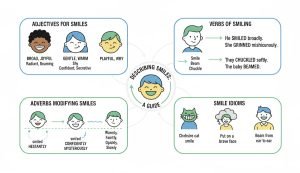
In English grammar, describing smiles typically involves using adjectives to modify the noun “smile” or verbs to show how someone is smiling. For instance, you might say “a warm smile” (adjective + noun) or “she beamed” (verb).
Similes and metaphors can also be used to create more evocative descriptions, such as “his smile was like sunshine” (simile) or “her smile was a weapon” (metaphor). The choice of words and grammatical structures depends on the specific effect you want to achieve and the type of smile you are describing.
Structural Breakdown
The structure of describing a smile can be broken down into several key components. First, you have the subject, which is the person who is smiling.
Second, you have the verb, which indicates the action of smiling. Third, you have descriptive elements, such as adjectives, adverbs, similes, and metaphors, that provide more detail about the smile.
Here are some common structural patterns:
- Subject + Verb (simple): She smiled.
- Subject + Adverb + Verb: She brightly smiled.
- Subject + Verb + Adjective + Noun: She gave a warm smile.
- Subject + Verb + Adverbial Phrase: She smiled with genuine happiness.
- Subject + Verb + Simile: She smiled like a child.
- Subject + Verb + Metaphor: Her smile was sunshine.
These patterns can be combined and modified to create more complex and nuanced descriptions. The key is to choose words that accurately reflect the specific characteristics of the smile you want to convey.
For instance, instead of saying “He smiled,” you could say “He flashed a mischievous grin,” which provides more specific information about the type of smile and the person’s intentions.
Consider also the use of sensory details beyond just the visual. Does the smile reach the eyes?
Does it crinkle the corners of the mouth? Does it change the tone of their voice?
These details can enhance the description and make it more impactful.
Types of Smiles
Smiles are not all the same; they vary greatly in their appearance and the emotions they convey. Understanding the different types of smiles can help you choose the most appropriate words to describe them.
Genuine Smiles (Duchenne Smiles)
A genuine smile, also known as a Duchenne smile, involves the contraction of both the zygomatic major muscle (which raises the corners of the mouth) and the orbicularis oculi muscle (which raises the cheeks and creates wrinkles around the eyes). This type of smile is often associated with true happiness and enjoyment.
Fake Smiles (Pan Am Smiles)
A fake smile, sometimes called a Pan Am smile, only involves the contraction of the zygomatic major muscle. The eyes do not participate in the expression, and the smile often appears forced or insincere.
Smirks
A smirk is a type of smile that is often characterized by self-satisfaction, smugness, or irony. It is usually a half-smile, with one corner of the mouth turned up slightly.
Grins
A grin is a wide, enthusiastic smile that often reveals the teeth. It is typically associated with happiness, amusement, or excitement.
Grimaces
A grimace is a contorted facial expression that can resemble a smile but is usually caused by pain, disgust, or discomfort. It is often involuntary and fleeting.
Wry Smiles
A wry smile is a smile that expresses irony, amusement, or resignation. It is often accompanied by a raised eyebrow or a slight tilt of the head.
Examples of Describing Smiles
Here are some examples of how to describe smiles using different grammatical structures and vocabulary.
Using Adjectives
Adjectives can be used to modify the noun “smile” and provide more detail about its appearance and nature. The following table provides examples of using adjectives to describe smiles.
| Adjective | Example Sentence |
|---|---|
| Warm | She greeted him with a warm smile. |
| Bright | His bright smile lit up the room. |
| Gentle | A gentle smile played on her lips. |
| Sweet | The baby gave her a sweet smile. |
| Sad | He offered a sad smile, masking his pain. |
| Forced | Her forced smile didn’t reach her eyes. |
| Genuine | It was a genuine smile, full of warmth. |
| Mischievous | A mischievous smile crept across his face. |
| Knowing | She gave him a knowing smile, understanding his secret. |
| Tired | A tired smile flickered on her face before she yawned. |
| Weak | He managed a weak smile, despite his illness. |
| Encouraging | She gave him an encouraging smile before the test. |
| Mysterious | A mysterious smile played on her lips, leaving him intrigued. |
| Teasing | He wore a teasing smile as he recounted the embarrassing story. |
| Radiant | Her radiant smile shone brighter than the sun. |
| Assuring | He gave an assuring smile to calm her nerves. |
| Confident | She flashed a confident smile before stepping onto the stage. |
| Playful | A playful smile danced on her lips as she joked around. |
| Sincere | His sincere smile made her trust him instantly. |
| Appreciative | He offered an appreciative smile for her thoughtful gift. |
| Bemused | A bemused smile appeared as he tried to understand the complex instructions. |
| Calculating | A calculating smile hinted at a plan forming in his mind. |
| Contained | A contained smile barely betrayed his excitement. |
| Disapproving | A disapproving smile showed his displeasure without words. |
| Embarrassed | An embarrassed smile crept onto his face after the blunder. |
Using Verbs
Verbs can be used to describe the action of smiling and provide more information about how someone is smiling. The following table provides examples of using verbs to describe smiles.
| Verb | Example Sentence |
|---|---|
| Smiled | She smiled at him warmly. |
| Grinned | He grinned from ear to ear. |
| Smirked | He smirked, knowing he had won. |
| Beamed | She beamed with pride. |
| Grimaced | He grimaced as he tasted the bitter medicine. |
| Chuckled | He chuckled, a smile playing on his lips. |
| Giggled | She giggled, her eyes sparkling with amusement. |
| Simpered | She simpered, trying to flirt with him. |
| Scoffed | He scoffed, a sarcastic smile on his face. |
| Wryly smiled | He wryly smiled at the absurdity of the situation. |
| Flash a smile | She flashed a smile before turning away. |
| Offer a smile | He offered a smile of encouragement. |
| Force a smile | She forced a smile, trying to hide her disappointment. |
| Crack a smile | He finally cracked a smile after hearing the joke. |
| Sport a smile | He sported a smile that didn’t quite reach his eyes. |
| Present a smile | She presented a smile as she accepted the award. |
| Don a smile | He donned a smile for the cameras. |
| Let out a smile | She couldn’t help but let out a smile at the memory. |
| Return a smile | He returned her smile with genuine warmth. |
| Bestow a smile | She bestowed a smile upon the child. |
| Curved his lips into a smile | He curved his lips into a smile, trying to appear friendly. |
| Parted his lips in a smile | He parted his lips in a smile as he greeted her. |
| His face broke into a smile | His face broke into a smile when he heard the good news. |
| A smile touched her lips | A smile touched her lips as she remembered the happy moment. |
| A smile played on his lips | A smile played on his lips, hinting at amusement. |
Using Similes and Metaphors
Similes and metaphors can be used to create more vivid and imaginative descriptions of smiles. Similes use “like” or “as” to compare a smile to something else, while metaphors directly equate a smile to something else.
| Type | Example |
|---|---|
| Simile | Her smile was like sunshine, warming everyone around her. |
| Simile | His smile was as cold as ice, sending a shiver down her spine. |
| Simile | Her smile was like a gentle breeze, soothing and comforting. |
| Metaphor | His smile was a weapon, used to manipulate others. |
| Metaphor | Her smile was a beacon of hope in the darkness. |
| Metaphor | His smile was a mask, hiding his true feelings. |
| Simile | His smile spread like wildfire across his face. |
| Simile | Her smile faded like a ghost, leaving her looking sad. |
| Metaphor | Her smile was an invitation, beckoning him closer. |
| Metaphor | His smile was a shield, protecting him from vulnerability. |
| Simile | His smile was as bright as a summer day, filling her with joy. |
| Simile | Her smile was like a secret, known only to him. |
| Metaphor | His smile was a key, unlocking her heart. |
| Metaphor | Her smile was a balm, soothing his troubled soul. |
| Simile | His smile was as genuine as a child’s laughter, pure and innocent. |
| Simile | Her smile was like coming home, warm and comforting. |
| Metaphor | His smile was a promise, assuring her of his love. |
| Metaphor | Her smile was a song, filled with joy and melody. |
| Simile | His smile was as elusive as a dream, fading quickly from her memory. |
| Simile | Her smile was like a sunrise, painting the sky with hope. |
| Metaphor | His smile was a treasure, something she would always cherish. |
| Metaphor | Her smile was a bridge, connecting them across the distance. |
| Simile | His smile was as unexpected as a rainbow, appearing after the storm. |
| Simile | Her smile was like a warm blanket, enveloping him in comfort. |
| Metaphor | His smile was a spark, igniting a flame of passion between them. |
Techniques for Descriptive Smile Language
Mastering descriptive smile language involves more than choosing the right adjectives—it requires attention to context, emotion, and body language. One effective method is to pair verbs with adverbs or adjectives, such as “she smiled warmly” or “he grinned mischievously.” Similes and metaphors are also powerful tools, turning a smile into “sunlight breaking through clouds” or “a brief flicker of mischief.”
Another key strategy is to describe the interplay between the smile and the eyes. A genuine smile often reaches the eyes, creating crinkles or a sparkle that enhances emotional authenticity. Conversely, a forced smile may appear stiff, with the eyes remaining cold or indifferent. Writers can also consider cultural and situational nuances, such as how smiles may convey politeness in formal settings or exuberance among friends.
By practicing these techniques, you can develop a richer vocabulary for conveying subtle differences in smiles, helping your characters express complex emotions naturally and vividly.
Describing the Eyes with Smiles
The eyes often play a crucial role in conveying the sincerity and emotion behind a smile. Describing the eyes along with the smile can create a more complete and impactful image.
Here’s a table with examples:
| Description | Example Sentence |
|---|---|
| Sparkling eyes | She smiled, her eyes sparkling with joy. |
| Crinkled eyes | He smiled, his eyes crinkling at the corners. |
| Warm eyes | She gave him a warm smile, her eyes full of affection. |
| Cold eyes | He smirked, but his eyes remained cold and distant. |
| Sad eyes | She forced a smile, but her eyes betrayed her sadness. |
| Mischievous eyes | He smiled mischievously, his eyes twinkling with amusement. |
| Knowing eyes | She gave him a knowing smile, her eyes reflecting her understanding. |
| Tired eyes | He managed a tired smile, his eyes heavy with fatigue. |
| Empty eyes | She smiled vacantly, her eyes empty of emotion. |
| Bright eyes | He smiled brightly, his eyes shining with happiness. |
| Soft eyes | She smiled softly, her eyes gentle and kind. |
| Intense eyes | He smiled intensely, his eyes boring into hers. |
| Playful eyes | She smiled playfully, her eyes dancing with mischief. |
| Wary eyes | He offered a small smile, his eyes remaining wary and cautious. |
| Dreamy eyes | She smiled dreamily, her eyes lost in thought. |
| Animated eyes | He smiled, his eyes animated with excitement. |
| Quiet eyes | She smiled quietly, her eyes reflecting a peaceful contentment. |
| Restrained eyes | He smiled with restraint, his eyes carefully guarded. |
| Yearning eyes | She smiled yearningly, her eyes full of longing. |
| Amused eyes | He smiled, his eyes filled with amusement at the situation. |
Usage Rules
When describing smiles, it’s important to follow certain usage rules to ensure clarity and accuracy. Here are some key rules to keep in mind:
- Use precise language: Choose adjectives and verbs that accurately reflect the specific type of smile you want to describe. Avoid vague or generic terms.
- Consider the context: The meaning and interpretation of a smile can vary depending on the context. Take into account the situation, the relationship between the people involved, and any other relevant factors.
- Pay attention to non-verbal cues: A smile is often accompanied by other non-verbal cues, such as facial expressions, body language, and tone of voice. Be sure to consider these cues when describing a smile.
- Avoid clichés: Try to avoid overused phrases and clichés when describing smiles. Instead, strive for originality and creativity.
- Use sensory details: Engage the reader’s senses by describing the physical sensations associated with the smile, such as the warmth of a genuine smile or the coldness of a forced smile.
Exceptions to these rules may occur in certain creative contexts, such as poetry or experimental fiction. However, in most cases, it’s best to follow these guidelines to ensure that your descriptions are clear, accurate, and effective.
Common Mistakes
Here are some common mistakes people make when describing smiles, along with examples of how to correct them.
| Incorrect | Correct | Explanation |
|---|---|---|
| She smiled good. | She smiled well. | “Well” is the adverb form that modifies the verb “smiled.” |
| He gave a happily smile. | He gave a happy smile. | “Happy” is the adjective that modifies the noun “smile.” |
| Her smile was like a sun. | Her smile was like the sun. | Use “the” before “sun” because it’s a specific object. |
| He smirked hardly. | He smirked slightly. | “Hardly” means “barely,” while “slightly” is a more appropriate adverb to describe a smirk. |
| She grinned widely on her face. | She grinned widely. | The phrase “on her face” is redundant because a grin naturally occurs on the face. |
| His smile was very. | His smile was warm. | “Very” is vague. Use a specific adjective to describe the smile. |
| She smiled with happy. | She smiled with happiness. | “Happiness” is the noun form of the emotion. |
| He gave a sadly smile. | He gave a sad smile. | Use the adjective “sad” to describe the smile. |
| She smiled, but it wasn’t reach her eyes. | She smiled, but it didn’t reach her eyes. | Correct the verb tense and use “didn’t” for the negative form. |
| He offered a encourage smile. | He offered an encouraging smile. | Use the adjective “encouraging” and the article “an” before a vowel sound. |
| She beamed, her eyes are sparkling. | She beamed, her eyes sparkling. | Remove the unnecessary verb “are” to make it a participle phrase. |
| He grimaced, but like he was smiling. | He grimaced, looking like he was smiling. | Clarify the sentence structure to show the resemblance to a smile. |
| She wryly smiled, but without humor. | She wryly smiled, but there was no humor in it. | Rephrase to emphasize the absence of humor. |
| He flashed a smile quick. | He flashed a quick smile. | Use the adjective “quick” to describe the smile. |
| She gave a knowing smile to him. | She gave him a knowing smile. | Rearrange the sentence for better flow and clarity. |
| He offered a tire smile. | He offered a tired smile. | Correct the spelling of “tired.” |
| Her smile was mystery. | Her smile was mysterious. | Use the adjective “mysterious” to describe the smile. |
| He grinned, showing all tooths. | He grinned, showing all his teeth. | Use the correct possessive pronoun “his” and the plural noun “teeth.” |
| She smirked, it was a evil smile. | She smirked; it was an evil smile. | Use a semicolon to connect two related independent clauses and the article “an” before “evil.” |
| He smiled, but his heart was sad. | He smiled, but his heart was heavy. | Use a more evocative adjective like “heavy” to describe the sadness. |
Practice Exercises
Test your understanding of describing smiles with these practice exercises.
Exercise 1: Identifying Smile Types
Identify the type of smile described in each sentence.
| Question | Answer |
|---|---|
| He turned up one corner of his mouth, a glint in his eye. | Smirk |
| Her face lit up, her eyes crinkling at the corners as she laughed. | Genuine Smile (Duchenne Smile) |
| He bared his teeth, his eyes wide with excitement. | Grin |
| She tried to smile, but her face was contorted with pain. | Grimace |
| His lips curved slightly, expressing amusement and resignation. | Wry Smile |
| She smiled politely, but her eyes remained unchanged and distant. | Fake Smile (Pan Am Smile) |
| He curled his lip, a mix of distaste and amusement on his face. | Smirk |
| Her face radiated happiness, showing a wide, toothy smile. | Grin |
| He forced his mouth into a smile, though his eyes showed his misery. | Fake Smile (Pan Am Smile) |
| She smiled sadly, a mixture of fondness and regret in her expression. | Wry Smile |
Exercise 2: Describing Smiles in Sentences
Complete the following sentences by adding a descriptive phrase about the smile.
| Question | Answer |
|---|---|
| She smiled, ____________________. | She smiled, her eyes sparkling with delight. |
| He gave a grin, ____________________. | He gave a grin, revealing a row of perfectly white teeth. |
| Her smirk suggested, ____________________. | Her smirk suggested she knew something he didn’t. |
| He grimaced, ____________________. | He grimaced, the bitter taste lingering on his tongue. |
| She offered a wry smile, ____________________. | She offered a wry smile, acknowledging the absurdity of the situation. |
| He smiled gently, ____________________. | He smiled gently, his eyes crinkling at the corners. |
| She beamed, ____________________. | She beamed, radiating pride and accomplishment. |
| He flashed a smile, ____________________. | He flashed a smile, hoping to disarm her suspicion. |
| She forced a smile, ____________________. | She forced a smile, trying to hide her disappointment. |
| He returned her smile, ____________________. | He returned her smile, his heart filled with warmth. |
Exercise 3: Correcting Common Mistakes
Correct the grammatical errors in the following sentences.
| Question | Answer |
|---|---|
| She smiled good to him. | She smiled kindly to him. |
| He gave a happily smile. | He gave a happy smile. |
| Her smile was like a sun. | Her smile was like the sun. |
| He smirked hardly at her. | He smirked subtly at her. |
| She grinned widely on her face. | She grinned widely. |
| His smile was very nice. | His smile was captivating. |
| She smiled with happy tears. | She smiled with tears of happiness. |
| He gave a sadly smile to her. | He gave her a sad smile. |
| She smiled, but it wasn’t reach her eyes. | She smiled, but it didn’t reach her eyes. |
| He offered a encourage smile. | He offered an encouraging smile. |
Advanced Topics
For advanced learners, here are some more complex aspects of describing smiles to consider.
Cultural Variations in Interpreting Smiles
The interpretation of smiles can vary significantly across cultures. In some cultures, smiling is a sign of friendliness and openness, while in others, it may be seen as a sign of weakness or insincerity.
Understanding these cultural nuances is essential for effective communication and avoiding misunderstandings. For example, in some Asian cultures, excessive smiling may be perceived as insincere or even disrespectful, particularly in formal situations.
Conversely, in Western cultures, a lack of smiling may be interpreted as cold or unfriendly.
Psychology of Smiles
The psychology of smiles is a complex field that explores the underlying motivations and meanings behind different types of smiles. Research has shown that genuine smiles (Duchenne smiles) are associated with positive emotions and are often perceived as more trustworthy and attractive than fake smiles.
Understanding the psychological aspects of smiles can help you create more realistic and compelling characters in your writing. For instance, a character who consistently displays fake smiles may be perceived as untrustworthy or manipulative, while a character who smiles genuinely may be seen as more likable and relatable.
Furthermore, the absence of a smile in a situation where it would be expected can be a powerful indicator of hidden emotions or internal conflict.
FAQ
Here are some frequently asked questions about describing smiles.
What is the difference between a smile and a grin?
A smile is a general expression of happiness or amusement, while a grin is a wide, often toothy smile that expresses intense joy or excitement. A grin is typically more exaggerated than a smile.
How can I describe a fake smile effectively?
To describe a fake smile, focus on the lack of involvement of the eyes. Use phrases like “the smile didn’t reach her eyes,” “a forced smile,” or “a plastic smile.” You can also describe the smile as being strained or unnatural.
What are some alternatives to the word “smile”?
Alternatives include “grin,” “smirk,” “beam,” “grimace,” “simper,” and “wry smile.” The best choice depends on the specific type of smile you want to describe.
How can I avoid clichés when describing smiles?
Avoid overused phrases like “lit up the room” or “beaming from ear to ear.” Instead, focus on specific details and use original similes and metaphors. Consider describing the texture, sound, or even the scent associated with the smile.
Is it important to describe the teeth when describing a smile?
Describing the teeth can add detail, but it’s not always necessary. Whether or not to describe the teeth depends on the context and the type of smile. If the teeth are a prominent feature of the smile, or if they convey something about the character’s
health or personality (e.g., crooked teeth, stained teeth), then it can be relevant. Otherwise, focus on other aspects of the smile.
Conclusion
Describing smiles effectively is a valuable skill that can enhance your writing and communication. By understanding the different types of smiles, using precise language, and avoiding common mistakes, you can create vivid and impactful descriptions that bring your characters and stories to life.
Whether you’re a student, writer, or language learner, mastering the art of describing smiles will undoubtedly enrich your ability to express emotions and connect with your audience. Remember to practice regularly and pay attention to the nuances of human expression to continuously improve your descriptive skills.
With dedication and attention to detail, you can transform simple sentences into powerful portrayals of human emotion, one smile at a time.