
Understanding the different sounds the letter ‘e’ can produce is crucial for clear English pronunciation and comprehension. The ‘e’ sound can vary significantly depending on its position in a word and the letters surrounding it.
Understanding the e pronunciation in English is essential for learners at all levels. The sound of e can change depending on the word’s structure, surrounding letters, and stress patterns. Paying close attention to the letter e and its variations helps in distinguishing words that might otherwise sound similar. By practicing the different pronunciations of the letter e, including short e, long e, schwa e, and silent e, learners can enhance both their speaking clarity and listening comprehension.
This guide will explore the diverse ways ‘e’ is pronounced, from the short ‘e’ in “bed” to the long ‘e’ in “meet,” and the silent ‘e’ at the end of words like “cake.” Whether you’re a beginner or an advanced learner, mastering these nuances will improve your speaking and listening skills, and help you avoid common pronunciation errors. Let’s dive into the fascinating world of the ‘e’ sound!
Table of Contents
- Introduction
- Definition of the ‘E’ Sound
- Structural Breakdown
- Types and Categories of ‘E’ Sounds
- Examples of ‘E’ Sounds
- Usage Rules for the ‘E’ Sound
- Common Mistakes with the ‘E’ Sound
- Practice Exercises
- Advanced Topics
- Frequently Asked Questions (FAQ)
- Conclusion
Definition of the ‘E’ Sound
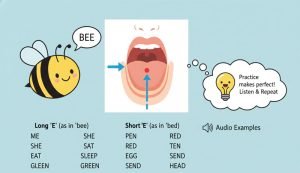
The letter ‘e’ in English can represent multiple distinct vowel sounds, making it a versatile but sometimes confusing letter. These sounds are categorized based on how the tongue, lips, and jaw are positioned during articulation.
Understanding these positions helps in accurately producing and recognizing each sound. The ‘e’ sound is fundamental to English pronunciation, impacting word meaning and overall fluency.
From a phonetic perspective, the ‘e’ sound can be classified into several categories, each with its own symbol in the International Phonetic Alphabet (IPA). These include the short ‘e’ (ɛ), the long ‘e’ (iː), and the schwa (ə), among others.
The specific context of the word—including surrounding letters and syllable stress—dictates which sound is produced.
Structural Breakdown
The pronunciation of ‘e’ is heavily influenced by its surrounding letters and the syllable structure of the word. In general, the position of ‘e’ within a word, whether it’s in a stressed or unstressed syllable, and the presence of other vowels nearby are key determinants of its sound.
Learning to recognize these patterns is crucial for accurate pronunciation.
For example, the vowel-consonant-vowel (VCV) pattern often leads to a long ‘e’ sound when the second vowel is ‘e’ (e.g., Pete). Conversely, the consonant-vowel-consonant (CVC) pattern often results in a short ‘e’ sound (e.g., pet). Recognizing these patterns can significantly improve pronunciation skills and reading comprehension.
Types and Categories of ‘E’ Sounds
Short ‘E’ (ɛ)
The short ‘e’ sound, represented by the IPA symbol /ɛ/, is often found in words where ‘e’ is followed by one or more consonants within a closed syllable. It’s similar to the ‘e’ in the word “bed.” To produce this sound, the mouth is slightly open, and the tongue is positioned in the middle of the mouth.
The short ‘e’ is a lax vowel, meaning the muscles in the vocal tract are relatively relaxed when producing the sound. This contrasts with tense vowels like the long ‘e’, where the muscles are more engaged.
Recognizing and practicing the short ‘e’ sound is essential for distinguishing between similar-sounding words.
Long ‘E’ (iː)
The long ‘e’ sound, represented by the IPA symbol /iː/, is typically found in words where ‘e’ is followed by another vowel or when it appears at the end of a word. Examples include “see” and “meet.” To produce this sound, the mouth is slightly open, and the tongue is positioned high and forward in the mouth.
The long ‘e’ is a tense vowel, requiring more muscular effort than the short ‘e’. This sound is often created by vowel digraphs like ‘ee’ and ‘ea’.
Mastering the long ‘e’ sound is crucial for clear and accurate pronunciation, especially when distinguishing it from the short ‘i’ sound.
Schwa ‘E’ (ə)
The schwa sound, represented by the IPA symbol /ə/, is the most common vowel sound in English. It is a reduced, unstressed vowel sound that can be represented by any vowel, including ‘e’.
The schwa ‘e’ is often found in unstressed syllables, such as in the word “taken.” The mouth is relaxed, and the tongue is in a neutral position.
The schwa sound is crucial for natural-sounding English, as it helps to create rhythm and flow in speech. Recognizing and using the schwa ‘e’ in unstressed syllables can significantly improve pronunciation and comprehension.
Silent ‘E’
The silent ‘e’ is a common feature in English words, particularly at the end of words following the vowel-consonant-‘e’ (VCe) pattern. The silent ‘e’ typically modifies the preceding vowel, making it a long vowel sound.
Examples include “cake,” “Pete,” and “kite.” The ‘e’ itself is not pronounced.
The silent ‘e’ plays a crucial role in distinguishing between words with different meanings, such as “pet” and “Pete.” Understanding the silent ‘e’ rule is essential for both reading and spelling in English. Without the silent ‘e’, the vowel sound would be short.
‘E’ + ‘R’ Combinations
When ‘e’ is followed by ‘r’, the pronunciation can vary depending on the dialect of English. In many dialects, the ‘e’ and ‘r’ combine to form a single sound, often represented as /ɜr/ or /ər/.
Examples include “her,” “term,” and “serve.” The ‘r’ sound affects the preceding ‘e’, changing its quality.
In some dialects, especially non-rhotic dialects, the ‘r’ sound may be dropped, but the ‘e’ sound is still modified. Understanding the ‘e’ + ‘r’ combinations is important for accurate pronunciation and for understanding different accents in English.
Examples of ‘E’ Sounds
Understanding the different ‘e’ sounds requires practice with a variety of examples. The following tables provide numerous examples of each type of ‘e’ sound, helping you to recognize and pronounce them accurately.
Short ‘E’ Examples
The table below provides examples of words containing the short ‘e’ sound. Pay attention to how the ‘e’ is typically followed by consonants, resulting in the /ɛ/ sound.
| Word | Pronunciation (IPA) |
|---|---|
| Bed | /bɛd/ |
| Red | /rɛd/ |
| Pen | /pɛn/ |
| Ten | /tɛn/ |
| Net | /nɛt/ |
| Wet | /wɛt/ |
| Set | /sɛt/ |
| Get | /ɡɛt/ |
| Met | /mɛt/ |
| Let | /lɛt/ |
| Pet | /pɛt/ |
| Neck | /nɛk/ |
| Desk | /dɛsk/ |
| Test | /tɛst/ |
| Rest | /rɛst/ |
| West | /wɛst/ |
| Best | /bɛst/ |
| Next | /nɛkst/ |
| Left | /lɛft/ |
| Step | /stɛp/ |
| Sent | /sɛnt/ |
| Went | /wɛnt/ |
| Felt | /fɛlt/ |
| Belt | /bɛlt/ |
| Help | /hɛlp/ |
| Shell | /ʃɛl/ |
| Well | /wɛl/ |
| Tell | /tɛl/ |
Long ‘E’ Examples
The following table showcases words with the long ‘e’ sound. Notice how this sound often occurs with vowel digraphs like ‘ee’ and ‘ea’, or when ‘e’ is at the end of a syllable.
| Word | Pronunciation (IPA) |
|---|---|
| See | /siː/ |
| Meet | /miːt/ |
| Eat | /iːt/ |
| Tea | /tiː/ |
| Bee | /biː/ |
| Free | /friː/ |
| Tree | /triː/ |
| Green | /ɡriːn/ |
| Need | /niːd/ |
| Keep | /kiːp/ |
| Sleep | /sliːp/ |
| Weak | /wiːk/ |
| Team | /tiːm/ |
| Sea | /siː/ |
| Heat | /hiːt/ |
| Bean | /biːn/ |
| Mean | /miːn/ |
| Clean | /kliːn/ |
| Please | /pliːz/ |
| Easy | /ˈiːzi/ |
| Believe | /bɪˈliːv/ |
| Receive | /rɪˈsiːv/ |
| Key | /kiː/ |
| Field | /fiːld/ |
| Piece | /piːs/ |
| Chief | /tʃiːf/ |
| Brief | /briːf/ |
| Grief | /ɡriːf/ |
Schwa ‘E’ Examples
The schwa sound is a reduced, unstressed vowel sound. In the following examples, notice how the ‘e’ in the unstressed syllable is pronounced as /ə/.
| Word | Pronunciation (IPA) |
|---|---|
| Taken | /ˈteɪkən/ |
| Problem | /ˈprɒbləm/ |
| Chicken | /ˈtʃɪkɪn/ |
| Garden | /ˈɡɑːrdən/ |
| Open | /ˈoʊpən/ |
| Happen | /ˈhæpən/ |
| Eleven | /ɪˈlɛvən/ |
| Experiment | /ɪkˈspɛrɪmənt/ |
| Excellent | /ˈɛksələnt/ |
| Depend | /dɪˈpɛnd/ |
| Sentence | /ˈsɛntəns/ |
| President | /ˈprɛzɪdənt/ |
| Evidence | /ˈɛvɪdəns/ |
| Incident | /ˈɪnsɪdənt/ |
| Consequence | /ˈkɒnsɪkwəns/ |
| Subsequent | /ˈsʌbsɪkwənt/ |
| Eloquent | /ˈɛləkwənt/ |
| Frequent | /ˈfriːkwənt/ |
| Equivalent | /ɪˈkwɪvələnt/ |
| Excellent | /ˈeksələnt/ |
| Element | /ˈelɪmənt/ |
| Benefit | /ˈbenɪfɪt/ |
| Different | /ˈdɪfrənt/ |
| Confident | /ˈkɒnfɪdənt/ |
| Permanent | /ˈpɜːrmənənt/ |
| Ornament | /ˈɔːrnəmənt/ |
| Document | /ˈdɒkjʊmənt/ |
| Instrument | /ˈɪnstrʊmənt/ |
Silent ‘E’ Examples
In these examples, the ‘e’ at the end of the word is silent but influences the preceding vowel, making it a long vowel sound. This is the VCe pattern.
| Word | Pronunciation (IPA) |
|---|---|
| Cake | /keɪk/ |
| Pete | /piːt/ |
| Kite | /kaɪt/ |
| Home | /hoʊm/ |
| Cute | /kjuːt/ |
| Bike | /baɪk/ |
| Name | /neɪm/ |
| Late | /leɪt/ |
| Hope | /hoʊp/ |
| Tube | /tjuːb/ |
| Fine | /faɪn/ |
| Mine | /maɪn/ |
| Ride | /raɪd/ |
| Hide | /haɪd/ |
| Side | /saɪd/ |
| Vote | /voʊt/ |
| Note | /noʊt/ |
| Code | /koʊd/ |
| Rule | /ruːl/ |
| June | /dʒuːn/ |
| Bake | /beɪk/ |
| Wake | /weɪk/ |
| Take | /teɪk/ |
| Made | /meɪd/ |
| Fade | /feɪd/ |
| Safe | /seɪf/ |
| Life | /laɪf/ |
| Wife | /waɪf/ |
‘E’ + ‘R’ Examples
The ‘e’ followed by ‘r’ creates a unique sound, often different from the typical short or long ‘e’. Note the variations in pronunciation depending on the dialect.
The table provides some examples.
| Word | Pronunciation (IPA) |
|---|---|
| Her | /hɜːr/ (RP) /hɜː/ (Non-rhotic) |
| Term | /tɜːrm/ (RP) /tɜːm/ (Non-rhotic) |
| Serve | /sɜːrv/ (RP) /sɜːv/ (Non-rhotic) |
| Nerve | /nɜːrv/ (RP) /nɜːv/ (Non-rhotic) |
| Per | /pɜːr/ (RP) /pɜː/ (Non-rhotic) |
| Were | /wɜːr/ (RP) /wɜː/ (Non-rhotic) |
| Alert | /əˈlɜːrt/ (RP) /əˈlɜːt/ (Non-rhotic) |
| Expert | /ˈɛkspɜːrt/ (RP) /ˈɛkspɜːt/ (Non-rhotic) |
| Infer | /ɪnˈfɜːr/ (RP) /ɪnˈfɜː/ (Non-rhotic) |
| Refer | /rɪˈfɜːr/ (RP) /rɪˈfɜː/ (Non-rhotic) |
| Prefer | /prɪˈfɜːr/ (RP) /prɪˈfɜː/ (Non-rhotic) |
| Verse | /vɜːrs/ (RP) /vɜːs/ (Non-rhotic) |
| Merge | /mɜːrdʒ/ (RP) /mɜːdʒ/ (Non-rhotic) |
| Emerge | /ɪˈmɜːrdʒ/ (RP) /ɪˈmɜːdʒ/ (Non-rhotic) |
| Submerge | /səbˈmɜːrdʒ/ (RP) /səbˈmɜːdʒ/ (Non-rhotic) |
| Deter | /dɪˈtɜːr/ (RP) /dɪˈtɜː/ (Non-rhotic) |
| Defer | /dɪˈfɜːr/ (RP) /dɪˈfɜː/ (Non-rhotic) |
| Sphere | /sfɪər/ |
| Here | /hɪər/ |
| There | /ðeər/ |
| Where | /weər/ |
| Mere | /mɪər/ |
| Severe | /sɪˈvɪər/ |
| Sincere | /sɪnˈsɪər/ |
| Adhere | /ədˈhɪər/ |
| Revere | /rɪˈvɪər/ |
| Persevere | /ˌpɜːrsɪˈvɪər/ |
Usage Rules for the ‘E’ Sound
General Rules
Several general rules govern the pronunciation of the letter ‘e’ in English. These rules are helpful guidelines, though exceptions do exist.
Understanding these rules can significantly improve pronunciation accuracy.
- Short ‘E’: Typically occurs in CVC (consonant-vowel-consonant) words or syllables (e.g., bed, pen).
- Long ‘E’: Often occurs in VCV (vowel-consonant-vowel) words, with ‘e’ as the second vowel (e.g., Pete), or in words with ‘ee’ or ‘ea’ (e.g., see, eat).
- Silent ‘E’: Usually found at the end of words, making the preceding vowel long (e.g., cake, kite).
- Schwa ‘E’: Common in unstressed syllables, often sounding like “uh” (e.g., taken).
Exceptions to the Rules
English is known for its exceptions, and the pronunciation of ‘e’ is no different. Several words defy the general rules, requiring learners to memorize their specific pronunciations.
Being aware of these exceptions is crucial for avoiding pronunciation errors.
For example, the word “pretty” has a short ‘i’ sound instead of a short ‘e’, despite the ‘e’ being followed by consonants. The word “there” has a different vowel sound than expected, not fitting neatly into the short or long ‘e’ categories.
“Were” also deviates, having a sound closer to /ɜːr/ rather than /ɛr/.
Special Cases
Certain combinations and word endings create special cases for the ‘e’ sound. These include words ending in ‘-ed’, ‘-es’, and specific vowel combinations.
Understanding these special cases can further refine pronunciation skills.
Words ending in ‘-ed’ can have three different pronunciations: /ɪd/ after ‘t’ or ‘d’ (e.g., wanted), /t/ after voiceless consonants (e.g., walked), and /d/ after voiced consonants and vowels (e.g., played). Words ending in ‘-es’ are pronounced /ɪz/ after sounds that create a new syllable (e.g., boxes). Vowel combinations like ‘ei’ and ‘ie’ also have specific pronunciation rules, such as ‘i before e, except after c’ (e.g., believe, receive).
Common Mistakes with the ‘E’ Sound
One common mistake is confusing the short ‘e’ and short ‘i’ sounds. For example, pronouncing “pen” like “pin” or vice versa.
Another mistake is mispronouncing the schwa ‘e’ in unstressed syllables, giving it too much emphasis. Many learners also struggle with the silent ‘e’ rule, either pronouncing the ‘e’ or not correctly lengthening the preceding vowel.
The table below illustrates some common mistakes and provides the correct pronunciations.
| Incorrect Pronunciation | Correct Pronunciation | Word |
|---|---|---|
| /pɪn/ | /pɛn/ | Pen |
| /bɪd/ | /bɛd/ | Bed |
| /ˈteɪkɪnd/ | /ˈteɪkən/ | Taken |
| /keɪkə/ | /keɪk/ | Cake |
| /hɛr/ | /hɜːr/ (RP) | Her |
| /mit/ | /miːt/ | Meet |
| /wɛntɪd/ | /ˈwɒntɪd/ | Wanted |
| /ˈprɒblɛm/ | /ˈprɒbləm/ | Problem |
| /ˈeksɪlənt/ | /ˈeksələnt/ | Excellent |
| /ˈgardɛn/ | /ˈɡɑːrdən/ | Garden |
Practice Exercises
To solidify your understanding of the ‘e’ sounds, complete the following exercises. These exercises will help you practice identifying and distinguishing between the different types of ‘e’ sounds.
Exercise 1: Identifying Short ‘E’
Identify the words in the following sentences that contain the short ‘e’ sound.
| Question | Answer |
|---|---|
| 1. The red pen is on the desk. | red, pen, desk |
| 2. He went to the store to get bread. | went, get, bread |
| 3. The best way to learn is to read. | best |
| 4. I felt very well after the test. | felt, well |
| 5. She left the letter on the shelf. | left, letter, shelf |
| 6. The next step is to check the web. | next, step, web |
| 7. He slept well in his bed. | slept, bed |
| 8. They met at the edge of the town. | met, edge |
| 9. The jet landed safely at the airport. | jet |
| 10. We sent a message to her friend. | sent, friend |
Exercise 2: Identifying Long ‘E’
Identify the words in the following sentences that contain the long ‘e’ sound.
| Question | Answer |
|---|---|
| 1. Please see the green tree. | Please, see, green, tree |
| 2. I need to eat a piece of meat. | need, eat, piece, meat |
| 3. She believes he will receive the key. | believes, receive, key |
| 4. Keep the seat clean and neat. | Keep, seat, clean, neat |
| 5. The team will meet next week. | team, meet, week |
| 6. We feel the heat in the street. | feel, heat, street |
| 7. He dreamed he was free. | dreamed, free |
| 8. She agreed to read the deed. | agreed, read, deed |
| 9. The bee flew over the sea. | bee, sea |
| 10. He needs to succeed to achieve. | need, succeed, achieve |
Exercise 3: Identifying Schwa ‘E’
Identify the words in the following sentences that contain the schwa ‘e’ sound.
| Question | Answer |
|---|---|
| 1. The problem is taken care of. | problem, taken |
| 2. The chicken is in the garden. | chicken, garden |
| 3. It will happen in eleven days. | happen, eleven |
| 4. The experiment was excellent. | experiment, excellent |
| 5. I depend on his judgment. | depend |
| 6. Write a sentence with evidence. | sentence, evidence |
| 7. It was an incident of consequence. | incident, consequence |
| 8. He is an eloquent president. | eloquent, president |
| 9. The element is equivalent. | element, equivalent |
| 10. What is the document’s content? | document |
Exercise 4: Identifying Silent ‘E’
Identify the words in the following sentences that contain the silent ‘e’.
| Question | Answer |
|---|---|
| 1. Bake a cake for Pete’s birthday. | Bake, cake, Pete |
| 2. The kite flew high above the home. | kite, home |
| 3. The cute boy rode his bike. | cute, bike, rode |
| 4. Write your name on the late form. | name, late |
| 5. I hope to see the tube working. | hope, tube |
| 6. The fine is due on the first. | fine |
| 7. He voted for his candidate. | voted |
| 8. Follow the rule to write in June. | rule, June |
| 9. He made a safe choice in life. | made, safe, life |
| 10. She will take the wake boarding test. | take, wake |
Advanced Topics
Regional Variations
The pronunciation of the ‘e’ sound can vary significantly across different English-speaking regions. These variations are influenced by historical linguistic developments and ongoing phonetic changes.
Understanding these regional differences can improve comprehension and communication with speakers from diverse backgrounds.
For example, in some dialects of American English, the distinction between the short ‘e’ and short ‘i’ sounds is less pronounced, leading to potential confusion between words like “pen” and “pin.” In British English, the pronunciation of words with ‘er’ (like “her”) can differ significantly from American English, particularly in non-rhotic accents where the ‘r’ sound is not pronounced.
Loanwords
Loanwords, or words borrowed from other languages, can introduce unique pronunciations of the letter ‘e’ into English. These pronunciations often retain elements of the original language, adding complexity to the English phonetic landscape.
For instance, words borrowed from French, such as “café” or “fiancé,” often retain a modified ‘e’ sound that might not align with typical English pronunciation rules. Similarly, words from Spanish or Italian may have ‘e’ sounds that are slightly different in quality or length compared to standard English pronunciations.
Historical Changes
The pronunciation of the letter ‘e’ in English has undergone significant changes over time. These historical shifts reflect broader trends in the evolution of the English language and provide insight into the complexities of modern pronunciation.
The Great Vowel Shift, a major phonetic change that occurred between the 14th and 18th centuries, significantly altered the pronunciation of long vowels in English, including the long ‘e’ sound. Additionally, the influence of printing and standardization has played a role in shaping current pronunciation norms, often preserving older pronunciations in written form while spoken language continues to evolve.
Frequently Asked Questions (FAQ)
Why does the ‘e’ sound have so many different pronunciations?
The ‘e’ sound has multiple pronunciations due to the complex history of the English language, including influences from various other languages and historical phonetic shifts like the Great Vowel Shift. These factors have led to a variety of contexts in which ‘e’ can be pronounced differently.
How can I improve my pronunciation of the short ‘e’ sound?
To improve your pronunciation of the short ‘e’ sound, practice with minimal pairs (words that differ by only one sound) such as “bed” and “bad,” focusing on the mouth and tongue positions. Record yourself and compare your pronunciation to native speakers.
What is the best way to recognize the schwa ‘e’ sound?
The schwa ‘e’ sound typically occurs in unstressed syllables. Pay attention to syllables that are spoken quickly and with reduced emphasis.
Listening to native speakers and practicing identifying unstressed syllables can help you recognize the schwa ‘e’ sound.
Are there any reliable rules for predicting when ‘e’ will be silent?
The most reliable rule for a silent ‘e’ is the VCe pattern (vowel-consonant-e), where the ‘e’ makes the preceding vowel long. However, there are exceptions, so it’s important to learn common words with silent ‘e’ through practice and exposure.
How do regional accents affect the pronunciation of ‘e’?
Regional accents can significantly affect the pronunciation of ‘e’. For example, some accents may merge the short ‘e’ and short ‘i’ sounds, while others may pronounce ‘er’ differently.
Exposure to various accents can help you become more adaptable and understanding of these variations.
When can the letter e in a word be pronounced as a?
The letter “e” in a word can be pronounced as /æ/ (like the “a” in “cat”) usually when it appears in short vowel positions in certain words, especially in English words of one syllable or in some borrowed words. For example: “bed”, “men”, “pen”.
In general, it depends on the word’s spelling pattern and surrounding letters.
If you want, I can make a tiny list of common words where “e” sounds like “a.”
Conclusion
Mastering the ‘e’ sound in English requires understanding its various pronunciations, the rules that govern them, and the exceptions that exist. By studying the different categories of ‘e’ sounds—short ‘e’, long ‘e’, schwa ‘e’, silent ‘e’, and ‘e’ + ‘r’ combinations—and practicing with examples, you can significantly improve your pronunciation and comprehension skills.
Remember to pay attention to regional variations and historical changes to gain a deeper appreciation of the complexities of English phonetics. With consistent effort and practice, you can confidently and accurately navigate the diverse world of the ‘e’ sound.