
The English language is filled with colorful and descriptive idioms that add depth and nuance to our communication. One such idiom is “off the charts.” Understanding and using this expression correctly can significantly enhance your ability to express extreme degrees or values.
This article provides a comprehensive guide to mastering “off the charts,” covering its definition, usage, common mistakes, and practical exercises. Whether you are an ESL learner or a native speaker looking to refine your language skills, this guide will equip you with the knowledge and confidence to use this idiom effectively.
This article will benefit English language learners, students, and anyone who wants to improve their understanding and use of idiomatic expressions. By the end of this guide, you’ll have a solid grasp of what “off the charts” means, how to use it correctly, and how to avoid common errors.
Let’s dive in and explore the world of “off the charts.”
Table of Contents
- Definition of “Off the Charts”
- Structural Breakdown
- Types and Categories
- Examples of “Off the Charts” in Use
- Usage Rules
- Common Mistakes
- Practice Exercises
- Advanced Topics
- Frequently Asked Questions (FAQ)
- Conclusion
Definition of “Off the Charts”
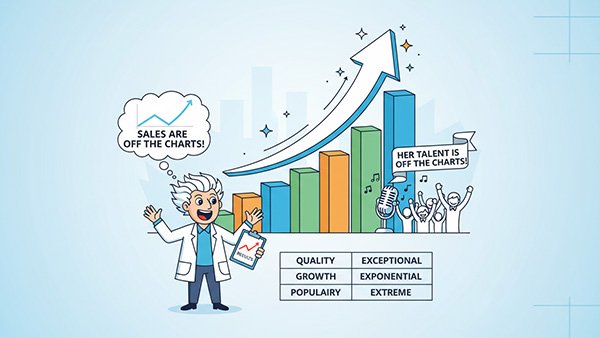
The idiomatic expression “off the charts” is used to describe something that is beyond the normal scale of measurement or expectation. It signifies that something is extraordinarily high, impressive, or intense.
The phrase evokes the image of a graph or chart where the value or data point exceeds the boundaries of the chart itself, indicating an extreme or exceptional level. It implies that the quality, quantity, or intensity is so great that it cannot be accurately represented within a standard framework.
In essence, “off the charts” is a figurative way of saying something is exceptionally high, extremely good, or incredibly intense. It is often used to describe positive attributes, such as performance, popularity, or happiness, but it can also be used to describe negative attributes, such as anger or pain, when they are experienced to an extreme degree.
When people talk about being off the charts, they refer to a state or quality that exceeds expectations or norms. This can apply to performance, emotions, or even atmosphere, like when someone says “The party had off the charts vibes,” indicating an exceptionally energetic and enjoyable environment.
Similarly, you might hear phrases like “The brilliance is off the charts” to emphasize extraordinary talent, skill, or creativity. These variations highlight how flexible the idiom is across contexts, from describing emotions to praising achievements.
The phrase is classified as an idiom, which means its meaning cannot be derived directly from the literal definitions of the individual words. Instead, the phrase has a specific, established meaning within the English language.
Its function is to add emphasis and color to descriptions, making them more vivid and engaging. The context in which “off the charts” is used is typically informal or conversational, but it can also appear in more formal settings depending on the specific situation and audience.
Structural Breakdown
The structure of the idiom “off the charts” is relatively simple. It consists of three words: “off,” “the,” and “charts.” Each word contributes to the overall meaning of the phrase.
- Off: This preposition indicates a departure or deviation from a standard or norm. In this context, it suggests that something is exceeding the limits of what is considered typical or measurable.
- The: This definite article specifies that we are referring to a particular set of charts or scales. It implies a known or understood framework for measurement or comparison.
- Charts: This noun refers to visual representations of data, typically in the form of graphs or tables. It symbolizes a standard scale or range of values.
The combination of these words creates a figurative expression that conveys the idea of something being so extreme that it goes beyond the boundaries of conventional measurement. The structure is fixed, meaning that the order of the words cannot be changed without altering the meaning or making the phrase grammatically incorrect.
It is important to use the phrase exactly as it is to maintain its idiomatic meaning and avoid confusion.
The phrase often functions as an adjective phrase, modifying a noun or pronoun to describe its exceptional quality or intensity. For example, in the sentence “Her performance was off the charts,” the phrase “off the charts” modifies the noun “performance,” indicating that it was extraordinarily good.
Types and Categories
While the basic meaning of “off the charts” remains consistent, its application can vary slightly depending on the context. Here are some common categories in which this idiom is used:
Describing Positive Qualities
This is the most common usage, where “off the charts” describes something exceptionally good, impressive, or desirable. Examples include outstanding performance, incredible talent, or remarkable success.
Describing Negative Qualities (Extreme Intensity)
Although less frequent, “off the charts” can also describe negative qualities that are experienced to an extreme degree. This could include intense pain, overwhelming anger, or extreme sadness.
In these cases, the idiom emphasizes the severity of the negative experience.
Describing Quantities
“Off the charts” can be used to describe quantities that are exceptionally high or large. This could include sales figures, attendance numbers, or any other measurable quantity that exceeds expectations.
Describing Popularity
The idiom is often used to describe something that is extremely popular or well-liked. This could include a song, a movie, a product, or a person that has achieved a high level of recognition and acclaim.
Examples of “Off the Charts” in Use
To fully understand the usage of “off the charts,” let’s examine various examples across different categories. These examples will illustrate how the idiom is used in context and how it adds emphasis to the description.
Describing Performance
The following table provides examples of “off the charts” used to describe performance in various fields, such as sports, music, and academics. Each example demonstrates how the idiom highlights the exceptional quality of the performance.
| Example | Context |
|---|---|
| Her singing performance last night was off the charts. | Describing a singer’s exceptional performance |
| The team’s performance in the championship game was off the charts. | Highlighting the team’s outstanding performance |
| His academic achievements are off the charts; he’s the top student in his class. | Emphasizing the student’s exceptional academic success |
| The chef’s culinary skills are off the charts; every dish is a masterpiece. | Describing the chef’s exceptional culinary abilities |
| The dancer’s grace and technique were off the charts. | Highlighting the dancer’s exceptional skills |
| The athlete’s speed and agility were off the charts during the competition. | Emphasizing the athlete’s outstanding physical abilities |
| The actor’s portrayal of the character was off the charts, captivating the audience. | Describing the actor’s exceptional acting skills |
| The pianist’s performance was off the charts, leaving the audience in awe. | Highlighting the pianist’s exceptional musical talent |
| The surgeon’s precision and skill were off the charts, saving the patient’s life. | Describing the surgeon’s exceptional surgical abilities |
| The writer’s creativity and imagination are off the charts. | Emphasizing the writer’s exceptional writing skills |
| The architect’s design was off the charts, innovative and aesthetically pleasing. | Describing the architect’s exceptional design skills |
| The programmer’s coding skills are off the charts, solving complex problems with ease. | Highlighting the programmer’s exceptional technical abilities |
| The artist’s painting was off the charts, vibrant and emotionally evocative. | Describing the artist’s exceptional artistic talent |
| The speaker’s charisma and eloquence were off the charts, inspiring the audience. | Emphasizing the speaker’s exceptional communication skills |
| The company’s innovation in technology is off the charts. | Highlighting the company’s outstanding technological advancements |
| The scientist’s research was off the charts, leading to groundbreaking discoveries. | Describing the scientist’s exceptional research abilities |
| The entrepreneur’s business acumen is off the charts, building a successful empire. | Emphasizing the entrepreneur’s exceptional business skills |
| The teacher’s dedication and passion are off the charts, inspiring students to excel. | Describing the teacher’s exceptional teaching abilities |
| The volunteer’s selflessness and compassion were off the charts, making a difference in the community. | Highlighting the volunteer’s exceptional humanitarian efforts |
| The doctor’s diagnostic skills are off the charts, accurately identifying rare diseases. | Describing the doctor’s exceptional medical expertise |
| The lawyer’s persuasive arguments were off the charts, winning difficult cases. | Emphasizing the lawyer’s exceptional legal skills |
| The negotiator’s diplomatic skills are off the charts, resolving complex international disputes. | Describing the negotiator’s exceptional diplomatic abilities |
| The investigator’s detective work was off the charts, solving intricate mysteries. | Highlighting the investigator’s exceptional investigative skills |
| The builder’s craftsmanship is off the charts, creating durable and beautiful structures. | Describing the builder’s exceptional construction skills |
| The gardener’s horticultural skills are off the charts, cultivating stunning landscapes. | Emphasizing the gardener’s exceptional gardening abilities |
Describing Emotions
This table illustrates how “off the charts” can be used to describe emotions, both positive and negative, when they are experienced to an extreme degree. The idiom adds emphasis to the intensity of the emotion.
| Example | Context |
|---|---|
| Her happiness was off the charts when she received the award. | Describing extreme happiness |
| His anger was off the charts after the accident. | Highlighting intense anger |
| The excitement at the concert was off the charts. | Emphasizing extreme excitement |
| Her sadness was off the charts when she heard the news. | Describing intense sadness |
| The fear during the storm was off the charts. | Highlighting extreme fear |
| Their joy was off the charts when they welcomed their new baby. | Emphasizing extreme joy |
| His frustration was off the charts when the project failed. | Describing intense frustration |
| The relief after the surgery was off the charts. | Highlighting extreme relief |
| Her anxiety was off the charts before the presentation. | Describing intense anxiety |
| Their love for each other is off the charts. | Highlighting extreme love |
| His disappointment was off the charts when he didn’t get the job. | Describing intense disappointment |
| The anticipation before the trip was off the charts. | Highlighting extreme anticipation |
| Her gratitude was off the charts for all the support she received. | Describing intense gratitude |
| His rage was off the charts when he discovered the betrayal. | Highlighting extreme rage |
| The nervousness before the wedding was off the charts. | Describing intense nervousness |
| Their enthusiasm for the project is off the charts. | Highlighting extreme enthusiasm |
| Her despair was off the charts after the loss. | Describing intense despair |
| The anticipation for the movie release was off the charts. | Highlighting extreme anticipation |
| His pride was off the charts when his daughter graduated. | Describing intense pride |
| The stress before the deadline was off the charts. | Highlighting extreme stress |
| Her appreciation for the gift was off the charts. | Describing intense appreciation |
| His resentment towards his rival was off the charts. | Highlighting extreme resentment |
| The excitement before the game was off the charts. | Describing intense excitement |
| Her loneliness after moving was off the charts. | Highlighting extreme loneliness |
| His passion for his work is off the charts. | Describing intense passion |
Describing Quantities
This table provides examples of “off the charts” used to describe quantities that are exceptionally high or large. The idiom emphasizes the magnitude of the quantity.
| Example | Context |
|---|---|
| The sales figures for the new product are off the charts. | Describing exceptionally high sales |
| The attendance at the event was off the charts. | Highlighting a large attendance |
| The demand for the tickets was off the charts. | Emphasizing high demand |
| The amount of donations received was off the charts. | Describing a large amount of donations |
| The number of visitors to the website is off the charts. | Highlighting a large number of visitors |
| The profits for the company were off the charts this year. | Describing exceptionally high profits |
| The amount of rainfall this month has been off the charts. | Highlighting a large amount of rainfall |
| The number of applications received was off the charts. | Describing a large number of applications |
| The amount of traffic on the highway was off the charts. | Highlighting a large amount of traffic |
| The number of downloads for the app is off the charts. | Describing a large number of downloads |
| The amount of food consumed at the festival was off the charts. | Highlighting a large quantity of food consumed |
| The number of complaints received was off the charts. | Describing a high number of complaints |
| The amount of energy consumed during the heatwave was off the charts. | Highlighting a large amount of energy consumed |
| The number of errors in the report was off the charts. | Describing a high number of errors |
| The amount of data generated by the experiment was off the charts. | Highlighting a large amount of data generated |
| The number of participants in the study was off the charts. | Describing a high number of participants |
| The amount of resources required for the project was off the charts. | Highlighting a large quantity of resources required |
| The number of attendees at the conference was off the charts. | Describing a high number of attendees |
| The amount of waste produced by the factory was off the charts. | Highlighting a large quantity of waste produced |
| The number of views on the video is off the charts. | Describing a high number of views |
| The level of pollution in the city is off the charts. | Highlighting a high level of pollution |
| The scale of the disaster was off the charts. | Describing a large-scale disaster |
| The volume of traffic on the website during the sale was off the charts. | Highlighting a high volume of traffic |
| The amount of money raised for the charity was off the charts. | Describing a large amount of money raised |
| The degree of difficulty of the task was off the charts. | Highlighting a high degree of difficulty |
Describing Popularity
This table demonstrates how “off the charts” is used to describe something that is extremely popular or well-liked. The idiom emphasizes the high level of recognition and acclaim.
| Example | Context |
|---|---|
| The popularity of the new song is off the charts. | Describing an extremely popular song |
| The movie’s success is off the charts. | Highlighting a highly successful movie |
| The demand for the celebrity’s autograph was off the charts. | Emphasizing high demand for an autograph |
| The restaurant’s ratings are off the charts. | Describing a highly rated restaurant |
| The app’s user reviews are off the charts. | Highlighting highly positive user reviews |
| The politician’s approval ratings are off the charts. | Describing a politician with very high approval |
| The brand’s reputation is off the charts. | Highlighting a brand with an excellent reputation |
| The book’s sales are off the charts. | Describing a book with very high sales figures |
| The festival’s attendance numbers are off the charts. | Highlighting a festival with a very large attendance |
| The website’s traffic is off the charts. | Describing a website with a very high volume of traffic |
| The product’s customer satisfaction ratings are off the charts. | Highlighting a product with very high customer satisfaction |
| The artist’s album sales are off the charts. | Describing an artist with very high album sales |
| The event’s media coverage was off the charts. | Highlighting an event with extensive media coverage |
| The charity’s fundraising success is off the charts. | Describing a charity with very successful fundraising efforts |
| The athlete’s fan base is off the charts. | Highlighting an athlete with a very large fan base |
| The influencer’s social media engagement is off the charts. | Describing an influencer with very high social media engagement |
| The innovation’s impact on the industry is off the charts. | Highlighting an innovation with a significant impact |
| The organization’s community support is off the charts. | Describing an organization with very strong community support |
| The volunteer program’s participation rate is off the charts. | Highlighting a volunteer program with a very high participation rate |
| The online course’s enrollment numbers are off the charts. | Describing an online course with very high enrollment numbers |
| The new restaurant’s reservations are off the charts. | Highlighting a restaurant with very high reservation numbers |
| The video game’s pre-orders were off the charts. | Describing a video game with very high pre-order numbers |
| The concert’s ticket sales are off the charts. | Highlighting a concert with very high ticket sales |
| The museum’s visitor numbers are off the charts. | Describing a museum with very high visitor numbers |
| The software’s download rate is off the charts. | Highlighting software with a very high download rate |
Usage Rules
Using “off the charts” correctly involves understanding the context and adhering to certain grammatical rules. Here are some key guidelines:
- Use in informal contexts: The idiom is generally used in informal or conversational settings. While it can be used in more formal contexts, it’s important to consider the audience and the overall tone of the communication.
- Modify nouns: The phrase typically functions as an adjective phrase, modifying a noun or pronoun. For example, “The performance was off the charts.”
- Avoid literal interpretation: Remember that “off the charts” is a figurative expression. Avoid interpreting it literally as referring to actual charts or graphs.
- Maintain the structure: The structure of the idiom is fixed and should not be altered. Use the phrase exactly as it is: “off the charts.”
- Consider the connotation: While “off the charts” is often used to describe positive qualities, it can also describe negative qualities when they are experienced to an extreme degree. Be mindful of the connotation when using the idiom.
Exceptions and Special Cases: There are no significant exceptions or special cases to the usage rules of “off the charts.” However, it’s important to ensure that the context is appropriate and that the idiom is used in a way that enhances the description rather than causing confusion.
Common Grammar Questions about “Off the Charts”
Some learners wonder about small but important details when using this idiom. For instance, should you say *off the chart* or *off the charts*? The correct form is always *off the charts*, as the plural “charts” emphasizes the idea of exceeding measurable limits.
Another question involves hyphenation. When using “off the charts” as an adjective directly before a noun, it is common to hyphenate it for clarity: for example, *an off-the-charts performance*. This hyphenation signals that the phrase collectively modifies the noun, maintaining grammatical precision and readability.
Understanding these subtle distinctions ensures your use of the idiom is not only idiomatic but also grammatically correct in both written and spoken English.
Common Mistakes
Even with a good understanding of the definition and usage rules, it’s easy to make mistakes when using “off the charts.” Here are some common errors to avoid:
- Misusing the structure: Incorrect: “The charts were off.” Correct: “The performance was off the charts.”
- Literal interpretation: Avoid using the idiom in contexts where a literal interpretation is more appropriate. For example, if you are actually discussing data on a chart, use more precise language.
- Inappropriate context: Avoid using the idiom in highly formal or technical settings where it may sound out of place.
The following table illustrates some common mistakes and provides the correct alternatives:
| Incorrect | Correct | Explanation |
|---|---|---|
| The charts were off. | The sales figures were off the charts. | The structure of the idiom was misused. |
| The data is literally off the charts. | The data exceeds the chart’s maximum value. | The idiom was used when a literal description was more appropriate. |
| In this formal report, the results are off the charts. | In this formal report, the results are exceptionally high. | The idiom was used in an inappropriate context. |
| The charts are off the hook. | The sales figures are off the charts. | The wrong idiom was used (“off the hook” has a different meaning). |
| The charts are over the top. | The sales figures are off the charts. | While “over the top” has a similar meaning, “off the charts” is more specific to exceeding expectations. |
Practice Exercises
To solidify your understanding of “off the charts,” complete the following practice exercises. These exercises will test your ability to use the idiom correctly in various contexts.
Exercise 1: Fill in the Blanks
Fill in the blanks with the correct form of “off the charts” to complete the sentences.
| Question | Answer |
|---|---|
| The popularity of the new video game is __________. | off the charts |
| Her performance in the play was absolutely __________. | off the charts |
| The amount of rain we’ve had this month is __________. | off the charts |
| The excitement at the concert was __________. | off the charts |
| The restaurant’s customer reviews are __________. | off the charts |
| The athlete’s speed during the race was __________. | off the charts |
| His anger after the argument was __________. | off the charts |
| The demand for the new phone is __________. | off the charts |
| The amount of support they received was __________. | off the charts |
| Her happiness when she got the news was __________. | off the charts |
Exercise 2: Sentence Completion
Complete the following sentences using “off the charts” in a meaningful way.
| Question | Answer |
|---|---|
| Because of the overwhelming positive response, the success of the event was __________. | off the charts. |
| After practicing for months, the dancer’s skill level was __________. | off the charts. |
| Due to the unprecedented demand, the waiting list for the product is __________. | off the charts. |
| When the team finally won the championship, their celebration was __________. | off the charts. |
| The chef’s creativity in the kitchen is __________. | off the charts. |
| Since the new policy was implemented, the company’s productivity has been __________. | off the charts. |
| With the launch of their new album, the band’s popularity is __________. | off the charts. |
| Because of the severity of the storm, the amount of damage was __________. | off the charts. |
| After years of hard work, the scientist’s breakthrough discovery was __________. | off the charts. |
| The politician’s charisma and ability to connect with people are __________. | off the charts. |
Exercise 3: Error Correction
Identify and correct the errors in the following sentences related to the usage of “off the charts.”
| Incorrect | Correct | Explanation |
|---|---|---|
| The charts were off for his performance. | His performance was off the charts. | The structure of the idiom was incorrect. |
| The results are literally off the charts, exceeding the maximum value. | The results exceed the chart’s maximum value. | The idiom was used when a literal description was more appropriate. |
| The success of the event was off the hook. | The success of the event was off the charts. | The wrong idiom was used. |
| In this technical report, the findings are off the charts. | In this technical report, the findings are exceptionally high. | The idiom was used in an inappropriate context. |
| The charts were completely off. | The sales figures were off the charts. | Missing the noun being modified to complete the sentence. |
| The charts became off. | The popularity became off the charts. | Grammatically incorrect structure. |
| The performance was over the charts. | The performance was off the charts. | Incorrect preposition use. |
| The popularity is off the board. | The popularity is off the charts. | The wrong idiom was used. |
| The charts were beyond. | The sales were off the charts. | Missing the noun being modified to complete the sentence. |
| His skill is charts off the. | His skill is off the charts. | Structure of the idiom was incorrect. |
Advanced Topics
For advanced learners, understanding the nuances and variations of “off the charts” can further enhance their command of the English language. Here are some advanced topics to consider:
- Synonyms and related idioms: Explore other idioms that convey similar meanings, such as “through the roof,” “sky-high,” and “over the top.” Understanding these synonyms can provide more options for expressing extreme degrees or values.
- Cultural context: Consider how cultural factors may influence the usage and interpretation of “off the charts.” In some cultures, certain expressions may be more or less common or appropriate.
- Figurative language analysis: Analyze the use of “off the charts” in literature, media, and other forms of communication to gain a deeper understanding of its impact and effectiveness.
Analyzing the subtle differences between “off the charts” and its synonyms can help you choose the most appropriate expression for a given context. For example, “through the roof” often implies a sudden and dramatic increase, while “off the charts” emphasizes the exceptional level itself.
Understanding these nuances can add depth and precision to your communication.
Frequently Asked Questions (FAQ)
Here are some frequently asked questions about the idiomatic expression “off the charts”:
What does “off the charts” mean?
It means something is beyond the normal scale of measurement or expectation, signifying that it is extraordinarily high, impressive, or intense.
Is “off the charts” used for positive or negative things?
It is primarily used to describe positive qualities like outstanding performance or popularity, but it can also describe negative qualities when they are experienced to an extreme degree, such as intense pain or anger.
Can I use “off the charts” in formal writing?
While it’s generally used in informal contexts, it can be used in more formal settings if the audience and tone are appropriate. Consider the context carefully before using it in formal writing.
What are some synonyms for “off the charts”?
Synonyms include “through the roof,” “sky-high,” “over the top,” and “out of this world.”
How do I avoid misusing “off the charts”?
Ensure you use the correct structure (“off the charts”), avoid literal interpretations, and consider the context to ensure it’s appropriate.
What part of speech is “off the charts”?
It typically functions as an adjective phrase, modifying a noun or pronoun to describe its exceptional quality or intensity.
Is it correct to say “the charts were off”?
No, that is not the correct usage of the idiom. The correct structure is “off the charts,” used to modify a noun or pronoun. For example, “The sales were off the charts.”
Can I use “off the charts” to describe something that is slightly above average?
No, “off the charts” is used to describe something that is far beyond the average or expected level. It signifies an extreme degree or intensity.
Conclusion
Mastering the idiomatic expression “off the charts” can significantly enhance your ability to express extreme degrees or values in English. By understanding its definition, usage rules, and common mistakes, you can confidently incorporate this idiom into your vocabulary.
Remember to use it in appropriate contexts, avoid literal interpretations, and practice using it in various sentences to solidify your understanding.
Continue to expand your knowledge of English idioms to further enrich your communication skills. Idiomatic expressions add color and depth to the language, making your speech and writing more engaging and effective.
With consistent practice and attention to detail, you can become proficient in using “off the charts” and other idioms to express yourself with greater precision and flair.