Understanding antonyms is crucial for expanding vocabulary and improving communication skills. This article focuses on the antonyms of “encroach,” a word that describes the act of intruding or gradually advancing beyond recognized boundaries.
By exploring words that represent the opposite of encroachment, such as respecting boundaries, retreating, or yielding, we can gain a deeper understanding of nuance and precision in language. This guide is beneficial for students, writers, and anyone looking to enhance their command of the English language.
This article provides a comprehensive overview of the antonyms of “encroach,” offering definitions, examples, and practice exercises to help you master this essential aspect of vocabulary. Whether you are preparing for an exam, writing a report, or simply seeking to improve your communication skills, this guide will provide you with the tools and knowledge you need.
Table of Contents
- Introduction
- Definition of Encroach
- Structural Breakdown of Encroach
- Antonyms of Encroach
- Examples of Antonyms in Use
- Usage Rules
- Common Mistakes
- Practice Exercises
- Advanced Topics
- FAQ
- Conclusion
Definition of Encroach
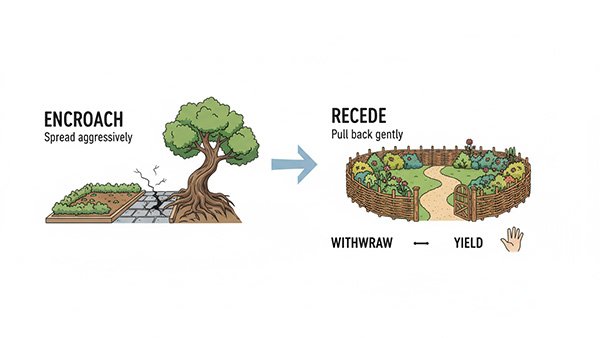
Encroach is a verb that means to intrude on, advance beyond proper limits, or gradually take possession of something belonging to another. When considering the definition of “encroach,” it becomes clear that its antonyms represent the opposite actions implied by the word. While “encroach” suggests gradual intrusion or overstepping, its antonyms—such as withdraw, abstain, or vacate—highlight restraint, respect, and deliberate avoidance.
It often implies a gradual and subtle process of intrusion. The word can be used in various contexts, including physical spaces, rights, and abstract concepts such as time or authority.
For example, “The new building encroached on the park’s green space,” or “The company’s marketing tactics encroached on the privacy of its customers.” In both cases, there is an implication of crossing a boundary that should have been respected.
Structural Breakdown of Encroach
The word “encroach” is composed of the prefix en- and the root word croach. The prefix “en-” often means “to put in” or “to get into.” The root “croach” is related to the Old French word “crochier,” which means “to hook” or “to seize.” Thus, “encroach” literally means “to seize upon” or “to gradually take hold of.”
Understanding the etymology and structural components of “encroach” can enhance our grasp of its meaning and usage. It highlights the subtle, persistent nature of the action, suggesting that encroachment is not a sudden event but a gradual process.
Antonyms of Encroach
The antonyms of “encroach” represent actions or states that are the opposite of intruding or advancing beyond proper limits. These antonyms emphasize respecting boundaries, retreating, or yielding.
In summary, the antonyms of “encroach” cover a range of actions that emphasize stepping back, giving way, or respecting boundaries. Common examples include respect and retreat, which highlight conscious avoidance of intrusion.
Yielding or withdrawing similarly demonstrates a willingness to honor someone else’s claim, while ceding, relinquishing, vacating, and abstaining provide more formal or specific contexts for non-encroachment. Understanding these antonyms not only clarifies the meaning of “encroach” but also helps communicate precise intentions when describing boundaries or rights.
Here are some key antonyms of “encroach,” each with its own nuance and context:
Respect
Respect, in this context, means to show regard for the boundaries, rights, or property of others. It implies a conscious effort to avoid intruding or interfering.
Retreat
Retreat means to withdraw from a position or to move back. It implies a conscious decision to move away from a boundary or to avoid encroaching further.
Yield
Yield means to give way or to surrender to someone else’s claim or right. It implies a willingness to relinquish control or possession.
Withdraw
Withdraw means to remove oneself or something else from a place or situation. It implies a deliberate action to step back and avoid intrusion.
Cede
Cede means to give up power or territory. This is often used in political or legal contexts.
Relinquish
Relinquish means to voluntarily cease to keep or claim; give up. This implies a more formal or deliberate act of giving something up.
Vacate
Vacate means to leave a place empty; abandon. This emphasizes the act of leaving a space to avoid intrusion.
Abstain
Abstain means to restrain oneself from doing or enjoying something. In the context of encroachment, it means refraining from intruding.
Examples of Antonyms in Use
To fully understand the antonyms of “encroach,” it is helpful to see them in context. The following tables provide examples of how these antonyms can be used in sentences to convey the opposite meaning of “encroach.”
Table 1: Examples Using “Respect” as an Antonym of Encroach
This table provides examples of sentences where ‘respect’ is used to show the opposite of encroachment, emphasizing regard for boundaries and rights.
| Original Sentence (Encroachment) | Revised Sentence (Respect) |
|---|---|
| The construction company encroached on the neighbor’s property line. | The construction company respected the neighbor’s property line. |
| The government’s policies encroached on individual freedoms. | The government’s policies respected individual freedoms. |
| The new development encroached on the natural habitat of the local wildlife. | The new development respected the natural habitat of the local wildlife. |
| The company’s advertising campaign encroached on the privacy of its customers. | The company’s advertising campaign respected the privacy of its customers. |
| The rising sea levels are encroaching on the coastal communities. | The coastal communities respect the power of the sea and adapt accordingly. |
| Her constant questions encroached on his personal space. | She respected his personal space by giving him room to breathe. |
| The weeds encroached on the flower garden. | The gardener respected the boundaries of the flower garden. |
| The new regulations encroached on the autonomy of the local businesses. | The new regulations respected the autonomy of the local businesses. |
| The loud music encroached on the peace and quiet of the neighborhood. | The residents respected the peace and quiet of the neighborhood by keeping the music down. |
| The developer’s plans encroached on the historical significance of the site. | The developer’s plans respected the historical significance of the site. |
| The politician’s remarks encroached on the dignity of his opponent. | The politician’s remarks respected the dignity of his opponent. |
| The student’s actions encroached on the authority of the teacher. | The student’s actions respected the authority of the teacher. |
| The company’s expansion encroached on the territory of its competitor. | The company’s expansion respected the territory of its competitor. |
| The city’s growth encroached on the surrounding farmland. | The city’s growth respected the boundaries of the surrounding farmland. |
| The hiker’s path encroached on the protected wildlife area. | The hiker’s path respected the protected wildlife area. |
| The new law encroached on the rights of the minority group. | The new law respected the rights of the minority group. |
| The journalist’s investigation encroached on the privacy of the celebrity. | The journalist’s investigation respected the privacy of the celebrity. |
| The artist’s work encroached on the intellectual property of another creator. | The artist’s work respected the intellectual property of another creator. |
| The children’s game encroached on the neighbor’s yard. | The children’s game respected the boundaries of the neighbor’s yard. |
| The company’s data collection practices encroached on user privacy. | The company’s data collection practices respected user privacy. |
Table 2: Examples Using “Retreat” as an Antonym of Encroach
This table illustrates sentences where ‘retreat’ is used to convey the opposite of encroachment, indicating a withdrawal from a position or boundary.
| Original Sentence (Encroachment) | Revised Sentence (Retreat) |
|---|---|
| The floodwaters encroached on the town. | The floodwaters retreated from the town. |
| The army encroached on enemy territory. | The army retreated from enemy territory. |
| The glacier encroached on the valley. | The glacier retreated from the valley. |
| The disease encroached on his health. | The disease retreated, and his health improved. |
| The darkness encroached on the daylight. | The darkness retreated as dawn approached. |
| The rising tide encroached upon the beach. | The rising tide retreated, revealing the sandy beach once more. |
| The protesters encroached upon the government building. | The protesters retreated from the government building after negotiations. |
| The forest fire encroached upon the residential area. | The forest fire retreated as firefighters gained control. |
| The invading army encroached further into the country. | The invading army retreated across the border after suffering heavy losses. |
| The desert encroached upon the fertile land. | The desert retreated due to successful irrigation efforts. |
| The shadow encroached upon the sunny spot. | The shadow retreated as the sun moved higher in the sky. |
| The construction workers encroached upon the adjacent property. | The construction workers retreated, realigning the construction site within their boundaries. |
| The sales team encroached upon the competitor’s market share. | The sales team retreated from their aggressive tactics, focusing on their strengths. |
| The argument encroached upon their friendship. | The argument subsided, and they retreated from the contentious topic to preserve their friendship. |
| The economic crisis encroached upon their savings. | As the economy recovered, the crisis retreated, and their savings began to rebound. |
| The invasive species encroached upon the native ecosystem. | The invasive species retreated as conservationists implemented control measures. |
| The deadline encroached upon their free time. | The project was completed, and the deadline retreated into the past, giving them free time again. |
| The interviewer’s questions encroached upon her privacy. | The interviewer retreated from the personal questions, focusing on her professional experience. |
| The darkness of the cave encroached upon their sense of direction. | They turned back, and the darkness retreated as they moved toward the entrance. |
| The bad news encroached upon their celebratory mood. | They decided to focus on the positive aspects, and the bad news retreated into the background. |
Table 3: Examples Using “Yield” as an Antonym of Encroach
This table shows how ‘yield’ is used to express the opposite of encroachment, indicating giving way or surrendering a claim or right.
| Original Sentence (Encroachment) | Revised Sentence (Yield) |
|---|---|
| The stronger nation encroached on the weaker nation’s territory. | The stronger nation yielded the disputed territory to the weaker nation. |
| The company encroached on its competitor’s market share. | The company yielded some of its market share to its competitor. |
| The government encroached on the rights of its citizens. | The government yielded to the demands of its citizens and restored their rights. |
| The invading army encroached on the city. | The defending forces yielded the city to the invading army after a long siege. |
| The weeds encroached on the garden. | The gardener yielded to the weeds, letting them grow freely. |
| The corporation encroached on the small business’s customer base. | The corporation yielded, agreeing not to target the small business’s customers. |
| The landlord encroached on the tenant’s privacy. | The landlord yielded to the tenant’s request for more privacy. |
| The larger animal encroached on the smaller animal’s feeding ground. | The larger animal yielded the feeding ground to the smaller animal. |
| The dominant player in the industry encroached on the newcomer’s innovations. | The dominant player yielded, acknowledging the newcomer’s innovative contributions. |
| The bureaucracy encroached on the individual’s freedom to act. | The bureaucracy yielded, reducing regulations to allow more individual freedom. |
| The new technology encroached on traditional methods. | The industry yielded to the rise of new technology, integrating it into traditional methods. |
| The powerful country encroached on the weaker country’s natural resources. | The powerful country yielded, agreeing to share the natural resources equitably. |
| The senior employee encroached on the junior employee’s responsibilities. | The senior employee yielded, allowing the junior employee to take ownership of their responsibilities. |
| The established artist encroached on the emerging artist’s creative space. | The established artist yielded, giving the emerging artist room to express their creativity. |
| The traditional belief system encroached on new scientific discoveries. | Society yielded, integrating new scientific discoveries into the traditional belief system. |
| The older generation encroached on the younger generation’s cultural expressions. | The older generation yielded, embracing the younger generation’s cultural expressions. |
| The established political party encroached on the emerging party’s platform. | The established political party yielded, incorporating some of the emerging party’s ideas into their platform. |
| The urban development encroached on the rural landscape. | The developers yielded, preserving the rural landscape alongside the urban development. |
| The social media platform encroached on users’ personal data. | The social media platform yielded, tightening privacy controls to protect users’ data. |
| The government regulation encroached on the industry’s flexibility. | The government yielded, adjusting the regulation to allow for more industry flexibility. |
Table 4: Examples Using “Withdraw” as an Antonym of Encroach
This table shows examples of ‘withdraw’ being used as the opposite of ‘encroach’, indicating a removal of oneself or something else from a situation.
| Original Sentence (Encroachment) | Revised Sentence (Withdraw) |
|---|---|
| The troops encroached on the border. | The troops withdrew from the border. |
| The company encroached on the agreement. | The company withdrew from the agreement. |
| He encroached on the conversation. | He withdrew from the conversation. |
| The investor encroached on his funds. | The investor withdrew his funds from the project. |
| The negotiator encroached on his offer. | The negotiator withdrew his offer. |
| The country encroached on its financial support. | The country withdrew its financial support. |
| The candidate encroached on his nomination. | The candidate withdrew his nomination. |
| The researcher encroached on his study. | The researcher withdrew his study. |
| The team encroached on the competition. | The team withdrew from the competition. |
| The organization encroached on its membership. | The organization withdrew its membership. |
| The participant encroached on the experiment. | The participant withdrew from the experiment. |
| The nation encroached on the treaty. | The nation withdrew from the treaty. |
| The author encroached on his book. | The author withdrew his book. |
| The group encroached on the coalition. | The group withdrew from the coalition. |
| The scientist encroached on the discovery. | The scientist withdrew the discovery. |
| The alliance encroached on the consensus. | The alliance withdrew from the consensus. |
| The community encroached on the funding. | The community withdrew the funding. |
| The committee encroached on the recommendation. | The committee withdrew the recommendation. |
| The institution encroached on the endorsement. | The institution withdrew the endorsement. |
| The partnership encroached on the collaboration. | The partnership withdrew from the collaboration. |
Table 5: Examples Using “Cede,” “Relinquish,” “Vacate,” and “Abstain” as Antonyms of Encroach
This table demonstrates the use of ‘cede’, ‘relinquish’, ‘vacate’, and ‘abstain’ to illustrate the opposite of encroachment, emphasizing the act of giving up or refraining from intrusion.
| Antonym | Original Sentence (Encroachment) | Revised Sentence (Antonym) |
|---|---|---|
| Cede | The conquering army encroached on the captured territory. | The conquering army ceded the captured territory back to its original owners. |
| Relinquish | The manager encroached on the employee’s responsibilities. | The manager relinquished the employee’s responsibilities, allowing them autonomy. |
| Vacate | The squatters encroached on the abandoned building. | The squatters vacated the abandoned building. |
| Abstain | The politician encroached on the debate. | The politician abstained from the debate to remain neutral. |
| Cede | The larger company encroached on the startup’s niche market. | The larger company ceded the niche market to the startup. |
| Relinquish | The dictator encroached on the citizens’ fundamental rights. | The dictator relinquished power, restoring the citizens’ fundamental rights. |
| Vacate | The construction crew encroached on the protected wildlife area. | The construction crew vacated the protected wildlife area immediately. |
| Abstain | The judge encroached on the case by showing bias. | The judge abstained from the case to avoid any appearance of bias. |
| Cede | The colonial power encroached on the indigenous people’s land. | The colonial power ceded the land back to the indigenous people. |
| Relinquish | The older sibling encroached on the younger sibling’s personal space. | The older sibling relinquished the younger sibling’s personal space. |
| Vacate | The trespassers encroached on the private property. | The trespassers vacated the private property upon request. |
| Abstain | The board member encroached on the decision-making process. | The board member abstained from the decision-making process due to a conflict of interest. |
| Cede | The invading force encroached on the defending nation’s borders. | The invading force ceded the captured territory back to the defending nation. |
| Relinquish | The manager encroached on the team’s creative freedom. | The manager relinquished control, allowing the team creative freedom. |
| Vacate | The protesters encroached on the government building’s lawn. | The protesters vacated the government building’s lawn peacefully. |
| Abstain | The voter encroached on the election by casting multiple ballots. | The voter abstained from casting multiple ballots to ensure a fair election. |
| Cede | The corporation encroached on the smaller company’s patent rights. | The corporation ceded the patent rights back to the smaller company. |
| Relinquish | The dominant species encroached on the weaker species’ habitat. | The dominant species relinquished some of its habitat to allow the weaker species to thrive. |
| Vacate | The illegal miners encroached on the protected natural reserve. | The illegal miners vacated the protected natural reserve. |
| Abstain | The judge encroached on the judicial process by making premature judgments. | The judge abstained from making premature judgments to ensure a fair judicial process. |
Usage Rules
When using the antonyms of “encroach,” it is important to consider the context and nuance of each word. Here are some usage rules to keep in mind:
- Respect is used when referring to the act of honoring boundaries, rights, or property.
- Retreat is used when describing the act of moving back or withdrawing from a position.
- Yield is used when describing the act of giving way or surrendering to someone else’s claim or right.
- Withdraw is used when describing the act of removing oneself or something else from a place or situation.
- Cede is used in formal contexts, such as political or legal situations, to indicate the giving up of power or territory.
- Relinquish is used to describe voluntarily giving up something, often a right or possession.
- Vacate is used to describe leaving a place empty, often to avoid intrusion or trespassing.
- Abstain is used to describe refraining from doing something, especially when there is a conflict of interest or ethical concern.
Understanding these nuances will help you choose the most appropriate antonym for “encroach” in any given situation.
Common Mistakes
One common mistake is using “invade” as an antonym for “encroach.” While “invade” does imply the opposite of respecting boundaries, it suggests a sudden and forceful intrusion, whereas “encroach” implies a gradual and subtle process. Therefore, “invade” is not a direct antonym.
Another common mistake is using “ignore” as an antonym. “Ignore” means to pay no attention to something, but it does not necessarily imply the opposite of encroaching.
To ignore a boundary is not the same as respecting it or retreating from it.
Here are some examples of correct and incorrect usage:
| Incorrect | Correct |
|---|---|
| The army invaded the enemy territory, respecting their borders. | The army respected the enemy territory, not encroaching on their borders. |
| The company ignored the privacy of its customers, not encroaching on it. | The company respected the privacy of its customers, not encroaching on it. |
Practice Exercises
Test your understanding of the antonyms of “encroach” with the following practice exercises.
Exercise 1: Fill in the Blanks
Choose the best antonym of “encroach” to complete each sentence.
| Question | Answer |
|---|---|
| The city planners decided to ______ the park’s boundaries, ensuring it remained untouched. | respect |
| After the negotiations, the troops agreed to ______ from the disputed territory. | retreat |
| The company decided to ______ to the demands of the environmental activists and reduce its carbon emissions. | yield |
| The investor decided to ______ his funds from the risky venture. | withdraw |
| The government decided to ______ the disputed land to the neighboring country. | cede |
| The CEO decided to ______ his position after the scandal. | relinquish |
| The family decided to ______ the haunted house. | vacate |
| The judge decided to ______ from the case due to a conflict of interest. | abstain |
| The developer promised to ______ the natural habitat of the local wildlife. | respect |
| The firefighters worked tirelessly to ensure the fire did not ______ further into the forest. | encroach |
Exercise 2: Multiple Choice
Choose the best antonym of “encroach” for each sentence.
| Question | Options | Answer |
|---|---|---|
| The company decided to _______ the intellectual property rights of the inventor. | a) encroach b) respect c) ignore d) invade | b) respect |
| The army decided to _______ from the enemy’s territory after the peace treaty. | a) encroach b) retreat c) advance d) attack | b) retreat |
| The government decided to _______ to the demands of the protesters. | a) encroach b) resist c) yield d) dominate | c) yield |
| The investor decided to _______ his investment due to the high risk. | a) encroach b) withdraw c) deposit d) increase | b) withdraw |
| The country decided to _______ the territory to the neighboring nation. | a) encroach b) seize c) cede d) occupy | c) cede |
| The dictator decided to _______ power and allow free elections. | a) encroach b) maintain c) relinquish d) seize | c) relinquish |
| The family decided to _______ the old, dilapidated house. | a) encroach b) occupy c) vacate d) invade | c) vacate |
| The politician decided to _______ from voting on the bill. | a) encroach b) participate c) abstain d) interfere | c) abstain |
| The construction crew made sure to _______ the property lines. | a) encroach b) ignore c) respect d) violate | c) respect |
| The floodwaters began to _______ after the storm passed. | a) encroach b) rise c) retreat d) advance | c) retreat |
Advanced Topics
For advanced learners, it’s important to understand the subtle differences in meaning between the various antonyms and how they apply in specific contexts. For instance, “respect” implies a proactive regard for boundaries, while “abstain” suggests a conscious decision to avoid involvement.
Additionally, exploring the legal and ethical implications of encroachment can provide a deeper understanding of the topic. Laws regarding property rights, intellectual property, and personal privacy often deal with issues related to encroachment, and understanding these laws can help you use the antonyms more accurately.
FAQ
Q1: Is “ignore” an antonym of “encroach”?
No, “ignore” is not an antonym of “encroach.” While ignoring a boundary might lead to encroachment, the act of ignoring itself does not represent the opposite of intruding or advancing beyond proper limits. Antonyms like “respect” or “withdraw” are more accurate as they directly imply the opposite action.
Q2: Can “encroach” be used in a positive sense?
Generally, “encroach” has a negative connotation, implying an unwanted or inappropriate intrusion. It is rarely used in a positive sense.
In most contexts, it’s best to avoid using “encroach” unless you intend to convey a negative action.
Q3: What is the difference between “cede” and “relinquish”?
“Cede” typically refers to formally giving up territory or rights, often in a political or legal context. “Relinquish,” on the other hand, refers to voluntarily giving up something, such as a possession or a position.
While both involve giving something up, “cede” carries a more formal and often involuntary implication.
Q4: How does “respect” function as an antonym of “encroach” in abstract contexts?
In abstract contexts, “respect” can refer to honoring someone’s privacy, rights, or autonomy. For example, “The company respected the privacy of its users by not encroaching on their personal data.” This implies a conscious effort to avoid intruding on someone’s personal space or violating their rights.
Q5: When is it appropriate to use “vacate” as an antonym of “encroach”?
“Vacate” is appropriate when referring to leaving a physical space to avoid intrusion or trespassing. For example, “The squatters vacated the property after being asked to leave,” indicating they left to avoid encroaching on the owner’s property rights.
Q6: What are some synonyms of “encroach” to better understand its meaning?
Some synonyms of “encroach” include “intrude,” “trespass,” “infringe,” “invade,” “obtrude,” and “impinge.” Understanding these synonyms can help you grasp the nuanced meaning of “encroach” and better appreciate its antonyms.
Q7: How does the context affect the choice of antonym for “encroach?”
The context significantly affects the choice of antonym. If the encroachment involves physical space, “retreat” or “
vacate” might be appropriate.
If it involves rights or autonomy, “respect” or “yield” might be more suitable. Always consider the specific situation to choose the most accurate antonym.
Conclusion
Understanding the antonyms of “encroach” is essential for effective communication and precise language use. By exploring words such as “respect,” “retreat,” “yield,” “withdraw,” “cede,” “relinquish,” “vacate,” and “abstain,” we can better convey the opposite of intrusion and appreciate the nuances of boundary-respecting actions.
This guide has provided definitions, examples, and practice exercises to help you master these antonyms and enhance your vocabulary skills. Whether you are writing, speaking, or simply seeking to improve your understanding of the English language, mastering the antonyms of “encroach” will undoubtedly prove valuable.