
Understanding the nuances of language involves not only grasping the meaning of words but also recognizing their opposites. Inclusivity is a concept that promotes acceptance, diversity, and belonging.
Therefore, it’s equally important to understand the antonyms of inclusion, terms that represent exclusion, segregation, and discrimination.
This article delves into the various facets of exclusionary language, exploring the words and phrases that stand in opposition to inclusion.
By recognizing these terms, we can become more aware of their impact and strive to use language that fosters a more inclusive environment. This article will benefit students, educators, writers, and anyone keen to enhance their understanding of language and promote positive communication.
Table of Contents
- Introduction
- Definition of Exclusionary Language
- Structural Breakdown
- Types and Categories of Exclusionary Language
- Examples of Exclusionary Language
- Usage Rules and Considerations
- Common Mistakes in Identifying and Avoiding Exclusionary Language
- Practice Exercises
- Advanced Topics: Nuances and Subtleties
- Frequently Asked Questions
- Conclusion
Definition of Exclusionary Language
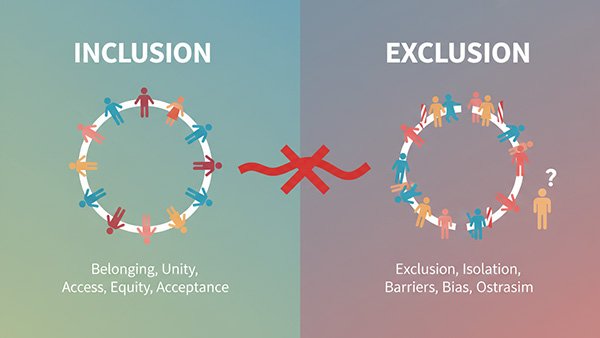
Exclusionary language refers to words, phrases, and expressions that deliberately or inadvertently exclude, marginalize, or discriminate against certain individuals or groups based on characteristics such as race, ethnicity, gender, sexual orientation, religion, disability, socioeconomic status, or other attributes. It encompasses a wide range of linguistic practices, from overt hate speech to subtle forms of bias embedded in everyday communication.
The effect of exclusionary language is to create a sense of “otherness,” reinforcing social hierarchies and perpetuating inequality. Recognizing and avoiding exclusionary language is crucial for fostering inclusive and equitable environments.
This type of language can manifest in various forms, including direct insults, stereotypes, microaggressions, and even seemingly innocuous expressions that carry historical or cultural baggage.
The function of exclusionary language is to establish and maintain power dynamics. By devaluing or dismissing certain groups, it reinforces the dominance of others.
This can have significant psychological and social consequences for those who are targeted, leading to feelings of alienation, self-doubt, and even mental health issues. In professional contexts, exclusionary language can create hostile work environments and hinder career advancement.
In social settings, it can erode trust and undermine relationships. Therefore, understanding the definition and implications of exclusionary language is essential for creating a more just and inclusive society.
Structural Breakdown
The structure of exclusionary language can be analyzed at various levels, from individual words to complex rhetorical strategies. At the word level, certain terms carry inherent biases or negative connotations.
For example, slurs and derogatory epithets are explicitly designed to demean and dehumanize individuals or groups. At the phrase level, seemingly innocuous expressions can perpetuate stereotypes or reinforce harmful assumptions.
For instance, the phrase “that’s so gay” trivializes the experiences of LGBTQ+ individuals and equates homosexuality with something negative.
At a more complex level, exclusionary language can manifest in the form of narratives or rhetorical devices that subtly reinforce social hierarchies. This can include the use of euphemisms to mask discriminatory practices, the construction of “us vs. them” narratives that demonize certain groups, or the deployment of coded language that only certain audiences can understand.
Understanding these structural elements is crucial for identifying and challenging exclusionary language in all its forms. It requires a critical awareness of the historical and social context in which language is used, as well as a sensitivity to the potential impact of words on different audiences.
Types and Categories of Exclusionary Language
Exclusionary language manifests in various forms, each with distinct characteristics and impacts. Categorizing these forms helps in identifying and addressing them effectively.
Discrimination
Discriminatory language directly targets individuals or groups based on protected characteristics, such as race, gender, religion, or sexual orientation. It often involves explicit statements of prejudice or bias.
Segregation
Language that promotes or justifies segregation aims to separate individuals or groups, often based on discriminatory criteria. This can involve explicit calls for separation or subtle reinforcement of existing divisions.
Marginalization
Marginalizing language diminishes the importance or relevance of certain individuals or groups, often by excluding them from discussions, decisions, or opportunities. This can take the form of ignoring their perspectives or dismissing their experiences.
Isolation
Language that promotes isolation aims to separate individuals from social connections and support networks. This can involve spreading rumors, creating distrust, or deliberately excluding individuals from social activities.
Othering
Othering language emphasizes the differences between groups, often in a way that portrays one group as superior or more “normal” than others. This can involve using stereotypes, exaggerating differences, or dehumanizing certain groups.
Examples of Exclusionary Language
To fully grasp the concept of exclusionary language, let’s examine specific examples categorized by the types discussed above. These examples illustrate how exclusionary language can manifest in different contexts and with varying degrees of explicitness.
Discriminatory Language Examples
These examples directly express bias or prejudice against individuals or groups based on protected characteristics. The language used is often overtly offensive and harmful.
The following table provides examples of discriminatory language, categorized by the characteristic targeted.
| Category | Example | Explanation |
|---|---|---|
| Race | “They’re all lazy and unreliable.” | Perpetuates a negative stereotype about a racial group. |
| Gender | “Women are too emotional to be leaders.” | Reinforces a harmful stereotype about women’s capabilities. |
| Religion | “All Muslims are terrorists.” | Associates an entire religious group with violence and extremism. |
| Sexual Orientation | “Homosexuality is a sin.” | Expresses disapproval and condemnation of same-sex attraction. |
| Disability | “He’s mentally retarded; he can’t possibly do that job.” | Uses a derogatory term and assumes incompetence based on disability. |
| Age | “She’s too old to learn new things.” | Assumes that older people are incapable of acquiring new skills. |
| Socioeconomic Status | “Those poor people are just looking for handouts.” | Stereotypes individuals based on their economic circumstances. |
| Race | “Go back to where you came from.” | Implicitly denies someone’s belonging and citizenship based on race. |
| Gender | “Man up!” | Reinforces traditional and often harmful stereotypes about masculinity. |
| Religion | “You can’t trust them; they have different values.” | Creates suspicion and distrust based on religious differences. |
| Sexual Orientation | “That’s so gay!” (used negatively) | Equates homosexuality with something negative or undesirable. |
| Disability | “Are you deaf or something?” | Uses disability as an insult or to imply stupidity. |
| Age | “Okay, boomer.” (used dismissively) | Dismisses someone’s opinion based on their age. |
| Socioeconomic Status | “She’s just white trash.” | Uses a derogatory term to denigrate someone based on their socioeconomic status. |
| Race | “You’re pretty for a [racial group].” | Implies that the racial group is generally considered unattractive. |
| Gender | “She’s just playing the woman card.” | Dismisses someone’s legitimate concerns or arguments based on their gender. |
| Religion | “They’re all brainwashed.” | Implies that members of a religious group are incapable of independent thought. |
| Sexual Orientation | “I don’t care what you do in your bedroom, just don’t flaunt it.” | Implies that LGBTQ+ individuals should hide their identities. |
| Disability | “He’s special needs.” (used condescendingly) | Uses a euphemism in a way that is still demeaning and condescending. |
| Age | “He’s over the hill.” | Suggests that someone is past their prime and no longer useful because of their age. |
| Socioeconomic Status | “They’re just a bunch of freeloaders.” | Stereotypes individuals based on their economic circumstances and implies they are lazy or undeserving. |
Segregation-Related Language Examples
These examples promote or justify the separation of individuals or groups based on various characteristics. They often reinforce existing social divisions and inequalities.
The following table provides examples of language that promotes or reinforces segregation.
| Context | Example | Explanation |
|---|---|---|
| Residential | “This neighborhood is for families only.” | Excludes single individuals or same-sex couples. |
| Education | “We need to maintain separate schools for different races.” | Advocates for racial segregation in education. |
| Social | “They should stick to their own kind.” | Encourages people to associate only with members of their own group. |
| Employment | “This job is only suitable for men.” | Excludes women from certain employment opportunities. |
| Public Spaces | “Whites only” (historical example) | Explicitly excludes people of color from public spaces. |
| Online Communities | “This forum is for [specific group] only.” | Restricts access to a community based on a specific characteristic. |
| Healthcare | “We don’t have the resources to cater to their needs.” | Implies that certain groups are not deserving of adequate healthcare. |
| Residential | “Gated communities are necessary to protect property values.” | Justifies socioeconomic segregation by framing it as a matter of security and property values. |
| Education | “Special education students should be kept separate from the ‘normal’ kids.” | Perpetuates the idea that students with disabilities are fundamentally different and should be segregated. |
| Social | “They have their own culture; they should celebrate it separately.” | Discourages integration and promotes the idea that different cultures cannot coexist harmoniously. |
| Employment | “We need to hire someone who ‘fits in’ with our company culture.” (when used to exclude certain groups) | Subtly excludes individuals who are different from the dominant group within the company. |
| Public Spaces | “This park is not safe for children after dark.” (when used to target specific groups) | Implies that certain groups are responsible for making the park unsafe. |
| Online Communities | “This is a safe space for [specific group] only; no allies allowed.” (when used to exclude well-meaning individuals) | While intended to provide safety, it can also unintentionally exclude individuals who are genuinely supportive. |
| Healthcare | “We need to prioritize resources for patients who are more likely to recover.” (when used to discriminate) | Can lead to discrimination against patients with chronic illnesses or disabilities. |
| Residential | “We need to maintain the character of this neighborhood.” (when used to exclude certain groups) | Often used as a code word to exclude people of color or other marginalized groups. |
| Education | “We need to focus on educating the ‘gifted’ students.” (when resources are limited) | Can lead to the neglect of students who are struggling or have different learning styles. |
| Social | “We don’t want to lower our standards.” (when used to exclude certain groups) | Implies that certain groups are inherently inferior or less capable. |
| Employment | “We need to find someone who is a ‘cultural fit’.” (when used to exclude certain groups) | Often used as a pretext for discriminatory hiring practices. |
| Public Spaces | “We need to clean up this area.” (when used to target homeless people) | Implies that homeless people are a blight on the community and should be removed. |
| Online Communities | “This is a private group; you need an invitation to join.” (when used discriminatorily) | Can be used to exclude individuals based on protected characteristics. |
Marginalization Language Examples
These examples diminish the importance or relevance of certain individuals or groups, often by excluding them from discussions or decisions. The effect is to silence or invalidate their experiences.
The following table provides examples of language that marginalizes certain groups or individuals.
| Context | Example | Explanation |
|---|---|---|
| Discussion | “Let’s not get bogged down in the details.” (when dismissing someone’s concerns) | Dismisses someone’s valid points as unimportant. |
| Decision-Making | “We don’t need their input; we know what’s best.” | Excludes certain groups from decision-making processes. |
| Representation | “We can’t find anyone qualified from that group.” | Implies that certain groups lack qualified individuals. |
| Recognition | “Their contributions are not as significant as others’.” | Downplays the contributions of certain individuals or groups. |
| Resource Allocation | “We don’t have the budget to address their needs.” | Prioritizes the needs of some groups over others. |
| Project Planning | “We’ll handle that later; it’s not a priority.” (when referring to marginalized group concerns) | Defers action on issues important to marginalized groups, effectively ignoring them. |
| Company Meetings | “He’s just being difficult.” (when a marginalized employee voices concerns) | Dismisses legitimate concerns as mere complaining or troublemaking. |
| Public Debate | “That’s just identity politics.” (when discussing issues of inequality) | Trivializes serious issues of inequality by framing them as mere political maneuvering. |
| Social Interactions | “I don’t see color.” (when race is relevant) | Denies the reality of racial inequality and invalidates the experiences of people of color. |
| Historical Narratives | “History is written by the victors.” (when justifying the erasure of marginalized voices) | Implies that it’s acceptable to ignore or downplay the contributions and experiences of marginalized groups. |
| Discussion | “Let’s focus on the big picture.” (when someone raises a specific concern about equity) | Suggests that concerns about equity are too narrow or insignificant to warrant attention. |
| Decision-Making | “We’ve always done it this way.” (when challenged about inclusive practices) | Resists change and perpetuates exclusionary practices by invoking tradition. |
| Representation | “We tried to find someone from that group, but it just didn’t work out.” | Offers a vague excuse for the lack of diversity, without addressing the underlying issues. |
| Recognition | “They’re lucky to even have this opportunity.” (when referring to marginalized individuals) | Implies that marginalized individuals should be grateful for any opportunities they receive, regardless of fairness or equity. |
| Resource Allocation | “We need to invest in areas that will give us the biggest return.” (when neglecting marginalized communities) | Justifies the neglect of marginalized communities by prioritizing economic gains over social equity. |
| Project Planning | “We’ll get to that eventually.” (when discussing concerns voiced by marginalized groups) | Puts off addressing important issues indefinitely, effectively ignoring them. |
| Company Meetings | “That’s not relevant to this discussion.” (when a marginalized employee raises an issue of discrimination) | Dismisses concerns about discrimination as being outside the scope of the meeting. |
| Public Debate | “Why are you making everything about race/gender/etc.?” (when someone raises an issue of inequality) | Silences discussions about inequality by accusing people of being overly sensitive or divisive. |
| Social Interactions | “I don’t see why everyone is so sensitive these days.” (when someone expresses offense at a microaggression) | Invalidates the feelings of those who are hurt by microaggressions and implies that they are overreacting. |
| Historical Narratives | “We should focus on the positive aspects of our history.” (when discussing historical injustices) | Avoids confronting the painful realities of the past and perpetuates a sanitized version of history. |
Isolation-Promoting Language Examples
These examples create distance and division among individuals or groups, fostering feelings of loneliness and alienation. They often involve spreading rumors, creating distrust, or deliberately excluding individuals from social activities.
| Context | Example | Explanation |
|---|---|---|
| Gossip | “Did you hear what they did? You can’t trust them.” | Spreads rumors and creates distrust. |
| Exclusion | “We’re having a party, but they’re not invited.” | Deliberately excludes someone from a social event. |
| Intimidation | “If you associate with them, you’ll regret it.” | Threatens individuals who associate with certain groups. |
| Discrediting | “They’re just trying to cause trouble.” | Undermines someone’s credibility and isolates them from others. |
| Cyberbullying | “Nobody likes you; you should just disappear.” | Uses online platforms to harass and isolate individuals. |
| Social Media | “Unfollowed and blocked! Goodbye loser.” | Publicly cuts ties to isolate and shame someone. |
| Workplace | “Don’t talk to her; she’s always complaining.” | Discourages colleagues from interacting with a particular person. |
| Community | “They don’t belong here.” | Creates a sense of not belonging in the community. |
| Family | “You’re a disgrace to the family.” | Emotional manipulation to isolate a family member. |
| Group Projects | “I’ll do it myself; you’ll just mess it up.” | Excludes someone and undermines their confidence. |
| Gossip | “I heard they’re always causing problems, so it’s best to avoid them.” | Spreads rumors to discourage others from interacting with a particular person. |
| Exclusion | “We’re going out, but it’s girls/guys only.” | Excludes individuals based on gender. |
| Intimidation | “If you hang out with them, you’ll be ostracized.” | Threatens social isolation for associating with certain individuals. |
| Discrediting | “They’re just trying to get attention.” | Undermines someone’s motives and isolates them from support. |
| Cyberbullying | “You’re ugly and no one cares about you.” | Uses abusive language to isolate and demoralize someone online. |
| Social Media | “Reported and blocked! You’re toxic.” | Publicly accuses someone of being harmful and cuts them off. |
| Workplace | “Don’t share important information with him; he’s not trustworthy.” | Creates distrust and prevents someone from being part of the team. |
| Community | “We need to protect our neighborhood from outsiders.” | Promotes a sense of us-versus-them and isolates newcomers. |
| Family | “You’re not welcome here anymore.” | Excludes a family member from gatherings and support. |
| Group Projects | “Just sit back and watch; we’ll handle everything.” | Completely excludes someone from participating in a group activity. |
Othering Language Examples
These examples emphasize the differences between groups, often in a way that portrays one group as superior or more “normal” than others. This can involve using stereotypes, exaggerating differences, or dehumanizing certain groups.
| Context | Example | Explanation |
|---|---|---|
| Stereotyping | “They’re all the same.” | Reduces individuals to a single, often negative, characteristic. |
| Dehumanization | “They’re animals.” | Compares a group to animals, stripping them of their humanity. |
| Exaggeration | “They’re completely different from us.” | Overemphasizes differences and creates a sense of separation. |
| Condescension | “We need to help them understand.” | Positions one group as superior and in need of educating others. |
| Dismissal | “That’s just their culture.” (used to excuse harmful practices) | Dismisses concerns about harmful practices by attributing them to culture. |
| Political Discourse | “They’re not like us; they don’t share our values.” | Creates division and distrust based on perceived differences in values. |
| Media Representation | “Foreigners are taking our jobs.” | Scapegoats immigrants for economic problems. |
| Everyday Conversation | “You’re so articulate!” (said to a person of color) | Implies surprise that a person of color can speak well, reinforcing a stereotype. |
| Historical Accounts | “The savages were no match for our superior technology.” | Justifies colonialism and violence by portraying indigenous people as inferior. |
| Scientific Discourse | “Studies show they have smaller brains.” (pseudoscience) | Uses false science to justify discrimination and inequality. |
| Stereotyping | “They’re always causing trouble.” | Perpetuates a negative stereotype about a particular group. |
| Dehumanization | “They’re like robots; they have no feelings.” | Stripping individuals of their emotions and humanity. |
| Exaggeration | “They live in a completely different world.” | Creates a sense of insurmountable difference. |
| Condescension | “We need to show them how things are done.” | Implies that one group is more competent or knowledgeable than another. |
| Dismissal | “That’s just how they are.” (used to excuse discriminatory behavior) | Avoids addressing problematic behavior by attributing it to group characteristics. |
| Political Discourse | “They’re a threat to our way of life.” | Creates fear and animosity towards a particular group. |
| Media Representation | “Immigrants are a drain on our resources.” | Paints immigrants as a burden on society. |
| Everyday Conversation | “You don’t act like the rest of them.” (said to a member of a marginalized group) | Implies that the person is an exception to their group and reinforces negative stereotypes about the group as a whole. |
| Historical Accounts | “They were uncivilized and needed our guidance.” | Justifies colonialism and exploitation by portraying indigenous people as needing to be “civilized.” |
| Scientific Discourse | “Studies show they have different genetic predispositions.” (when used to justify inequality) | Uses genetic arguments to justify social and economic disparities. |
Usage Rules and Considerations
Avoiding exclusionary language requires careful attention to the words we use and the context in which we use them. It’s essential to be mindful of the potential impact of our language on others and to strive for inclusivity in our communication.
Here are some key rules and considerations:
- Avoid slurs and derogatory terms: These terms are explicitly designed to demean and dehumanize individuals or groups.
- Be mindful of stereotypes: Avoid making generalizations about entire groups of people based on limited information.
- Use inclusive language: Opt for gender-neutral terms, avoid ableist language, and be respectful of different cultural backgrounds.
- Consider the context: The same word or phrase can have different meanings and implications depending on the context in which it is used.
- Listen to feedback: Be open to hearing from others about the impact of your language and be willing to adjust your communication accordingly.
- Educate yourself: Continuously learn about different cultures, identities, and perspectives to broaden your understanding of inclusive language.
It’s also useful to consider the intent versus the impact of your words. Even if your intention is not to offend, the impact of your words can still be harmful.
Therefore, being mindful and receptive to feedback is crucial. Remember that language evolves, so staying informed about current best practices is essential for effective and inclusive communication.
Common Mistakes in Identifying and Avoiding Exclusionary Language
Even with good intentions, it’s easy to make mistakes when trying to avoid exclusionary language. Here are some common pitfalls and how to avoid them:
- Assuming good intentions excuse harmful language: Even if you didn’t mean to offend, the impact of your words can still be hurtful. Focus on the effect of your language, not just your intent.
- Using euphemisms to mask discriminatory practices: Euphemisms can be used to disguise discriminatory practices, making them seem more acceptable. Be wary of language that obscures the truth.
- Believing that “colorblindness” promotes equality: Ignoring race can actually perpetuate inequality by failing to acknowledge the unique challenges faced by people of color.
- Dismissing concerns about microaggressions: Microaggressions may seem small, but they can have a cumulative negative impact on individuals and groups.
- Relying on “politically correct” language without understanding the underlying issues: Using politically correct language without a genuine commitment to inclusivity can come across as superficial or insincere.
The key to avoiding these mistakes is to cultivate a mindset of continuous learning and self-reflection. Be open to feedback, challenge your own assumptions, and strive to understand the perspectives of others.
Remember that inclusive language is not just about avoiding certain words; it’s about creating a culture of respect and understanding.
Practice Exercises
Test your understanding of exclusionary language with these practice exercises. Identify the exclusionary language in each sentence and explain why it is problematic.
Exercise 1: Identify the exclusionary language in the following sentences.
| Question | Answer |
|---|---|
| 1. “She’s surprisingly competent for a woman.” | Exclusionary language: “surprisingly competent for a woman.” Explanation: Implies that women are generally not competent. |
| 2. “He’s confined to a wheelchair.” | Exclusionary language: “confined to a wheelchair.” Explanation: Uses negative language to describe disability. A better alternative is “uses a wheelchair.” |
| 3. “That’s so lame.” | Exclusionary language: “lame.” Explanation: Uses ableist language to describe something as undesirable. |
| 4. “They’re just a bunch of thugs.” | Exclusionary language: “thugs.” Explanation: Stereotypes and dehumanizes a particular group. |
| 5. “We need to protect our borders from those people.” | Exclusionary language: “those people.” Explanation: Creates an “us vs. them” mentality and demonizes immigrants. |
| 6. “He’s a crazy old man.” | Exclusionary language: “crazy old man.” Explanation: Uses ageist and ableist language to demean someone. |
| 7. “She’s playing the race card.” | Exclusionary language: “playing the race card.” Explanation: Dismisses legitimate concerns about racism. |
| 8. “You guys need to work harder.” | Exclusionary language: “guys” (when addressing a mixed-gender group). Explanation: Uses gendered language to address a mixed-gender group. A better alternative is “everyone” or “folks.” |
| 9. “Are you deaf, dumb, and blind?” | Exclusionary language: “deaf, dumb, and blind.” Explanation: Uses ableist language to insult someone’s intelligence. |
| 10. “He’s a real go-getter, unlike the rest of them.” | Exclusionary language: “unlike the rest of them.” Explanation: Stereotypes and demeans a particular group by contrasting them with an individual. |
Exercise 2: Rewrite the following sentences to be more inclusive.
| Question | Answer |
|---|---|
| 1. “The businessman needs to sign the contract.” | Rewritten: “The businessperson needs to sign the contract.” |
| 2. “Only able-bodied people can participate in this event.” | Rewritten: “This event is accessible to people of all abilities.” |
| 3. “We need a male perspective on this issue.” | Rewritten: “We need a different perspective on this issue.” |
| 4. “The mentally retarded student needs extra help.” | Rewritten: “The student with intellectual disabilities needs extra help.” |
| 5. “Our company is an equal opportunity employer for men and women.” | Rewritten: “Our company is an equal opportunity employer.” |
| 6. “The cleaning lady did a great job.” | Rewritten: “The cleaner did a great job.” |
| 7. “He’s a homosexual.” | Rewritten: “He’s gay.” |
| 8. “The firemen rescued the cat.” | Rewritten: “The firefighters rescued the cat.” |
| 9. “We need to cater to the special needs children.” | Rewritten: “We need to support the children with disabilities.” |
| 10. “The mailman delivered the package.” | Rewritten: “The mail carrier delivered the package.” |
Advanced Topics: Nuances and Subtleties
Exclusionary language can often be subtle and nuanced, making it challenging to identify and address. Some advanced topics to consider include:
- Microaggressions: These are subtle, often unintentional, expressions of bias that can have a cumulative negative impact on individuals from marginalized groups.
- Intersectionality: This concept recognizes that individuals can experience multiple forms of discrimination based on the intersection of different identities, such as race, gender, and sexual orientation.
- Code-switching: This refers to the practice of altering one’s language or behavior to fit in with a dominant culture, which can be a form of self-preservation but also a reflection of exclusionary practices.
- Historical context: Understanding the historical context of certain words and phrases is crucial for recognizing their potential to be exclusionary.
- Unconscious bias: We all have unconscious biases that can influence our language and behavior. Recognizing and addressing these biases is essential for promoting inclusivity.
Exploring these advanced topics can deepen your understanding of exclusionary language and help you to become a more effective advocate for inclusivity.
Frequently Asked Questions
What is the difference between intent and impact when it comes to exclusionary language?
Intent refers to what you meant to communicate, while impact refers to how your words were received. Even if your intent was not to offend, the impact of your words can still be harmful.
It’s important to focus on the impact of your language, not just your intent.
How can I respond when someone uses exclusionary language?
You can respond by pointing out the problematic language and explaining why it is hurtful. You can also offer alternative language that is more inclusive.
It’s important to be respectful but firm in your response.
What if I accidentally use exclusionary language?
If you accidentally use exclusionary language, apologize and correct yourself. Use it as an opportunity to learn and grow.
It’s okay to make mistakes, as long as you are willing to learn from them.
How can I create a more inclusive environment in my workplace or community?
You can create a more inclusive environment by using inclusive language, challenging exclusionary language when you hear it, and advocating for policies and practices that promote equity and inclusion.
Is it possible to eliminate all exclusionary language?
While it may not be possible to eliminate all exclusionary language, we can strive to minimize its use and impact. By being mindful of our language and continuously learning, we can create a more inclusive and equitable society.
Conclusion
In conclusion, understanding the opposite of inclusion involves recognizing and actively avoiding exclusionary language. By identifying discriminatory terms, segregation-related phrases, marginalizing statements, isolation-promoting words, and othering language, we can foster more inclusive and equitable environments.
This requires continuous learning, self-reflection, and a willingness to challenge our own biases. Embracing inclusive language is not just about political correctness; it’s about creating a culture of respect, empathy, and understanding where everyone feels valued and belongs.
In understanding exclusionary practices, it’s helpful to explicitly identify the opposite of inclusion. The inclusion antonym highlights behaviors and language that marginalize or segregate individuals. Recognizing the inclusion opposite word allows us to pinpoint patterns of discrimination, isolation, and othering in social and professional contexts.
Knowing what is the opposite of inclusion provides clarity on how exclusion manifests, while familiarizing ourselves with antonyms of inclusion—such as segregation, marginalization, and exclusion—equips us to replace harmful practices with inclusive alternatives. Overall, opposite to inclusion represents the social and linguistic behaviors that inclusive language seeks to prevent.
By committing to these principles, we can contribute to a more just and inclusive world for all.