Understanding antonyms is crucial for expanding your vocabulary and enhancing your communication skills. While “responsible” implies reliability, accountability, and good judgment, its opposites paint a completely different picture.
This article delves into the various antonyms of “responsible,” exploring their nuances and providing practical examples to help you use them effectively. When exploring the opposite of responsible, several words come into play depending on context.
The most direct opposite of responsible is “irresponsible,” but other terms like careless, negligent, and reckless serve as valid alternatives in specific situations. Understanding responsibility antonyms helps in identifying nuances in behavior, communication, and legal or professional contexts. If you are wondering, “what is the opposite of responsible?” this guide provides clear examples and usage rules to distinguish each term effectively. Learning the responsible opposite word for various contexts strengthens both writing and spoken English skills.
Whether you are an English language learner or a native speaker looking to refine your vocabulary, this guide will provide valuable insights and practical exercises to master the concept of irresponsibility and its many forms.
Table of Contents
- Introduction
- Defining “Responsible”
- Structural Breakdown
- Types of Antonyms
- Examples of Antonyms
- Usage Rules
- Common Mistakes
- Practice Exercises
- Advanced Topics
- FAQ
- Conclusion
Introduction
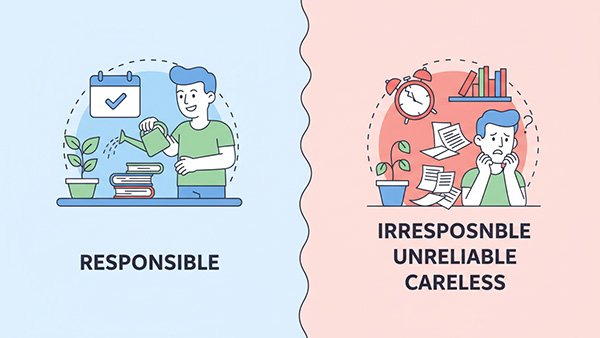
The concept of “responsibility” is central to personal and professional success. It signifies the ability to be accountable for one’s actions and decisions. However, understanding what it means to be *un*responsible is equally important.
This article explores the spectrum of words that represent the opposite of “responsible,” offering a comprehensive guide to antonyms like irresponsible, careless, negligent, reckless, and more. By examining these antonyms, we can better appreciate the qualities associated with responsibility and avoid the pitfalls of its absence. This knowledge is beneficial for anyone looking to improve their communication skills, particularly in contexts where accountability and behavior are being assessed.
Defining “Responsible”
The word “responsible” is an adjective that describes someone who is accountable, reliable, and capable of rational thought and action. A responsible person is dependable and can be trusted to fulfill obligations and make sound decisions.
Understanding the opposite of responsibility requires examining both linguistic and practical perspectives. Responsibility antonym words describe a lack of accountability, care, or judgment, and they often convey negative implications. Antonyms for responsible, such as irresponsible, careless, negligent, and reckless, vary in intensity and context. For example, someone who ignores deadlines might be deemed irresponsible, while a failure to follow safety protocols could be classified as negligent.
Exploring responsibility antonyms provides a more precise vocabulary to describe behavior in personal, professional, and legal settings. Recognizing the responsibility opposite word in each context ensures clearer communication and more accurate assessments of actions. By mastering these antonyms, learners can not only describe lapses in responsibility effectively but also differentiate subtle variations in meaning that influence tone, judgment, and perception.
They take ownership of their actions and are willing to accept the consequences, both positive and negative. In essence, responsibility embodies a sense of duty and commitment.
Classification and Function
“Responsible” functions primarily as an adjective, modifying nouns to describe their qualities. It can also be part of a predicate adjective phrase, following a linking verb to describe the subject.
The word is derived from the verb “respond,” highlighting the idea of answering for one’s actions or being answerable to someone or something.
Contexts of Use
“Responsible” is used in a wide variety of contexts, including personal relationships, professional settings, legal environments, and civic duties. It is a key trait valued in employees, parents, citizens, and leaders.
In each of these contexts, being responsible implies a certain level of maturity, awareness, and ethical behavior. For example, a responsible employee completes tasks on time and adheres to company policies, while a responsible parent provides for their children’s needs and ensures their safety.
Structural Breakdown
The word “responsible” is composed of several parts that contribute to its overall meaning. Understanding these components can shed light on its nuances and related terms.
- Root Word: Respond – The core of the word implies an answer or reaction to something.
- Suffix: -ible / -able – These suffixes denote capability or suitability. In this case, “responsible” means capable of responding or answering for one’s actions.
- Prefix (Implied): While not explicitly present, the concept of “re-” (again, back) can be inferred, suggesting a repeated or continuous answering for one’s actions.
By understanding these components, you can better grasp the meaning of “responsible” and its relationship to other words. Furthermore, this knowledge can aid in understanding the formation and meanings of its antonyms, which often involve negative prefixes or entirely different root words.
Types of Antonyms
Antonyms can be classified into different types based on their relationship to the original word. Understanding these types can help you choose the most appropriate antonym in a given context.
Complementary Antonyms
Complementary antonyms are pairs of words where the presence of one implies the absence of the other. There is no middle ground.
For example, “alive” and “dead” are complementary antonyms. For “responsible,” a complementary antonym might be considered “irresponsible” in some contexts, where one is either fully responsible or fully irresponsible.
Gradable Antonyms
Gradable antonyms represent opposite ends of a spectrum. There are intermediate degrees between the two words.
Examples include “hot” and “cold,” with words like “warm” and “cool” falling in between. Many antonyms of “responsible” are gradable, such as “careful” and “careless,” where varying degrees of care can exist.
Relational Antonyms
Relational antonyms describe a relationship from opposite perspectives. For example, “teacher” and “student” are relational antonyms.
While not directly applicable to “responsible,” understanding this type helps differentiate it from other types of oppositeness.
Examples of Antonyms
The following sections provide detailed examples of antonyms for “responsible,” categorized by their specific connotations and contexts of use.
Irresponsible
“Irresponsible” is arguably the most direct antonym of “responsible.” It denotes a lack of accountability, reliability, and good judgment. An irresponsible person often fails to fulfill obligations and may act without considering the consequences.
The table below provides examples of “irresponsible” in various contexts:
| Sentence | Context |
|---|---|
| His irresponsible behavior led to the company’s financial loss. | Professional |
| It was irresponsible of her to leave the children unattended. | Parenting |
| The politician’s irresponsible comments fueled public unrest. | Political |
| Driving under the influence is an irresponsible act. | General |
| Failing to pay your taxes is an irresponsible financial decision. | Financial |
| An irresponsible pet owner neglects their animal’s needs. | Personal |
| He was deemed irresponsible for not completing his assigned tasks. | Professional |
| Leaving the stove on was an irresponsible mistake. | Household |
| She was labeled as irresponsible after missing several deadlines. | Academic |
| His irresponsible spending habits led to significant debt. | Financial |
| The irresponsible management of resources caused the project to fail. | Project Management |
| It’s irresponsible to spread rumors without verifying their truth. | Social |
| Ignoring safety regulations is an irresponsible practice. | Workplace Safety |
| He showed irresponsible conduct by not attending mandatory meetings. | Professional |
| The company was criticized for its irresponsible disposal of waste. | Environmental |
| It’s irresponsible to drive without insurance. | Legal |
| His irresponsible attitude affected the entire team’s performance. | Teamwork |
| She was reprimanded for making irresponsible decisions under pressure. | Decision Making |
| The irresponsible use of social media can lead to negative consequences. | Technology |
| He was known for his irresponsible handling of confidential information. | Information Security |
| Leaving confidential documents in a public place is an irresponsible action. | Security |
| His irresponsible handling of the funds led to the project’s failure. | Financial Management |
| An irresponsible leader can damage the morale of their team. | Leadership |
Careless
“Careless” implies a lack of attention to detail and a tendency to make mistakes. A careless person may not intentionally cause harm, but their negligence can still lead to negative outcomes.
The table below illustrates the use of “careless” in different scenarios:
| Sentence | Context |
|---|---|
| Her careless mistake resulted in a costly error. | Professional |
| He was careless with his belongings and often lost things. | Personal |
| The careless driver caused an accident. | General |
| The careless proofreader missed several errors in the document. | Editing |
| A careless approach to safety can have serious consequences. | Workplace Safety |
| She was reprimanded for her careless handling of the equipment. | Workplace |
| The careless storage of chemicals led to a hazardous situation. | Environmental Safety |
| He made a careless remark that offended many people. | Social |
| The careless disposal of waste contributed to pollution. | Environmental |
| The careless use of resources resulted in a shortage. | Resource Management |
| A careless approach to data entry can lead to inaccurate records. | Data Management |
| He was known for his careless spending habits. | Financial |
| The careless maintenance of the building resulted in structural damage. | Property Management |
| Her careless attitude towards deadlines caused delays. | Project Management |
| The careless handling of evidence compromised the investigation. | Legal |
| His careless approach to the problem made it worse. | Problem Solving |
| The careless distribution of information led to confusion. | Communication |
| She was criticized for her careless disregard for the rules. | Rules and Regulations |
| The careless application of the policy led to unintended consequences. | Policy Implementation |
| His careless driving resulted in a traffic violation. | Driving |
| The careless handling of the package resulted in damage to the contents. | Logistics |
| Her careless comments at the meeting made a negative impression. | Professional Communication |
| The careless management of the project led to its failure. | Project Management |
Negligent
“Negligent” implies a failure to exercise the appropriate level of care and attention, often resulting in harm or damage. Negligence can be a legal term, referring to a breach of duty of care.
The following table provides examples of “negligent” in different contexts:
| Sentence | Context |
|---|---|
| The company was found negligent in its safety practices. | Legal/Professional |
| The doctor was accused of negligent treatment of his patient. | Medical |
| Her negligent supervision of the children led to an accident. | Parenting |
| The landlord was negligent in maintaining the property. | Property Management |
| The negligent handling of hazardous materials caused a spill. | Environmental Safety |
| He was sued for negligent misrepresentation of the facts. | Legal |
| The negligent security measures made the company vulnerable to attack. | Cybersecurity |
| Her negligent bookkeeping led to financial discrepancies. | Accounting |
| The negligent enforcement of the rules resulted in widespread violations. | Law Enforcement |
| He was deemed negligent for failing to report the incident. | Reporting |
| The negligent maintenance of the equipment caused a malfunction. | Equipment Maintenance |
| She showed negligent disregard for the safety regulations. | Safety Regulations |
| The negligent handling of the data led to a data breach. | Data Security |
| He was accused of negligent driving after the accident. | Driving |
| The negligent oversight of the project caused it to run over budget. | Project Management |
| She was criticized for her negligent response to the crisis. | Crisis Management |
| The negligent monitoring of the system allowed the intrusion to go undetected. | System Monitoring |
| He was found negligent in his duties as a supervisor. | Supervision |
| The negligent management of the resources led to their depletion. | Resource Management |
| She was reprimanded for her negligent attention to detail. | Attention to Detail |
| The negligent implementation of the policy led to its failure. | Policy Implementation |
| He was blamed for the negligent planning that resulted in the disaster. | Disaster Planning |
| The negligent handling of the complaint led to further escalation. | Complaint Handling |
Reckless
“Reckless” implies a disregard for danger and a willingness to take unnecessary risks. A reckless person acts without thinking about the potential consequences of their actions.
Here are examples of “reckless” in various contexts:
| Sentence | Context |
|---|---|
| His reckless driving resulted in a serious accident. | General |
| She made a reckless investment that lost all her money. | Financial |
| His reckless behavior put his life and others at risk. | Personal |
| The company was criticized for its reckless disregard for the environment. | Environmental |
| He was known for his reckless spending habits. | Financial |
| The reckless use of resources led to their depletion. | Resource Management |
| She made a reckless decision without considering the consequences. | Decision Making |
| His reckless actions damaged the company’s reputation. | Business |
| The reckless handling of the situation made it worse. | Crisis Management |
| He was reprimanded for his reckless disregard for the rules. | Rules and Regulations |
| The reckless implementation of the policy led to unintended consequences. | Policy Implementation |
| She showed a reckless disregard for her own safety. | Personal Safety |
| His reckless approach to the problem made it harder to solve. | Problem Solving |
| The reckless trading of stocks led to a financial crisis. | Finance |
| She was known for her reckless pursuit of success. | Career |
| His reckless disregard for the truth damaged his credibility. | Integrity |
| The reckless use of technology can have negative consequences. | Technology |
| She made a reckless promise that she couldn’t keep. | Commitment |
| His reckless gamble cost him everything. | Risk Management |
| The reckless release of information led to a security breach. | Security |
| The pilot’s reckless flying maneuvers endangered the passengers. | Aviation |
| His reckless attempts to climb the mountain led to a rescue operation. | Mountaineering |
Usage Rules
While the antonyms of “responsible” share a general sense of lacking accountability, they have distinct connotations and usage patterns. It’s important to choose the most appropriate word based on the specific context.
- Irresponsible: Use when emphasizing a general lack of responsibility or a failure to fulfill obligations.
- Careless: Use when highlighting a lack of attention to detail or a tendency to make mistakes.
- Negligent: Use when implying a failure to exercise the appropriate level of care, often resulting in harm or damage.
- Reckless: Use when emphasizing a disregard for danger and a willingness to take unnecessary risks.
Consider the following examples to illustrate these distinctions:
- Incorrect: He was careless for not paying his bills on time. (Should be “irresponsible”)
- Correct: He was irresponsible for not paying his bills on time.
- Incorrect: Her reckless mistake resulted in a costly error. (Should be “careless”)
- Correct: Her careless mistake resulted in a costly error.
- Incorrect: The company was irresponsible in its safety practices, leading to the accident. (Should be “negligent”)
- Correct: The company was negligent in its safety practices, leading to the accident.
- Incorrect: His negligent driving resulted in a serious accident. (Should be “reckless”)
- Correct: His reckless driving resulted in a serious accident.
Common Mistakes
Using the wrong antonym of “responsible” can lead to miscommunication and inaccurate judgments. Here are some common mistakes to avoid:
| Incorrect Sentence | Correct Sentence | Explanation |
|---|---|---|
| He was careless for abandoning his responsibilities. | He was irresponsible for abandoning his responsibilities. | “Irresponsible” is more appropriate when referring to a complete abandonment of duties. |
| Her irresponsible mistake caused the error. | Her careless mistake caused the error. | “Careless” is better suited for unintentional errors due to lack of attention. |
| The doctor was reckless in treating the patient. | The doctor was negligent in treating the patient. | “Negligent” is more accurate when referring to a failure to provide the necessary standard of care. |
| His negligent spending led to financial ruin. | His reckless spending led to financial ruin. | “Reckless” implies a deliberate disregard for financial risks. |
Practice Exercises
Test your understanding of the antonyms of “responsible” with the following exercises.
Exercise 1: Fill in the Blanks
Choose the most appropriate antonym of “responsible” to complete each sentence.
- His _________ behavior at the party embarras
- sed his family. (irresponsible/careless)
- The _________ driver was fined for speeding. (reckless/negligent)
- Her _________ bookkeeping led to several errors in the accounts. (careless/irresponsible)
- The company was found _________ in its waste disposal practices. (negligent/reckless)
- It was _________ of him to leave the children alone. (irresponsible/careless)
- The _________ handling of the equipment resulted in damage. (careless/reckless)
- His _________ disregard for safety regulations led to an accident. (negligent/irresponsible)
- She made a _________ investment that lost all her savings. (reckless/careless)
- The _________ maintenance of the building caused structural problems. (negligent/irresponsible)
- He was _________ for not completing his assigned tasks. (irresponsible/careless)
Answer Key:
- irresponsible
- reckless
- careless
- negligent
- irresponsible
- careless
- negligent
- reckless
- negligent
- irresponsible
Exercise 2: Sentence Rewriting
Rewrite each sentence using a different antonym of “responsible” while maintaining the original meaning.
- The manager’s irresponsible decisions led to the company’s downfall.
- Her careless mistake cost the company a significant amount of money.
- The doctor’s negligent treatment of the patient resulted in further complications.
- His reckless spending habits put him in serious debt.
- It was irresponsible of him to ignore the warning signs.
- The careless disposal of chemicals caused environmental damage.
- The supervisor was negligent in his oversight of the project.
- Her reckless actions endangered the lives of others.
- The company’s irresponsible behavior led to a public outcry.
- His careless attitude resulted in numerous errors.
Sample Answers:
- The manager’s reckless decisions led to the company’s downfall.
- Her irresponsible mistake cost the company a significant amount of money.
- The doctor’s negligent treatment of the patient resulted in further complications.
- His reckless spending habits put him in serious debt.
- It was careless of him to ignore the warning signs.
- The negligent disposal of chemicals caused environmental damage.
- The supervisor was irresponsible in his oversight of the project.
- Her reckless actions endangered the lives of others.
- The company’s negligent behavior led to a public outcry.
- His irresponsible attitude resulted in numerous errors.
Advanced Topics
For advanced learners, exploring the nuances of responsibility and its antonyms can lead to a deeper understanding of ethics, law, and social behavior.
Degrees of Responsibility
Responsibility is not always an all-or-nothing concept. There can be varying degrees of responsibility depending on the context and the individual’s role.
For example, in a team project, each member may have a different level of responsibility for the overall outcome. Understanding these nuances is crucial in complex situations.
Legal Implications
In legal contexts, concepts like negligence and recklessness have specific definitions and consequences. Negligence often forms the basis of civil lawsuits, while recklessness can lead to criminal charges.
Understanding the legal implications of these terms is essential for anyone working in fields such as law, medicine, or engineering.
Ethical Considerations
The antonyms of “responsible” often raise ethical concerns. For example, is it always unethical to take risks?
Are there situations where carelessness is excusable? Exploring these questions can lead to a more nuanced understanding of ethical decision-making.
FAQ
What is the most direct antonym of “responsible”?
The most direct antonym is arguably “irresponsible,” as it directly negates the quality of being responsible.
How does “careless” differ from “irresponsible”?
“Careless” implies a lack of attention to detail and a tendency to make mistakes, while “irresponsible” suggests a general lack of accountability and a failure to fulfill obligations. A careless person might make a mistake unintentionally, while an irresponsible person might knowingly neglect their duties.
When should I use “negligent” instead of “careless”?
Use “negligent” when implying a failure to exercise the appropriate level of care, often resulting in harm or damage. Negligence often carries legal implications, suggesting a breach of duty of care.
What is the difference between “reckless” and “irresponsible”?
“Reckless” implies a disregard for danger and a willingness to take unnecessary risks, while “irresponsible” suggests a general lack of accountability. A reckless person might act without thinking about the potential consequences, while an irresponsible person might simply neglect their duties.
Can someone be both “careless” and “irresponsible”?
Yes, it is possible for someone to exhibit both qualities. For example, an employee who consistently makes careless mistakes and also fails to meet deadlines could be described as both careless and irresponsible.
Are there situations where it’s okay to be “irresponsible”?
While generally viewed negatively, there might be limited situations where deviating from strict responsibility is acceptable, such as prioritizing personal well-being over minor obligations in extreme circumstances. However, these situations are rare and require careful consideration.
How can I improve my ability to use these antonyms correctly?
Practice using the words in different contexts, pay attention to the specific connotations of each word, and seek feedback from others. Reading widely and paying attention to how these words are used in literature and news articles can also be helpful.
What are the legal consequences of being found “negligent”?
The legal consequences of negligence can vary depending on the jurisdiction and the specific circumstances. In civil cases, negligence can lead to financial liability for damages caused. In some cases, particularly in professional fields like medicine, negligence can also result in disciplinary action or loss of license.
Conclusion
Understanding the antonyms of “responsible” is essential for effective communication and nuanced expression. While “irresponsible,” “careless,” “negligent,” and “reckless” all represent a lack of responsibility, they each carry distinct connotations and usage patterns.
By mastering these distinctions, you can improve your ability to describe and analyze behavior, make informed judgments, and avoid common mistakes. Continuous practice and attention to context are key to mastering these important aspects of the English language.