Understanding is a cornerstone of communication and learning. However, the English language offers a rich tapestry of words that represent the absence or negation of understanding.
Mastering these antonyms is crucial for precise expression and nuanced comprehension. This guide not only lists the primary antonyms for understanding but also explores subtle distinctions between them, ensuring you can choose the most precise word for any situation. Mastery of these antonyms for understanding allows for clear and nuanced communication in both written and spoken English.
This article delves into the diverse range of words that stand in opposition to “understand,” exploring their subtle differences and providing practical examples.
Whether you are an English language learner, a seasoned writer, or simply curious about the intricacies of language, this guide will enhance your vocabulary and improve your ability to articulate the lack of understanding in various contexts.
This comprehensive exploration will cover various antonyms, their structural breakdown, different categories, usage rules, common mistakes, and practice exercises to solidify your understanding. We will also delve into advanced topics and frequently asked questions to provide a complete learning experience.
By the end of this article, you will have a strong grasp of the words that mean the opposite of “understand” and how to use them effectively.
Table of Contents
- Introduction
- Definition of “Understand” and Its Opposites
- Structural Breakdown of Antonyms
- Types and Categories of Antonyms for “Understand”
- Examples of Antonyms in Sentences
- Usage Rules for Antonyms of “Understand”
- Common Mistakes When Using Antonyms of “Understand”
- Practice Exercises
- Advanced Topics: Nuances and Context
- Frequently Asked Questions
- Conclusion
Definition of “Understand” and Its Opposites
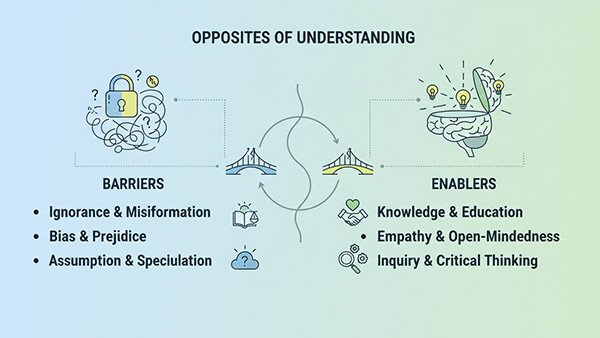
To truly grasp the concept of antonyms for “understand,” we must first define the word itself. Understand means to perceive the intended meaning of words, ideas, or actions; to comprehend or grasp something. It implies a mental process of making sense of information and forming a coherent understanding. It can also refer to being sympathetic or tolerant of something.
The opposites of “understand” encompass a range of states and conditions where this comprehension is absent, incomplete, or distorted. These antonyms can be broadly categorized as representing a lack of knowledge, a misinterpretation, or a state of mental confusion.
When exploring the antonym of understand, it’s important to recognize that different contexts call for different opposite words. For example, while “misunderstand” directly contrasts with “understand” in situations of incorrect interpretation, “ignorance” or “incomprehension” may be more suitable when knowledge or awareness is absent. If you are wondering what is the opposite of understood, it could range from “misinterpreted” to “uncomprehended,” depending on the nuance you wish to convey.
Each antonym carries its unique nuance, reflecting different degrees and types of non-understanding.
For example, ignorance implies a complete lack of knowledge about a particular subject. Misunderstanding suggests a flawed or incorrect interpretation. Confusion denotes a state of mental disarray where clear comprehension is impossible. Therefore, selecting the appropriate antonym is crucial for conveying the intended meaning accurately.
Structural Breakdown of Antonyms
The antonyms of “understand” can be analyzed based on their word formation and grammatical structure. Many of these antonyms are formed by adding prefixes to existing words, such as “mis-” (misunderstand), “in-” (incomprehension), or “un-” (unaware).
These prefixes negate or reverse the meaning of the base word.
Another common structure involves using entirely different words with opposite meanings, such as “ignore” or “disbelieve.” These words have no direct morphological relationship to “understand” but convey the opposite concept. Understanding the structural breakdown can aid in recognizing and using these antonyms correctly.
Furthermore, some antonyms are nouns (e.g., ignorance, confusion), while others are verbs (e.g., misunderstand, ignore) or adjectives (e.g., unaware, oblivious). The grammatical form of the antonym must be appropriate for the sentence structure in which it is used.
Paying attention to these structural details will enhance the precision and clarity of your writing and speaking.
Types and Categories of Antonyms for “Understand”
The antonyms of “understand” can be grouped into several categories based on the specific type of non-understanding they represent. Here’s a breakdown of these categories:
Ignorance
Ignorance refers to a lack of knowledge or information. It’s a state of being unaware or uninformed about something. This can be due to a lack of exposure, education, or interest in the subject matter.
Misunderstanding
A misunderstanding occurs when someone interprets information incorrectly. It’s a failure to understand something properly, often leading to confusion or disagreement. Misunderstandings can arise from unclear communication, differing perspectives, or assumptions.
Confusion
Confusion is a state of being bewildered or unclear in one’s mind about something. It involves a lack of clarity and an inability to think coherently. Confusion can be caused by complex information, conflicting ideas, or emotional distress.
Bewilderment
Bewilderment is a state of being perplexed and confused. It’s a stronger form of confusion that often involves a sense of being lost or disoriented. Bewilderment can be triggered by unexpected events, complex situations, or unfamiliar environments.
Perplexity
Perplexity refers to a state of being puzzled or deeply confused. It involves a feeling of being unable to make sense of something. Perplexity often arises when facing complex problems, contradictory information, or enigmatic situations.
Obliviousness
Obliviousness is the state of being unaware or unconscious of what is happening around you. It’s a lack of attention or perception, often leading to missed opportunities or social faux pas. Obliviousness can be caused by distraction, preoccupation, or a lack of interest.
Incomprehension
Incomprehension denotes a complete inability to understand something. It’s a lack of comprehension or grasp of the meaning. Incomprehension can result from complex language, technical jargon, or abstract concepts.
Disbelief
Disbelief is a state of being unable to accept something as true or real. It’s a lack of faith or conviction in the veracity of information. Disbelief can stem from skepticism, past experiences, or a lack of evidence.
Examples of Antonyms in Sentences
To illustrate the usage of these antonyms, let’s examine them in context. The following tables provide examples of each antonym used in sentences, showcasing their different nuances and applications.
The table below showcases examples of the antonym “Ignorance” in sentences. Notice how the word reflects a lack of knowledge or awareness.
| Antonym | Example Sentence |
|---|---|
| Ignorance | His ignorance of basic economics was astounding. |
| Ignorance | The politician pleaded ignorance when questioned about the scandal. |
| Ignorance | She lived in blissful ignorance of the dangers lurking nearby. |
| Ignorance | The company’s ignorance of customer needs led to its downfall. |
| Ignorance | Complete ignorance of the law is no excuse. |
| Ignorance | His ignorance about the local culture was evident. |
| Ignorance | The students’ ignorance of the historical context hindered their understanding. |
| Ignorance | She feigned ignorance to avoid answering the difficult question. |
| Ignorance | The report highlighted the widespread ignorance of the issue. |
| Ignorance | His ignorance of the rules resulted in a penalty. |
| Ignorance | They were operating in complete ignorance of the risks involved. |
| Ignorance | The public’s ignorance of the scientific facts was concerning. |
| Ignorance | He attributed his failure to sheer ignorance. |
| Ignorance | Her ignorance of the language made communication difficult. |
| Ignorance | The company’s ignorance of environmental regulations was costly. |
| Ignorance | He blamed his ignorance for the mistake. |
| Ignorance | She was in complete ignorance of the plot. |
| Ignorance | Their ignorance of the situation was understandable, given the circumstances. |
| Ignorance | The report exposed the ignorance surrounding the problem. |
| Ignorance | His ignorance of the subject matter was apparent. |
| Ignorance | He was blissfully in ignorance about the negative consequences of his actions. |
| Ignorance | The widespread ignorance of the dangers of smoking is alarming. |
| Ignorance | Their ignorance of the local customs led to several awkward situations. |
| Ignorance | He feigned ignorance to avoid taking responsibility for his mistake. |
| Ignorance | The government’s ignorance of the needs of the poor is unacceptable. |
The following table showcases examples of the antonym “Misunderstanding” in sentences. Note how it reflects an incorrect or flawed interpretation of information.
| Antonym | Example Sentence |
|---|---|
| Misunderstanding | A simple misunderstanding led to a major argument. |
| Misunderstanding | The contract was canceled due to a fundamental misunderstanding of the terms. |
| Misunderstanding | Their relationship ended because of constant misunderstandings. |
| Misunderstanding | The misunderstanding arose from a language barrier. |
| Misunderstanding | He blamed the error on a simple misunderstanding. |
| Misunderstanding | The entire conflict was based on a misunderstanding. |
| Misunderstanding | Let’s clear up any misunderstandings before we proceed. |
| Misunderstanding | The misunderstanding was quickly resolved. |
| Misunderstanding | She tried to clarify the misunderstanding. |
| Misunderstanding | The misunderstanding caused a lot of unnecessary stress. |
| Misunderstanding | It was all just a big misunderstanding. |
| Misunderstanding | The misunderstanding stemmed from a lack of communication. |
| Misunderstanding | They were able to overcome their misunderstanding. |
| Misunderstanding | The misunderstanding almost ruined their friendship. |
| Misunderstanding | He wanted to avoid any further misunderstandings. |
| Misunderstanding | The misunderstanding was due to a cultural difference. |
| Misunderstanding | She apologized for the misunderstanding. |
| Misunderstanding | The misunderstanding was eventually sorted out. |
| Misunderstanding | They worked hard to resolve the misunderstanding. |
| Misunderstanding | The misunderstanding created a rift between them. |
| Misunderstanding | The misunderstanding was based on a false assumption. |
| Misunderstanding | Let’s make sure there are no misunderstandings going forward. |
| Misunderstanding | The misunderstanding nearly derailed the project. |
| Misunderstanding | He tried to prevent the misunderstanding from escalating. |
| Misunderstanding | The misunderstanding could have been avoided with better communication. |
The table below illustrates examples of sentences using “Confusion” as an antonym of “Understand”. This highlights the state of being unclear or bewildered.
| Antonym | Example Sentence |
|---|---|
| Confusion | The complex instructions caused widespread confusion. |
| Confusion | He stared at the map in utter confusion. |
| Confusion | The sudden announcement created confusion among the employees. |
| Confusion | She felt a sense of confusion wash over her. |
| Confusion | The confusion stemmed from conflicting reports. |
| Confusion | He tried to clear up the confusion. |
| Confusion | The confusion led to several mistakes. |
| Confusion | She was in a state of complete confusion. |
| Confusion | The confusion was palpable in the room. |
| Confusion | He tried to navigate through the confusion. |
| Confusion | The confusion made it difficult to make decisions. |
| Confusion | She felt overwhelmed by the confusion. |
| Confusion | The confusion was a result of poor planning. |
| Confusion | He tried to bring order to the confusion. |
| Confusion | The confusion slowed down the process. |
| Confusion | She was lost in a sea of confusion. |
| Confusion | The confusion made it impossible to proceed. |
| Confusion | He struggled to overcome the confusion. |
| Confusion | The confusion was a major setback. |
| Confusion | She felt trapped in a web of confusion. |
| Confusion | The speaker’s rambling style caused widespread confusion among the audience. |
| Confusion | The sudden change in policy resulted in mass confusion. |
| Confusion | The lack of clear signage led to confusion for tourists. |
| Confusion | He tried to dispel the confusion by providing more details. |
| Confusion | The contradictory statements only added to the confusion. |
This table presents examples of using “Bewilderment” as an antonym of “Understand”. It emphasizes a deeper level of confusion and perplexity.
| Antonym | Example Sentence |
|---|---|
| Bewilderment | She stared at the abstract painting in complete bewilderment. |
| Bewilderment | He was filled with bewilderment by the strange events. |
| Bewilderment | The complex riddle left her in a state of bewilderment. |
| Bewilderment | He looked around in utter bewilderment. |
| Bewilderment | The news filled her with bewilderment and disbelief. |
| Bewilderment | He shook his head in bewilderment. |
| Bewilderment | She couldn’t hide her bewilderment. |
| Bewilderment | The situation caused him great bewilderment. |
| Bewilderment | He struggled to understand his bewilderment. |
| Bewilderment | She was lost in a sea of bewilderment. |
| Bewilderment | The magician’s trick left the audience in bewilderment. |
| Bewilderment | He was struck by a wave of bewilderment. |
| Bewilderment | She tried to make sense of her bewilderment. |
| Bewilderment | The dream left him with a lingering sense of bewilderment. |
| Bewilderment | He couldn’t shake off his bewilderment. |
| Bewilderment | She was overwhelmed by a feeling of bewilderment. |
| Bewilderment | The unexpected turn of events caused widespread bewilderment. |
| Bewilderment | He was completely lost in bewilderment. |
| Bewilderment | She tried to mask her bewilderment. |
| Bewilderment | The sheer absurdity of the situation caused bewilderment. |
| Bewilderment | The cryptic message left him in a state of utter bewilderment. |
| Bewilderment | He experienced a moment of complete bewilderment when he woke up in the unfamiliar room. |
| Bewilderment | The complex scientific theory filled her with bewilderment and a desire to learn more. |
| Bewilderment | He scratched his head in bewilderment, trying to decipher the ancient symbols. |
| Bewilderment | The unexpected plot twist left the audience gasping in bewilderment. |
This table provides examples of “Obliviousness” used as an antonym of “Understand”. It emphasizes a lack of awareness of the surrounding environment or situation.
| Antonym | Example Sentence |
|---|---|
| Obliviousness | He walked into the meeting with complete obliviousness to the tension in the room. |
| Obliviousness | She displayed a startling obliviousness to the needs of others. |
| Obliviousness | His obliviousness to the social cues made him appear rude. |
| Obliviousness | She continued talking, in complete obliviousness to the fact that everyone was bored. |
| Obliviousness | His obliviousness to the danger almost cost him his life. |
| Obliviousness | She lived in a state of blissful obliviousness. |
| Obliviousness | His obliviousness to the consequences of his actions was frustrating. |
| Obliviousness | She was completely oblivious to the admiring glances she received. |
| Obliviousness | His obliviousness to the suffering of others was disheartening. |
| Obliviousness | She remained in obliviousness to the impending disaster. |
| Obliviousness | His obliviousness to the political climate made him a poor leader. |
| Obliviousness | She seemed to have a remarkable capacity for obliviousness. |
| Obliviousness | His obliviousness to the feelings of others was a major flaw. |
| Obliviousness | She was completely oblivious to the fact that she was being watched. |
| Obliviousness | His obliviousness to the importance of teamwork hindered the project. |
| Obliviousness | She displayed a surprising level of obliviousness to the environmental issues. |
| Obliviousness | His obliviousness to the financial risks led to the company’s downfall. |
| Obliviousness | She was completely oblivious to the fact that she was being taken advantage of. |
| Obliviousness | His obliviousness to the cultural sensitivities caused offense. |
| Obliviousness | She lived in a world of her own, completely oblivious to reality. |
| Obliviousness | He demonstrated an almost willful obliviousness to the problems around him. |
| Obliviousness | Her obliviousness to the subtle hints made it difficult to communicate with her. |
| Obliviousness | He attributed his success to his obliviousness to the naysayers. |
| Obliviousness | Her obliviousness to the passage of time often made her late. |
| Obliviousness | He cultivated an air of obliviousness to avoid dealing with difficult situations. |
Usage Rules for Antonyms of “Understand”
Using the antonyms of “understand” correctly requires attention to context and nuance. Here are some key usage rules:
- Choose the right degree: Select an antonym that accurately reflects the degree of non-understanding. “Ignorance” implies a complete lack of knowledge, while “confusion” suggests a temporary state of mental disarray.
- Consider the cause: The reason for the lack of understanding can influence the choice of antonym. “Misunderstanding” indicates a flawed interpretation, while “incomprehension” suggests an inability to grasp the meaning.
- Pay attention to grammar: Ensure that the grammatical form of the antonym (noun, verb, adjective) is appropriate for the sentence structure.
- Avoid ambiguity: Use clear and precise language to avoid any potential confusion about the intended meaning.
For example, instead of saying “He didn’t understand,” you could choose a more specific antonym like “He misunderstood the instructions,” “He was ignorant of the facts,” or “He was confused by the complex jargon.” The choice depends on the specific context and the nuance you wish to convey.
Common Mistakes When Using Antonyms of “Understand”
Several common mistakes can occur when using antonyms of “understand.” Being aware of these errors can help you avoid them in your own writing and speaking.
- Using “misunderstand” when “not understand” is more appropriate: “Misunderstand” implies an incorrect interpretation, while “not understand” simply means a lack of comprehension.
- Confusing “ignorance” with “stupidity”: “Ignorance” refers to a lack of knowledge, while “stupidity” implies a lack of intelligence.
- Using “confusion” when “bewilderment” is more fitting: “Bewilderment” is a stronger form of confusion that suggests a sense of being lost or disoriented.
Here are some examples of common mistakes and their corrections:
| Incorrect | Correct | Explanation |
|---|---|---|
| He ignoranced the question. | He ignored the question. | “Ignoranced” is not a valid verb form. “Ignored” is the correct verb form of “ignore.” |
| She was in oblivious of the danger. | She was oblivious to the danger. | The correct preposition to use with “oblivious” is “to.” |
| They misunderstanding the situation. | They misunderstood the situation. | The verb “misunderstand” requires the correct tense. In this case, the past tense “misunderstood” is needed. |
Practice Exercises
Test your understanding of the antonyms of “understand” with these practice exercises. Choose the best antonym to complete each sentence.
Exercise 1: Fill in the blanks with the appropriate antonym of “understand.”
| Question | Answer |
|---|---|
| 1. Due to his _________ of the local customs, he accidentally offended the host. (ignorance/misunderstanding) | ignorance |
| 2. The complex instructions left her in a state of _________. (confusion/obliviousness) | confusion |
| 3. The argument started because of a simple _________ between the two friends. (ignorance/misunderstanding) | misunderstanding |
| 4. He was completely _________ to the fact that he was being followed. (oblivious/perplexed) | oblivious |
| 5. The abstract painting filled her with _________. (bewilderment/confusion) | bewilderment |
| 6. The student showed complete _________ of the professor’s lecture. (incomprehension/ignorance) | incomprehension |
| 7. He couldn’t hide his _________ when he heard the unbelievable news. (disbelief/confusion) | disbelief |
| 8. The complicated math problem left her feeling totally _________. (perplexed/oblivious) | perplexed |
| 9. Despite repeated explanations, he remained in complete _________ of the situation. (incomprehension/misunderstanding) | incomprehension |
| 10. She lived in _______ of the true dangers that surrounded her. (ignorance/confusion) | ignorance |
Exercise 2: Choose the best word to replace the phrase “did not understand” in the following sentences.
| Question | Answer |
|---|---|
| 1. He did not understand the complex scientific theory. (misunderstood/incomprehended) | incomprehended |
| 2. She did not understand the instructions and made a mistake. (misunderstood/ignored) | misunderstood |
| 3. They did not understand the risks involved in the project. (ignored/were ignorant of) | were ignorant of |
| 4. I did not understand the question and asked for clarification. (confused/was confused by) | was confused by |
| 5. The audience did not understand the speaker’s point. (misunderstood/was bewildered by) | was bewildered by |
| 6. He did not understand the social cues and made an inappropriate comment. (ignored/was oblivious to) | was oblivious to |
| 7. She did not understand the urgency of the situation. (disbelieved/misunderstood) | misunderstood |
| 8. The student did not understand the problem and asked for help. (perplexed/was perplexed by) | was perplexed by |
| 9. The witness claimed he did not understand the events that transpired. (misunderstood/was ignorant of) | was ignorant of |
| 10. The child did not understand why he was being punished. (confused/was confused by) | was confused by |
Advanced Topics: Nuances and Context
Beyond the basic definitions and usage rules, the antonyms of “understand” can be explored in more nuanced and contextual ways. The choice of antonym can depend on the speaker’s attitude, the social dynamics of the situation, and the specific domain of knowledge involved.
For example, using “ignorance” can be accusatory or judgmental, while using “lack of awareness” might be more neutral. Similarly, “misunderstanding” can imply a shared responsibility for the communication breakdown, while “incomprehension” might suggest a deficiency in the listener’s ability to process information.
In legal contexts, the distinction between “ignorance of the law” and “misinterpretation of the law” can have significant consequences. In scientific contexts, “lack of understanding” might be framed as a “knowledge gap” or an “area for further research.” These subtle differences highlight the importance of considering the broader context when choosing the most appropriate antonym.
Frequently Asked Questions
Here are some frequently asked questions about the antonyms of “understand”:
What is the difference between “ignorance” and “stupidity”?
Ignorance refers to a lack of knowledge or awareness about a particular subject. It’s a state of being uninformed. Stupidity, on the other hand, implies a lack of intelligence or cognitive ability. It suggests a difficulty in learning or understanding, even when information is available. Someone can be ignorant about a topic without being stupid, and vice versa.
When should I use “misunderstanding” instead of “not understand”?
Use misunderstanding when there’s been an incorrect or flawed interpretation of information. It implies that someone has understood something, but in the wrong way. Use not understand when there’s a complete lack of comprehension. For instance, “They misunderstood the instructions” means they followed the instructions incorrectly. “They did not understand the instructions” means they couldn’t make sense of them at all.
Is “confusion” the same as “bewilderment”?
While both confusion and bewilderment involve a lack of clarity, bewilderment is a stronger and more intense form of confusion. Confusion is a general state of being unclear or uncertain, while bewilderment implies a deeper sense of perplexity and disorientation. Bewilderment often arises from something unexpected or inexplicable.
How does “obliviousness” differ from “ignorance”?
Ignorance is a lack of knowledge, whereas obliviousness is a lack of awareness or attention to what’s happening around you. Someone can be ignorant of a fact because they’ve never been exposed to it. Someone can be oblivious to something happening right in front of them because they’re distracted or preoccupied.
What are some formal alternatives to “I don’t understand”?
Formal alternatives include: “I do not comprehend,” “I am unable to grasp the meaning,” “I require further clarification,” or “Could you please elaborate?” The choice depends on the specific context and the level of formality required.
How can I avoid misunderstandings in communication?
To avoid misunderstandings, practice clear and concise communication. Use precise language, avoid jargon or ambiguous
language, and actively listen to the other person’s perspective. Ask clarifying questions and summarize key points to ensure mutual understanding. Be mindful of cultural differences and non-verbal cues that could lead to misinterpretations.
Conclusion
The English language provides a rich array of antonyms for “understand,” each with its unique nuance and application. By mastering these antonyms, you can enhance your ability to express the absence or negation of understanding with precision and clarity.
Whether you’re describing a simple misunderstanding or a profound state of bewilderment, the right antonym can make all the difference.
This comprehensive guide has explored the definition, structural breakdown, types, usage rules, common mistakes, and advanced topics related to the antonyms of “understand.” By incorporating these insights into your vocabulary and communication skills, you can become a more effective and articulate speaker and writer. Remember to consider the context, degree, and cause of non-understanding when choosing the most appropriate antonym.
With practice and attention to detail, you can confidently navigate the complexities of language and express your ideas with greater accuracy and impact.