
Understanding predicate adjectives is crucial for mastering English grammar. These adjectives, unlike attributive adjectives, don’t directly modify nouns but instead describe the subject of a sentence after a linking verb.
This article provides a comprehensive guide to predicate adjectives, covering their definition, structure, types, usage rules, common mistakes, and advanced topics. Whether you’re a beginner or an advanced learner, this guide will help you confidently identify and use predicate adjectives in your writing and speech.
This guide is designed for English language learners of all levels, students studying grammar, writers seeking to improve their style, and anyone interested in a deeper understanding of English sentence structure. By the end of this article, you’ll be able to recognize predicate adjectives, construct grammatically correct sentences using them, and avoid common errors.
Table of Contents
- Introduction
- Definition of Predicate Adjective
- Structural Breakdown
- Types and Categories of Predicate Adjectives
- Examples of Predicate Adjectives
- Usage Rules for Predicate Adjectives
- Common Mistakes with Predicate Adjectives
- Practice Exercises
- Advanced Topics
- Frequently Asked Questions (FAQ)
- Conclusion
Definition of Predicate Adjective
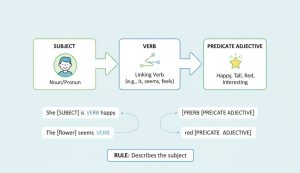
A predicate adjective is an adjective that follows a linking verb and modifies the subject of the sentence.
In simple terms, a predicate adjective—or predicative adjective—is an adjective that describes the subject of a sentence after a linking verb. So, when someone asks, “What is a predicate adjective?” you can explain that it provides descriptive information about the subject without directly modifying the noun. For example, in “The sky is blue,” “blue” is a predicate adjective, or predicative adjective, because it tells us more about the subject, “sky,” following the linking verb “is.”
Unlike attributive adjectives, which precede the noun they modify (e.g., “the tall man”), predicate adjectives appear after a linking verb and describe the subject (e.g., “The man is tall“). They function as a subject complement, providing more information about the subject’s state, condition, or quality.
Classification
Predicate adjectives are classified based on their function within a sentence. They always follow a linking verb and describe the subject.
The key is that they don’t directly modify a noun; instead, they are linked to the subject via a linking verb.
Function
The primary function of a predicate adjective is to describe or modify the subject of a sentence. They provide information about the subject’s characteristics, qualities, or state of being. They complete the meaning of the sentence by adding descriptive detail about the subject after a linking verb. For example, in the sentence “The soup tastes delicious,” the predicate adjective “delicious” describes the soup.
Contexts
Predicate adjectives are commonly used in sentences that describe states, conditions, or qualities. They are frequently found in descriptive writing, character analyses, and general observations. They help create vivid and detailed descriptions by providing information about the subject’s current state or an inherent quality. They are also used in sentences expressing opinions or judgments about the subject. For instance, “The movie was entertaining” expresses an opinion about the movie.
Structural Breakdown
The basic structure of a sentence with a predicate adjective is as follows:
Subject + Linking Verb + Predicate Adjective
The subject is the noun or pronoun that the sentence is about. The linking verb connects the subject to the predicate adjective. Common linking verbs include forms of “to be” (is, are, was, were, am, been, being), as well as verbs such as *seem, become, appear, look, feel, taste, smell, sound, and grow.* The predicate adjective is the adjective that describes the subject. For example:
- The sky is blue. (Subject: sky; Linking Verb: is; Predicate Adjective: blue)
- She seems happy. (Subject: She; Linking Verb: seems; Predicate Adjective: happy)
- The food tastes spicy. (Subject: food; Linking Verb: tastes; Predicate Adjective: spicy)
Understanding this structure is essential for correctly identifying and using predicate adjectives.
To better understand what predicate adjectives are, let’s look at some clear predicate adjective examples. For instance, in the sentence “The music sounds loud,” “loud” is a predicate adjective describing the subject “music” after the linking verb “sounds.” Similarly, in “She seems happy,” “happy” is a predicate adjective. These examples show how predicate adjectives function to give more information about the subject rather than directly modifying a noun.
Types and Categories of Predicate Adjectives
Predicate adjectives can be categorized based on the type of information they convey about the subject. Here are some common categories:
Descriptive Adjectives
Descriptive adjectives describe the physical characteristics, qualities, or attributes of the subject. They provide sensory details or general descriptions.
Examples include:
- The house is big.
- The flower is red.
- The music sounds loud.
Evaluative Adjectives
Evaluative adjectives express an opinion, judgment, or assessment about the subject. They indicate whether something is good or bad, positive or negative.
Examples include:
- The performance was amazing.
- The food tasted terrible.
- The idea seems brilliant.
Stative Adjectives
Stative adjectives describe the subject’s state of being or condition. They often refer to emotions, feelings, or temporary conditions.
Examples include:
- She is tired.
- They are excited.
- He seems unhappy.
Examples of Predicate Adjectives
Here are extensive examples of predicate adjectives, organized by category:
Descriptive Adjectives Examples
The following table illustrates the use of descriptive adjectives as predicate adjectives in various sentences. These adjectives provide sensory details and general descriptions of the subjects they modify.
| Sentence | Predicate Adjective | Subject | Linking Verb |
|---|---|---|---|
| The sky is blue. | blue | sky | is |
| The grass is green. | green | grass | is |
| The coffee smells strong. | strong | coffee | smells |
| The building appears tall. | tall | building | appears |
| The fabric feels soft. | soft | fabric | feels |
| The room looks bright. | bright | room | looks |
| The water tastes salty. | salty | water | tastes |
| The music sounds loud. | loud | music | sounds |
| The car looks new. | new | car | looks |
| The cake smells sweet. | sweet | cake | smells |
| The stone feels rough. | rough | stone | feels |
| The flower is fragrant. | fragrant | flower | is |
| The night is dark. | dark | night | is |
| The bread smells fresh. | fresh | bread | smells |
| The metal feels cold. | cold | metal | feels |
| The painting looks colorful. | colorful | painting | looks |
| The soup tastes creamy. | creamy | soup | tastes |
| The wind sounds fierce. | fierce | wind | sounds |
| The house seems old. | old | house | seems |
| The silk feels smooth. | smooth | silk | feels |
| The lemon tastes sour. | sour | lemon | tastes |
| The bird looks small. | small | bird | looks |
| The answer seems correct. | correct | answer | seems |
| The problem appears difficult. | difficult | problem | appears |
| The solution sounds simple. | simple | solution | sounds |
| The journey became tiring. | tiring | journey | became |
| The challenge felt overwhelming. | overwhelming | challenge | felt |
Evaluative Adjectives Examples
This table showcases evaluative adjectives used as predicate adjectives. These adjectives express opinions, judgments, and assessments about the subject, indicating whether something is good or bad, positive or negative.
| Sentence | Predicate Adjective | Subject | Linking Verb |
|---|---|---|---|
| The movie was entertaining. | entertaining | movie | was |
| The dinner tasted delicious. | delicious | dinner | tasted |
| The concert sounded amazing. | amazing | concert | sounded |
| The idea seems brilliant. | brilliant | idea | seems |
| The plan appears foolish. | foolish | plan | appears |
| The result was satisfactory. | satisfactory | result | was |
| The experience felt wonderful. | wonderful | experience | felt |
| The suggestion sounds reasonable. | reasonable | suggestion | sounds |
| The proposal seems promising. | promising | proposal | seems |
| The outcome was disappointing. | disappointing | outcome | was |
| The service was excellent. | excellent | service | was |
| The presentation seemed informative. | informative | presentation | seemed |
| The solution appears practical. | practical | solution | appears |
| The book was captivating. | captivating | book | was |
| The performance was outstanding. | outstanding | performance | was |
| The food tasted terrible. | terrible | food | tasted |
| The music sounded horrible. | horrible | music | sounded |
| The situation appeared hopeless. | hopeless | situation | appeared |
| The answer seems incorrect. | incorrect | answer | seems |
| The decision was unfortunate. | unfortunate | decision | was |
| The weather became unpleasant. | unpleasant | weather | became |
| The news sounded alarming. | alarming | news | sounded |
| The result seems questionable. | questionable | result | seems |
| The design appears elegant. | elegant | design | appears |
| The atmosphere felt inviting. | inviting | atmosphere | felt |
| The approach seems innovative. | innovative | approach | seems |
| The landscape appeared picturesque. | picturesque | landscape | appeared |
Stative Adjectives Examples
The following table provides examples of stative adjectives used as predicate adjectives. These adjectives describe the subject’s state of being or condition, often referring to emotions, feelings, or temporary conditions.
| Sentence | Predicate Adjective | Subject | Linking Verb |
|---|---|---|---|
| She is tired. | tired | She | is |
| They are excited. | excited | They | are |
| He seems unhappy. | unhappy | He | seems |
| I am nervous. | nervous | I | am |
| We are grateful. | grateful | We | are |
| You seem anxious. | anxious | You | seem |
| The children are bored. | bored | children | are |
| The patient is stable. | stable | patient | is |
| The team is ready. | ready | team | is |
| The city is safe. | safe | city | is |
| The door remained open. | open | door | remained |
| The room felt empty. | empty | room | felt |
| The situation appeared calm. | calm | situation | appeared |
| The coffee stayed hot. | hot | coffee | stayed |
| The weather turned cold. | cold | weather | turned |
| The food became stale. | stale | food | became |
| The audience grew silent. | silent | audience | grew |
| The music continued loud. | loud | music | continued |
| The story sounded unbelievable. | unbelievable | story | sounded |
| The task seemed easy. | easy | task | seemed |
| The account appeared legitimate. | legitimate | account | appeared |
| The surface felt sticky. | sticky | surface | felt |
| The wound looked infected. | infected | wound | looked |
| The plant remained alive. | alive | plant | remained |
| The machine became operational. | operational | machine | became |
| The atmosphere felt tense. | tense | atmosphere | felt |
| The explanation sounded confusing. | confusing | explanation | sounded |
Compound Predicate Adjectives Examples
Compound adjectives can also function as predicate adjectives, adding complexity and nuance to descriptions. Here’s a table illustrating their use:
| Sentence | Predicate Adjective | Subject | Linking Verb |
|---|---|---|---|
| The project is well-planned. | well-planned | project | is |
| The child seemed well-behaved. | well-behaved | child | seemed |
| The house looked run-down. | run-down | house | looked |
| The solution appeared short-sighted. | short-sighted | solution | appeared |
| The argument became long-winded. | long-winded | argument | became |
| The task felt time-consuming. | time-consuming | task | felt |
| The decision seemed ill-advised. | ill-advised | decision | seemed |
| The approach sounded forward-thinking. | forward-thinking | approach | sounded |
| The design appeared user-friendly. | user-friendly | design | appeared |
| The method became widely-used. | widely-used | method | became |
Participial Predicate Adjectives Examples
Participial adjectives, derived from verbs, can also function as predicate adjectives. Here’s a table showcasing examples:
| Sentence | Predicate Adjective | Subject | Linking Verb |
|---|---|---|---|
| The audience was captivated. | captivated | audience | was |
| The child seemed amused. | amused | child | seemed |
| The food smelled burnt. | burnt | food | smelled |
| The speaker appeared bored. | bored | speaker | appeared |
| The students were motivated. | motivated | students | were |
Usage Rules for Predicate Adjectives
Using predicate adjectives correctly requires understanding a few key rules:
Linking Verbs
As mentioned earlier, predicate adjectives must follow a linking verb. Ensure that the verb you use connects the subject to the adjective, rather than expressing an action. Common linking verbs include: *be (is, are, was, were, am, been, being), seem, become, appear, look, feel, taste, smell, sound, grow, remain, stay.*
Subject Complement
The predicate adjective functions as a subject complement, meaning it completes the meaning of the subject. It provides additional information about the subject’s characteristics or state.
Agreement with Subject
Although the adjective itself doesn’t change form, ensure that the linking verb agrees with the subject in number. For example:
- Singular: The flower is beautiful.
- Plural: The flowers are beautiful.
Exceptions and Special Cases
Some verbs can function as both linking verbs and action verbs. The key is to determine whether the verb is describing the subject or expressing an action.
Consider these examples:
- Linking Verb: She looks happy. (describes her state)
- Action Verb: She looks at the painting. (expresses an action)
In the first sentence, “looks” is a linking verb, and “happy” is a predicate adjective. In the second sentence, “looks” is an action verb, and “at the painting” is a prepositional phrase.
Common Mistakes with Predicate Adjectives
One common mistake is using an adverb instead of an adjective after a linking verb. Remember that predicate adjectives modify the subject, which is a noun or pronoun, so you need an adjective, not an adverb.
| Incorrect | Correct | Explanation |
|---|---|---|
| The soup tastes badly. | The soup tastes bad. | “Badly” is an adverb; “bad” is the correct predicate adjective. |
| He seems angrily. | He seems angry. | “Angrily” is an adverb; “angry” is the correct predicate adjective. |
| She looks sadly. | She looks sad. | “Sadly” is an adverb; “sad” is the correct predicate adjective. |
Another mistake is confusing predicate adjectives with attributive adjectives. Remember that attributive adjectives come *before* the noun they modify, while predicate adjectives come *after* a linking verb.
| Incorrect | Correct | Explanation |
|---|---|---|
| The tall is man. | The man is tall. | “Tall” is used as a predicate adjective after the linking verb “is.” |
| The red is flower. | The flower is red. | “Red” is used as a predicate adjective after the linking verb “is.” |
Practice Exercises
Test your understanding of predicate adjectives with these exercises:
Exercise 1: Identifying Predicate Adjectives
Identify the predicate adjective in each of the following sentences. If the sentence does not contain a predicate adjective, write “None.”
| Question | Answer |
|---|---|
| 1. The coffee is hot. | hot |
| 2. She sings beautifully. | None |
| 3. The sky looks cloudy. | cloudy |
| 4. He runs quickly. | None |
| 5. The food tastes delicious. | delicious |
| 6. They are happy. | happy |
| 7. The car is red. | red |
| 8. The music sounds loud. | loud |
| 9. She writes well. | None |
| 10. The house seems old. | old |
Exercise 2: Completing Sentences with Predicate Adjectives
Complete each sentence with an appropriate predicate adjective.
| Question | Answer |
|---|---|
| 1. The weather is ______. | cold/sunny/pleasant |
| 2. The cake tastes ______. | sweet/delicious/amazing |
| 3. The music sounds ______. | beautiful/loud/harmonious |
| 4. She seems ______. | happy/tired/anxious |
| 5. The room looks ______. | bright/clean/organized |
| 6. The fabric feels ______. | soft/smooth/comfortable |
| 7. The problem seems ______. | difficult/complicated/challenging |
| 8. The solution appears ______. | practical/simple/effective |
| 9. The situation is ______. | tense/calm/serious |
| 10. The coffee smells ______. | strong/aromatic/inviting |
Exercise 3: Correcting Sentences with Predicate Adjective Errors
Correct the sentences that contain errors in the use of predicate adjectives.
| Question | Answer |
|---|---|
| 1. The soup tastes badly. | The soup tastes bad. |
| 2. He seems happily. | He seems happy. |
| 3. She looks sadly. | She looks sad. |
| 4. The flower is beautifully. | The flower is beautiful. |
| 5. The weather is nicely. | The weather is nice. |
| 6. The man is tall. | Correct |
| 7. The music is loudly. | The music is loud. |
| 8. The children are excitedly. | The children are excited. |
| 9. The cake is deliciously. | The cake is delicious. |
| 10. She looks pretty. | Correct |
Advanced Topics
For advanced learners, here are some more complex aspects of predicate adjectives:
Predicate Adjectives as Subjective Complements
Predicate adjectives are a type of subjective complement, which is a word or phrase that follows a linking verb and describes or renames the subject. They are essential for providing detailed descriptions and completing the meaning of the sentence.
Predicate Adjectives in Complex Sentences
Predicate adjectives can also be used in complex sentences, where they may appear in subordinate clauses. For example:
Although she seemed tired, she continued working.
In this sentence, “tired” is a predicate adjective in the subordinate clause “Although she seemed tired.”
Frequently Asked Questions (FAQ)
- What is the difference between a predicate adjective and an attributive adjective?An attributive adjective comes *before* the noun it modifies (e.g., “the red car”), while a predicate adjective comes *after* a linking verb and describes the subject (e.g., “The car is red“).
- What are some common linking verbs?Common linking verbs include forms of “to be” (is, are, was, were, am, been, being), as well as verbs such as *seem, become, appear, look, feel, taste, smell, sound, and grow.* These verbs connect the subject to the predicate adjective.
- Can an adverb be used as a predicate adjective?No, an adverb cannot be used as a predicate adjective. Predicate adjectives modify the subject, which is a noun or pronoun, so you need an adjective, not an adverb.
- How do I identify a predicate adjective in a sentence?Look for an adjective that follows a linking verb and describes the subject of the sentence. The adjective should provide information about the subject’s characteristics, qualities, or state of being.
- What is a subject complement?A subject complement is a word or phrase that follows a linking verb and describes or renames the subject. Predicate adjectives are a type of subject complement.
- Can compound adjectives be used as predicate adjectives?Yes, compound adjectives can be used as predicate adjectives. For example, “The project is well-planned.”
- What happens if a verb can be both a linking verb and an action verb? How do I know when the adjective is a predicate adjective?If the verb is describing a state of being or a characteristic of the subject, it’s a linking verb, and the following adjective is a predicate adjective. If the verb shows an action performed by the subject, it’s an action verb. For example, in “She *looks* tired,” ‘looks’ is linking her to the state of ‘tired.’ In “She *looks* at the star,” ‘looks’ is an action she is doing.
- Are there any exceptions to the rule that predicate adjectives must follow a linking verb?Generally, no. The presence of a linking verb is a defining characteristic of sentences containing predicate adjectives. However, understanding which verbs function as linking verbs can sometimes be tricky, as some verbs can act as both linking and action verbs depending on the context.
Conclusion
Predicate adjectives are an essential component of English grammar, allowing you to provide detailed descriptions and express your opinions effectively. By understanding their definition, structure, types, and usage rules, you can improve the clarity and
precision of your writing and speaking.
By mastering the use of predicate adjectives, you can add depth and nuance to your descriptions, making your communication more engaging and effective. Continue to practice identifying and using predicate adjectives to enhance your overall command of the English language.