
The phrase “second to none” is a powerful idiom used to convey unparalleled excellence. Understanding its nuances is crucial for effective communication, allowing you to express the highest degree of quality or skill.
This article delves into the meaning, usage, and grammatical aspects of “second to none,” providing a comprehensive guide for English learners of all levels. By mastering this idiom, you’ll enhance your vocabulary and gain a deeper appreciation for the richness of the English language.
Whether you’re a beginner or an advanced speaker, this guide will equip you with the knowledge and tools to confidently use “second to none” in your writing and speech.
This guide is designed to benefit a wide range of learners, from students preparing for exams to professionals aiming to refine their communication skills. We’ll explore the idiom’s origins, its various applications, and common pitfalls to avoid.
Through clear explanations, numerous examples, and practical exercises, you’ll develop a solid understanding of “second to none” and its role in conveying exceptional quality.
Table of Contents
- Definition of “Second to None”
- Structural Breakdown
- Contexts of Use
- Examples of “Second to None”
- Usage Rules
- Common Mistakes
- Practice Exercises
- Advanced Topics
- Frequently Asked Questions
- Conclusion
Definition of “Second to None”
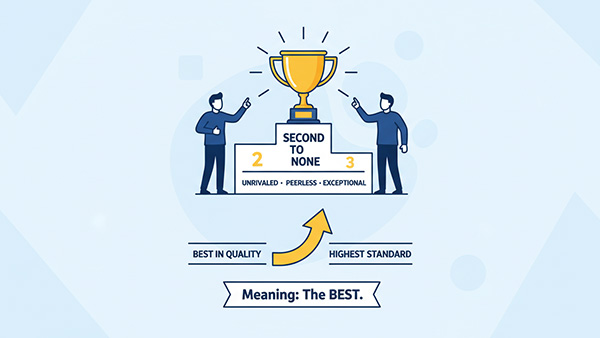
The idiom “second to none” means the best; unsurpassed; of the highest quality; without equal.
To define “second to none” clearly, it conveys unparalleled quality, skill, or performance. Its meaning in English is straightforward: nothing else surpasses the subject in question. In essence, to say someone or something is “second to none” is to assert that it holds the top position, unmatched by any competitor. Understanding this idiom’s meaning allows speakers and writers to express admiration or excellence with precision.
It’s used to express that something or someone is outstanding and cannot be surpassed by anything or anyone else. It emphasizes the superior nature of the subject being described, positioning it as the absolute best in its category. The phrase implies a comparison, suggesting that while others may exist, none can match the qualities or performance of the subject in question.
Classification: “Second to none” is an idiomatic expression. Idioms are phrases or expressions whose meanings cannot be understood from the ordinary meanings of the words that comprise them.
Exploring the idiom meaning of “second to none” helps learners grasp why it cannot be taken literally. The idiom communicates unparalleled excellence, going beyond the words themselves to express a strong cultural understanding of comparison and praise in English. They are culturally specific and often add color and emphasis to language.
Function: The primary function of “second to none” is to convey superlative praise or admiration. It elevates the subject above all competition, highlighting its exceptional qualities and leaving no doubt about its superiority.
Contexts: “Second to none” can be used in a variety of contexts, from describing a person’s skills and abilities to lauding the quality of a product or service. It often appears in formal settings, such as business reports, academic papers, and public speeches, but it can also be used in informal conversations to express strong approval or admiration.
The key is to ensure that the context warrants such a strong expression of excellence.
Structural Breakdown
The structure of “second to none” is relatively simple, yet its impact is profound. Let’s break down the components:
* Second: In this context, “second” refers to the ordinal position in a ranking or comparison. It implies that there is a first, but that nothing can occupy that position because the subject is already there.
* To: This is a preposition indicating a relationship or direction. In this case, it links “second” to “none.”
* None: “None” means “not one” or “no one.” It emphasizes the absence of anything or anyone else that can compare to the subject.
The phrase works by suggesting that nothing is better than the subject being described. Logically, if something is “second to none,” it occupies the top position because there is nothing superior to it.
The phrase’s power lies in its concise and emphatic assertion of unparalleled quality.
The phrase typically follows a noun or noun phrase that it is describing. For example: “Their customer service is second to none.” In this case, “customer service” is the noun phrase, and “is second to none” is the predicate that describes its quality.
Contexts of Use
“Second to none” is versatile and can be applied in various situations. Here are some common contexts:
* Describing Skills and Abilities: When referring to a person’s expertise or talent.
* Evaluating Quality of Products or Services: When emphasizing the superior quality of goods or services.
* Praising Performance: When highlighting outstanding achievements or accomplishments.
* Comparing Entities: When asserting that one entity is superior to all others in a specific area.
* Expressing Confidence or Pride: When conveying a strong belief in the excellence of something or someone.
The key to using “second to none” effectively is to ensure that the context warrants such a strong expression of superiority. It should be reserved for situations where the subject truly stands out and deserves exceptional praise.
Examples of “Second to None”
To illustrate the usage of “second to none,” let’s examine various examples categorized by their specific context.
Examples Highlighting Excellence
This table provides examples of the idiom “second to none” being used to highlight the excellence of something or someone. Each example demonstrates how the phrase emphasizes the superior qualities and unparalleled performance of the subject.
| # | Example Sentence | Context |
|---|---|---|
| 1 | Their dedication to customer satisfaction is second to none. | Customer service |
| 2 | The chef’s culinary skills are truly second to none. | Cooking ability |
| 3 | The quality of their craftsmanship is second to none. | Artisan work |
| 4 | Her commitment to the team is second to none. | Teamwork and dedication |
| 5 | The level of detail in his paintings is second to none. | Artistic talent |
| 6 | Their research in the field of medicine is second to none. | Scientific research |
| 7 | The beauty of the scenery in this national park is second to none. | Natural beauty |
| 8 | The company’s innovative approach to technology is second to none. | Technological advancement |
| 9 | His knowledge of ancient history is second to none. | Scholarly expertise |
| 10 | The hospitality at this hotel is second to none. | Service industry |
| 11 | The orchestra’s performance last night was second to none. | Musical performance |
| 12 | Their commitment to environmental sustainability is second to none. | Ethical business practices |
| 13 | The safety measures implemented at the plant are second to none. | Industrial safety |
| 14 | Her ability to inspire others is second to none. | Leadership qualities |
| 15 | The restaurant’s ambiance is second to none. | Dining experience |
| 16 | The dedication of the medical staff is second to none. | Healthcare services |
| 17 | His contributions to the field of engineering are second to none. | Professional achievements |
| 18 | The elegance of her writing style is second to none. | Literary skill |
| 19 | The efficiency of their logistics network is second to none. | Business operations |
| 20 | Their passion for education is second to none. | Educational commitment |
| 21 | The quality of the coffee beans they use is second to none. | Product quality |
| 22 | The support they provide to their employees is second to none. | Employee welfare |
| 23 | The speed of their internet service is second to none. | Technological performance |
| 24 | Her ability to solve complex problems is second to none. | Problem-solving skills |
| 25 | The museum’s collection of artifacts is second to none. | Cultural heritage |
Examples Describing Skill
This table provides examples focusing on skills, showcasing how “second to none” emphasizes unmatched proficiency and expertise in various fields.
| # | Example Sentence | Context |
|---|---|---|
| 1 | His negotiation skills are second to none in the industry. | Business negotiation |
| 2 | The surgeon’s precision is second to none. | Medical expertise |
| 3 | Her programming skills are second to none. | Technical proficiency |
| 4 | The athlete’s speed and agility are second to none. | Physical abilities |
| 5 | The pianist’s technique is second to none. | Musical talent |
| 6 | His ability to analyze complex data is second to none. | Analytical skills |
| 7 | Her leadership skills are second to none in the organization. | Management abilities |
| 8 | The chef’s ability to create innovative dishes is second to none. | Culinary creativity |
| 9 | His craftsmanship in woodworking is second to none. | Artisan skills |
| 10 | Her communication skills are second to none. | Interpersonal abilities |
| 11 | The architect’s design skills are second to none. | Creative design |
| 12 | His troubleshooting skills in IT are second to none. | Technical problem-solving |
| 13 | Her writing skills are second to none. | Literary talent |
| 14 | The dancer’s grace and coordination are second to none. | Artistic performance |
| 15 | His teaching skills are second to none. | Educational abilities |
| 16 | The tailor’s sewing skills are second to none. | Craftsmanship |
| 17 | Her marketing skills are second to none. | Business acumen |
| 18 | The mechanic’s diagnostic skills are second to none. | Technical expertise |
| 19 | His public speaking skills are second to none. | Communication skills |
| 20 | Her research skills are second to none. | Academic abilities |
| 21 | The gardener’s landscaping skills are second to none. | Horticultural expertise |
| 22 | His carpentry skills are second to none. | Woodworking proficiency |
| 23 | Her project management skills are second to none. | Organizational abilities |
| 24 | The musician’s improvisational skills are second to none. | Creative performance |
| 25 | His sales skills are second to none. | Business development |
Examples Describing Quality
This table focuses on examples where “second to none” is used to describe the superior quality of products, services, or experiences. It illustrates how the idiom emphasizes the unmatched excellence and high standards of the subject.
| # | Example Sentence | Context |
|---|---|---|
| 1 | The quality of the ingredients used in their dishes is second to none. | Restaurant food |
| 2 | The service at this resort is second to none. | Hospitality |
| 3 | The durability of their products is second to none. | Manufacturing |
| 4 | The comfort and luxury of this hotel are second to none. | Accommodation |
| 5 | The freshness of the produce at this market is second to none. | Retail |
| 6 | The reliability of their software is second to none. | Technology |
| 7 | The attention to detail in their designs is second to none. | Fashion industry |
| 8 | The educational value of this program is second to none. | Academic program |
| 9 | The safety features of this vehicle are second to none. | Automotive industry |
| 10 | The entertainment value of this show is second to none. | Performing arts |
| 11 | The nutritional quality of this food is second to none. | Health and wellness |
| 12 | The craftsmanship of these handmade goods is second to none. | Artisan products |
| 13 | The environmental impact of their practices is second to none in its positive effects. | Sustainable business |
| 14 | The customer support they provide is second to none. | Customer service |
| 15 | The overall experience at this spa is second to none. | Wellness and relaxation |
| 16 | The clarity of the audio system is second to none. | Technological performance |
| 17 | The level of security they provide is second to none. | Safety and protection |
| 18 | The variety of options available is second to none. | Product selection |
| 19 | The speed of their delivery service is second to none. | Logistics |
| 20 | The level of customization they offer is second to none. | Personalization options |
| 21 | The energy efficiency of this appliance is second to none. | Sustainable technology |
| 22 | The aesthetic appeal of their designs is second to none. | Visual design |
| 23 | The reliability of their machinery is second to none. | Industrial equipment |
| 24 | The immersive experience of this virtual reality game is second to none. | Entertainment technology |
| 25 | The precision of their measurements is second to none. | Scientific instrumentation |
Usage Rules
While “second to none” is a relatively straightforward idiom, adhering to certain usage rules ensures clarity and effectiveness.
Formal vs. Informal Use
“Second to none” is suitable for both formal and informal contexts, though it’s more commonly found in formal settings due to its emphatic nature. In formal writing or speech, it adds a touch of sophistication and conviction.
In informal settings, it can be used to express strong admiration or approval, but should be used judiciously to avoid sounding overly dramatic.
Words That Commonly Precede “Second to None”
The phrase “second to none” typically follows a noun or noun phrase that it modifies. Common words that precede it include:
* Is: “Their service is second to none.”
* Are: “Their products are second to none.”
* Was: “The performance was second to none.”
* Were: “The facilities were second to none.”
It’s also common to see possessive pronouns or adjectives before the noun phrase: “Our commitment is second to none,” or “The company’s dedication is second to none.”
Here’s a table illustrating the correct usage with preceding words:
| Preceding Word | Example Sentence |
|---|---|
| Is | Their customer service is second to none. |
| Are | The resources available here are second to none. |
| Was | The quality of the food was second to none. |
| Were | The facilities at the resort were second to none. |
| Possessive Adjective (Our) | Our dedication to excellence is second to none. |
| Possessive Noun (Company’s) | The company’s commitment to innovation is second to none. |
Common Mistakes
Even with a solid understanding of “second to none,” some common mistakes can occur. Here are a few to watch out for:
* Misunderstanding the Meaning: Confusing “second to none” with simply being “good” or “above average.” Remember, it means the absolute best.
* Using it Inappropriately: Applying the phrase to situations where the subject doesn’t truly warrant such high praise.
* Incorrect Word Order: Altering the order of the words, such as saying “none to second.”
* Overuse: Using the phrase too frequently, which can diminish its impact.
Here are examples of correct and incorrect usages:
| Incorrect | Correct | Explanation |
|---|---|---|
| Their service is none to second. | Their service is second to none. | Correct word order is essential. |
| The product is somewhat second to none. | The product is second to none. | “Second to none” implies absolute best; modifiers like “somewhat” are contradictory. |
| Everything is second to none here. | The quality of the ingredients is second to none here. | Be specific about what is “second to none.” |
Practice Exercises
To solidify your understanding of “second to none,” try these practice exercises.
Exercise 1: Fill in the Blanks
Complete the following sentences using the phrase “second to none.”
| # | Sentence | Answer |
|---|---|---|
| 1 | The quality of the education at this university is ______________. | second to none |
| 2 | Their dedication to providing excellent customer service is ______________. | second to none |
| 3 | The chef’s culinary expertise is ______________. | second to none |
| 4 | The commitment of the volunteers is ______________. | second to none |
| 5 | The beauty of the natural scenery in this region is ______________. | second to none |
| 6 | The company’s innovative approach to problem-solving is ______________. | second to none |
| 7 | His knowledge of the subject matter is ______________. | second to none |
| 8 | The level of hospitality at this establishment is ______________. | second to none |
| 9 | The orchestra’s performance was truly ______________. | second to none |
| 10 | Their commitment to environmental responsibility is ______________. | second to none |
Exercise 2: Sentence Construction
Create sentences using “second to none” to describe the following:
| # | Prompt | Example Answer |
|---|---|---|
| 1 | The quality of a luxury car. | The quality of the interior of this luxury car is second to none. |
| 2 | A famous athlete’s skills. | The athlete’s speed and agility are second to none in the sport. |
| 3 | The customer service at a particular store. | The customer service at that store is second to none; they are always helpful and friendly. |
| 4 | The food at a specific restaurant. | The authenticity and flavor of the dishes at that restaurant are second to none. |
| 5 | A company’s commitment to innovation. | This company’s dedication to innovation is second to none, constantly pushing the boundaries of technology. |
| 6 | The beauty of a national park. | The scenic beauty of Yellowstone National Park is second to none. |
| 7 | The educational value of a specific program. | The educational value and comprehensive curriculum of this program are second to none. |
| 8 | A hotel’s level of hospitality. | The level of hospitality and personalized service at this hotel is second to none. |
| 9 | The safety features of a car. | The advanced safety features of this car are second to none in its class. |
| 10 | The entertainment value of a show. | The entertainment value of the Broadway show we saw last night was second to none. |
Exercise 3: Error Correction
Identify and correct the errors in the following sentences:
| # | Incorrect Sentence | Correct Sentence |
|---|---|---|
| 1 | Their service is none to second. | Their service is second to none. |
| 2 | The product is somewhat second to none. | The product is second to none. |
| 3 | Everything is second to none here. | The quality of the ingredients is second to none here. |
| 4 | Our dedication, it’s second to none. | Our dedication is second to none. |
| 5 | Them skills are second to none. | Their skills are second to none. |
| 6 | Second to none, their commitment is. | Their commitment is second to none. |
| 7 | The experience, it was second to none. | The experience was second to none. |
| 8 | The facility are second to none. | The facilities are second to none. |
| 9 | His ability its second to none. | His ability is second to none. |
| 10 | Their support, that’s second to none. | Their support is second to none. |
Advanced Topics
For advanced learners, let’s delve into some more complex aspects of “second to none.”
Historical Context
The exact origins of the phrase “second to none” are difficult to pinpoint precisely, but it has been used in English for centuries. It likely emerged from the concept of ranking or comparison, where something is so superior that it cannot be surpassed.
Over time, it evolved into a widely recognized idiom for expressing unparalleled excellence. The phrase’s longevity and continued usage attest to its enduring power and effectiveness in conveying superlative praise.
Synonyms and Antonyms
Understanding synonyms and antonyms can provide a deeper appreciation for the nuances of “second to none.”
* Synonyms:
* Unsurpassed
* Unrivaled
* Incomparable
* Peerless
* Matchless
* The best
* Top-notch
* Excellent
* Antonyms:
* Inferior
* Subpar
* Mediocre
* Average
* Second-rate
* Poor
* Worst
Using synonyms can help you vary your language and avoid repetition, while understanding antonyms can clarify the meaning of “second to none” by highlighting its opposite qualities.
Frequently Asked Questions
Here are some frequently asked questions about “second to none”:
Is “second to none” formal or informal?
It can be used in both formal and informal contexts, but it is more common in formal settings due to its emphatic nature. In informal settings, use it judiciously to avoid sounding overly dramatic.
Can “second to none” be used to describe a group of people?
Yes, it can. For example, “Their team’s dedication is second to none,” meaning that the team as a whole is exceptionally dedicated.
When asking whether “second to none” is a good thing, the answer is always yes. This idiom conveys the highest level of excellence, so using it in reference to a person, product, or service highlights outstanding qualities. Similarly, phrases like “are second to none” emphasize that multiple items or people share this superior status.
What part of speech is “second to none”?
It functions as a predicate adjective, modifying a noun or noun phrase and describing its quality or characteristic.
Is it grammatically correct to say “none to second”?
No, that is grammatically incorrect. The correct order is “second to none.”
Can I use “second to none” to compare two things?
While it implies a comparison, “second to none” is used to assert that something is the best, with no equal. It doesn’t directly compare two specific things; rather, it positions the subject above all others.
Are there any situations where “second to none” should be avoided?
Avoid using it in situations where the subject doesn’t truly warrant such high praise, or when it sounds insincere. Also, be mindful of overuse, as it can diminish its impact.
What’s the difference between “second to none” and “the best”?
They are very similar in meaning, but “second to none” is more emphatic and idiomatic. It conveys a stronger sense of unparalleled excellence.
How can I effectively use “second to none” in my writing?
Use it to highlight truly exceptional qualities or achievements. Ensure that the context supports such a strong expression of superiority, and avoid overuse to maintain its impact. Be specific about what aspect is second to none.
Conclusion
Mastering the idiom “second to none” is a valuable asset for any English learner. It allows you to express unparalleled excellence and convey strong admiration with precision and impact.
By understanding its meaning, structure, and usage rules, you can confidently incorporate it into your writing and speech, enhancing your communication skills and adding a touch of sophistication to your language.
Throughout this guide, we’ve explored various aspects of “second to none,” from its definition and structural breakdown to its usage in different contexts. We’ve also addressed common mistakes and provided practice exercises to solidify your understanding.
Remember to use this idiom judiciously, reserving it for situations where the subject truly deserves exceptional praise. With practice and attention to detail, you can effectively use “second to none” to express the highest degree of quality and skill.
Continue to explore the nuances of the English language, and don’t be afraid to experiment with new vocabulary and expressions. By expanding your linguistic repertoire, you’ll become a more confident and effective communicator, capable of expressing your thoughts and ideas with clarity and precision.
Keep practicing, keep learning, and strive for excellence in all your linguistic endeavors!