Choosing between “she and I” and “her and me” can be tricky, even for native English speakers. These phrases involve pronouns, and using them correctly is crucial for clear and grammatically sound communication.
This article will provide a comprehensive guide to understanding when to use “she and I” versus “her and me,” covering the underlying grammatical principles, common mistakes, and practical exercises to help you master this aspect of English grammar. Whether you’re an English language learner or a native speaker looking to refine your skills, this guide will equip you with the knowledge and confidence to use these phrases correctly in any context.
Table of Contents
- Introduction
- Definition: Subjective vs. Objective Pronouns
- Structural Breakdown
- Types and Categories of Pronoun Usage
- Examples
- Usage Rules
- Common Mistakes
- Practice Exercises
- Advanced Topics
- FAQ
- Conclusion
Definition: Subjective vs. Objective Pronouns
Understanding the difference between subjective and objective pronouns is fundamental to using “she and I” or “her and me” correctly. Pronouns replace nouns, and their form changes depending on their function in a sentence.
Subjective pronouns act as the subject of a verb, while objective pronouns act as the object of a verb or preposition.
Subjective pronouns are used when the pronoun performs the action of the verb. The common subjective pronouns are: I, he, she, it, we, you, they. For example, in the sentence “She went to the store,” “she” is the subject pronoun because she is performing the action of going.
Objective pronouns are used when the pronoun receives the action of the verb or is the object of a preposition. The common objective pronouns are: me, him, her, it, us, you, them. For example, in the sentence “The dog bit him,” “him” is the object pronoun because he is receiving the action of being bitten.
Here’s a table summarizing the key differences:
| Pronoun Type | Function | Examples |
|---|---|---|
| Subjective | Performs the action of the verb (subject of the sentence) | I, he, she, it, we, you, they |
| Objective | Receives the action of the verb or is the object of a preposition | me, him, her, it, us, you, them |
Structural Breakdown
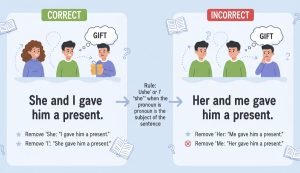
When dealing with compound subjects or objects (i.e., two or more nouns or pronouns acting as a single unit), the correct pronoun form is determined by the grammatical function of the entire compound. To determine whether to use “she and I” or “her and me,” isolate the pronoun and see how it functions in the sentence.
For example, consider the sentence: “She and I went to the park.” Here, “she and I” act as the subject of the verb “went.” If you remove “she,” the sentence becomes “I went to the park,” which is grammatically correct. Therefore, “I” is the correct pronoun form.
Now consider the sentence: “The teacher praised her and me.” Here, “her and me” act as the object of the verb “praised.” If you remove “her,” the sentence becomes “The teacher praised me,” which is grammatically correct. Therefore, “me” is the correct pronoun form.
The order of pronouns can also influence the perceived politeness of the sentence. Generally, it’s considered more polite to list other people before yourself (e.g., “She and I” rather than “I and she”).
However, this doesn’t change the fundamental grammatical rule of using the correct pronoun form based on its function.
Types and Categories of Pronoun Usage
Compound Subjects
A compound subject consists of two or more subjects joined by a conjunction (usually “and” or “or”) that share the same verb. In these cases, use subjective pronouns.
Examples include:
- She and I are going to the concert.
- He and I finished the project.
- They and I will present the findings.
Compound Objects
A compound object consists of two or more objects joined by a conjunction that receive the action of the same verb or are objects of the same preposition. In these cases, use objective pronouns.
Examples include:
- The teacher praised her and me.
- The dog followed him and me.
- The gift was for them and me.
Predicate Nominatives
A predicate nominative (also called a predicate noun or predicate pronoun) renames or identifies the subject of a sentence. It follows a linking verb (such as is, are, was, were, be, being, been). In formal English, subjective pronouns are used as predicate nominatives, although this rule is often relaxed in informal speech.
For example: “It is she and I who are responsible.” (Formal). In casual conversation, “It’s her and me” might be heard, but the formal construction is grammatically correct.
Examples
Subject Examples
The following table provides examples of “she and I” used correctly as the subject of a sentence. Notice how the pronoun “I” functions as the subject alongside “she.”
| Sentence | Explanation |
|---|---|
| She and I are planning a trip to Italy. | “She and I” are the subjects performing the action of planning. |
| She and I decided to volunteer at the local shelter. | “She and I” are the subjects performing the action of deciding. |
| She and I will be attending the conference next week. | “She and I” are the subjects performing the action of attending. |
| She and I have been working on this project for months. | “She and I” are the subjects performing the action of working. |
| She and I are excited about the upcoming performance. | “She and I” are the subjects experiencing the excitement. |
| She and I both enjoy reading classic literature. | “She and I” are the subjects who enjoy reading. |
| She and I are collaborating on a research paper. | “She and I” are the subjects performing the action of collaborating. |
| She and I often go for walks in the park together. | “She and I” are the subjects performing the action of going for walks. |
| She and I are taking a pottery class this semester. | “She and I” are the subjects performing the action of taking a class. |
| She and I have been friends since childhood. | “She and I” are the subjects in the state of being friends. |
| She and I are organizing a fundraiser for the charity. | “She and I” are the subjects performing the action of organizing. |
| She and I both love to cook and bake. | “She and I” are the subjects who love to cook and bake. |
| She and I are considering starting our own business. | “She and I” are the subjects performing the action of considering. |
| She and I will be performing in the school play. | “She and I” are the subjects performing in the play. |
| She and I have always supported each other’s dreams. | “She and I” are the subjects who have supported. |
| She and I are learning to play the guitar. | “She and I” are the subjects performing the action of learning. |
| She and I decided to adopt a rescue dog. | “She and I” are the subjects performing the action of deciding. |
| She and I are passionate about environmental conservation. | “She and I” are the subjects who are passionate. |
| She and I are training for a marathon. | “She and I” are the subjects performing the action of training. |
| She and I are saving up for a new car. | “She and I” are the subjects performing the action of saving. |
| She and I are attending a workshop on creative writing. | “She and I” are the subjects performing the action of attending. |
| She and I have been volunteering at the food bank for years. | “She and I” are the subjects performing the action of volunteering. |
| She and I are planning a surprise party for our friend. | “She and I” are the subjects performing the action of planning. |
Object Examples
The following table provides examples of “her and me” used correctly as the object of a verb or preposition. Notice how “me” receives the action or is the object of a preposition alongside “her.”
| Sentence | Explanation |
|---|---|
| The teacher praised her and me for our excellent work. | “Her and me” are the objects of the verb “praised.” |
| The project manager assigned her and me to the most important task. | “Her and me” are the objects of the verb “assigned.” |
| The company invited her and me to the leadership summit. | “Her and me” are the objects of the verb “invited.” |
| The award was presented to her and me for our contributions. | “Her and me” are the objects of the preposition “to.” |
| The supervisor mentored her and me throughout our careers. | “Her and me” are the objects of the verb “mentored.” |
| The team selected her and me to represent them at the conference. | “Her and me” are the objects of the verb “selected.” |
| The boss trusted her and me with the confidential information. | “Her and me” are the objects of the verb “trusted.” |
| The client thanked her and me for the successful presentation. | “Her and me” are the objects of the verb “thanked.” |
| The committee appointed her and me to the advisory board. | “Her and me” are the objects of the verb “appointed.” |
| The organization honored her and me for our community service. | “Her and me” are the objects of the verb “honored.” |
| The director commended her and me for our innovative ideas. | “Her and me” are the objects of the verb “commended.” |
| The university recognized her and me for our academic achievements. | “Her and me” are the objects of the verb “recognized.” |
| The foundation awarded her and me a grant for our research. | “Her and me” are the objects of the verb “awarded.” |
| The museum featured her and me in their exhibition. | “Her and me” are the objects of the verb “featured.” |
| The publisher contracted her and me to write a book. | “Her and me” are the objects of the verb “contracted.” |
| The gallery showcased her and me in their art show. | “Her and me” are the objects of the verb “showcased.” |
| The festival invited her and me to perform on stage. | “Her and me” are the objects of the verb “invited.” |
| The company hired her and me as consultants. | “Her and me” are the objects of the verb “hired.” |
| The school appointed her and me as student representatives. | “Her and me” are the objects of the verb “appointed.” |
| The charity selected her and me as volunteers of the year. | “Her and me” are the objects of the verb “selected.” |
| The magazine interviewed her and me for their cover story. | “Her and me” are the objects of the verb “interviewed.” |
| The newspaper quoted her and me in their article. | “Her and me” are the objects of the verb “quoted.” |
| The website featured her and me in their blog post. | “Her and me” are the objects of the verb “featured.” |
| The podcast invited her and me to be guest speakers. | “Her and me” are the objects of the verb “invited.” |
Predicate Nominative Examples
The following table provides examples of “she and I” used as predicate nominatives. Remember that this usage is more formal and might sound stilted in casual conversation.
In informal speech, “her and me” is often used instead.
| Sentence | Explanation |
|---|---|
| It is she and I who are responsible for the presentation. | “She and I” renames the subject “it” after the linking verb “is.” |
| If I were to choose, it would be she and I who lead the project. | “She and I” renames the subject “it” after the linking verb “would be.” |
| The ones who are going to organize the event are she and I. | “She and I” renames the subject “ones” after the linking verb “are.” |
| The people who will be in charge are she and I. | “She and I” renames the subject “people” after the linking verb “are.” |
| The only ones left to finish the task are she and I. | “She and I” renames the subject “ones” after the linking verb “are.” |
| The individuals who are best suited for the job are she and I. | “She and I” renames the subject “individuals” after the linking verb “are.” |
| The representatives selected for the conference are she and I. | “She and I” renames the subject “representatives” after the linking verb “are.” |
| The candidates most likely to succeed are she and I. | “She and I” renames the subject “candidates” after the linking verb “are.” |
| The organizers of the charity event are she and I. | “She and I” renames the subject “organizers” after the linking verb “are.” |
| The members of the winning team are she and I. | “She and I” renames the subject “members” after the linking verb “are.” |
| The instructors for the advanced course are she and I. | “She and I” renames the subject “instructors” after the linking verb “are.” |
| The researchers who conducted the study are she and I. | “She and I” renames the subject “researchers” after the linking verb “are.” |
| The authors of the bestselling novel are she and I. | “She and I” renames the subject “authors” after the linking verb “are.” |
| The musicians who composed the symphony are she and I. | “She and I” renames the subject “musicians” after the linking verb “are.” |
| The artists who created the masterpiece are she and I. | “She and I” renames the subject “artists” after the linking verb “are.” |
Usage Rules
Subject Pronoun Rule
Use subjective pronouns (she, I, he, we, they) when the pronoun is the subject of the verb. When you have a compound subject, consider the pronoun separately.
If the sentence makes sense with just the pronoun as the subject, then the subjective form is correct.
Example: She and I went to the store. (I went to the store. – Correct)
Object Pronoun Rule
Use objective pronouns (her, me, him, us, them) when the pronoun is the object of the verb or the object of a preposition. Again, consider the pronoun separately in a compound object.
If the sentence makes sense with just the pronoun as the object, then the objective form is correct.
Example: The teacher praised her and me. (The teacher praised me. – Correct)
The Politeness Rule (and its Limitations)
While grammatically irrelevant, there’s a convention of politeness in English that suggests placing yourself last when listing yourself with others. This means saying “She and I” instead of “I and she,” and “her and me” instead of “me and her.” However, remember that politeness should not override grammatical correctness.
Always prioritize using the correct pronoun form first.
Example: “She and I will attend the meeting” is considered more polite than “I and she will attend the meeting,” but both are grammatically correct.
The “Take One Out” Test
A helpful trick to determine the correct pronoun form is the “Take One Out” test. Remove the other person from the sentence and see if the sentence still makes sense grammatically.
This will help you isolate whether you need a subjective or objective pronoun.
For example, in the sentence “The manager thanked her and me,” remove “her.” The sentence becomes “The manager thanked me,” which is grammatically correct. This confirms that “me” is the correct pronoun form.
Many people wonder about “she and i or she and me.” To determine the correct form, isolate the pronoun and test the sentence. For instance, in “They invited she and I,” removing “she” gives “They invited I,” which is incorrect. Therefore, the correct phrase is “They invited her and me.”
Common Mistakes
One of the most common mistakes is using “she and I” when “her and me” is required, and vice versa. This often happens because people are unsure of the grammatical function of the pronoun in the sentence.
Here are some examples of common mistakes and their corrections:
| Incorrect | Correct | Explanation |
|---|---|---|
| The teacher praised she and I. | The teacher praised her and me. | “She and I” is the object of the verb “praised,” so objective pronouns are needed. |
| Her and me are going to the party. | She and I are going to the party. | “Her and me” are the subjects of the verb “are going,” so subjective pronouns are needed. |
| It is her and me who are responsible. | It is she and I who are responsible. (Formal) | “She and I” is a predicate nominative, so subjective pronouns are needed (in formal usage). |
| They invited she and I to the event. | They invited her and me to the event. | “She and I” are the objects of the verb “invited,” so objective pronouns are needed. |
| The gift was for she and I. | The gift was for her and me. | “She and I” are the objects of the preposition “for,” so objective pronouns are needed. |
| He asked she and I to help him. | He asked her and me to help him. | “She and I” are the objects of the verb “asked,” so objective pronouns are needed. |
| She and me went to the movies. | She and I went to the movies. | “She and me” are the subjects of the verb “went,” so subjective pronouns are needed. |
| Everyone except she and I enjoyed the show. | Everyone except her and me enjoyed the show. | “She and I” are the objects of the preposition “except,” so objective pronouns are needed. |
| Between she and I, we need to decide. | Between her and me, we need to decide. | “She and I” are the objects of the preposition “between,” so objective pronouns are needed. |
| The secret is just between she and I. | The secret is just between her and me. | “She and I” are the objects of the preposition “between,” so objective pronouns are needed. |
Practice Exercises
Exercise 1: Identifying Correct Pronoun Usage
Choose the correct pronoun form in each sentence.
| Question | Option A | Option B | Answer |
|---|---|---|---|
| 1. _____ will be attending the conference. | She and me | She and I | |
| 2. The manager praised _____. | she and I | her and me | |
| 3. The gift is for _____. | she and I | her and me | |
| 4. _____ are responsible for the project. | Her and me | She and I | |
| 5. They invited _____. | she and I | her and me | |
| 6. The decision is between _____. | she and I | her and me | |
| 7. _____ decided to volunteer. | Her and me | She and I | |
| 8. The teacher asked _____. | she and I | her and me | |
| 9. _____ are going to the concert. | Her and me | She and I | |
| 10. Everyone except _____ enjoyed the party. | she and I | her and me |
Answer Key: 1. B, 2. B, 3. B, 4. A, 5. B, 6. B, 7. B, 8. B, 9. B, 10. B
Exercise 2: Filling in the Blanks
Fill in the blank with the correct pronoun form (“she and I” or “her and me”).
| Question | Answer |
|---|---|
| 1. _____ are planning a vacation to Hawaii. | |
| 2. The coach selected _____ for the team. | |
| 3. The secret is just between _____. | |
| 4. _____ will be presenting the award. | |
| 5. The company offered _____ internships. | |
| 6. The responsibility falls on _____. | |
| 7. _____ are organizing the fundraiser. | |
| 8. The author dedicated the book to _____. | |
| 9. _____ are excited about the new project. | |
| 10. The manager assigned the task to _____. |
Answer Key: 1. She and I, 2. her and me, 3. her and me, 4. She and I, 5. her and me, 6. her and me, 7. She and I, 8. her and me, 9. She and I, 10. her and me
Exercise 3: Error Correction
Identify and correct the errors in the following sentences.
| Question | Corrected Sentence |
|---|---|
| 1. Her and me are going to the store. | |
| 2. The teacher praised she and I. | |
| 3. It is her and me who are responsible. | |
| 4. They invited she and I to the party. | |
| 5. The gift was for she and I. | |
| 6. She and me are best friends. | |
| 7. Everyone except she and I enjoyed the show. | |
| 8. He gave the book to she and I. | |
| 9. Between she and I, we need to decide. | |
| 10. The secret is just between she and I. |
Answer Key: 1. She and I are going to the store., 2. The teacher praised her and me., 3. It is she and I who are responsible. (Formal), 4. They invited her and me to the party., 5. The gift was for her and me., 6. She and I are best friends., 7. Everyone except her and me enjoyed the show., 8. He gave the book to her and me., 9. Between her and me, we need to decide., 10. The secret is just between her and me.
Many search for clarification on “her and me or her and i.” Remember: only use “her and me” when the pronoun is the object. Using “her and i” is grammatically incorrect in all standard contexts. Always test by isolating the pronoun: “The teacher praised her and me” is correct, while “The teacher praised her and i” is not.
Advanced Topics
“Who” vs. “Whom” with Compound Pronouns
The same principles apply when using “who” and “whom” with compound pronouns. “Who” is a subjective pronoun, and “whom” is an objective pronoun.
Use the “Take One Out” test to determine the correct form.
Example: “The people who she and I invited are coming to the party.” (She and I invited them – correct). “The people whom she and I thanked appreciated the gesture.” (We thanked her and me – incorrect, should be “they”).
Corrected: The people who she and I thanked appreciated the gesture. (She and I thanked them.)
Formal vs. Informal Usage
As mentioned earlier, using subjective pronouns as predicate nominatives (e.g., “It is she and I”) is considered more formal. In casual conversation, it’s common to hear objective pronouns used in these situations (e.g., “It’s her and me”).
Some learners are specifically confused by “her and i.” Remember, the choice depends entirely on grammatical function: if the pronoun is the subject, “she and I” is correct; if the pronoun is the object, “her and me” is correct. Using “her and i” as a subject is always incorrect, though it sometimes appears in casual speech. Apply the “Take One Out” test to verify: “She went to the store” works, but “Her went to the store” does not.
While grammatically incorrect in formal writing, this usage is widely accepted in informal speech. Be aware of your audience and the context when making this choice.
Some users search for “me and her or her and i.” The rule remains consistent: always choose the pronoun form that matches its grammatical role. In compound objects, “her and me” is correct, while “me and her” or “her and i” are incorrect as subjects or objects. Testing each pronoun individually ensures accuracy.
FAQ
Q1: How can I quickly determine whether to use “she and I” or “her and me”?
A1: Use the “Take One Out” test. Remove “she” or “her” from the sentence and see if the sentence still makes sense with just “I” or “me.” If “I” sounds correct, use “she and I.” If “me” sounds correct, use “her and me.”
Q2: Is it always impolite to say “I and she” instead of “she and I”?
A2: While it’s generally considered more polite to list yourself last, prioritizing grammatical correctness is more important. If “I and she” is grammatically correct in a particular sentence (though unlikely), then use it.
However, in most cases, “she and I” will be both grammatically correct and more polite.
Q3: What if I’m still unsure after using the “Take One Out” test?
A3: Try rephrasing the sentence. Sometimes, a different sentence structure can make the correct pronoun usage more obvious.
For instance, instead of saying “The teacher gave the books to she and I,” you could say “The teacher gave us the books,” which makes it clear that “us” (the equivalent of “her and me”) is the correct pronoun form.
Q4: Does the “Take One Out” test work in all situations?
A4: The “Take One Out” test is a helpful guideline, but it’s not foolproof. In some complex sentences, it might not be as clear-cut.
In those cases, carefully analyze the grammatical function of the pronoun within the sentence.
Q5: Is it ever acceptable to use “her and me” as the subject of a sentence?
A5: No, “her and me” should never be used as the subject of a sentence in formal or standard English. The correct form is always “she and I.” Using “her and me” as the subject is a common grammatical error.
Q6: Why is it considered more polite to say “she and I” instead of “I and she”?
A6: It’s a cultural convention in English to prioritize others before yourself. Listing yourself last is seen as a sign of humility and consideration for others.
However, this is a social convention and doesn’t affect the grammatical correctness of the sentence.
Q7: What about sentences with “or” instead of “and”? Does the same rule apply?
A7: Yes, the same principle of identifying the pronoun’s function applies whether you use “and” or “or.” For example: “Either she or I will attend the meeting” (subjective) vs. “The decision affects either her or me” (objective).
Q8: Are there any exceptions to the rules about using subjective and objective pronouns?
A8: While the core rules remain consistent, there are nuances in informal speech. As mentioned, predicate nominatives often take objective pronouns in casual conversation.
However, in formal writing and speaking, it’s best to adhere to the standard grammatical rules.
Conclusion
Mastering the correct usage of “she and I” versus “her and me” is essential for clear and effective communication in English. By understanding the difference between subjective and objective pronouns, applying the “Take One Out” test, and being mindful of the grammatical function of the pronoun within the sentence, you can confidently navigate these tricky situations.
Remember that while politeness is a consideration, grammatical accuracy should always be the priority. With practice and attention to detail, you can avoid common mistakes and ensure that your pronoun usage is always correct.
Continue to practice with the exercises provided and seek out opportunities to apply these rules in your writing and speaking. Pay attention to how native speakers use these pronouns and don’t be afraid to ask for feedback.
With consistent effort, you’ll develop a strong command of pronoun usage and enhance your overall English language proficiency
. Good luck!