Stative verbs, unlike action verbs, describe a state of being, a thought, or an emotion rather than a physical action. Understanding stative verbs is crucial for constructing grammatically correct and nuanced sentences in English.
This guide provides a comprehensive overview of stative verbs, covering their definition, types, usage rules, common mistakes, and practice exercises. Whether you’re a beginner or an advanced learner, this article will help you master the intricacies of stative verbs and improve your overall English proficiency.
Table of Contents
- Introduction
- Definition of Stative Verbs
- Structural Breakdown
- Types and Categories of Stative Verbs
- Examples of Stative Verbs
- Usage Rules of Stative Verbs
- Common Mistakes with Stative Verbs
- Practice Exercises
- Advanced Topics
- Frequently Asked Questions (FAQ)
- Conclusion
Definition of Stative Verbs
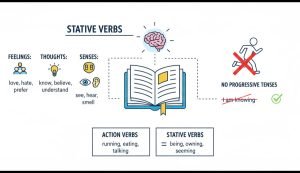
Stative verbs, also known as non-continuous verbs, describe a state, condition, quality, or feeling. They typically express something that is not an action and does not change quickly.
Unlike dynamic verbs, which describe actions that can be started and stopped, stative verbs often refer to things that are relatively permanent or unchanging. They are generally not used in continuous (progressive) tenses, such as the present continuous or past continuous, because the state they describe is ongoing and inherent.
The key characteristic of stative verbs is that they describe conditions that are relatively stable or unchanging. These verbs often relate to thoughts, emotions, senses, possessions, or measurements.
Recognizing stative verbs is crucial for using tenses correctly and avoiding common grammatical errors in English. Understanding the nuances of stative verbs allows for more accurate and sophisticated communication.
Using Stative Verbs Naturally in Conversation
Understanding grammar rules is important, but real mastery comes from knowing how stative verbs function in everyday conversation. In spoken English, stative verbs are commonly used to express opinions, feelings, preferences, and mental states without drawing attention to the grammar itself. For example, phrases like “I think you’re right,” “I feel nervous,” or “She wants more time” sound natural because the verbs describe internal states rather than visible actions.
When learners ask how to use statics verb in conversation examples, the key is to focus on meaning rather than form. Native speakers instinctively avoid continuous tenses with stative verbs unless a change in meaning is intended. Saying “I’m loving this song” is acceptable in informal speech because it emphasizes a temporary, emotional reaction, while “I love this song” states a general preference.
Paying attention to context, tone, and intent helps ensure stative verbs sound fluent and natural in conversation, especially in informal dialogue and spoken exchanges.
Structural Breakdown
Stative verbs function similarly to other verbs in a sentence, but their usage with tenses differs. A typical sentence structure with a stative verb follows the Subject-Verb-Object (SVO) pattern, where the subject performs the state described by the verb, and the object (if present) receives the state.
However, the key distinction lies in their incompatibility with continuous tenses.
For example, in the sentence “I know the answer,” the verb “know” is a stative verb. It describes a state of understanding. You would not typically say “I am knowing the answer” because knowing is an ongoing state, not an action in progress. While there are exceptions where some stative verbs can be used in continuous tenses, these instances usually imply a change in meaning, suggesting a temporary action rather than a permanent state. The structure of a sentence with a stative verb is straightforward, but the choice of tense is critical for grammatical accuracy. Understanding the meaning of the verb and whether it describes a state or an action is key to correctly structuring sentences with stative verbs.
Types and Categories of Stative Verbs
Stative verbs can be grouped into several categories based on the type of state they describe. These categories include verbs of perception, emotion, possession, mental state, measurement, and other miscellaneous stative verbs.
Each category represents a different aspect of non-action states, helping to clarify their usage and meaning.
Verbs of Perception
Verbs of perception relate to the five senses: sight, hearing, smell, taste, and touch. These verbs describe how we perceive the world around us. Common verbs of perception include see, hear, smell, taste, and feel.
Verbs of Emotion
Verbs of emotion express feelings or emotional states. These verbs describe how we feel or what we like or dislike. Examples include love, hate, like, dislike, want, need, and prefer.
Verbs of Possession
Verbs of possession indicate ownership or belonging. These verbs describe what we own or possess. Common verbs of possession include have, own, possess, and belong.
Verbs of Mental State
Verbs of mental state describe cognitive processes, thoughts, beliefs, and knowledge. These verbs express what we think or believe. Examples include know, believe, think, understand, remember, forget, doubt, and recognize.
Verbs of Measurement
Verbs of measurement indicate size, weight, or other measurable qualities. These verbs describe dimensions or quantities. Common verbs of measurement include weigh, measure, and cost.
Other Stative Verbs
Some stative verbs do not fit neatly into the above categories but still describe states rather than actions. These include verbs like seem, appear, consist, include, and resemble.
Examples of Stative Verbs
To illustrate the different categories of stative verbs, here are several examples organized by type. These examples demonstrate how stative verbs are used in sentences and highlight their role in expressing states, emotions, and perceptions.
The following table provides examples of verbs of perception used in sentences.
| Verb of Perception | Example Sentence |
|---|---|
| See | I see a bird in the tree. |
| Hear | She hears the music playing softly. |
| Smell | The flowers smell wonderful. |
| Taste | This soup tastes delicious. |
| Feel | The fabric feels soft and smooth. |
| Look | He looks tired after the long journey. |
| Sound | That sounds like a good idea. |
| Appear | The solution appears simple, but it’s not. |
| Seem | She seems happy today. |
| Look like | He looks like his father. |
| Sound like | It sounds like rain outside. |
| Taste like | This drink tastes like apples. |
| Feel like | It feels like a dream. |
| Spot | I spot him across the room. |
| Notice | I notice a change in her behavior. |
| Observe | Scientists observe the stars. |
| Detect | The machine can detect the slightest movement. |
| Sense | I sense danger in the air. |
| Witness | He witnesses the accident. |
| Survey | They survey the damage. |
The table below presents examples of verbs of emotion used in sentences.
| Verb of Emotion | Example Sentence |
|---|---|
| Love | I love spending time with my family. |
| Hate | She hates doing laundry. |
| Like | He likes playing video games. |
| Dislike | They dislike crowded places. |
| Want | I want a new car. |
| Need | She needs a vacation. |
| Prefer | He prefers coffee over tea. |
| Adore | They adore their grandchildren. |
| Despise | I despise dishonesty. |
| Appreciate | We appreciate your help. |
| Care for | She cares for her elderly mother. |
| Enjoy | They enjoy hiking in the mountains. |
| Fear | He fears heights. |
| Loathe | I loathe being late. |
| Mind | Do you mind if I open the window? |
| Value | We value your opinion. |
| Cherish | I cherish our friendship. |
| Prize | He prizes his collection of stamps. |
| Revere | They revere their ancestors. |
| Worship | Some people worship celebrities. |
The following table showcases examples of verbs of possession used in sentences.
| Verb of Possession | Example Sentence |
|---|---|
| Have | I have a new bicycle. |
| Own | She owns a large house. |
| Possess | He possesses a rare talent. |
| Belong | This book belongs to me. |
| Include | The price includes tax. |
| Consist | The team consists of five members. |
| Contain | This box contains valuable items. |
| Comprise | The committee comprises experts in the field. |
| Lack | They lack the necessary skills. |
| Hold | She holds a high position in the company. |
| Retain | We retain the right to refuse service. |
| Keep | I keep my keys in my pocket. |
| Maintain | The building maintains its original charm. |
| Boast | The city boasts a rich history. |
| Enjoy | They enjoy certain privileges. |
| Control | The company controls a large market share. |
| Command | The general commands a large army. |
| Dominate | The team dominates the competition. |
| Encompass | The project encompasses several areas. |
| Embrace | The community embraces diversity. |
The table below provides examples of verbs of mental state used in sentences.
| Verb of Mental State | Example Sentence |
|---|---|
| Know | I know the answer to the question. |
| Believe | She believes in ghosts. |
| Think | He thinks that’s a good idea. |
| Understand | They understand the concept. |
| Remember | I remember my childhood. |
| Forget | She forgets names easily. |
| Doubt | He doubts the accuracy of the report. |
| Recognize | I recognize her from the photo. |
| Assume | I assume you’re coming to the party. |
| Consider | We consider your proposal carefully. |
| Imagine | I imagine a beautiful future. |
| Suppose | I suppose that’s true. |
| Suspect | I suspect that something is wrong. |
| Realize | I realize my mistake. |
| Perceive | They perceive the situation differently. |
| Acknowledge | He acknowledges the problem. |
| Conclude | We conclude that the evidence is insufficient. |
| Determine | They determine the cause of the accident. |
| Estimate | I estimate the cost to be around $100. |
| Judge | Don’t judge a book by its cover. |
The table below provides examples of verbs of measurements used in sentences.
| Verb of Measurement | Example Sentence |
|---|---|
| Weigh | This bag weighs five kilograms. |
| Measure | The room measures ten meters by twelve meters. |
| Cost | This book costs twenty dollars. |
| Equal | Two plus two equals four. |
| Contain | The bottle contains one liter of water. |
| Hold | The tank holds 50 gallons of fuel. |
| Total | The expenses total $500. |
| Amount to | The damages amount to a significant sum. |
| Reach | The tower reaches a height of 100 meters. |
| Extend | The fence extends for two miles. |
Usage Rules of Stative Verbs
The primary rule for stative verbs is that they are generally not used in continuous tenses. This means you should not use them with forms of “be” + verb-ing (e.g., “is knowing,” “was wanting”).
However, there are exceptions to this rule, particularly when the verb takes on a different meaning that implies an action or temporary state.
For instance, while “I think it’s a good idea” is correct, “I am thinking about it” is also correct but has a different meaning. In the first sentence, “think” expresses a belief or opinion. In the second sentence, “am thinking” expresses the action of considering something. This difference in meaning justifies the use of the continuous tense.
Another exception involves verbs like “have” and “be.” When “have” is used to describe possession, it’s stative (e.g., “I have a car”). However, when “have” is used to describe an action or experience (e.g., “I am having lunch”), it can be used in the continuous tense.
Similarly, “be” is typically stative, but it can be used in the continuous tense to describe temporary behavior (e.g., “He is being rude”). These exceptions highlight the importance of understanding the context and intended meaning when using stative verbs.
Common Mistakes with Stative Verbs
One of the most common mistakes is using stative verbs in continuous tenses when they should not be. This often occurs when learners are not fully aware of which verbs are stative and which are dynamic.
Here are some examples of common mistakes and their corrections:
| Incorrect | Correct | Explanation |
|---|---|---|
| I am knowing the answer. | I know the answer. | “Know” is a stative verb describing a state of understanding. |
| She is wanting a new car. | She wants a new car. | “Want” is a stative verb expressing a desire. |
| He is having a car. | He has a car. | “Have” is a stative verb when it indicates possession. |
| They are being happy. | They are happy. | “Be” is stative when describing a state. |
| It is seeming like a good idea. | It seems like a good idea. | “Seem” is a stative verb indicating appearance. |
| I am thinking the movie is good. | I think the movie is good. | “Think” expresses an opinion, not an action of considering. |
Another common mistake is not recognizing when a stative verb can be used in a continuous tense with a change in meaning. For example, “I am seeing the doctor tomorrow” is correct because “seeing” implies an action of visiting, not the state of sight.
Practice Exercises
Test your understanding of stative verbs with these practice exercises. Identify whether the verb in each sentence is stative or dynamic and correct any sentences that incorrectly use stative verbs in continuous tenses.
Exercise 1: Identifying Stative Verbs
For each sentence, indicate whether the underlined verb is stative (S) or dynamic (D).
| Question | Answer |
|---|---|
| 1. I believe you. | S |
| 2. She is running a marathon. | D |
| 3. He owns a restaurant. | S |
| 4. They are playing soccer. | D |
| 5. The soup tastes delicious. | S |
| 6. We are studying for the exam. | D |
| 7. She loves chocolate. | S |
| 8. He is writing a letter. | D |
| 9. I understand the problem. | S |
| 10. They are eating dinner. | D |
Exercise 2: Correcting Sentences with Stative Verbs
Correct the following sentences if they incorrectly use stative verbs in continuous tenses. If the sentence is already correct, write “Correct.”
| Question | Answer |
|---|---|
| 1. I am wanting a new bicycle. | I want a new bicycle. |
| 2. She is knowing the answer. | She knows the answer. |
| 3. He is having a good time. | Correct |
| 4. They are being happy. | They are happy. |
| 5. It is seeming like rain. | It seems like rain. |
| 6. I am thinking that’s a good idea. | I think that’s a good idea. |
| 7. She is seeing her doctor tomorrow. | Correct |
| 8. He is understanding the lesson now. | He understands the lesson now. |
| 9. We are needing more information. | We need more information. |
| 10. They are believing in ghosts. | They believe in ghosts. |
Exercise 3: Using Stative Verbs in Sentences
Complete the following sentences using the correct form of the stative verb in parentheses.
| Question | Answer |
|---|---|
| 1. I _______ (believe) you are telling the truth. | believe |
| 2. She _______ (have) a beautiful garden. | has |
| 3. The food _______ (taste) delicious. | tastes |
| 4. He _______ (understand) the instructions. | understands |
| 5. They _______ (love) spending time together. | love |
| 6. It _______ (seem) like a long time ago. | seems |
| 7. We _______ (need) more volunteers. | need |
| 8. She _______ (prefer) coffee over tea. | prefers |
| 9. He _______ (know) the answer to the question. | knows |
| 10. They _______ (own) a successful business. | own |
Advanced Topics
For advanced learners, it’s important to delve deeper into the nuances of stative verbs. This includes understanding how context can influence whether a verb is stative or dynamic, and how certain verbs can function as both depending on their meaning.
Stative Verbs Theory and Linguistic Perspective
From a linguistic standpoint, stative verbs theory focuses on how verbs encode states rather than actions. In traditional grammar, verbs are often categorized by what they “do,” but stative verbs challenge this idea by representing conditions, perceptions, or mental states that exist rather than occur. This theoretical distinction helps explain why stative verbs resist continuous tenses: a state does not unfold moment by moment in the same way an action does.
In functional grammar, stative verbs are closely linked to how speakers conceptualize reality. When someone says “I know the answer” or “She owns the house,” the verb signals a stable condition that frames the situation rather than advances it. Linguists also note that many stative verbs occupy a middle ground, shifting into dynamic usage when context introduces change, intention, or temporary behavior.
Understanding stative verbs theory is especially useful for advanced learners, as it clarifies why some verbs appear to “break the rules.” These apparent exceptions are not random; they reflect how meaning, context, and speaker intent interact within the English tense system.
For example, the verb “see” is typically stative, but in the sentence “I am seeing my friends tonight,” it functions as a dynamic verb meaning “meeting.”
Another advanced topic is the use of stative verbs in more complex sentence structures, such as those involving modal verbs or conditional clauses. For instance, “I should know the answer” uses the modal verb “should” with the stative verb “know.” Understanding these advanced usages requires a solid foundation in both stative verbs and general English grammar.
Furthermore, exploring the historical evolution of stative verbs and their usage can provide valuable insights into the changing nature of the English language. This involves studying older texts and comparing them to contemporary usage to identify shifts in grammatical conventions.
Frequently Asked Questions (FAQ)
Here are some frequently asked questions about stative verbs:
What is the difference between stative and dynamic verbs?
Stative verbs describe a state, condition, or quality, while dynamic verbs describe an action that can be started and stopped. Stative verbs are generally not used in continuous tenses, while dynamic verbs often are.
Can a stative verb ever be used in a continuous tense?
Yes, some stative verbs can be used in continuous tenses, but usually with a change in meaning. For example, “I am thinking about it” implies the action of considering, not a state of belief.
How can I identify a stative verb?
Stative verbs often relate to thoughts, emotions, senses, possessions, or measurements. If a verb describes something that is ongoing and unchanging, it is likely a stative verb.
Are all verbs of perception stative?
Most verbs of perception are stative, such as “see,” “hear,” “smell,” “taste,” and “feel.” However, their usage can vary depending on the context. For example, “I am seeing the doctor” implies an action of visiting.
Why is it important to understand stative verbs?
Understanding stative verbs is crucial for using tenses correctly and avoiding common grammatical errors in English. It allows for more accurate and sophisticated communication.
What are some examples of stative verbs of emotion?
Examples include “love,” “hate,” “like,” “dislike,” “want,” “need,” and “prefer.” These verbs express feelings or emotional states.
How do I correct a sentence that incorrectly uses a stative verb in a continuous tense?
Replace the continuous tense with a simple tense. For example, change “I am wanting a new car” to “I want a new car.”
Are there any exceptions to the rule that stative verbs are not used in continuous tenses?
Yes, there are exceptions, particularly when the verb takes on a different meaning that implies an action or temporary state. For example, “He is being rude” describes temporary behavior.
Conclusion
Mastering stative verbs is essential for achieving accuracy and fluency in English. By understanding their definition, types, usage rules, and common mistakes, you can significantly improve your grammatical skills.
Remember that stative verbs describe states, conditions, or qualities, and are generally not used in continuous tenses. However, be aware of the exceptions and how context can influence their usage.
Continue practicing with exercises and real-world examples to reinforce your knowledge. Pay attention to the nuances of stative verbs and how they contribute to the overall meaning of your sentences.
With consistent effort, you can confidently use stative verbs and enhance your ability to communicate effectively in English.