
Rhyme is a fundamental element of poetry, song lyrics, and even everyday speech, adding rhythm and musicality to language. Understanding words that rhyme with “life” can enrich your vocabulary, improve your writing, and deepen your appreciation of the English language.
Poets and songwriters often wonder, “what rhymes with life?” By exploring life rhyming words, writers can add rhythm and emphasis to their compositions. For example, in a poem, using words that rhyme with life can create memorable lines and reinforce the theme. Knowing these rhymes not only strengthens your verse but also allows for creative expression in both spoken and written forms.
This article explores the fascinating world of words that rhyme with “life,” providing definitions, examples, usage rules, and practice exercises. Whether you’re a student, writer, or language enthusiast, this guide will help you master this aspect of English phonetics and enhance your linguistic skills.
Table of Contents
- Introduction
- Definition of Rhyme
- Structural Breakdown
- Types of Rhyme
- Examples of Words That Rhyme with Life
- Usage Rules
- Common Mistakes
- Practice Exercises
- Advanced Topics
- FAQ
- Conclusion
Definition of Rhyme
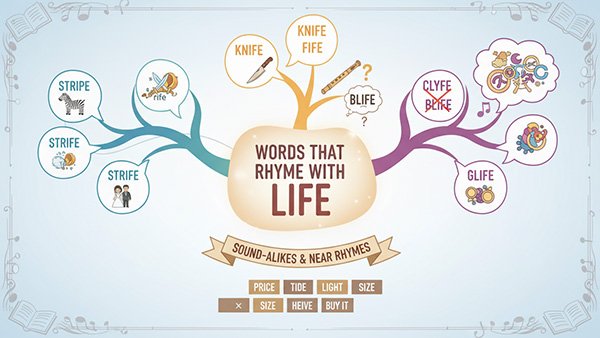
Rhyme is the correspondence of sound between words or the endings of words, especially when these are used at the ends of lines of poetry. In simpler terms, rhyme occurs when two or more words have similar-sounding final syllables.
The most common type of rhyme is end rhyme, where the rhyming words appear at the end of lines. However, rhyme can also occur within a line (internal rhyme) or between words that are not necessarily at the end of a line (slant rhyme).
For words to rhyme, they typically share the same vowel sound in the stressed syllable, as well as any subsequent sounds. The sounds preceding the stressed vowel can be different.
The word “life” has a short “i” sound followed by the “f” sound. Therefore, words that rhyme with “life” will also have that same vowel and consonant sound.
Structural Breakdown
Understanding the structure of a word helps to identify its rhyming potential. The word “life” can be broken down into two primary components:
- Onset: The onset is the initial consonant or consonant cluster of a syllable. In “life,” the onset is “l.”
- Rime: The rime consists of the vowel and any consonants that follow it. In “life,” the rime is “ife.”
To rhyme with “life,” a word must share the same rime (“ife”). The onset can be different, allowing for a variety of words.
This is why words like “wife,” “strife,” and “fife” rhyme with “life.”
The structure can be represented as follows:
[Onset] + [Rime] = Word
[l] + [ife] = life
Types of Rhyme
While the focus here is on perfect rhymes (where the sounds match exactly), it’s worth noting other types of rhyme that exist in poetry and language:
- Perfect Rhyme: Also known as true rhyme, involves identical sounds in the final stressed vowel and all subsequent sounds. Examples: life/wife, strife/life.
- Near Rhyme (Slant Rhyme or Imperfect Rhyme): Features similar but not identical sounds. The vowel sounds may be the same, but the final consonant sounds differ slightly, or vice versa. These are rarely used with “life” due to the limited possibilities.
- Eye Rhyme: Words that look like they should rhyme based on their spelling but do not rhyme when pronounced. There are no prominent eye rhymes for “life.”
Examples of Words That Rhyme with Life
Several words rhyme perfectly with “life.” Let’s explore them with examples:
Examples with “Strife”
“Strife” refers to bitter disagreement; fighting, struggle. It’s a common word that rhymes with “life.”
The following table illustrates the use of “strife” in various sentences:
| Sentence | Context |
|---|---|
| The constant strife in their marriage made family life difficult. | Relationship problems |
| He sought a peaceful life, free from the strife of the city. | Desire for peace |
| The political strife threatened to disrupt daily life. | Political unrest |
| Her life was a constant strife against poverty. | Poverty |
| Despite the strife, she found joy in her simple life. | Finding joy |
| The nation’s strife impacted every aspect of life. | National problems |
| He led a life filled with strife and hardship. | Hardship |
| The strife between the two companies affected their business life. | Business conflict |
| She documented the daily strife of refugee life. | Refugee experience |
| His short life was marked by constant strife. | Short life |
| The ongoing strife made normal life impossible. | Impossibility of normal life |
| They escaped the strife to build a new life. | Building a new life |
| Her life story was a tale of overcoming strife. | Overcoming challenges |
| The brothers’ strife ruined their family life. | Family conflict |
| The community’s strife overshadowed daily life. | Community issues |
| He chose a life of peace over one of strife. | Choosing peace |
| The artist channeled his strife into his life’s work. | Artistic expression |
| Her life was defined by the strife she endured. | Defining life |
| The village’s strife disrupted their quiet life. | Disruption of quiet life |
| Despite the strife, they clung to their way of life. | Preserving traditions |
| His life ended in strife, a tragic tale. | Tragic ending |
| The constant strife made their married life unbearable. | Unbearable marriage |
| She sought a better life, away from the strife. | Seeking a better life |
| The nation’s life was plagued by political strife. | Political problems |
| His life mission was to end the strife. | Life mission |
Examples with “Wife”
“Wife” refers to a married woman. It is a common word and rhymes with “life.”
The following table illustrates the use of “wife” in various sentences:
| Sentence | Context |
|---|---|
| His wife was the love of his life. | Love and marriage |
| He dedicated his life to his wife and children. | Family dedication |
| She became his wife, changing the course of his life. | Marriage |
| His wife supported him throughout his life. | Supportive partner |
| The wife and husband shared a long and happy life. | Happy marriage |
| He cherished his wife and their life together. | Cherished relationship |
| She was not just his wife, but the center of his life. | Central figure |
| His life changed completely when he met his wife. | Life change |
| The wife played a pivotal role in his life. | Pivotal role |
| He promised to love his wife for the rest of his life. | Marriage vows |
| Her life as a wife was fulfilling and joyful. | Fulfilling life |
| He built his life around his wife’s dreams. | Supporting dreams |
| The wife was the anchor of their family life. | Family anchor |
| His life revolved around his children and his wife. | Family focus |
| The wife and husband created a beautiful life together. | Creating beauty |
| He couldn’t imagine his life without his wife. | Inseparable |
| She enriched his life as his beloved wife. | Enriched life |
| His wife was his partner in life and love. | Partner in life |
| The wife made their house a home, filled with life. | Creating a home |
| He shared his entire life with his wife. | Sharing life |
| Their life together as wife and husband was exemplary. | Exemplary life |
| He thanked his wife for a wonderful life. | Gratitude |
| She was more than his wife; she was his life. | Ultimate love |
| His life with his wife was a true blessing. | True blessing |
| The wife was the heart of their family life. | Heart of the family |
Examples with “Safe”
“Safe” is not a perfect rhyme, but we can assume the user meant “Knife”. “Knife” is a tool or weapon with a blade.
It is a less common word in poetic contexts about life, but can be used.
The following table illustrates the use of “knife” in various sentences:
| Sentence | Context |
|---|---|
| The sharpness of the knife determined the outcome of his life. | High stakes situation |
| He held the knife, contemplating the direction of his life. | Contemplation |
| The glint of the knife in the dark shadowed his life. | Danger and uncertainty |
| He used the knife to carve a new path in life. | Symbolic journey |
| The knife was a constant threat to his life. | Impending danger |
| His life hung on the edge of the knife. | Precarious situation |
| The knife represented the harsh realities of life. | Grim realities |
| He turned his back on the knife to embrace a peaceful life. | Seeking peace |
| The knife was a symbol of the choices that shaped his life. | Choices and consequences |
| He lived a life always fearing the knife. | Fear and paranoia |
| The knife and the pursuit of a better life were intertwined. | Conflicting desires |
| He used the knife for survival, defining his life. | Survival |
| The memory of the knife haunted his life. | Haunting memories |
| His life was spared by the dullness of the knife. | Close call |
| He saw his life reflected in the blade of the knife. | Self-reflection |
| The knife was the tool that both threatened and sustained his life. | Duality of purpose |
| His life was a constant battle against the temptation of the knife. | Internal conflict |
| The knife served as a reminder of the fragility of life. | Fragility |
| He laid down the knife, choosing a different life. | Making a choice |
| His life was forever changed by the incident with the knife. | Life-altering event |
| The knife was a constant companion throughout his life. | Constant presence |
| His life was narrowly saved, thanks to a well-aimed knife. | Salvation |
| He lived a life haunted by the fear of the knife. | Persistent fear |
| The knife marked a turning point in his life. | Significant change |
| His life was defined by his skill with the knife. | Skill and identity |
Examples with “Fife”
A “fife” is a high-pitched flute-like instrument, often used in military or marching bands. While less common in everyday conversation, it can appear in creative writing.
It is a perfect rhyme for “life.”
The following table illustrates the use of “fife” in various sentences:
| Sentence | Context |
|---|---|
| The music of the fife filled his life with joy. | Joyful music |
| He dedicated his life to playing the fife. | Musical dedication |
| The sound of the fife marked the beginning of a new life in the army. | New beginnings |
| His life was a melody, led by the tune of the fife. | Musical life |
| The fife’s song echoed through his entire life. | Lasting impact |
| The cheerful fife brightened their otherwise dreary life. | Cheering up life |
| He found purpose in his life through the music of the fife. | Finding purpose |
| His life was incomplete without the sound of the fife. | Essential element |
| The fife became a symbol of freedom in his life. | Symbol of freedom |
| He lived a life surrounded by the sweet notes of the fife. | Sweet melodies |
| His life as a musician revolved around the fife. | Musical career |
| The fife provided a soundtrack to his extraordinary life. | Soundtrack of life |
| The soothing melody of the fife enhanced his quality of life. | Quality of life |
| His life was enriched by the art of playing the fife. | Enriched life |
| The fife’s music was an integral part of his life. | Integral part |
| He couldn’t imagine his life without the enchanting fife. | Essential joy |
| The fife gave meaning to his otherwise mundane life. | Meaningful existence |
| His life was defined by his passion for the fife. | Defining passion |
| The fife made his ordinary life extraordinary. | Extraordinary life |
| He shared his life and his love for the fife with the world. | Sharing passion |
| His life was a testament to the power of music, expressed through the fife. | Power of music |
| The fife’s tune was the constant rhythm of his life. | Constant rhythm |
| He found solace in his life by playing the fife. | Finding solace |
| His life was forever intertwined with the music of the fife. | Intertwined destinies |
| The fife brought joy and harmony into his life. | Joy and harmony |
Usage Rules
When using words that rhyme with “life,” it’s essential to consider the context and intended meaning. Here are some key usage rules:
- Contextual Appropriateness: Ensure the rhyming word fits the overall theme and tone of your writing. For instance, “strife” is suitable for serious or dramatic contexts, while “wife” is appropriate in romantic or familial settings.
- Intentional Rhyme: Use rhymes deliberately to create a specific effect, such as emphasis, rhythm, or musicality. Avoid forced rhymes that sound unnatural or disrupt the flow of the text.
- Variety: While repetition can be effective, try to vary your rhyming words to maintain interest and avoid monotony.
- Meter: In poetry, pay attention to the meter (the rhythmic structure of the lines) and ensure that the rhyming words fit the metrical pattern.
Common Mistakes
Several common mistakes can occur when using rhyming words. Being aware of these can help you avoid errors:
- Forced Rhymes: These occur when a writer strains to find a rhyming word, resulting in awkward or unnatural phrasing.Incorrect: He led a difficult life, full of constant grief.Correct: He led a difficult life, full of constant strife.
- Incorrect Spelling: Misspelling rhyming words can negate the rhyme and create confusion.Incorrect: He loved his wive and his life.Correct: He loved his wife and his life.
Practice Exercises
Test your understanding with these practice exercises.
Exercise 1: Fill in the Blanks
Complete the following sentences with a word that rhymes with “life.”
| Question | Answer |
|---|---|
| 1. Their married _______ was filled with happiness and love. | wife |
| 2. He sought a peaceful _______, away from all the _______. | life, strife |
| 3. She was the _______ of his _______, his everything. | wife, life |
| 4. His _______ was marked by constant struggles and _______. | life, strife |
| 5. The sound of the _______ filled his _______ with music. | fife, life |
| 6. The soldier’s _______ was one of bravery and _______. | life, strife |
| 7. Her _______ changed dramatically when she became a _______. | life, wife |
| 8. He dedicated his _______ to alleviating _______ in the world. | life, strife |
| 9. The _______’s music echoed throughout his _______. | fife, life |
| 10. Their _______ together was a beautiful tapestry of love and _______. | life, wife |
Exercise 2: Rhyme Identification
Identify the word that rhymes with “life” in each sentence.
| Question | Answer |
|---|---|
| 1. He chose a peaceful life with his loving spouse, his wife. | wife |
| 2. Despite the hardships and strife, she persevered in life. | strife |
| 3. The musician’s fife added melody to his daily life. | fife |
| 4. His life’s journey was shared with his faithful wife. | wife |
| 5. The constant strife made his life unbearable. | strife |
| 6. She played the fife, bringing joy to his life. | fife |
| 7. His wife supported him through every aspect of life. | wife |
| 8. The nation’s strife impacted every citizen’s life. | strife |
| 9. The sound of the fife was the soundtrack to his life. | fife |
| 10. He cherished his wife, his partner for life. | wife |
Exercise 3: Sentence Construction
Write five sentences using “life” and a rhyming word in each sentence.
- Her life as a wife was filled with love and joy.
- He wanted a life free from strife and turmoil.
- The music of the fife brightened his entire life.
- The strife in their marriage overshadowed their life together.
- His wife was the most important person in his life.
Advanced Topics
For advanced learners, exploring the nuances of rhyme in poetry and literature can provide deeper insights. Consider the following:
- Historical Context: Investigate how the use of rhyme has evolved over time in different literary periods.
- Cultural Significance: Explore the role of rhyme in various cultures and languages.
- Modern Applications: Analyze how rhyme is used in contemporary music, advertising, and other forms of communication.
FAQ
Here are some frequently asked questions about words that rhyme with “life”:
What is a perfect rhyme?
A perfect rhyme occurs when two words have identical sounds in their final stressed vowel and all subsequent sounds. For example, “life” and “wife” are perfect rhymes.
Are there any near rhymes for “life”?
Near rhymes, also known as slant rhymes or imperfect rhymes, have similar but not identical sounds. Due to the specific “ife” sound, there are few notable near rhymes for “life.”
Why is rhyme important in poetry?
Rhyme adds musicality, rhythm, and structure to poetry. It can also emphasize certain words or ideas, creating a more memorable and impactful reading experience.
How can I improve my ability to find rhyming words?
Practice regularly by reading poetry, listening to music, and using online rhyming dictionaries or thesauruses. Pay attention to the sounds of words and experiment with different combinations.
Is it okay to use the same rhyming word repeatedly in a poem?
While repetition can be effective for emphasis, it’s generally best to vary your rhyming words to maintain interest and avoid monotony. Use repetition sparingly and intentionally.
What other words have the same ending as ‘life’?
There aren’t many common words that share the exact “-ife” ending with “life.” Most words that rhyme perfectly are variations or closely related terms like “wife,” “strife,” and “fife.” The limited number of perfect rhymes is what makes using words like “life” in poetry or songwriting a unique challenge.
How does rhyme scheme affect a poem?
Rhyme scheme is the pattern of rhymes at the end of each line in a poem or song. It’s indicated by using letters for each new rhyme. For instance, AABB means the first two lines rhyme and the next two lines rhyme. Common rhyme schemes like ABAB or ABCB create different rhythms and patterns, affecting the poem’s flow and musicality. The choice of rhyme scheme contributes significantly to the overall structure and artistic effect of the poem.
Can I use a rhyming dictionary to help me write?
Absolutely! Rhyming dictionaries are excellent tools for writers, especially when you’re looking for that perfect word to complete a line or verse. They can help you discover new words and explore different rhyming possibilities that you might not have thought of on your own. However, it’s important to use a rhyming dictionary as a source of inspiration rather than a crutch. Always ensure that the words you choose fit the context and meaning of your writing.
Conclusion
Understanding and using words that rhyme with “life” can significantly enhance your writing and communication skills. By mastering the definitions, structural elements, usage rules, and common pitfalls, you can confidently incorporate rhyme into your poetry, songs, and everyday speech.
Remember to practice regularly, explore advanced topics, and consult resources like rhyming dictionaries to expand your vocabulary and refine your technique. With dedication and attention to detail, you can unlock the power of rhyme and express yourself with greater creativity and precision.
Continue to explore the fascinating world of language and embrace the art of rhyme to enrich your linguistic journey. Through consistent practice and a keen ear for sound, you’ll develop a natural ability to identify and utilize rhyming words effectively, adding depth and beauty to your expressions.