
Fire, a powerful and mesmerizing force of nature, holds a significant place in our lives, both literally and figuratively. Whether it’s the comforting warmth of a hearth fire, the destructive power of a wildfire, or the metaphorical flames of passion, the ability to describe fire accurately and vividly is essential for effective communication.
This article delves into the rich vocabulary available to English speakers for portraying fire in all its forms. Understanding these words and their nuances not only enhances your descriptive writing but also improves your comprehension of literature, news reports, and everyday conversations.
This guide is particularly beneficial for students, writers, ESL learners, and anyone seeking to expand their expressive capabilities.
Table of Contents
- Definition of Fire-Related Vocabulary
- Structural Breakdown of Fire Descriptors
- Categories of Words Describing Fire
- Examples of Fire Descriptors
- Usage Rules for Fire-Related Words
- Common Mistakes When Describing Fire
- Practice Exercises
- Advanced Topics in Fire Terminology
- Frequently Asked Questions
- Conclusion
Definition of Fire-Related Vocabulary
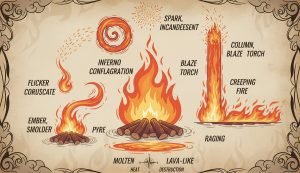
The vocabulary used to describe fire encompasses a broad range of words that capture its various attributes, including its intensity, color, movement, sound, and effects. These words can be nouns, verbs, adjectives, and adverbs, each contributing a unique perspective to the overall depiction of fire.
Understanding the precise meaning of each term is crucial for accurately conveying the intended image or sensation. When learning words to describe fire, it’s helpful to focus on its key characteristics: intensity, color, movement, sound, and effects. Using descriptive words for fire allows you to communicate not just what the fire looks like, but also its energy and impact.
Writers can explore different ways to describe fire, from a gentle candle flame to a raging wildfire. Paying attention to these details improves both writing and comprehension. For ESL learners or students, understanding how to describe fire with precise language enhances the clarity and vividness of their descriptions.
For instance, ‘blaze’ and ’ember’ both relate to fire, but one signifies a large, intense fire, while the other refers to a glowing remnant.
Classifying fire-related vocabulary helps to understand their function. Adjectives such as ‘scorching’ or ‘smoldering’ describe the state or quality of the fire.
Verbs like ‘ignite’ or ‘consume’ describe the actions associated with fire. Nouns such as ‘inferno’ or ‘spark’ refer to the types or components of fire.
Adverbs such as ‘fiercely’ or ‘gently’ modify the verbs and adjectives, adding another layer of detail. The context in which these words are used significantly impacts their interpretation, requiring careful consideration of the surrounding words and the overall message.
Structural Breakdown of Fire Descriptors
The structure of fire descriptors often involves specific patterns and word formations. Adjectives frequently modify nouns directly (e.g., ‘raging fire’), while adverbs modify verbs or adjectives (e.g., ‘burn fiercely,’ ‘intensely hot’).
Compound adjectives, such as ‘flame-retardant,’ combine two or more words to create a more precise description. Understanding these structural elements enables you to construct grammatically correct and impactful sentences.
The use of figurative language, such as metaphors and similes, adds another layer of complexity. Comparing fire to other phenomena (e.g., “the fire roared like a lion”) can create vivid imagery and evoke strong emotions.
Pay attention to how these figurative expressions are constructed and how they contribute to the overall effect. Moreover, the tense of the verbs used to describe fire can also change the meaning.
For example, “the fire is burning” describes an ongoing action, while “the fire burned” describes a completed action.
Categories of Words Describing Fire
Intensity and Size
Words describing the intensity and size of a fire range from subtle to overwhelming. These terms help to convey the scale and power of the fire, from a tiny spark to a massive conflagration.
Color and Appearance
The color and appearance of fire can vary depending on the fuel source and temperature. Words in this category capture the visual characteristics of the flames and embers.
Movement and Behavior
Fire is dynamic and constantly changing. Describing its movement and behavior requires a vocabulary that captures its fluidity and unpredictability.
Sound of Fire
Fire is not only a visual phenomenon but also an auditory one. Words describing the sounds of fire evoke the crackling, roaring, and hissing noises associated with combustion.
Effects and Consequences
The effects and consequences of fire can be both immediate and long-lasting. This category includes words that describe the impact of fire on its surroundings.
Examples of Fire Descriptors
Below are several tables with examples of words describing fire organized by category. Each table includes 25 examples to provide a comprehensive overview of the vocabulary available.
Table 1: Words Describing Fire Intensity and Size
This table showcases words that specifically describe the intensity and size of a fire. These terms range from very small and weak to immensely powerful and large-scale fires, helping to paint a picture of the fire’s magnitude.
| Word | Example Sentence |
|---|---|
| Spark | A single spark ignited the dry grass. |
| Ember | The glowing embers provided warmth long after the fire died down. |
| Flicker | A faint flicker of light appeared in the darkness. |
| Glimmer | The glimmer of the campfire was barely visible through the trees. |
| Smolder | The pile of leaves continued to smolder for hours. |
| Kindle | He used dry twigs to kindle a small fire. |
| Weak | The fire was weak and barely produced any heat. |
| Gentle | A gentle flame danced in the lantern. |
| Small | A small fire burned in the hearth. |
| Controlled | The firefighters kept the controlled burn from spreading. |
| Blaze | The blaze consumed the entire building in minutes. |
| Inferno | The forest fire turned into a raging inferno. |
| Conflagration | The great fire of London was a devastating conflagration. |
| Roar | The fire began to roar as it spread through the dry wood. |
| Raging | A raging fire swept across the hillside. |
| Intense | The intense heat of the fire could be felt from a distance. |
| Fierce | A fierce fire threatened to engulf the nearby homes. |
| Devouring | The devouring flames left nothing but ashes behind. |
| Consuming | The consuming fire spread rapidly through the dry forest. |
| Enormous | An enormous fire lit up the night sky. |
| Vast | A vast fire stretched across the horizon. |
| Great | The great fire destroyed much of the city. |
| Extensive | The extensive fire damage was visible from miles away. |
| Massive | A massive fire engulfed the warehouse. |
| Wildfire | The wildfire burned for weeks, consuming thousands of acres. |
Table 2: Words Describing Fire Color and Appearance
This table provides examples of words that describe the color and appearance of fire. Fire can display a spectrum of colors depending on what is burning, each contributing to the overall visual impact.
| Word | Example Sentence |
|---|---|
| Red | The flames glowed red in the darkness. |
| Orange | Orange flames danced around the logs. |
| Yellow | Bright yellow flames shot up into the air. |
| Blue | The gas fire burned with a clear blue flame. |
| White | The white-hot fire was incredibly intense. |
| Golden | The campfire cast a golden glow on the faces of the campers. |
| Fiery | The sunset painted the sky with fiery colors. |
| Bright | The bright flames illuminated the entire area. |
| Glowing | The glowing embers emitted a soft light. |
| Luminous | The luminous flames were mesmerizing to watch. |
| Smoky | The smoky flames obscured the view. |
| Dark | Dark shadows flickered around the edges of the fire. |
| Pale | A pale flame struggled to stay alight. |
| Shimmering | The shimmering heat waves rose from the fire. |
| Dancing | The dancing flames created a hypnotic effect. |
| Twinkling | Twinkling embers scattered across the ground. |
| Gleaming | The gleaming fire reflected in their eyes. |
| Blazing | The blazing inferno lit up the night sky. |
| Scorching | The scorching heat radiated from the fire. |
| Crimson | The crimson flames were a warning of danger. |
| Azure | The azure fire burned with an otherworldly glow. |
| Opalescent | The opalescent flames shifted in color. |
| Iridescent | The iridescent fire displayed a rainbow of colors. |
| Glistening | The glistening flames caught the light. |
| Vivid | The vivid colors of the fire were captivating. |
Table 3: Words Describing Fire Movement and Behavior
This table focuses on words that describe the movement and behavior of fire. These words capture the dynamic nature of fire, from its initial spark to its consuming spread.
| Word | Example Sentence |
|---|---|
| Leap | The flames leaped high into the air. |
| Dance | The flames danced gracefully in the hearth. |
| Flicker | The candle flame flickered in the breeze. |
| Spread | The fire spread rapidly through the dry brush. |
| Consume | The fire began to consume everything in its path. |
| Engulf | The flames engulfed the building in minutes. |
| Rise | Smoke began to rise from the burning forest. |
| Erupt | The volcano erupted, sending lava and fire into the sky. |
| Burn | The fire continued to burn through the night. |
| Ignite | A single spark can ignite a massive fire. |
| Smolder | The remains of the fire continued to smolder for hours. |
| Flare | The flames flared up briefly before dying down. |
| Crawl | The fire seemed to crawl slowly across the ground. |
| Rush | The flames rushed forward with incredible speed. |
| Twist | The flames twisted and turned in the wind. |
| Waver | The candle flame wavered, threatening to go out. |
| Surge | A sudden surge of flames shot upwards. |
| Devour | The fire seemed to devour everything in its path. |
| Advance | The fire continued to advance towards the town. |
| Recede | As the rain fell, the fire began to recede. |
| Expand | The fire continued to expand, consuming more and more land. |
| Dissipate | Eventually, the fire began to dissipate, leaving behind only ashes. |
| Subside | After hours of burning, the fire began to subside. |
| Linger | The smell of smoke continued to linger in the air. |
| Falter | The flames began to falter as the fuel ran out. |
Table 4: Words Describing the Sound of Fire
This table presents words that describe the sounds associated with fire. Fire isn’t just a visual phenomenon; it also produces distinct sounds that add to the sensory experience of witnessing it.
| Word | Example Sentence |
|---|---|
| Crackle | The fire began to crackle merrily in the fireplace. |
| Pop | The logs popped and hissed as they burned. |
| Hiss | The fire made a soft hissing sound as it consumed the leaves. |
| Roar | The roar of the fire could be heard from miles away. |
| Snap | The dry branches snapped in the fire. |
| Sizzle | The fat sizzled as it dripped into the flames. |
| Cackle | The fire seemed to cackle as it devoured the wood. |
| Boom | A loud boom echoed as a tree fell into the fire. |
| Rustle | The fire made a soft rustling sound as it spread. |
| Whisper | The flames seemed to whisper secrets in the night. |
| Clamor | The clamor of the fire grew louder as it intensified. |
| Resonate | The deep resonate sound of the fire filled the forest. |
| Crack | A sharp crack echoed through the night as the log split. |
| Rumble | A low rumble accompanied the intense heat of the fire. |
| Clatter | The clatter of burning debris filled the air. |
| Murmur | A soft murmur of flames could be heard nearby. |
| Screech | The burning metal gave off a high-pitched screech. |
| Groan | The old house groaned as the fire consumed it. |
| Hum | A low hum emanated from the burning embers. |
| Chirp | The fire seemed to chirp as it consumed the small twigs. |
| Chuckle | The fire seemed to chuckle to itself as it raged. |
| Sing | The flames seemed to sing a song of destruction. |
| Ring | The sound of the fire seemed to ring in their ears. |
| Echo | The sound of the fire continued to echo through the valley. |
| Reverberate | The sound of the fire seemed to reverberate through the forest. |
Table 5: Words Describing the Effects and Consequences of Fire
This table lists words that describe the effects and consequences of fire. These words capture the impact fire has on its surroundings, from immediate destruction to lasting changes.
| Word | Example Sentence |
|---|---|
| Ashes | Only ashes remained after the fire. |
| Charred | The trees were charred and blackened by the flames. |
| Smoked | The air was smoked with the smell of burning wood. |
| Burned | The forest was severely burned by the wildfire. |
| Scorched | The earth was scorched by the intense heat. |
| Destroyed | The fire completely destroyed the building. |
| Devastated | The town was devastated by the fire. |
| Ruined | The crops were ruined by the fire. |
| Damaged | The house was severely damaged by the fire. |
| Blackened | The walls were blackened by the smoke. |
| Eradicated | The fire eradicated the entire ecosystem. |
| Consumed | The forest was consumed by the flames. |
| Obliterated | The fire obliterated everything in its path. |
| Annihilated | The fire annihilated the ancient city. |
| Razed | The village was razed to the ground by the fire. |
| Desolated | The landscape was desolated by the wildfire. |
| Decimated | The fire decimated the wildlife population. |
| Wasted | The land was wasted by the fire. |
| Barren | The earth was left barren after the fire. |
| Sterile | The soil became sterile due to the intense heat. |
| Infertile | The land was rendered infertile by the fire. |
| Parched | The ground was parched and dry after the fire. |
| Lifeless | The landscape became lifeless after the fire. |
| Empty | The area was left empty and desolate. |
| Devoid | The region was devoid of all vegetation. |
Usage Rules for Fire-Related Words
The correct usage of fire-related words depends on the context and the intended meaning. Pay close attention to the connotations of each word.
For example, ‘inferno’ suggests a large, uncontrolled fire, while ‘campfire’ refers to a small, contained fire used for cooking or warmth. Using the wrong word can create a misleading or inaccurate impression.
Verb tenses are also crucial. Use the present tense to describe an ongoing fire (e.g., “The fire is burning”), the past tense to describe a fire that has already occurred (e.g., “The fire burned for days”), and the future tense to describe a fire that may occur (e.g., “The fire will spread if it’s not contained”).
Be mindful of subject-verb agreement and pronoun references to ensure grammatical correctness. The use of idioms and figurative language should be appropriate for the audience and purpose.
Overuse of clichés can weaken your writing, so strive for fresh and original expressions.
Common Mistakes When Describing Fire
One common mistake is using words interchangeably without understanding their precise meanings. For example, confusing ’embers’ with ‘flames’ can lead to inaccurate descriptions.
Another common error is misusing verb tenses, resulting in incorrect or confusing sentences. Additionally, overuse of clichés or figurative language can weaken the impact of your writing.
Here are some examples of common mistakes:
Incorrect: The embers raged through the forest.
Correct: The flames raged through the forest.
Incorrect: The fire will burn yesterday.
Correct: The fire burned yesterday.
Incorrect: The fire was as angry as a storm (cliché).
Correct: The fire consumed the forest with relentless fury.
Practice Exercises
Test your understanding of fire-related vocabulary with these exercises. Choose the best word to complete each sentence, or rewrite the sentence to improve its descriptive accuracy.
Exercise 1: Fill in the Blanks
Choose the best word from the options provided to complete each sentence.
| Question | Options | Answer |
|---|---|---|
| 1. The ________ of the campfire kept us warm on the cold night. | (a) spark, (b) embers, (c) blaze | (b) embers |
| 2. The ________ fire quickly spread through the dry forest. | (a) small, (b) raging, (c) gentle | (b) raging |
| 3. The ________ flames illuminated the dark room. | (a) smoky, (b) bright, (c) pale | (b) bright |
| 4. We could hear the fire ________ as it consumed the wood. | (a) whisper, (b) roar, (c) murmur | (b) roar |
| 5. The fire ________ the building, leaving nothing but ashes. | (a) damaged, (b) scorched, (c) destroyed | (c) destroyed |
| 6. A single ________ was enough to start the fire. | (a) ember, (b) blaze, (c) spark | (c) spark |
| 7. The ________ heat from the fire was almost unbearable. | (a) gentle, (b) intense, (c) weak | (b) intense |
| 8. The ________ flames danced in the wind. | (a) still, (b) wavering, (c) steady | (b) wavering |
| 9. The fire began to ________ as the rain started to fall. | (a) expand, (b) surge, (c) subside | (c) subside |
| 10. The ________ remains of the forest fire were a stark reminder of its power. | (a) green, (b) charred, (c) lively | (b) charred |
Exercise 2: Sentence Rewriting
Rewrite the following sentences to make them more descriptive and vivid.
| Original Sentence | Rewritten Sentence |
|---|---|
| 1. The fire was big. | The enormous fire raged across the landscape, consuming everything in its path. |
| 2. The flames were red. | Crimson flames danced wildly, casting a menacing glow upon the scene. |
| 3. The fire made noise. | The fire crackled and roared, its sounds echoing through the silent night. |
| 4. The fire destroyed the building. | The fire utterly destroyed the building, leaving behind a desolate scene of ashes and ruin. |
| 5. The fire was hot. | The scorching heat of the fire radiated outwards, making it impossible to approach. |
| 6. The fire moved quickly. | The fire surged forward, rapidly engulfing everything in its path with terrifying speed. |
| 7. The fire looked pretty. | The luminous flames shimmered and danced, creating a mesmerizing and beautiful spectacle. |
| 8. The fire left ashes. | The fire left behind a trail of gray ashes, a somber testament to its destructive power. |
| 9. The fire smelled bad. | The air was thick with the acrid smell of smoke, a pungent reminder of the recent fire. |
| 10. The fire was dangerous. | The fierce and uncontrolled fire posed a significant danger to the surrounding area, threatening lives and property. |
Advanced Topics in Fire Terminology
For advanced learners, exploring the etymology of fire-related words can provide deeper insights into their meanings and historical contexts. For example, the word ‘conflagration’ comes from the Latin word ‘conflagrare,’ meaning ‘to burn up.’ Studying the scientific aspects of fire, such as the chemical reactions involved in combustion, can also enhance your understanding of fire terminology.
Additionally, analyzing literary works that feature fire as a central theme can reveal how skilled writers use language to create powerful and evocative images.
Learning how to describe fire goes beyond listing words; it also involves considering metaphorical and symbolic meanings. For instance, the phrase “the metaphorical flames of passion” uses fire to convey emotion, while “smoldering anger” shows restrained intensity. Incorporating how to describe fire in both literal and figurative contexts strengthens writing by connecting imagery to feelings or themes. Writers can use fire related words strategically to highlight transformation, danger, or energy, making descriptions more vivid and engaging.
Consider the impact of fire on different cultures and mythologies. Fire often symbolizes transformation, destruction, and purification.
Understanding these symbolic meanings can add another layer of interpretation to your understanding of fire-related language. Finally, research current events related to wildfires and other fire-related disasters to see how fire terminology is used in news reports and scientific articles.
Frequently Asked Questions
Q1: What is the difference between ‘flames’ and ’embers’?
A1: ‘Flames’ refer to the visible, luminous part of a fire, while ’embers’ are the glowing remnants of a fire after the flames have died down. Flames are actively burning, while embers are smoldering and still capable of producing heat.
Q2: How can I improve my descriptive writing about fire?
A2: To improve your descriptive writing, focus on using specific and vivid language. Pay attention to the intensity, color, movement, and sound of the fire. Use figurative language sparingly and avoid clichés. Practice writing regularly and seek feedback from others.
Q3: What are some common metaphors for fire?
A3: Common metaphors for fire include passion, anger, destruction, and purification. For example, “He had a fiery temper” uses fire to represent intense anger, while “She felt a burning passion for her work” uses fire to symbolize intense motivation.
Q4: How does the color of fire relate to its temperature?
A4: The color of fire is directly related to its temperature. Red flames are the coolest, followed by orange, yellow, and white. Blue flames are the hottest. This is due to the different wavelengths of light emitted at different temperatures.
Q5: What are some safety precautions to take when dealing with fire?
A5: When dealing with fire, always maintain a safe distance, use appropriate fire-resistant clothing and equipment, and have a fire extinguisher or water source nearby. Never leave a fire unattended, and ensure that it is completely extinguished before leaving the area.
Q6: What is the difference between ‘ignite’ and ‘kindle’?
A6: ‘Ignite’ means to start burning or catch fire, often suddenly and forcefully. ‘Kindle’ means to start a fire gradually and carefully, often by using small pieces of easily combustible material. ‘Ignite’ suggests a more immediate and intense start, while ‘kindle’ implies a gentler, more deliberate process.
Q7: How do wildfires affect the environment?
A7: Wildfires can have both positive and negative effects on the environment. They can clear out dead vegetation, promote new growth, and release nutrients into the soil. However, they can also destroy habitats, release large amounts of carbon dioxide into the atmosphere, and contribute to soil erosion.
Q8: What is the role of fire in different cultures?
A8: Fire plays a significant role in many cultures, often symbolizing warmth, light, and transformation. In some cultures, it is used in religious ceremonies for purification or as a means of communication with the spiritual realm. Fire can also represent destruction and danger, depending on the context and cultural beliefs.
Conclusion
Mastering the vocabulary for describing fire enhances your ability to communicate effectively and vividly. By understanding the nuances of fire-related words, you can create more impactful and engaging writing.
Remember to pay attention to the intensity, color, movement, sound, and effects of fire, and use language that accurately conveys your intended message. Practice using these words in different contexts and seek feedback to further improve your descriptive skills.
Continue to expand your vocabulary by reading widely and exploring different genres. Pay attention to how skilled writers use language to describe fire and other natural phenomena.
With consistent effort and a keen eye for detail, you can become a master of fiery vocabulary and elevate your writing to new heights. Remember that language is a powerful tool, and the ability to wield it effectively can make all the difference in conveying your ideas and emotions.