The universe is full of wonders, and stars are among the most captivating. To truly capture their essence in writing, a rich vocabulary is essential.
When thinking about how to describe stars, consider the context and the emotion you wish to convey. Whether you are writing a scientific observation or a poetic passage, selecting precise words to describe the stars can make your description more vivid. For example, instead of using a vague term like “good star,” choose a very good adjective for star such as “radiant,” “gleaming,” or “ethereal” to capture its unique qualities. Words to describe the stars should highlight characteristics like color, size, brightness, and behavior, ensuring your audience can visualize them clearly.
This article provides a comprehensive guide to words that describe stars, enhancing your ability to convey their beauty, power, and mystery. Understanding these descriptive terms is crucial for astronomy enthusiasts, writers, and anyone seeking to express the awe-inspiring nature of celestial objects.
This guide will benefit students, educators, and creative writers alike, providing the tools to paint vivid pictures of the cosmos with words.
From their radiant glow to their immense size and age, this article explores a wide range of adjectives that bring stars to life. We’ll delve into their physical characteristics, colors, and behaviors, equipping you with the language necessary to describe them accurately and poetically.
Whether you’re writing a science fiction novel, crafting a poem, or simply expanding your knowledge of the universe, this comprehensive guide will be your go-to resource.
Table of Contents
- Definition: Describing Stars
- Structural Breakdown: Adjectives and Their Placement
- Types and Categories of Stellar Adjectives
- Examples: Stellar Adjectives in Use
- Usage Rules: Proper Application of Stellar Adjectives
- Common Mistakes: Avoiding Errors in Stellar Descriptions
- Practice Exercises: Test Your Knowledge
- Advanced Topics: Nuances in Stellar Description
- FAQ: Frequently Asked Questions
- Conclusion: Mastering Stellar Descriptions
Definition: Describing Stars
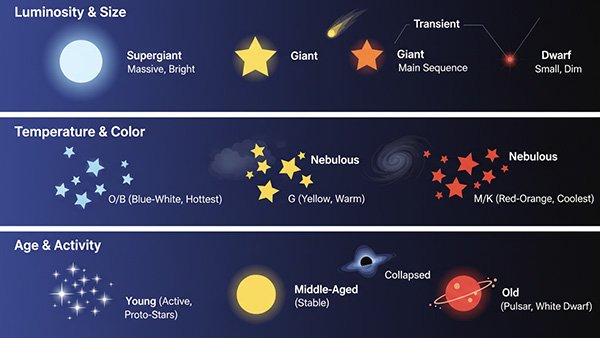
Describing stars involves using adjectives to provide detailed information about their various characteristics. Adjectives are words that modify nouns, adding detail and specificity.
In the context of stars, adjectives can describe their color, brightness, size, temperature, age, composition, and behavior. These words help us visualize and understand the diverse nature of stars, from the smallest red dwarfs to the largest supergiants.
The function of adjectives in stellar descriptions is to create a more vivid and accurate picture of the star. Instead of simply saying “a star,” we can say “a radiant star,” “a gigantic star,” or “a fading star.” Each adjective adds a layer of information, helping the reader or listener form a clearer mental image. Understanding the nuances of these adjectives is essential for anyone interested in astronomy, science fiction, or creative writing.
Context plays a crucial role in choosing the right adjectives. For example, when discussing the life cycle of a star, adjectives like “protostar,” “main-sequence,” “red giant,” and “white dwarf” are appropriate. In a more poetic context, adjectives like “twinkling,” “distant,” and “ethereal” might be preferred. The key is to select adjectives that are both accurate and evocative, enhancing the overall impact of the description.
Structural Breakdown: Adjectives and Their Placement
In English, adjectives typically precede the noun they modify. For example, we say “a bright star” rather than “a star bright.” This is the most common structure for descriptive adjectives. However, there are exceptions, particularly with certain types of adjectives or in specific stylistic contexts.
Attributive adjectives are those that come before the noun, as in “a red giant.” Predicate adjectives, on the other hand, follow a linking verb (such as *is*, *are*, *was*, *were*, *seems*, *becomes*) and describe the subject of the sentence. For example, “The star is luminous.” In this case, “luminous” is a predicate adjective modifying “star.”
Multiple adjectives can be used to describe a single star, and they generally follow a specific order: opinion, size, age, shape, color, origin, material, and purpose. For example, “a beautiful, large, ancient, red star.” While this order is not always strictly followed, it provides a general guideline for structuring descriptive phrases. Consider the sentence: “The enormous, ancient, blue star filled the observer’s telescope view.” This follows the general order of size, age, and color, creating a clear and impactful image.
Types and Categories of Stellar Adjectives
Stellar adjectives can be categorized based on the specific characteristic they describe. Here are some key categories:
Describing Color
The color of a star is directly related to its surface temperature. Blue stars are the hottest, while red stars are the coolest.
Here are some adjectives to describe stellar color:
- Blue: Indicating a very hot star.
- Blue-white: Slightly cooler than pure blue.
- White: A hot star, but cooler than blue-white.
- Yellow-white: Similar to our Sun.
- Yellow: A star with a moderate surface temperature.
- Orange: Cooler than yellow stars.
- Red: Indicating a relatively cool star.
Describing Brightness
Brightness can refer to both the intrinsic luminosity of a star and its apparent magnitude as seen from Earth. Here are some relevant adjectives:
- Bright: Generally luminous.
- Faint: Not very luminous.
- Luminous: Emitting a great deal of light.
- Radiant: Emitting light or heat.
- Shining: Emitting a bright light.
- Dim: Not shining brightly.
- Gleaming: Shining with a soft, reflected light.
Describing Size
Stars vary enormously in size, from tiny neutron stars to enormous supergiants. Here are some adjectives to describe their size:
- Giant: Significantly larger than our Sun.
- Supergiant: Extremely large.
- Dwarf: Relatively small.
- Neutron: Extremely small and dense.
- Massive: Having a large mass.
- Enormous: Very large in size or extent.
- Tiny: Extremely small.
Describing Temperature
A star’s temperature determines its color and energy output. Here are some adjectives to describe stellar temperature:
- Hot: High surface temperature.
- Cool: Low surface temperature.
- Scorching: Extremely hot.
- Freezing: Extremely cold (relatively speaking, for a star).
- Warm: Moderately hot.
- Torrid: Very hot and dry.
- Frigid: Extremely cold.
Describing Age
Stars have lifespans ranging from millions to billions of years. Here are some adjectives to describe their age:
- Young: Newly formed.
- Old: Having existed for a long time.
- Ancient: Very old.
- Mature: In its prime.
- Evolving: Undergoing changes as it ages.
- Primeval: Existing from the beginning.
- Nascent: Just coming into existence.
Describing Composition
Stars are primarily composed of hydrogen and helium, but they can also contain heavier elements. Here are some adjectives to describe their composition:
- Metallic: Containing a significant amount of elements heavier than hydrogen and helium.
- Hydrogen-rich: Primarily composed of hydrogen.
- Helium-burning: Currently fusing helium in its core.
- Carbon-rich: Containing a significant amount of carbon.
- Oxygen-rich: Containing a significant amount of oxygen.
- Dense: Having a high mass-to-volume ratio.
- Gaseous: Primarily composed of gas.
Describing Behavior
Stars exhibit various behaviors, such as pulsating, erupting, or collapsing. Here are some adjectives to describe these behaviors:
- Pulsating: Expanding and contracting periodically.
- Variable: Changing in brightness over time.
- Eruptive: Characterized by sudden bursts of energy.
- Collapsing: Undergoing gravitational collapse.
- Exploding: Undergoing a violent explosion (supernova).
- Flickering: Burning unsteadily.
- Stable: Remaining relatively constant in brightness and behavior.
Examples: Stellar Adjectives in Use
This section provides numerous examples of stellar adjectives used in sentences, organized by category. These examples illustrate how adjectives can be used to create vivid and accurate descriptions of stars.
Each table includes a variety of adjectives and contexts to showcase their versatility.
The following table provides examples of stellar adjectives related to color. Each example demonstrates how the adjective enhances the description of the star, providing a richer understanding of its characteristics.
| Adjective | Example Sentence |
|---|---|
| Blue | The blue star, a giant among its peers, burned with intense heat. |
| Blue-white | A blue-white star dominated the constellation, its light piercing through the darkness. |
| White | The white star, a distant beacon, guided the interstellar travelers. |
| Yellow-white | A yellow-white star, much like our Sun, provided warmth to its orbiting planets. |
| Yellow | The yellow star, nearing the end of its life, began to expand. |
| Orange | An orange star, a cooling giant, cast a warm glow across the nebula. |
| Red | The red star, a dying ember, signaled the end of a stellar cycle. |
| Crimson | A crimson star painted the celestial canvas. |
| Azure | An azure star twinkled in the night sky. |
| Golden | The golden star shimmered with unearthly light. |
| Pale | A pale star watched over humanity. |
| Ivory | The ivory star reflected in the river. |
| Scarlet | A scarlet star warned of cosmic danger. |
| Silvery | The silvery star was a beacon of hope. |
| Emerald | An emerald star was a rare cosmic sight. |
| Violet | A violet star pulsed with energy. |
| Cerulean | The cerulean star was a celestial gem. |
| Amber | An amber star burned softly in the distance. |
| Lilac | The lilac star whispered secrets of the universe. |
| Roseate | A roseate star marked the edge of the galaxy. |
| Teal | The teal star was a familiar sight to sailors. |
| Saffron | A saffron star was a symbol of prosperity. |
| Russet | The russet star was a sign of the changing seasons. |
The following table provides examples of stellar adjectives related to brightness. These adjectives help describe how luminous or faint a star appears, both intrinsically and from our perspective on Earth.
| Adjective | Example Sentence |
|---|---|
| Bright | The bright star outshone all others in the night sky. |
| Faint | A faint star flickered at the edge of the galaxy, barely visible. |
| Luminous | The luminous star illuminated the surrounding nebula with its radiant energy. |
| Radiant | A radiant star burst into life, casting its light across the cosmos. |
| Shining | The shining star served as a beacon for lost travelers in space. |
| Dim | A dim star signaled the end of its life cycle, slowly fading into darkness. |
| Gleaming | The gleaming star reflected in the calm waters of the alien ocean. |
| Blazing | A blazing star erupted in a supernova, scattering its elements across the universe. |
| Twinkling | The twinkling star winked playfully from across the vast expanse. |
| Dazzling | A dazzling star left us speechless. |
| Glimmering | The glimmering star was a distant memory. |
| Effulgent | An effulgent star bathed the land in light. |
| Coruscating | The coruscating star mesmerized onlookers. |
| Resplendent | A resplendent star graced the heavens. |
| Lackluster | The lackluster star was ignored. |
| Obscure | An obscure star hid behind dust clouds. |
| Subdued | The subdued star was peaceful. |
| Pallid | A pallid star chilled the air. |
| Murky | The murky star was a mystery. |
| Somber | A somber star mourned its loss. |
| Brilliant | The brilliant star illuminated the night. |
| Sparkling | A sparkling star caught my eye. |
| Pale | The pale star seemed distant and cold. |
The following table provides examples of stellar adjectives related to size. These adjectives help to convey the scale and magnitude of stars, from the smallest neutron stars to the largest supergiants.
| Adjective | Example Sentence |
|---|---|
| Giant | The giant star loomed over its planetary system, a colossal presence in the void. |
| Supergiant | A supergiant star, one of the largest known, was nearing the end of its life. |
| Dwarf | The dwarf star, a small and unassuming body, slowly cooled over billions of years. |
| Neutron | A neutron star, incredibly dense, was formed from the collapsed core of a massive star. |
| Massive | The massive star distorted spacetime around it, a testament to its immense gravity. |
| Enormous | An enormous star cast a long shadow on the planets, dwarfing them in comparison. |
| Tiny | The tiny star was easily overlooked, a mere speck in the vastness of space. |
| Colossal | A colossal star shook the galaxy. |
| Immense | The immense star was a force of nature. |
| Minute | A minute star burned quietly. |
| Scrawny | The scrawny star struggled to survive. |
| Vast | A vast star dominated the cosmos. |
| Wide | The wide star was easy to see. |
| Narrow | A narrow star was hard to find. |
| Petite | That petite star was delicate. |
| Grand | The grand star was magnificent. |
| Bulky | A bulky star took up space. |
| Compact | The compact star was efficient. |
| Little | A little star blinked out. |
| Great | The great star towered over us. |
| Gigantic | The gigantic star was awe-inspiring. |
| Subatomic | The subatomic star was a theoretical particle. |
| Humongous | The humongous star filled the screen. |
The following table provides examples of stellar adjectives related to temperature. These adjectives describe how hot or cool a star is, affecting its color and energy output.
| Adjective | Example Sentence |
|---|---|
| Hot | The hot star radiated intense ultraviolet radiation, dangerous to any nearby life. |
| Cool | A cool star emitted a gentle, reddish glow, warming its orbiting planets. |
| Scorching | The scorching star seared the landscape of the barren planet. |
| Freezing | A freezing star (relatively speaking) was a failed star, a brown dwarf. |
| Warm | The warm star provided a comfortable climate for the burgeoning civilization. |
| Torrid | A torrid star turned its orbiting world into a hellscape. |
| Frigid | The frigid star was a lonely sentinel in the outer reaches of the galaxy. |
| Fiery | The fiery star was a beacon. |
| Icy | An icy star was a rare sight. |
| Blazing | A blazing star threatened to explode. |
| Mild | The mild star was welcoming. |
| Arctic | An arctic star was desolate. |
| Tropical | A tropical star was lush. |
| Chilly | The chilly star was unwelcoming. |
| Scalding | A scalding star evaporated everything. |
| Temperate | The temperate star was ideal. |
| Frosty | A frosty star was distant. |
| Baking | The baking star was deadly. |
| Balmy | A balmy star was relaxing. |
| Lukewarm | The lukewarm star was unremarkable. |
| Boiling | The boiling star was volatile. |
| Steaming | A steaming star was unique. |
| Sweltering | The sweltering star was unbearable. |
Usage Rules: Proper Application of Stellar Adjectives
Using stellar adjectives correctly involves understanding their specific meanings and connotations. It’s important to choose adjectives that accurately reflect the characteristics of the star being described.
For example, using “blue” to describe a cool star would be incorrect, as blue stars are typically very hot.
Pay attention to the context in which you are using the adjectives. In scientific writing, accuracy is paramount.
In creative writing, you have more freedom to use adjectives in a metaphorical or evocative way, but still, ensure that the descriptions are plausible and consistent with the overall tone and style of the piece.
Consider the impact of multiple adjectives. While using several adjectives can create a more detailed picture, it’s important to avoid overloading the sentence. Choose adjectives that complement each other and add meaningful information.
Choosing a very good adjective for a star is essential for clear and evocative writing. Think about the star’s brightness, size, or behavior and match your adjective accordingly. Terms like “pulsating,” “massive,” or “twinkling” are much more effective than generic descriptors, helping readers imagine the star vividly.
Too many adjectives can make the writing sound cluttered and confusing. For example, instead of saying “a bright, luminous, radiant, shining star,” you might choose just one or two of these adjectives to convey the same idea more effectively.
Common Mistakes: Avoiding Errors in Stellar Descriptions
One common mistake is using adjectives that are scientifically inaccurate. For example, describing a red dwarf as “scorching” is incorrect because red dwarfs are relatively cool. Ensure that your adjectives align with the known properties of different types of stars.
Another mistake is using adjectives that are too vague or generic. Adjectives like “good” or “interesting” don’t provide specific information about the star. Instead, use more descriptive adjectives that convey the star’s unique characteristics. For example, instead of saying “an interesting star,” you could say “a variable star” or “a metallic star.”
Misusing the order of adjectives is also a common error. While the order of adjectives is not always strict, following the general guideline (opinion, size, age, shape, color, origin, material, purpose) can improve the clarity and flow of your writing. For example, “a large, red star” sounds more natural than “a red, large star.”
Here are some examples of common mistakes and their corrections:
| Incorrect | Correct | Explanation |
|---|---|---|
| A scorching red dwarf | A cool red dwarf | Red dwarfs are relatively cool stars. |
| An interesting star | A pulsating star | “Pulsating” provides specific information. |
| A red, large star | A large, red star | Adjectives are typically ordered by size then color. |
| The star is good | The star is luminous | “Luminous” is a more descriptive adjective. |
| A bright, shining, luminous, radiant star | A radiant star | Avoid using redundant adjectives. |
Practice Exercises: Test Your Knowledge
These practice exercises will help you apply your knowledge of stellar adjectives. Choose the best adjective to complete each sentence, or identify the incorrect adjective in a sentence and correct it.
The answers are provided below.
Exercise 1: Fill in the Blanks
- The ________ star was a beacon in the night sky. (a. dim, b. bright, c. faint)
- A ________ giant is nearing the end of its life cycle. (a. tiny, b. super, c. small)
- The ________ star emitted a reddish glow. (a. hot, b. cool, c. scorching)
- A ________ star is incredibly dense. (a. neutron, b. giant, c. supergiant)
- The ________ star distorted spacetime around it. (a. small, b. massive, c. tiny)
- An ________ star signaled the beginning of the universe. (a. young, b. ancient, c. mature)
- The ________ star was rich in hydrogen. (a. metallic, b. hydrogen, c. gaseous)
- The ________ star was undergoing a violent explosion. (a. collapsing, b. exploding, c. stable)
- The ________ star was a spectacle to see. (a. azure, b. turquoise, c. yellow)
- A ________ star was a rare sight. (a. icy, b. boiling, c. balmy)
Exercise 2: Identify and Correct the Incorrect Adjective
- The scorching red dwarf warmed the planet.
- A small supergiant dominated the constellation.
- The young ancient star shone brightly.
- The metallic hydrogen-rich star was unique.
- A collapsing stable star caused confusion.
- The dim dazzling star was a paradox.
- A minute wide star was hard to see.
- The tropical arctic star was confusing.
- The lukewarm boiling star was volatile.
- A brilliant dull star was an oxymoron.
Exercise 1 Answers:
- b. bright
- b. super
- b. cool
- a. neutron
- b. massive
- b. ancient
- b. hydrogen
- b. exploding
- a. azure
- a. icy
Exercise 2 Answers:
- Incorrect: scorching; Correct: cool
- Incorrect: small; Correct: large
- Incorrect: young; Correct: old
- Incorrect: hydrogen-rich; Correct: metallic-poor
- Incorrect: stable; Correct: collapsing
- Incorrect: dim; Correct: dazzling
- Incorrect: wide; Correct: narrow
- Incorrect: tropical; Correct: arctic
- Incorrect: lukewarm; Correct: boiling
- Incorrect: brilliant; Correct: dull
Advanced Topics: Nuances in Stellar Description
For advanced learners, understanding the subtle nuances of stellar adjectives can greatly enhance their ability to describe stars with precision and artistry. This includes exploring the use of figurative language, such as metaphors and similes, to create more evocative descriptions.
For example, instead of saying “a bright star,” you could say “a star as bright as a diamond.”
Another advanced topic is the use of technical jargon and specialized terminology. Astronomers often use specific terms to describe stellar characteristics, such as “spectral type,” “metallicity,” and “absolute magnitude.” Understanding these terms can add depth and accuracy to your descriptions.
Finally, consider the cultural and historical context of stellar descriptions. Different cultures have different names and interpretations of stars, and these can influence the way we describe them.
Exploring these cultural perspectives can enrich your understanding and appreciation of the stars.
FAQ: Frequently Asked Questions
What is the difference between brightness and luminosity?
Brightness refers to how bright a star appears from Earth, while luminosity is the total amount of light a star emits. Brightness depends on both luminosity and distance, while luminosity is an intrinsic property of the star. A star can appear dim because it is far away, even if it is highly luminous.
How do I determine the color of a star?
The color of a star is determined by its surface temperature. Hotter stars emit more blue light, while cooler stars emit more red light. Astronomers use spectral analysis to accurately measure a star’s temperature and color.
What is a red giant?
A red giant is a star that has exhausted the hydrogen fuel in its core and has begun to fuse hydrogen in a shell around the core. This causes the star to expand and cool, resulting in a reddish appearance. Red giants are much larger and more luminous than main-sequence stars.
What is a neutron star?
A neutron star is the collapsed core of a massive star that has undergone a supernova explosion. Neutron stars are incredibly dense, with a mass comparable to that of the Sun compressed into a sphere only a few kilometers in diameter. They are composed primarily of neutrons.
When learning how to describe stars, it is useful to categorize adjectives by their characteristics—color, brightness, size, temperature, age, composition, and behavior. This structured approach not only makes your writing more organized but also ensures that your descriptions are both accurate and engaging.
What does “metallicity” mean in the context of stars?
Metallicity refers to the abundance of elements heavier than hydrogen and helium in a star. Stars with higher metallicity are typically younger and formed from gas clouds that have been enriched by previous generations of stars.
What is a variable star?
A variable star is a star that changes in brightness over time. These changes can be caused by various factors, such as pulsations, eclipses, or eruptions. Variable stars provide valuable insights into stellar structure and evolution.
How do astronomers measure the age of a star?
Astronomers use various methods to estimate the age of a star, including analyzing its position on the Hertzsprung-Russell diagram, studying its rotation rate, and measuring the abundance of radioactive elements in its atmosphere. These methods provide estimates rather than precise measurements.
What is the Hertzsprung-Russell diagram?
The Hertzsprung-Russell diagram (H-R diagram) is a scatter plot of stars showing the relationship between their absolute magnitudes or luminosities versus their spectral classifications or effective temperatures. It is a fundamental tool for studying stellar evolution and classification.
Conclusion: Mastering Stellar Descriptions
Mastering the art of describing stars involves understanding the nuances of stellar adjectives and their proper usage. By exploring the various categories of adjectives, from color and brightness to size and behavior, you can create vivid and accurate descriptions that capture the essence of these celestial objects.
Remember to pay attention to context, avoid common mistakes, and continue to expand your vocabulary.
The ability to describe stars effectively is a valuable skill for anyone interested in astronomy, science fiction, or creative writing. Whether you’re crafting a detailed scientific report or a poetic exploration of the cosmos, a rich vocabulary of stellar adjectives will enhance your ability to communicate your vision and inspire awe in your audience.
Keep practicing, keep learning, and keep exploring the wonders of the universe.