

Understanding the nuances of language involves more than just knowing the definitions of words; it requires grasping their relationships to one another. Exploring antonyms, words with opposite meanings, is crucial for enriching vocabulary and improving communication skills.
This article focuses on the word “somber” and its diverse range of antonyms, providing a detailed exploration of their meanings, usage, and contexts. This guide is designed for English language learners, writers, and anyone seeking to enhance their understanding of word relationships and expressive capabilities.
By delving into the world of antonyms for “somber,” we can develop a deeper appreciation for the richness and complexity of the English language. This comprehensive exploration will equip you with the knowledge and tools to use language more effectively and expressively.
Table of Contents
- Introduction
- Definition of Somber
- Structural Breakdown: Understanding Word Roots and Affixes
- Types of Antonyms for Somber
- Examples of Antonyms in Sentences
- Usage Rules for Antonyms
- Common Mistakes When Using Antonyms
- Practice Exercises
- Advanced Topics: Nuances and Context
- Frequently Asked Questions
- Conclusion
Definition of Somber
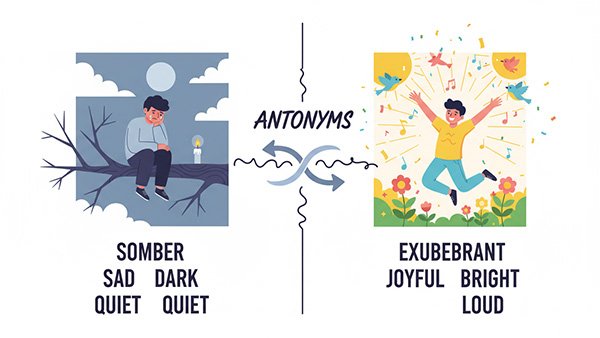
Somber is an adjective that describes a state of being serious, grave, or gloomy. It often implies a lack of cheerfulness or brightness. The word can be used to describe a person’s mood, the atmosphere of a place, or the tone of a piece of writing. It suggests a weightiness or oppressiveness that can be emotionally affecting.
It is common for people to search for the opposite of somber or ask, “what is the antonym of somber?” While some might assume that antonym of somber is gloomy, this is incorrect because “gloomy” shares a similar tone with somber. Correct antonyms for somber in English include words that convey happiness, brightness, or lightheartedness. Exploring the full range of antonyms for the word somber ensures clarity in writing and helps convey the intended emotional tone accurately.
The function of “somber” is to add depth and emotional color to descriptions. It helps to convey a sense of gravity, seriousness, or melancholy.
It can be used in both formal and informal contexts, although it is more commonly found in formal writing and speech due to its relatively elevated vocabulary level.
In various contexts, “somber” can evoke different nuances. For instance, a “somber” piece of music might be characterized by slow tempos and minor keys, while a “somber” expression on someone’s face could indicate sadness or contemplation.
The word is versatile and can be applied to various aspects of human experience and the world around us.
Structural Breakdown: Understanding Word Roots and Affixes
While “somber” itself doesn’t have a readily identifiable root in English or Latin, understanding word roots and affixes can help us better understand the nuances of its antonyms. Many words we use are built from smaller parts, and analyzing these parts can unlock deeper meanings and connections.
For example, prefixes like “un-“, “in-“, or “dis-” can negate the meaning of a word, while suffixes like “-ful”, “-ness”, or “-ity” can change a word’s part of speech or add specific connotations.
Consider the antonym “joyful.” The suffix “-ful” indicates “full of,” so “joyful” means “full of joy.” Similarly, understanding that “optimistic” is related to “opt” (to choose) helps us see that it means choosing to see the positive side of things. By breaking down words into their component parts, we can gain a more intuitive understanding of their meanings and how they relate to one another.
By recognizing these structural elements, we can more easily identify and understand new words, as well as appreciate the subtle differences between synonyms and antonyms. This knowledge is especially valuable for language learners and writers seeking to expand their vocabulary and improve their expressive abilities.
Types of Antonyms for Somber
The opposite of “somber” can be expressed through a variety of words, each with its own specific nuance. These antonyms can be broadly categorized into words that describe joy, lightheartedness, brightness, and optimism.
Understanding these different categories can help you choose the most appropriate antonym for a given context.
Joyful Antonyms
These antonyms emphasize a sense of happiness, delight, and exuberance. They suggest a state of being filled with positive emotions and a general sense of well-being.
Words in this category include: joyful, happy, elated, ecstatic, jubilant, delighted, cheerful, merry, gleeful, and jovial.
Lighthearted Antonyms
These antonyms focus on a sense of carefree amusement and a lack of seriousness. They suggest a relaxed and playful attitude, free from worry or burden.
Examples include: lighthearted, cheerful, blithe, carefree, jovial, whimsical, frivolous, playful, mirthful, and buoyant.
Bright Antonyms
These antonyms highlight a sense of luminosity, radiance, and vividness. They can refer to both literal brightness and a figurative sense of hope and optimism.
Words in this category include: bright, radiant, luminous, vibrant, vivid, sunny, cheerful, gleaming, sparkling, and brilliant.
Optimistic Antonyms
These antonyms emphasize a positive outlook and a belief in a favorable future. They suggest a hopeful and confident attitude, even in the face of challenges.
Examples include: optimistic, hopeful, positive, sanguine, confident, enthusiastic, buoyant, cheerful, assured, and promising.
Examples of Antonyms in Sentences
To illustrate how these antonyms are used in practice, let’s examine several examples in sentences. These examples will demonstrate the subtle differences in meaning and usage between the various antonyms of “somber.” Each category will be presented with a table containing 20-30 examples.
Joyful Antonyms Examples
The following table illustrates the use of joyful antonyms of “somber” in various sentences.
| Sentence |
|---|
| The wedding celebration was joyful, filled with laughter and dancing. |
| She felt happy when she received the good news. |
| He was elated after winning the competition. |
| The crowd was ecstatic when their team scored the winning goal. |
| The atmosphere at the festival was jubilant. |
| She was delighted to see her old friends again. |
| The children were cheerful as they played in the park. |
| The holiday season is a time to be merry. |
| The children were gleeful as they opened their presents. |
| He was a jovial host, always making sure his guests were comfortable. |
| The end-of-year party was incredibly joyful. |
| Winning the lottery made her incredibly happy. |
| He was elated to be accepted into his dream university. |
| The fans were ecstatic after the unexpected victory. |
| The concert ended with a jubilant encore. |
| She was delighted by the surprise birthday party. |
| The atmosphere in the room was cheerful and inviting. |
| They spent a merry Christmas with family and friends. |
| The children were gleeful when they saw the ice cream truck. |
| He was a jovial character, always telling jokes and making people laugh. |
| The reunion was a joyful occasion for everyone involved. |
| She was genuinely happy to see her hard work pay off. |
| He was elated by the positive feedback on his project. |
| The entire city was ecstatic after winning the championship. |
| The graduation ceremony was a jubilant celebration of achievement. |
Lighthearted Antonyms Examples
The following table provides sentence examples showcasing lighthearted antonyms.
| Sentence |
|---|
| The picnic had a lighthearted atmosphere, with games and laughter. |
| She maintained a cheerful disposition, even during difficult times. |
| He had a blithe attitude towards life, never taking things too seriously. |
| They spent a carefree afternoon at the beach. |
| He was a jovial companion, always ready with a joke. |
| The children enjoyed the whimsical decorations at the party. |
| Her comments were frivolous and meant to lighten the mood. |
| The puppy was playful, chasing its tail and jumping around. |
| The comedian’s performance was mirthful and had the audience roaring with laughter. |
| She felt buoyant after receiving the encouraging news. |
| The summer festival was filled with lighthearted fun and games. |
| Despite the challenges, she remained cheerful and optimistic. |
| He had a blithe disregard for the rules, much to his friends’ amusement. |
| They enjoyed a carefree vacation, free from all responsibilities. |
| The atmosphere at the gathering was jovial and festive. |
| The artist created a series of whimsical illustrations. |
| His remarks were intended to be frivolous and entertaining. |
| The kittens were incredibly playful, batting at anything that moved. |
| The play was a mirthful comedy that delighted the audience. |
| She felt buoyant and optimistic about the future. |
| The atmosphere at the party was lighthearted and relaxed. |
| He was known for his cheerful demeanor and positive attitude. |
| She had a blithe spirit and a contagious laugh. |
| They spent a carefree day exploring the city. |
| The host was jovial and welcoming, making everyone feel at ease. |
Bright Antonyms Examples
The subsequent table showcases examples of bright antonyms in sentences.
| Sentence |
|---|
| The sun was bright, filling the room with light. |
| She had a radiant smile that lit up her face. |
| The city was luminous at night, with all the lights twinkling. |
| The painting was vibrant, with bold and striking colors. |
| The garden was vivid with flowers of every hue. |
| The sky was sunny, a perfect day for a picnic. |
| She had a cheerful disposition, always looking on the bright side. |
| The jewelry was gleaming under the spotlight. |
| The stars were sparkling in the night sky. |
| He was a brilliant student, excelling in all his subjects. |
| The room was bright and airy, thanks to the large windows. |
| Her face was radiant with joy after the announcement. |
| The city skyline was luminous against the dark sky. |
| The artist used vibrant colors to capture the energy of the scene. |
| The market was vivid with the sights and sounds of local vendors. |
| It was a sunny afternoon, perfect for a stroll in the park. |
| He always had a cheerful word for everyone he met. |
| The trophies were gleaming on the shelf. |
| Her eyes were sparkling with excitement. |
| She was a brilliant scientist, making groundbreaking discoveries. |
| The future looked bright with possibilities. |
| She had a radiant personality that drew people to her. |
| The city was especially luminous during the holiday season. |
| The artist’s use of vibrant colors was truly inspiring. |
| The garden was vivid and full of life. |
Optimistic Antonyms Examples
The table below provides example sentences using optimistic antonyms.
| Sentence |
|---|
| She was optimistic about the future, despite the challenges. |
| He remained hopeful that things would get better. |
| She had a positive attitude towards life. |
| He was sanguine about his chances of success. |
| She was confident that she would pass the exam. |
| He was enthusiastic about the new project. |
| She felt buoyant after receiving the good news. |
| He was cheerful, always looking on the bright side. |
| She was assured of her abilities. |
| The forecast was promising, suggesting better weather ahead. |
| Despite the setbacks, she remained optimistic and determined. |
| He was hopeful that they could find a solution. |
| She tried to maintain a positive outlook, even in difficult times. |
| He was sanguine about the company’s prospects. |
| She was confident in her team’s ability to succeed. |
| He was enthusiastic about the opportunity to travel. |
| She felt buoyant and full of energy. |
| He was always cheerful, spreading joy to those around him. |
| She was assured of her place in the competition. |
| The initial results were promising, suggesting a successful outcome. |
| She approached the challenge with an optimistic mindset. |
| He was hopeful for a positive resolution to the conflict. |
| She tried to stay positive despite the negative news. |
| He was sanguine about the future of renewable energy. |
| She was confident in her ability to overcome any obstacle. |
Usage Rules for Antonyms
Using antonyms effectively requires understanding the nuances of both the original word and its opposite. Understanding an emphasis antonym is useful when contrasting words like somber with cheerful or bright. Using emphasis antonyms effectively can highlight differences in tone and mood, adding depth to your writing or speech.
While many words have clear antonyms, context is crucial in determining the most appropriate choice.
For example, while “happy” is a general antonym for “sad,” it might not be the best choice to contrast with a more specific term like “despondent.”
Consider the following guidelines:
- Understand the context: Pay attention to the specific situation and the intended meaning.
- Consider the degree of opposition: Some antonyms are direct opposites, while others are more nuanced.
- Avoid using antonyms that don’t fit the tone: Choose words that are appropriate for the overall style and register of your writing.
- Use a thesaurus as a guide: A thesaurus can provide a range of antonyms, but always double-check their meanings and usage in a dictionary.
Common Mistakes When Using Antonyms
One common mistake is using antonyms that are too general or don’t accurately reflect the intended meaning. For example, using “happy” as an antonym for “grief-stricken” might not fully capture the depth of the emotion being contrasted.
Another mistake is using antonyms that don’t fit the context. For instance, using “bright” as an antonym for “somber” in a discussion about emotions might be inappropriate; “joyful” or “lighthearted” would be more suitable.
Here are some examples of correct and incorrect usage:
| Incorrect | Correct | Explanation |
|---|---|---|
| The funeral was happy. | The funeral was somber. | “Happy” is an inappropriate antonym in this context; “somber” is the correct word to describe the atmosphere. |
| The dark room was joyful. | The bright room was joyful. | “Dark” and “bright” are opposites. “Joyful” describes the atmosphere. |
| He felt bright after failing the test. | He felt somber after failing the test. | “Bright” is inappropriate here; “somber” conveys the correct emotion. |
Practice Exercises
Test your understanding of antonyms for “somber” with these practice exercises. Choose the best antonym from the options provided to complete each sentence.
Exercise 1: Choose the best antonym for “somber” in each sentence.
| Question | Options | Answer |
|---|---|---|
| The atmosphere at the party was the opposite of somber; it was truly _____. | a) gloomy b) joyful c) serious d) grave | b) joyful |
| Instead of a somber mood, the room was filled with _____ laughter. | a) sad b) lighthearted c) serious d) solemn | b) lighthearted |
| The painting was not somber; it was _____ with vibrant colors. | a) dull b) dark c) bright d) muted | c) bright |
| Despite the challenges, she remained _____ about the future. | a) pessimistic b) somber c) optimistic d) doubtful | c) optimistic |
| The music was far from somber; it was lively and _____. | a) depressing b) cheerful c) mournful d) grave | b) cheerful |
| His demeanor was not somber, but rather _____ and engaging. | a) reserved b) serious c) jovial d) solemn | c) jovial |
| The event was a _____ celebration, the opposite of a somber occasion. | a) mournful b) gloomy c) jubilant d) grave | c) jubilant |
| She felt _____ after receiving the good news, a stark contrast to her somber mood earlier. | a) sad b) depressed c) elated d) grave | c) elated |
| The room, once somber, was now _____ with sunlight. | a) dim b) dark c) luminous d) shaded | c) luminous |
| He was _____ about the project’s success, a complete opposite of feeling somber about it. | a) uncertain b) doubtful c) confident d) worried | c) confident |
Exercise 2: Rewrite the following sentences, replacing the word “somber” with an appropriate antonym.
| Original Sentence | Rewritten Sentence |
|---|---|
| The funeral was a somber occasion. | The funeral was a joyful occasion. (Note: This might require a change in context to make sense). |
| He had a somber expression on his face. | He had a cheerful expression on his face. |
| The room was filled with a somber atmosphere. | The room was filled with a lighthearted atmosphere. |
| She felt somber after hearing the bad news. | She felt optimistic after hearing the good news. (Note: Context change). |
| The music was somber and slow. | The music was bright and lively. |
| The painting had a somber tone. | The painting had a vibrant tone. |
| The meeting began with a somber announcement. | The meeting began with a promising announcement. |
| The play was known for its somber themes. | The play was known for its whimsical themes. |
| His somber mood was contagious. | His cheerful mood was contagious. |
| The city felt somber after the storm. | The city felt bright after the cleanup. |
Advanced Topics: Nuances and Context
At a more advanced level, understanding the subtleties of language becomes crucial. Antonyms are not always perfect opposites, and the best choice depends heavily on the specific context and the intended nuance.
For example, “cheerful” and “jovial” are both antonyms of “somber,” but “cheerful” suggests a general sense of happiness, while “jovial” implies a more outgoing and sociable kind of cheerfulness.
Furthermore, the use of antonyms can be a powerful rhetorical device. By contrasting a somber situation with a hopeful alternative, writers can create a stronger emotional impact and persuade their audience more effectively.
Understanding these advanced concepts can elevate your writing and communication skills to a higher level.
Exploring idioms and figurative language associated with both “somber” and its antonyms can also deepen your understanding. For instance, “a ray of sunshine” is a common idiom for something that brings joy and brightness into a somber situation.
Recognizing these expressions can enrich your vocabulary and improve your ability to understand and use language creatively.
Frequently Asked Questions
Here are some frequently asked questions about antonyms and the opposite of “somber.”
What is the best antonym for “somber”?
The best antonym depends on the context. “Joyful,” “lighthearted,” “bright,” and “optimistic” are all possibilities, each with its own specific nuance.
Are there any words that are both synonyms and antonyms of “somber”?
Not directly. However, some words might have overlapping meanings in certain contexts. It’s essential to consider the specific nuance you want to convey.
How can I improve my vocabulary of antonyms?
Read widely, use a thesaurus and dictionary regularly, and practice using new words in sentences. Pay attention to how authors use antonyms to create contrast and emphasis.
Is it always necessary to use an antonym when trying to convey the opposite of “somber”?
No. Sometimes, rephrasing the sentence or using a different construction can be more effective.
Can the opposite of “somber” be expressed through actions or behaviors?
Yes. Actions like laughing, smiling, or celebrating can convey the opposite of a somber mood.
How does the cultural context affect the use of antonyms for “somber”?
Cultural norms can influence the expression of emotions and the appropriateness of certain words. Be mindful of cultural differences when choosing antonyms.
Why is understanding antonyms important for language learning?
Understanding antonyms enriches vocabulary, enhances comprehension, and improves the ability to express oneself with greater precision and clarity. It helps in grasping the nuances of language and using words effectively in different contexts.
Are there any online resources that can help me find antonyms for different words?
Yes, many online resources are available, such as thesauruses like Thesaurus.com and Merriam-Webster’s Thesaurus, as well as dictionaries that provide antonyms along with definitions. These tools can be invaluable for expanding vocabulary and improving language skills.
Conclusion
Exploring the antonyms of “somber” provides a valuable insight into the richness and complexity of the English language. By understanding the nuances of words like “joyful,” “lighthearted,” “bright,” and “optimistic,” we can express ourselves more accurately and effectively.
This knowledge is essential for language learners, writers, and anyone seeking to enhance their communication skills.
Remember that context is key when choosing the most appropriate antonym. Consider the specific situation, the intended meaning, and the overall tone of your writing.
With practice and attention to detail, you can master the art of using antonyms to create contrast, emphasis, and emotional impact in your communication.