

Mastering various ways to greet someone during different times of the day is crucial for effective communication in English. While “Good afternoon” is a perfectly acceptable greeting, knowing alternative phrases can make your interactions more engaging and contextually appropriate.
This article delves into the nuances of expressing “good afternoon” in diverse ways, suitable for formal, informal, and specific situations. Whether you’re a student, a professional, or simply looking to enhance your English vocabulary, this guide will equip you with the knowledge and practice needed to confidently use these greetings.
Understanding how to choose the right phrase not only improves your communication skills but also displays cultural awareness and social intelligence.
Table of Contents
- Introduction
- Definition of “Good Afternoon”
- Structural Breakdown
- Types and Categories of Greetings
- Examples of Greetings
- Usage Rules and Guidelines
- Common Mistakes to Avoid
- Practice Exercises
- Advanced Topics and Nuances
- Frequently Asked Questions
- Conclusion
Definition of “Good Afternoon”
Recommended Products


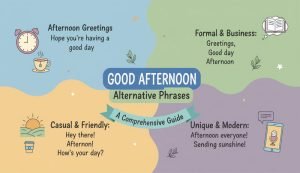
“Good afternoon” is a standard greeting used in the English language to express goodwill and acknowledge someone’s presence during the afternoon hours. It generally applies from noon (12:00 PM) until around 6:00 PM, although the exact timeframe can vary depending on cultural norms and individual interpretation.
Although “Good afternoon” is widely understood, questions often arise about the exact good afternoon time and when to say good afternoon appropriately. In general usage, it begins right after noon and continues until early evening, but social context matters just as much as the clock. In workplaces, many people continue using “Good afternoon” up to 5:30 or 6:00 PM, while in casual settings, some may switch to “Good evening” earlier based on lighting, atmosphere, or local habits. Paying attention to cues such as meeting schedules, email timestamps, or how others greet you can help determine the most natural transition point.
The phrase is composed of two words: “good,” expressing positive sentiment, and “afternoon,” referring to the period of the day following noon and preceding evening.
The primary function of “good afternoon” is to initiate a conversation or interaction in a polite and respectful manner. It sets a positive tone and indicates that you are acknowledging the person you are addressing.
The context in which it is used is crucial; it is suitable for both formal and informal settings, although the level of formality may influence the tone and delivery of the greeting. In professional environments, it is often used as a standard greeting during meetings, phone calls, or email correspondence.
In more casual settings, it can be used among friends, family, or acquaintances.
Structural Breakdown
The phrase “Good afternoon” follows a simple structural pattern: Adjective + Noun.
* Good: This is an adjective that modifies the noun “afternoon.” It expresses a positive sentiment or wish for the afternoon to be pleasant.
* Afternoon: This is a noun that refers to the period of the day between noon and evening. It specifies the timeframe to which the greeting applies.
The simplicity of this structure makes it easy to understand and use. However, variations in tone and delivery can significantly impact the perceived formality and sincerity of the greeting.
For instance, a more enthusiastic delivery might be appropriate in a casual setting, while a more reserved tone might be preferred in a formal context. The addition of other phrases, such as “How are you?” or “I hope you’re having a good day,” can further enhance the greeting and make it more personalized.
Types and Categories of Greetings
There are several ways to categorize greetings that can be used instead of or alongside “Good afternoon.” These categories are based on formality, context, and specific situations.
Formal Greetings
Formal greetings are appropriate for professional environments, interactions with superiors, or when addressing someone you don’t know well. These greetings tend to be more polite and respectful, maintaining a certain level of distance.
Informal Greetings
Informal greetings are suitable for friends, family, close colleagues, or casual acquaintances. These greetings are more relaxed and often include personal touches or friendly inquiries.
Situational Greetings
Situational greetings are specific to particular circumstances or events. These greetings often include references to the activity taking place or express well wishes related to the situation.
Using “Good Afternoon, Everyone” in Group Settings
The phrase “good afternoon, everyone” is commonly used when addressing a group rather than an individual. It is especially effective in meetings, presentations, classrooms, webinars, and public announcements where inclusivity and clarity are important. By adding “everyone,” the speaker acknowledges the entire audience at once, setting a respectful and organized tone from the outset.
This greeting works well in both formal and semi-formal environments. In corporate meetings or academic settings, it often signals the official start of a session, while in community gatherings or online events, it creates a sense of shared attention. Tone plays a key role here; a calm, confident delivery suits professional contexts, whereas a warmer tone may be more appropriate for informal group interactions.
Using “good afternoon everyone” also helps establish authority and structure, particularly when transitioning from casual conversation into focused discussion. When paired with a follow-up sentence—such as outlining an agenda or welcoming participants—it becomes a practical and socially polished way to engage multiple listeners at once.
Examples of Greetings
Here are some examples of different ways to say “Good afternoon,” categorized by formality and situation. These examples demonstrate the versatility of greetings and how they can be tailored to different contexts.
Formal Greeting Examples
Formal greetings are essential in professional settings or when addressing individuals with respect. The following table provides examples of formal greetings that can be used in place of or in addition to “Good afternoon.”
| Formal Greeting | Context/Usage |
|---|---|
| Good afternoon, Mr./Ms./Dr. [Last Name]. | Addressing someone with their title and last name. |
| I hope you’re having a productive afternoon. | Expressing a wish for a successful afternoon. |
| It’s a pleasure to see you this afternoon. | Expressing pleasure at meeting someone. |
| Good afternoon, how may I assist you? | Offering assistance in a professional setting. |
| I trust your afternoon is going well. | Expressing hope that the person’s afternoon is positive. |
| Good afternoon, may I present [Name]? | Introducing someone formally. |
| Good afternoon, I’m delighted to meet you. | Expressing delight upon meeting someone. |
| Good afternoon, thank you for your time this afternoon. | Showing gratitude for someone’s time. |
| Good afternoon, I appreciate your promptness. | Acknowledging someone’s punctuality. |
| Good afternoon, please have a seat. | Offering someone a seat in a formal setting. |
| Good afternoon, let’s begin the meeting. | Starting a meeting formally. |
| Good afternoon, I’m calling regarding… | Starting a formal phone conversation. |
| Good afternoon, this is [Your Name] from [Company]. | Introducing yourself in a business call. |
| Good afternoon, I’m following up on… | Referring to a previous conversation or email. |
| Good afternoon, I hope this email finds you well. | Starting a formal email. |
| Good afternoon, I’m writing to inquire about… | Formally asking for information. |
| Good afternoon, I’d like to introduce myself. | Introducing yourself in a professional context. |
| Good afternoon, I’m here for the appointment with… | Announcing your arrival for a meeting. |
| Good afternoon, I’m looking forward to our discussion. | Expressing anticipation for a conversation. |
| Good afternoon, I hope you had a pleasant morning. | Referring to the earlier part of the day. |
| Good afternoon, I’m calling to confirm… | Confirming details in a formal setting. |
| Good afternoon, I’m pleased to be here today. | Expressing pleasure at attending an event. |
| Good afternoon, I’m honored to be speaking with you. | Showing respect and honor during a conversation. |
| Good afternoon, I trust you are well. | Expressing concern for someone’s well-being. |
| Good afternoon, I’m available to answer any questions. | Offering assistance and information. |
| Good afternoon, I’m here to present… | Introducing a presentation. |
| Good afternoon, I’m responsible for… | Defining your role or responsibility. |
| Good afternoon, I’m eager to learn more about… | Expressing enthusiasm to learn. |
| Good afternoon, I’m happy to collaborate with you. | Expressing willingness to work together. |
This table provides a comprehensive list of formal greetings, demonstrating how to address individuals respectfully and professionally in various situations.
Informal Greeting Examples
Informal greetings are used in casual settings with friends, family, or close colleagues. These greetings are more relaxed and often include personal inquiries.
The table below provides examples of informal greetings suitable for such contexts.
| Informal Greeting | Context/Usage |
|---|---|
| Hey, how’s your afternoon going? | A casual and friendly inquiry. |
| Afternoon! What’s up? | A short and informal greeting. |
| Hi, how’s it going this afternoon? | A friendly and slightly more detailed inquiry. |
| Hey there! Enjoying the afternoon? | A cheerful and engaging greeting. |
| Afternoon! Anything exciting happening? | Inquiring about interesting events. |
| Hi! How’s your day been so far? | Asking about the person’s day up to that point. |
| Hey! What are you up to this afternoon? | Inquiring about current activities. |
| Afternoon! Long time no see! | Greeting someone you haven’t seen in a while. |
| Hi! Glad to catch you this afternoon. | Expressing pleasure at connecting with the person. |
| Hey! Just wanted to say good afternoon. | A simple and friendly greeting. |
| Afternoon! Ready for the weekend? | Referring to the upcoming weekend. |
| Hi! Did you have a good lunch? | Inquiring about the person’s lunch. |
| Hey! How’s everything going? | A general inquiry about the person’s well-being. |
| Afternoon! How’s the family? | Asking about the person’s family. |
| Hi! What have you been doing? | Inquiring about recent activities. |
| Hey! Still working hard? | A lighthearted inquiry about work. |
| Afternoon! How are things? | A simple and direct inquiry. |
| Hi! Good to see you! | Expressing pleasure at seeing the person. |
| Hey! What’s new? | Inquiring about recent news or updates. |
| Afternoon! How’s life treating you? | A more philosophical inquiry about life. |
| Hi! Hope you’re having a good one! | Expressing hope for a positive day. |
| Hey! What’s the good word? | Inquiring about positive news. |
| Afternoon! Catching any rays? | Referring to sunny weather. |
| Hi! Still kicking? | A playful and informal inquiry. |
| Hey! How’s your project coming along? | Inquiring about a specific project. |
| Afternoon! Managed to relax at all? | Asking if the person has had any downtime. |
| Hi! What’s the latest? | Inquiring about the most recent news. |
| Hey! Nice to run into you! | Expressing pleasure at a chance encounter. |
This table offers a variety of informal greetings that can be used to create a friendly and welcoming atmosphere in casual conversations.
Situational Greeting Examples
Situational greetings are tailored to specific circumstances or events. These greetings often reference the context of the situation or express well wishes related to the activity taking place.
The following table provides examples of situational greetings.
| Situational Greeting | Context/Usage |
|---|---|
| Good afternoon, everyone. Let’s get started with the meeting. | Starting a meeting. |
| Good afternoon, I hope you’re enjoying the conference. | At a conference or event. |
| Good afternoon, are you ready for your appointment? | In a medical or professional appointment setting. |
| Good afternoon, welcome to our establishment. | Greeting customers at a business. |
| Good afternoon, I’m here to help you with your order. | Assisting customers in a retail setting. |
| Good afternoon, I hope you’re having a lovely walk. | Greeting someone during a walk in the park. |
| Good afternoon, are you finding everything you need? | Assisting customers in a store. |
| Good afternoon, I trust you had a good lunch break. | Greeting someone after their lunch break. |
| Good afternoon, let’s continue where we left off. | Resuming a task or conversation. |
| Good afternoon, I hope the presentation was informative. | After a presentation. |
| Good afternoon, ready to begin the training session? | Starting a training session. |
| Good afternoon, are you ready to check in? | At a hotel or reception desk. |
| Good afternoon, may I see your ticket? | At a concert or event entrance. |
| Good afternoon, I hope you’re enjoying the weather. | Referring to the current weather. |
| Good afternoon, I’m here to conduct the interview. | Starting an interview. |
| Good afternoon, let’s review the agenda. | Beginning a meeting with an agenda. |
| Good afternoon, I hope you found everything alright. | Checking on a customer’s shopping experience. |
| Good afternoon, I’ll be your server today. | Greeting customers in a restaurant. |
| Good afternoon, are you ready to order? | Taking an order in a restaurant. |
| Good afternoon, I’m here to deliver your package. | Delivering a package. |
| Good afternoon, I hope you’re enjoying the game. | At a sporting event. |
| Good afternoon, let’s start the rehearsal. | Starting a rehearsal. |
| Good afternoon, I’m here for the consultation. | Arriving for a consultation. |
| Good afternoon, I hope you had a safe trip. | Greeting someone after a journey. |
| Good afternoon, I’m here to inspect the property. | Conducting an inspection. |
| Good afternoon, let’s begin the tour. | Starting a tour. |
| Good afternoon, I’m here to provide support. | Offering assistance or support. |
| Good afternoon, let’s discuss the project progress. | Discussing project progress. |
| Good afternoon, I hope you’re having a good experience. | Ensuring a positive experience. |
This table demonstrates how greetings can be tailored to specific situations, enhancing the interaction and showing attentiveness to the context.
Usage Rules and Guidelines
Using “Good afternoon” and its alternatives correctly involves understanding the nuances of time, formality, and context. Here are some key rules and guidelines to follow:
* Time of Day: “Good afternoon” is generally used from 12:00 PM (noon) to 6:00 PM. After 6:00 PM, “Good evening” is more appropriate.
* Formality: Consider the relationship with the person you are addressing. Use formal greetings in professional settings or when addressing superiors, and informal greetings with friends and family.
* Context: Tailor your greeting to the specific situation. Use situational greetings that reference the activity or event taking place.
* Tone: Adjust your tone of voice to match the formality of the greeting. A more enthusiastic tone is suitable for informal greetings, while a more reserved tone is appropriate for formal greetings.
* Cultural Sensitivity: Be aware of cultural differences in greeting customs. Some cultures may have specific protocols or expectations regarding greetings.
* Adding Personal Touches: Enhance your greeting by adding personal touches, such as asking about the person’s well-being or mentioning something specific to their situation.
* Avoid Overuse: While “Good afternoon” is a versatile greeting, avoid using it excessively in a short period. Vary your greetings to keep the conversation engaging.
* Response: Be prepared to respond appropriately when someone greets you. A simple “Good afternoon” or a more detailed response is usually sufficient.
Common Mistakes to Avoid
Even with a clear understanding of the rules, common mistakes can occur when using “Good afternoon” and its alternatives. Here are some frequent errors to avoid:
| Incorrect | Correct | Explanation |
|---|---|---|
| Good afternoon at 9:00 AM. | Good morning. | Using “Good afternoon” before noon is incorrect. |
| Hey, Good afternoon, Mr. Smith. | Good afternoon, Mr. Smith. | Avoid mixing informal and formal greetings. |
| Good afternoon, what you want? | Good afternoon, how may I assist you? | Use proper grammar and vocabulary in formal settings. |
| Afternoon! How you doing? | Afternoon! How are you doing? | Ensure correct grammar even in informal greetings. |
| Good afternoon. (No response) | Good afternoon. (Response: Good afternoon!) | Always acknowledge and respond to greetings. |
| Good afternoon in the email without any other text. | Good afternoon, I am writing to inquire about… | Always include the purpose of the email. |
| Good afternoon to your night! | Good afternoon to you! | Avoid mixing time-of-day greetings. |
| Good afternoon, I hope you are good. | Good afternoon, I hope you are well. | Use “well” when asking about someone’s health or state of being. |
| Good afternoon, I want the report. | Good afternoon, could you please send me the report? | Always be polite when making requests, especially in formal settings. |
| Afternoon, sir. (Too informal) | Good afternoon, sir. | “Good” is necessary to show respect in formal settings. |
By avoiding these common mistakes, you can ensure that your greetings are appropriate and effective in any situation.
Practice Exercises
Test your understanding of “Good afternoon” and its alternatives with these practice exercises. Choose the most appropriate greeting for each scenario.
| Question | Possible Answers | Correct Answer |
|---|---|---|
| You are meeting your boss at 3:00 PM. | a) Hey, what’s up? b) Good afternoon, Mr. Smith. c) Afternoon! | b) Good afternoon, Mr. Smith. |
| You are greeting a friend at 4:00 PM. | a) Good afternoon. b) Hey, how’s it going? c) Good afternoon, Ms. Johnson. | b) Hey, how’s it going? |
| You are starting a meeting at 2:00 PM. | a) Afternoon! b) Good afternoon, everyone. Let’s get started. c) Hi! | b) Good afternoon, everyone. Let’s get started. |
| You are greeting a customer at your store at 5:00 PM. | a) Hey! b) Good afternoon, welcome to our store. c) What’s up? | b) Good afternoon, welcome to our store. |
| You are sending an email to a colleague at 3:30 PM. | a) Hi! b) Good afternoon, I hope this email finds you well. c) What’s new? | b) Good afternoon, I hope this email finds you well. |
| You are greeting a family member at 1:00 PM. | a) Good afternoon. b) Hey, how’s your day been so far? c) Good afternoon, Dr. Jones. | b) Hey, how’s your day been so far? |
| You are greeting someone you haven’t seen in a while at 2:00 PM. | a) Afternoon! Long time no see! b) Good afternoon, sir. c) Hey! | a) Afternoon! Long time no see! |
| You are greeting a hotel guest at 4:00 PM. | a) Afternoon! b) Good afternoon, are you ready to check in? c) What’s up? | b) Good afternoon, are you ready to check in? |
| You are starting a presentation at 3:00 PM. | a) Hi! b) Good afternoon, I hope the presentation was informative. c) Good afternoon, everyone. | c) Good afternoon, everyone. |
| You are responding to someone who greeted you with “Good afternoon” at 5:00 PM. | a) Hey! b) Good afternoon! c) What’s new? | b) Good afternoon! |
These exercises will help you practice choosing the most appropriate greeting in various scenarios, reinforcing your understanding of the rules and guidelines.
Advanced Topics and Nuances
For advanced learners, understanding the subtle nuances and cultural contexts of greetings can further enhance communication skills. Here are some advanced topics to consider:
* Regional Variations: Be aware that greeting customs can vary significantly between different regions and countries. Research the specific customs of the region you are visiting or interacting with.
* Nonverbal Communication: Pay attention to nonverbal cues, such as body language and facial expressions, as they can significantly impact the perception of your greeting.
* Historical Context: Understanding the historical origins of certain greetings can provide deeper insights into their meaning and usage.
* Social Dynamics: Consider the social dynamics of the situation, such as the age, gender, and status of the individuals involved, when choosing a greeting.
* Humor and Sarcasm: Use humor and sarcasm cautiously in greetings, as they can easily be misinterpreted, especially in formal settings.
Frequently Asked Questions
Here are some frequently asked questions about using “Good afternoon” and its alternatives:
What is the appropriate time to use “Good afternoon”?
“Good afternoon” is typically used from 12:00 PM (noon) to 6:00 PM. However, this can vary depending on personal and regional customs. Some people might switch to “Good evening” earlier, especially if it’s getting dark.
Is it rude to say “Hey” instead of “Good afternoon” in a formal setting?
Yes, using “Hey” in a formal setting is generally considered impolite. It’s best to use formal greetings such as “Good afternoon” or “Good afternoon, Mr./Ms./Dr. [Last Name]” to show respect.
How do I respond when someone greets me with “Good afternoon”?
A simple “Good afternoon” in return is usually sufficient. You can also add “How are you?” or “How’s your day going?” to make the response more engaging.
Can I use “Good afternoon” in an email?
Yes, “Good afternoon” is appropriate for starting an email, especially in professional correspondence. You can follow it with a brief introduction or the purpose of your email, such as “Good afternoon, I hope this email finds you well. I am writing to inquire about…”
What should I say if I’m not sure whether it’s afternoon or evening?
If you’re unsure, it’s safer to use a more general greeting like “Hello” or “Hi.” These greetings are appropriate for any time of day and avoid the risk of using the wrong time-specific greeting.
Is it okay to use slang in place of “Good afternoon” with close friends?
Yes, with close friends, using slang or informal greetings is perfectly acceptable. Phrases like “What’s up?” or “How’s it going?” are common and friendly.
How can I make my “Good afternoon” greeting more personal?
To make your greeting more personal, you can add a specific inquiry related to the person or situation. For example, “Good afternoon, I hope you had a great lunch,” or “Good afternoon, are you enjoying the conference?”
Are there any cultural differences in using “Good afternoon”?
Yes, greeting customs can vary significantly between cultures. In some cultures, a handshake or bow may accompany the greeting. Research the specific customs of the region you are interacting with to ensure you are being respectful.
Conclusion
Mastering various ways to say “Good afternoon” enhances your communication skills and allows you to interact effectively in diverse settings. Understanding the nuances of formality, context, and cultural sensitivity is crucial for choosing the most appropriate greeting.
By practicing different greetings and avoiding common mistakes, you can confidently express goodwill and build positive relationships.
Remember to consider the time of day, your relationship with the person you are addressing, and the specific situation when choosing a greeting. Adding personal touches and being aware of cultural differences can further enhance your communication skills.
Keep practicing, and you’ll become proficient in using a wide range of greetings in any situation. Good luck, and may your afternoons be filled with positive interactions!