Understanding the nuances between “align to” and “align with” is crucial for precise and effective communication in English. While both phrases relate to agreement or correspondence, they are not always interchangeable.
Choosing the correct phrase depends on the context and the specific relationship you want to convey. This article provides a comprehensive guide to mastering the usage of “align to” and “align with,” clarifying their distinct meanings, exploring various contexts, and offering practical examples.
Whether you’re an ESL learner, a student, or a professional seeking to refine your writing skills, this guide will equip you with the knowledge and confidence to use these phrases accurately and effectively.
This guide will provide a detailed breakdown of each phrase, coupled with numerous examples and practice exercises to solidify your understanding. By the end of this article, you’ll be able to confidently differentiate between “align to” and “align with” and use them appropriately in any situation.
Table of Contents
- Definition: Align To vs. Align With
- Structural Breakdown
- Types and Categories of Alignment
- Examples of Usage
- Usage Rules: When to Use Each Phrase
- Common Mistakes to Avoid
- Practice Exercises
- Advanced Topics
- Frequently Asked Questions (FAQ)
- Conclusion
Definition: Align To vs. Align With
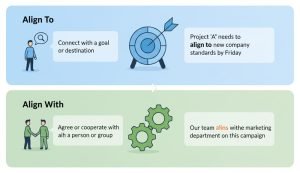
The phrases “align to” and “align with” both indicate a state of agreement, correspondence, or conformity. However, the nature of this agreement and the context in which it is used differ significantly.
Understanding these differences is key to using the phrases correctly.
Readers often wonder whether to use “align with or align to” and even “align to or with” interchangeably. While both combinations are commonly queried online, it’s important to note that the choice depends entirely on the context: “align to” emphasizes adherence to a standard, while “align with” emphasizes harmony or agreement. Similarly, when comparing past actions, phrases like “aligned with or aligned to” follow the same distinction, ensuring clarity whether you describe past compliance or collaboration.
Align To: Definition and Usage
“Align to” generally implies a more direct and often mandatory conformity to a specific standard, rule, or guideline. It suggests a process of bringing something into compliance with a predetermined target.
This phrase often appears in technical, business, or regulatory contexts where adherence to a set of standards is crucial. The emphasis is on ensuring that something *matches* a specific, often external, requirement.
For example, a company might “align its practices to industry standards” to ensure compliance and maintain a competitive edge. Similarly, a software program might “align its output to a specific data format” to ensure compatibility with other systems.
This usage highlights the action of adjusting something to meet a specific, often externally imposed, criterion.
Align With: Definition and Usage
“Align with,” on the other hand, suggests a more voluntary and often collaborative agreement or similarity. It implies a shared direction, purpose, or set of values.
This phrase is often used in contexts where there is a degree of choice or where the alignment is based on mutual benefit or shared ideals. The emphasis is on creating a sense of harmony or agreement between two or more entities.
For instance, a political party might “align with another party” to form a coalition based on shared policy goals. Similarly, an individual might “align with a particular cause” because they believe in its values and objectives.
This usage emphasizes the sense of choosing to be in agreement or harmony with something, rather than being forced to conform.
Understanding “Align With” Meaning
While “align to” is primarily about compliance with an external standard, the phrase “align with” carries a subtler, more voluntary meaning. To align with someone or something implies agreement, shared objectives, or harmony rather than strict conformity.
For instance, aligning with a company’s mission means acting in a way that supports shared values, whereas aligning to its regulations means following prescribed rules. Recognizing this distinction is crucial for clear communication, particularly in professional, political, or personal contexts where collaboration and voluntary agreement are emphasized.
Structural Breakdown
Both “align to” and “align with” follow a similar grammatical structure, but understanding the elements involved helps clarify their usage.
Basic Sentence Structure
The basic structure for both phrases is as follows:
[Subject] + align + [to/with] + [Object/Noun Phrase]
The subject is the entity performing the action of aligning. The verb is “align,” which can be conjugated to reflect different tenses (e.g., aligns, aligned, will align). The preposition is either “to” or “with,” which determines the nature of the alignment. The object/noun phrase is the standard, rule, person, or thing to which or with which the subject is aligning.
Examples of Structural Breakdown
Here are some examples illustrating the structural breakdown:
- The company (subject) + aligns (verb) + to (preposition) + industry standards (object).
- The software (subject) + will align (verb) + to (preposition) + the new data format (object).
- The political party (subject) + aligned (verb) + with (preposition) + the Green Party (object).
- She (subject) + aligns (verb) + with (preposition) + the principles of sustainable living (object).
Types and Categories of Alignment
The concept of alignment can be categorized based on the context in which it occurs. Understanding these categories can further clarify the appropriate use of “align to” and “align with.”
Technical Alignment
Technical alignment refers to the process of ensuring that systems, processes, or data formats are compatible and work together seamlessly. This often involves adhering to specific standards or protocols.
Example: The software developers had to align the new application to the existing database schema.
Business Alignment
Business alignment involves ensuring that business strategies, goals, and processes are in harmony to achieve overall organizational objectives. This might involve aligning departmental goals, aligning business processes with IT infrastructure, or aligning marketing efforts with sales strategies.
Example: The company decided to align its marketing strategy with its sustainability goals to attract environmentally conscious consumers.
Political Alignment
Political alignment refers to the process of forming alliances or coalitions between political parties or individuals who share similar ideologies or policy goals. This can involve aligning voting records, supporting common legislation, or forming joint platforms.
Example: The two political parties decided to align with each other on key environmental issues to increase their chances of passing legislation.
Personal Alignment
Personal alignment refers to the process of aligning one’s values, beliefs, and actions to live a more authentic and fulfilling life. This can involve aligning personal goals with career aspirations, aligning spending habits with financial goals, or aligning relationships with personal values.
Example: She strives to align her daily actions with her core values of compassion and integrity.
Examples of Usage
To further illustrate the nuances of “align to” and “align with,” here are several examples categorized by context.
Technical Context Examples
Here are several examples of “align to” and “align with” in a technical context. The examples highlight situations where systems, data, or processes need to conform to specific standards or protocols.
The table below provides examples of “align to” and “align with” within a technical context. Notice how ‘align to’ is used when referring to standards and specifications, while ‘align with’ is used more broadly.
| Phrase | Example Sentence |
|---|---|
| Align To | The software must align to the ISO 27001 security standard. |
| Align To | The database schema needs to align to the new data specifications. |
| Align To | The robot’s movements must align to the programmed trajectory. |
| Align To | The sensor data needs to align to the calibration parameters. |
| Align To | The communication protocol must align to the TCP/IP standard. |
| Align To | The printer settings must align to the document’s formatting requirements. |
| Align To | The GPS coordinates must align to the mapping system’s reference points. |
| Align To | The code needs to align to the coding guidelines established by the team. |
| Align To | The server configuration must align to the security baseline. |
| Align To | The test results must align to the acceptance criteria. |
| Align With | The new system should align with the existing IT infrastructure. |
| Align With | The data integration process needs to align with the company’s data governance policies. |
| Align With | The project’s technical roadmap should align with the overall business objectives. |
| Align With | The user interface design should align with the principles of usability and accessibility. |
| Align With | The security measures should align with the potential threats and vulnerabilities. |
| Align With | The development workflow should align with the Agile methodology. |
| Align With | The technology stack should align with the company’s long-term strategic vision. |
| Align With | The system architecture should align with the scalability requirements. |
| Align With | The documentation should align with the industry best practices. |
| Align With | The testing strategy should align with the quality assurance standards. |
| Align To | The robot’s sensor data must align to the pre-defined error margin. |
| Align With | The software architecture should align with the principles of modular design. |
Business Context Examples
The following examples illustrate the use of “align to” and “align with” in a business context, focusing on strategic alignment, compliance, and marketing efforts.
The table below showcases examples of ‘align to’ and ‘align with’ in business settings. Note that ‘align to’ often relates to regulations and goals, while ‘align with’ indicates broader compatibility.
| Phrase | Example Sentence |
|---|---|
| Align To | The company must align to the new GDPR regulations. |
| Align To | All departments need to align to the company’s strategic goals. |
| Align To | The project timeline must align to the critical path analysis. |
| Align To | The budget allocation should align to the priority projects. |
| Align To | The performance metrics must align to the key performance indicators (KPIs). |
| Align With | The marketing campaign should align with the company’s brand values. |
| Align With | The sales strategy needs to align with the customer’s needs and expectations. |
| Align With | The company’s mission statement should align with its core values. |
| Align With | The HR policies should align with the principles of diversity and inclusion. |
| Align With | The corporate culture should align with the company’s vision for the future. |
| Align To | The financial reports must align to the GAAP accounting standards. |
| Align To | The production process should align to the lean manufacturing principles. |
| Align To | The risk management plan must align to the industry best practices. |
| Align To | The data security protocols need to align to the NIST cybersecurity framework. |
| Align To | The employee training programs should align to the competency requirements. |
| Align With | The customer service approach should align with the company’s commitment to excellence. |
| Align With | The supply chain management should align with the sustainability initiatives. |
| Align With | The product development roadmap should align with the market trends. |
| Align With | The leadership style should align with the principles of servant leadership. |
| Align With | The organizational structure should align with the company’s growth strategy. |
| Align To | The company’s hiring practices must align to the equal opportunity employment laws. |
| Align With | The company’s CSR initiatives should align with the UN’s Sustainable Development Goals. |
Political Context Examples
The examples below illustrate the use of “align to” and “align with” in political contexts, highlighting alliances, policy agreements, and ideological similarities.
The table below presents examples of using ‘align to’ and ‘align with’ in political discourse. ‘Align to’ is used when referring to rules and constitutional principles, while ‘align with’ highlights agreements among groups.
| Phrase | Example Sentence |
|---|---|
| Align To | The new law must align to the constitution. |
| Align To | The government’s policies need to align to international treaties. |
| Align To | The election procedures should align to the established electoral laws. |
| Align To | The political campaign must align to the campaign finance regulations. |
| Align To | The diplomatic efforts should align to the principles of international law. |
| Align With | The political party decided to align with the labor union on key issues. |
| Align With | The senator’s voting record typically aligns with the conservative wing of the party. |
| Align With | The protesters’ demands align with the principles of social justice. |
| Align With | The international coalition aims to align with the UN’s peacekeeping efforts. |
| Align With | The NGO’s mission is to align with the global efforts to combat climate change. |
| Align To | The judicial rulings must align to the principles of legal precedent. |
| Align To | The public policies should align to the principles of democratic governance. |
| Align To | The international sanctions must align to the UN Security Council resolutions. |
| Align To | The refugee resettlement programs should align to the international humanitarian laws. |
| Align To | The human rights advocacy efforts must align to the Universal Declaration of Human Rights. |
| Align With | The grassroots movement seeks to align with the progressive political organizations. |
| Align With | The peace negotiations aim to align with the aspirations of the affected communities. |
| Align With | The advocacy group’s agenda is to align with the interests of marginalized populations. |
| Align With | The diplomatic strategy should align with the long-term geopolitical objectives. |
| Align With | The international aid programs should align with the needs of the recipient countries. |
| Align To | The government’s data collection practices must align to privacy laws. |
| Align With | The candidate’s rhetoric strongly aligns with nationalist sentiments. |
Usage Rules: When to Use Each Phrase
The correct usage of “align to” and “align with” hinges on the context and the intended meaning. Here’s a breakdown of the key rules:
When to Use “Align To”
Use “align to” when you want to emphasize conformity to a specific standard, rule, or guideline. This phrase is appropriate when there is a clear target or benchmark that something must match.
It often implies a mandatory or necessary adjustment.
- Compliance: Use “align to” when referring to compliance with regulations, standards, or legal requirements.
- Technical Specifications: Use “align to” when referring to technical specifications, data formats, or protocols.
- Direct Conformity: Use “align to” when emphasizing the need for something to directly match or adhere to a specific criterion.
When to Use “Align With”
Use “align with” when you want to emphasize agreement, harmony, or shared objectives. This phrase is appropriate when there is a sense of voluntary cooperation or when the alignment is based on mutual benefit or shared values.
It often implies a collaborative or harmonious relationship.
- Shared Objectives: Use “align with” when referring to shared goals, objectives, or purposes.
- Agreement or Harmony: Use “align with” when emphasizing agreement, consistency, or harmony between two or more entities.
- Values and Principles: Use “align with” when referring to alignment with values, principles, or beliefs.
Common Mistakes to Avoid
One of the most common mistakes is using “align to” and “align with” interchangeably, assuming they have the same meaning. This can lead to confusion and miscommunication.
Another common mistake is using the wrong preposition based on a misunderstanding of the context.
Here are some examples of common mistakes and their corrections:
| Incorrect | Correct | Explanation |
|---|---|---|
| The company’s values must align to its mission statement. | The company’s values must align with its mission statement. | Values should agree with the mission statement, not conform to it as a standard. |
| The software needs to align with the industry standards. | The software needs to align to the industry standards. | Software must conform to industry standards to be compliant. |
| The political parties aligned to each other on the issue of healthcare. | The political parties aligned with each other on the issue of healthcare. | Parties agree with each other, not conform to each other as a standard. |
| My personal goals need to align to my career aspirations. | My personal goals need to align with my career aspirations. | Personal goals should be in harmony with career aspirations, not forced into compliance. |
Practice Exercises
Test your understanding of “align to” and “align with” with these practice exercises.
Exercise 1: Fill in the Blanks
Fill in the blanks with the appropriate preposition: “to” or “with.”
| Question | Answer |
|---|---|
| 1. The project plan needs to ___________ the company’s overall strategy. | align with |
| 2. The new building must ___________ the city’s building codes. | align to |
| 3. The company’s marketing efforts should ___________ its target audience’s values. | align with |
| 4. The software update will ___________ the latest security protocols. | align to |
| 5. The employees’ goals should ___________ the company’s objectives. | align with |
| 6. The product design must ___________ the customer’s requirements. | align to |
| 7. The organization’s actions should ___________ its stated mission. | align with |
| 8. The experimental data must ___________ the theoretical predictions. | align to |
| 9. The research findings need to ___________ the existing scientific literature. | align with |
| 10. The safety procedures must ___________ the industry’s best practices. | align to |
Exercise 2: Correct the Sentence
Correct the sentences below that use “align to” or “align with” incorrectly.
| Question | Answer |
|---|---|
| 1. The company’s mission statement must align to its values. | The company’s mission statement must align with its values. |
| 2. The new regulations require all businesses to align with the environmental standards. | The new regulations require all businesses to align to the environmental standards. |
| 3. The political parties aligned to each other’s platforms to form a coalition. | The political parties aligned with each other’s platforms to form a coalition. |
| 4. The artist’s vision aligns to the principles of classical art. | The artist’s vision aligns with the principles of classical art. |
| 5. The project timeline needs to align with the critical path analysis. | The project timeline needs to align to the critical path analysis. |
| 6. The student’s essay must align with the professor’s instructions. | The student’s essay must align to the professor’s instructions. |
| 7. The company’s marketing strategy should align to the latest trends. | The company’s marketing strategy should align with the latest trends. |
| 8. The NGO’s goals must align to the United Nations’ Sustainable Development Goals. | The NGO’s goals must align with the United Nations’ Sustainable Development Goals. |
| 9. The security protocols must align with the ISO 27001 standard. | The security protocols must align to the ISO 27001 standard. |
| 10. The employee’s performance should align to the job description. | The employee’s performance should align with the job description. |
Advanced Topics
For advanced learners, exploring the nuances of “align to” and “align with” in more complex contexts can be beneficial.
Combining “Align To” and “Align With”
In some cases, it may be appropriate to use both “align to” and “align with” in the same sentence to convey a more nuanced meaning. This often involves aligning *to* a specific standard while simultaneously aligning *with* a broader set of values or objectives.
Example: The company’s environmental policies must align to the EPA’s regulations while also aligning with the company’s commitment to sustainability.
Formal vs. Informal Usage
While the core meanings of “align to” and “align with” remain consistent, their usage may vary slightly in formal versus informal contexts. In formal writing and speech, it is important to adhere strictly to the usage rules outlined above.
In more informal contexts, the distinction may be less rigid, but accuracy is still important for clear communication.
Acception vs. Exception: Understanding the Difference
A common point of confusion in English is distinguishing between “acception” and “exception.” Though they sound similar, their meanings diverge significantly. An **exception** refers to something that does not follow a general rule, standard, or expectation. For example, “All team members must submit reports on time, but John is an exception due to his travel schedule.” In contrast, **acception** is an archaic or formal term meaning the act of accepting or the meaning assigned to a word in a particular context. For instance, “The acception of ‘run’ in this sentence implies movement, not operation of a program.”
Understanding this distinction is crucial for clear writing and precise communication, especially in professional, legal, or academic contexts. Remember: when in doubt, use **exception** for cases that deviate from the norm, and reserve **acception** for nuanced meanings or formal usage in textual analysis.
This clarification complements the earlier discussion on aligning to standards or with values, as both alignment and exceptions involve careful consideration of rules, conformity, and interpretation.
Frequently Asked Questions (FAQ)
Here are some frequently asked questions about the usage of “align to” and “align with.”
Is it ever acceptable to use “align to” and “align with” interchangeably?
While there might be instances where the distinction seems subtle, it’s generally best to avoid using them interchangeably. The specific context usually dictates which preposition is more appropriate to convey the intended meaning. Using the correct preposition ensures clarity and precision in your communication.
Can “align to” be used in contexts other than technical or business settings?
“Align to” is most commonly used in technical, business, or regulatory contexts where conformity to a specific standard or rule is emphasized. However, it can be used in other contexts where a similar sense of mandatory compliance is intended. For example, “The athlete trained rigorously to align to the coach’s expectations.”
Is “align with” always voluntary, or can it be mandatory?
While “align with” often implies a voluntary agreement, it can also be used in situations where there is a strong expectation or requirement to agree, even if not strictly mandatory. For example, “As a team member, you are expected to align with the team’s goals.”
What is the difference between “in alignment with” and “align with”?
“In alignment with” is a more formal and emphatic way of saying “align with.” Both phrases convey the same basic meaning of agreement or harmony, but “in alignment with” adds a layer of formality and emphasis. “The company’s strategy is in alignment with its long-term vision” sounds more formal than “The company’s strategy aligns with its long-term vision.”
How can I improve my understanding of when to use each phrase?
The best way to improve your understanding is through practice and exposure. Pay attention to how native English speakers use these phrases in different contexts. Read articles, books, and other materials, and note the specific situations in which “align to” and “align with” are used. Also, try writing your own sentences using each phrase and ask a native speaker to review them.
Can I use ‘align to’ when referring to abstract concepts, like emotions or feelings?
While it is less common, you can use ‘align to’ with abstract concepts if you are referring to a standard or ideal that one is trying to meet. For instance, “He tried to align his actions to his sense of justice,” implies he was actively making sure his actions met a certain standard of justice he held.
Are there any regional differences in the usage of ‘align to’ and ‘align with’?
While the core meanings remain consistent across different English-speaking regions, there might be slight variations in frequency of use or specific contexts. However, the fundamental rules of when to use each phrase generally apply regardless of regional differences. Always prioritize clarity and accuracy in your communication.
How does the use of ‘align’ differ from similar words like ‘conform’ or ‘correspond’?
While ‘align,’ ‘conform,’ and ‘correspond’ all relate to agreement, they each have distinct nuances. ‘Conform’ often implies a more forceful or obligatory adjustment to fit a standard, while ‘correspond’ suggests a direct similarity or equivalence. ‘Align’ is more flexible, indicating a process of adjustment to harmonize with either a standard (‘align to’) or a shared goal (‘align with’.)
Conclusion
Mastering the distinction between “align to” and “align with” is essential for clear and precise communication in English. “Align to” emphasizes conformity to a specific standard or rule, while “align with” highlights agreement, harmony, or shared objectives.
By understanding these nuances and practicing their usage, you can enhance your writing and speaking skills and avoid common mistakes.
Remember to consider the context and the intended meaning when choosing between these phrases. Pay attention to how native English speakers use them and practice writing your own sentences.
With consistent effort, you can confidently and accurately use “align to” and “align with” in any situation.