
The complete subject is a fundamental element of sentence structure, crucial for clear and effective communication. Mastering this concept allows you to identify the core actor or topic of a sentence, understand how sentences are built, and avoid common grammatical errors.
This article provides a comprehensive guide to the complete subject, covering its definition, structure, types, usage rules, and common mistakes. It is designed for English language learners of all levels, from beginners seeking to grasp the basics to advanced students aiming to refine their understanding and usage.
Table of Contents
- Introduction
- Definition of the Complete Subject
- Structural Breakdown
- Types and Categories of Complete Subjects
- Examples of Complete Subjects
- Usage Rules for Complete Subjects
- Common Mistakes with Complete Subjects
- Practice Exercises
- Advanced Topics
- Frequently Asked Questions (FAQ)
- Conclusion
Definition of the Complete Subject
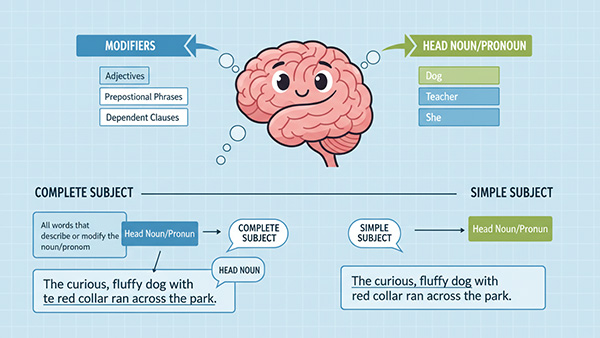
The complete subject includes the simple subject and all the words associated with it. It encompasses the main noun or pronoun performing the action or being described, along with any modifiers, such as adjectives, adverbs, and phrases, that provide additional information. The complete subject, therefore, represents the entire group of words that identifies who or what the sentence is about. Recognizing the complete subject is essential for understanding sentence structure and meaning.
In grammatical terms, the complete subject definition refers to the simple subject together with all words that modify or describe it. To define complete subject clearly, it is the full noun phrase that tells who or what the sentence is about. When asking what is a complete subject in grammar, the answer lies in identifying both the core noun or pronoun and every word attached to it.
In essence, the complete subject answers the question “Who or what is performing the action?” or “Who or what is being described?” It is a broader concept than the simple subject, which only consists of the noun or pronoun itself. The complete subject provides a more detailed picture of the entity involved in the sentence.
When learners ask what is the complete subject of a sentence, they are seeking the full group of words that names the topic being discussed. This includes the simple subject along with any modifiers that clarify or limit its meaning.
For example, in the sentence “The tall, old oak tree swayed in the wind,” the complete subject is “The tall, old oak tree.” The simple subject is “tree,” but the complete subject includes all the words that describe and identify which tree is being discussed.
Structural Breakdown
The structure of the complete subject can be broken down into the following components:
- Simple Subject: The core noun or pronoun. This is the essential element.
- Modifiers: Words or phrases that describe or limit the simple subject. These can include adjectives, adverbs, prepositional phrases, and participial phrases.
- Determiners: Articles (a, an, the) and other words that specify which noun is being referred to (e.g., this, that, these, those, my, his, her).
Understanding how these components work together is crucial for identifying the complete subject in complex sentences. The determiner usually comes first, followed by modifiers, and then the simple subject.
However, the order can vary depending on the specific sentence structure. Prepositional phrases can also act as modifiers, adding further detail to the subject.
For instance, in the sentence “My favorite blue sweater is missing,” “sweater” is the simple subject. “My” is a possessive determiner, “favorite” and “blue” are adjectives modifying the sweater. Therefore, the complete subject is “My favorite blue sweater.”
Let’s consider another example: “The book on the top shelf belongs to Sarah.” Here, “book” is the simple subject. “The” is a definite article, and “on the top shelf” is a prepositional phrase modifying the book. The complete subject is “The book on the top shelf.” These examples illustrate how the complete subject provides a fuller picture than the simple subject alone.
Types and Categories of Complete Subjects
Complete subjects can be categorized based on the number of simple subjects they contain:
Simple Subject
A complete subject with only one simple subject is called a simple complete subject. It consists of the simple subject and its modifiers.
Examples:
- The old car needs repairs.
- My little sister loves to sing.
- That big dog is barking loudly.
Compound Subject
A complete subject with two or more simple subjects joined by a conjunction (such as and, or, nor) is called a compound complete subject. Each simple subject in a compound subject may also have its own modifiers.
Examples:
- John and Mary are going to the party.
- The cat and the dog are playing together.
- My brother and his friend are visiting us.
It’s important to note that even with a compound subject, the entire group of words that identifies who or what the sentence is about constitutes the complete subject. In the example “The tall boy and the short girl are friends,” the complete subject is “The tall boy and the short girl,” which includes two simple subjects (boy and girl) along with their respective modifiers.
Examples of Complete Subjects
To further illustrate the concept, here are several examples of complete subjects in different sentence contexts.
For learners looking for clear complete subject examples, each sentence in this section highlights how modifiers expand the simple subject. If you are wondering what is a complete subject example, consider “The small, wooden table,” where descriptive words add detail to the core noun. These examples show how identifying the full subject improves sentence analysis.
The following table contains sentences with simple complete subjects. Each sentence highlights the complete subject, and the simple subject is identified for clarity.
| Sentence | Complete Subject | Simple Subject |
|---|---|---|
| The blue bird sang sweetly. | The blue bird | bird |
| My old bicycle needs a new tire. | My old bicycle | bicycle |
| That delicious chocolate cake disappeared quickly. | That delicious chocolate cake | cake |
| The rusty old gate creaked in the wind. | The rusty old gate | gate |
| Her bright red umbrella stood out in the crowd. | Her bright red umbrella | umbrella |
| The small, wooden table wobbled slightly. | The small, wooden table | table |
| Our friendly neighbor waved hello. | Our friendly neighbor | neighbor |
| That old, abandoned house looks haunted. | That old, abandoned house | house |
| The long, winding road led to the village. | The long, winding road | road |
| His new, expensive car gleamed in the sun. | His new, expensive car | car |
| The fluffy white clouds drifted lazily across the sky. | The fluffy white clouds | clouds |
| My favorite coffee shop is always crowded. | My favorite coffee shop | shop |
| The tall, green grass swayed in the breeze. | The tall, green grass | grass |
| Her beautiful, antique necklace sparkled. | Her beautiful, antique necklace | necklace |
| The old, leather-bound book smelled of must. | The old, leather-bound book | book |
| Our new computer works very fast. | Our new computer | computer |
| That spicy Thai food was delicious. | That spicy Thai food | food |
| The clear blue water looked inviting. | The clear blue water | water |
| His loud, booming voice echoed in the hall. | His loud, booming voice | voice |
| The adorable little puppy played in the garden. | The adorable little puppy | puppy |
| The ancient Roman ruins attract many tourists. | The ancient Roman ruins | ruins |
| My comfortable, old shoes are perfect for walking. | My comfortable, old shoes | shoes |
| The fragrant, blooming flowers filled the air. | The fragrant, blooming flowers | flowers |
| His impressive stamp collection is worth a lot. | His impressive stamp collection | collection |
The following table provides examples of sentences with compound complete subjects. Note how each compound subject consists of multiple simple subjects joined by a conjunction.
| Sentence | Complete Subject | Simple Subjects |
|---|---|---|
| John and Mary went to the store. | John and Mary | John, Mary |
| The cat and the dog are sleeping. | The cat and the dog | cat, dog |
| My sister and her friend are coming over. | My sister and her friend | sister, friend |
| Coffee and tea are my favorite drinks. | Coffee and tea | Coffee, tea |
| The teacher and the students worked hard. | The teacher and the students | teacher, students |
| My mom and dad are going on vacation. | My mom and dad | mom, dad |
| The book and the pen are on the table. | The book and the pen | book, pen |
| Pizza and pasta are Italian dishes. | Pizza and pasta | Pizza, pasta |
| The sun and the moon are celestial bodies. | The sun and the moon | sun, moon |
| My brother and I went to the movies. | My brother and I | brother, I |
| The car and the truck are parked outside. | The car and the truck | car, truck |
| My aunt and uncle live in Florida. | My aunt and uncle | aunt, uncle |
| The rain and the wind made it difficult to drive. | The rain and the wind | rain, wind |
| My phone and my wallet are missing. | My phone and my wallet | phone, wallet |
| The singer and the band performed well. | The singer and the band | singer, band |
| The actor and the director collaborated on the film. | The actor and the director | actor, director |
| My cat and her kittens are adorable. | My cat and her kittens | cat, kittens |
| The house and the garden look beautiful. | The house and the garden | house, garden |
| My friend and her sister are going to college. | My friend and her sister | friend, sister |
| The flowers and the trees are blooming. | The flowers and the trees | flowers, trees |
| My parents and grandparents are visiting. | My parents and grandparents | parents, grandparents |
| The ocean and the beach are lovely. | The ocean and the beach | ocean, beach |
| My shoes and socks are wet. | My shoes and socks | shoes, socks |
| The birds and the bees are buzzing around. | The birds and the bees | birds, bees |
The following table displays more intricate examples, showcasing how prepositional phrases and multiple modifiers can enrich the complete subject.
| Sentence | Complete Subject | Simple Subject |
|---|---|---|
| The old man with the cane walked slowly. | The old man with the cane | man |
| The book on the top shelf is mine. | The book on the top shelf | book |
| My favorite coffee shop in town is always busy. | My favorite coffee shop in town | shop |
| The tall building across the street is the bank. | The tall building across the street | building |
| The girl with the red hair is my sister. | The girl with the red hair | girl |
| The car parked in the driveway belongs to my neighbor. | The car parked in the driveway | car |
| The flowers in the vase are from my garden. | The flowers in the vase | flowers |
| The students in the class are very intelligent. | The students in the class | students |
| The movie playing at the theater is a comedy. | The movie playing at the theater | movie |
| The house with the blue door is for sale. | The house with the blue door | house |
| The coffee from that shop tastes great. | The coffee from that shop | coffee |
| The shoes on the floor are mine. | The shoes on the floor | shoes |
| The cake with the chocolate frosting is delicious. | The cake with the chocolate frosting | cake |
| The song on the radio is my favorite. | The song on the radio | song |
| The train to Chicago is delayed. | The train to Chicago | train |
| The dog in the yard is barking. | The dog in the yard | dog |
| The letter from my friend arrived today. | The letter from my friend | letter |
| The picture on the wall is a painting. | The picture on the wall | picture |
| The water in the pool is cold. | The water in the pool | water |
| The food at that restaurant is amazing. | The food at that restaurant | food |
| The people in the line are waiting. | The people in the line | people |
| The trees in the forest are tall. | The trees in the forest | trees |
| The music at the party is loud. | The music at the party | music |
| The sun in the sky is bright. | The sun in the sky | sun |
Usage Rules for Complete Subjects
Several rules govern the proper use of complete subjects:
Agreement with the Verb: The verb in a sentence must agree in number with the simple subject within the complete subject. If the simple subject is singular, the verb must be singular; if the simple subject is plural, the verb must be plural. For example: “The cat sleeps” (singular) vs. “The cats sleep” (plural).
Placement: While the subject typically appears before the verb, this is not always the case. In questions, the subject may follow the verb or be interrupted by an auxiliary verb. For example: “Is the blue car yours?“
Compound Subjects: When a compound subject is joined by “and,” it generally takes a plural verb. However, if the parts of the subject refer to the same person or thing, a singular verb is used. For example: “John and Mary are coming” vs. “The singer and songwriter is performing tonight” (one person).
Intervening Phrases: Phrases that come between the subject and verb do not affect subject-verb agreement. The verb must agree with the simple subject, not with any nouns in the intervening phrase. For example: “The box of chocolates is on the table” (singular verb agreeing with “box“).
Collective Nouns: Collective nouns (e.g., team, family, group) can be singular or plural, depending on whether they are acting as a single unit or as individual members. If the collective noun acts as a single unit, it takes a singular verb; if the members are acting individually, it takes a plural verb. For example: “The team is playing well” (single unit) vs. “The team are arguing about the strategy” (individual members).
Common Mistakes with Complete Subjects
Here are some common mistakes learners make when dealing with complete subjects:
- Incorrect Subject-Verb Agreement: This is one of the most frequent errors. Ensure that the verb agrees with the simple subject, not a nearby noun in a modifying phrase.
- Incorrect: The list of items are on the table.
- Correct: The list of items is on the table.
- Misidentifying the Simple Subject: Sometimes, it’s easy to be confused by long, descriptive complete subjects. Always isolate the core noun or pronoun.
- Incorrect: The big, fluffy dogs runs quickly.
- Correct: The big, fluffy dogs run quickly.
- Ignoring Intervening Phrases: Remember that phrases between the subject and the verb don’t change the agreement.
- Incorrect: The car, along with its spare tires, are ready to go.
- Correct: The car, along with its spare tires, is ready to go.
- Treating Compound Singular Subjects as Plural: Two singular subjects joined by ‘and’ usually take a plural verb, but not always.
- Incorrect: Peanut butter and jelly is making me sick.
- Correct: Peanut butter and jelly makes a great sandwich. (Here, it’s treated as one item)
Practice Exercises
Test your understanding with these exercises. Identify the complete subject in each sentence.
| Question | Answer |
|---|---|
| 1. The tall, green tree swayed in the wind. | The tall, green tree |
| 2. My little sister loves to play outside. | My little sister |
| 3. The old, wooden house needs repairs. | The old, wooden house |
| 4. John and Mary are going to the movies. | John and Mary |
| 5. The cat and the dog are sleeping soundly. | The cat and the dog |
| 6. The book on the top shelf is very interesting. | The book on the top shelf |
| 7. My favorite coffee shop is always crowded. | My favorite coffee shop |
| 8. The car parked in the driveway is mine. | The car parked in the driveway |
| 9. The students in the class are very attentive. | The students in the class |
| 10. The movie playing at the theater is a comedy. | The movie playing at the theater |
Exercise 2: Choose the correct verb form to agree with the complete subject.
| Question | Answer |
|---|---|
| 1. The box of chocolates (is/are) on the table. | is |
| 2. The students in the class (is/are) studying hard. | are |
| 3. John and Mary (is/are) coming to the party. | are |
| 4. The cat, along with its kittens, (is/are) sleeping. | is |
| 5. My favorite book (is/are) on the nightstand. | is |
| 6. The flowers in the vase (is/are) beautiful. | are |
| 7. The car parked outside (is/are) mine. | is |
| 8. The teacher and the students (is/are) working together. | are |
| 9. Coffee and tea (is/are) my favorite drinks. | are |
| 10. Peanut butter and jelly (is/are) a classic combination. | is |
Exercise 3: Identify the simple subject within the complete subject.
| Question | Answer |
|---|---|
| 1. The old, wooden table needs to be repaired. | table |
| 2. My younger brother enjoys playing video games. | brother |
| 3. The rusty, abandoned car sat in the yard. | car |
| 4. Her favorite black dress was ruined. | dress |
| 5. The tall, green grass grew quickly. | grass |
| 6. His new, expensive watch was stolen. | watch |
| 7. The clear blue water looked inviting. | water |
| 8. Their friendly old dog barked at the mailman. | dog |
| 9. The spicy, hot soup burned my tongue. | soup |
| 10. Our next-door neighbor is very kind. | neighbor |
Advanced Topics
For advanced learners, consider these more complex aspects of complete subjects:
- Elliptical Clauses: In some sentences, parts of the complete subject are omitted but understood. These are called elliptical clauses. For example: “He is taller than I” (the complete subject of the second clause is “I am,” but “am” is omitted).
- Inverted Sentences: In inverted sentences, the subject follows the verb. Identifying the complete subject in these sentences requires careful analysis. For example: “There is a cat on the roof” (the complete subject is “a cat“).
- Nominal Clauses as Subjects: Entire clauses can function as the complete subject of a sentence. For example: “What he said is not true” (the complete subject is “What he said“).
Frequently Asked Questions (FAQ)
What is the difference between a simple subject and a complete subject?
The simple subject is the main noun or pronoun that performs the action or is being described. The complete subject includes the simple subject and all its modifiers, providing a fuller description of who or what the sentence is about.
How do I identify the complete subject in a sentence?
Ask yourself “Who or what is performing the action?” or “Who or what is being described?” The answer to this question is the complete subject. Look for the main noun or pronoun and all the words associated with it.
Does the complete subject always come before the verb?
No, the complete subject usually comes before the verb, but in questions and inverted sentences, it may follow the verb or be interrupted by auxiliary verbs.
What is a compound subject, and how does it affect verb agreement?
A compound subject consists of two or more simple subjects joined by a conjunction (usually “and,” “or,” or “nor“). When joined by “and,” it typically takes a plural verb. However, if the parts of the subject refer to the same person or thing, a singular verb is used.
How do intervening phrases affect subject-verb agreement?
Intervening phrases that come between the subject and verb do not affect subject-verb agreement. The verb must agree with the simple subject, not with any nouns in the intervening phrase.
What are collective nouns, and how do they affect verb agreement?
Collective nouns (e.g., team, family, group) can be singular or plural, depending on whether they are acting as a single unit or as individual members. If the collective noun acts as a single unit, it takes a singular verb; if the members are acting individually, it takes a plural verb.
What is an elliptical clause, and how does it relate to the complete subject?
In elliptical clauses, parts of the complete subject are omitted but understood. Identifying the complete subject requires understanding the implied words.
Can an entire clause function as the complete subject of a sentence?
Yes, nominal clauses can function as the complete subject of a sentence. These clauses act as a single noun unit.
Conclusion
Understanding the complete subject is essential for mastering English grammar. By recognizing the components of the complete subject, including the simple subject and its modifiers, you can build grammatically correct and clear sentences.
Pay attention to subject-verb agreement, the placement of the subject, and the impact of intervening phrases. By practicing the concepts and avoiding common mistakes, you can significantly improve your writing and speaking skills.
Remember to identify the core noun or pronoun and all associated words to accurately pinpoint the complete subject.
Continue to practice identifying complete subjects in various contexts. Analyze complex sentences and pay attention to how modifiers and phrases contribute to the meaning of the subject.
With consistent effort, you will develop a strong understanding of this fundamental grammatical concept.