Understanding antonyms of “focused” is crucial for expressing a wide range of ideas related to attention, concentration, and clarity of purpose. This knowledge enhances both your receptive and expressive language skills, allowing you to comprehend nuanced meanings and articulate your thoughts with precision.
Whether you’re a student, a professional, or simply an English language enthusiast, mastering these antonyms will significantly improve your communication abilities.
This article provides a comprehensive exploration of the antonyms of “focused,” covering their definitions, structural breakdowns, types, usage rules, common mistakes, and practice exercises. By the end of this article, you will have a solid understanding of how to effectively use these words to convey different states of mind and levels of attentiveness.
Table of Contents
- Introduction
- Definition of “Focused” and Its Antonyms
- Structural Breakdown
- Types and Categories of Antonyms
- Examples
- Usage Rules
- Common Mistakes
- Practice Exercises
- Advanced Topics
- FAQ
- Conclusion
Definition of “Focused” and Its Antonyms
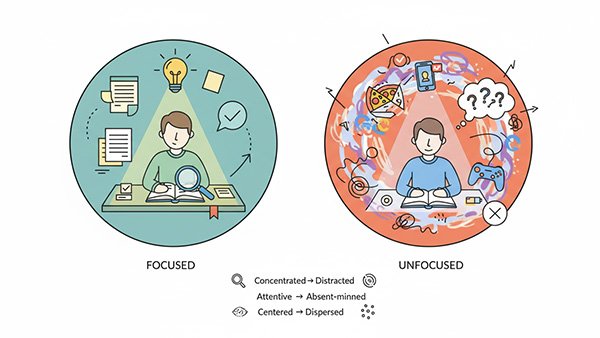
“Focused” generally means having one’s attention sharply directed or concentrated on something. It implies a clear sense of purpose and a sustained effort to achieve a specific goal.
The opposite of focused encompasses a range of states characterized by a lack of concentration, a wandering mind, or a lack of clear objectives.
When discussing words that are the opposite of focused, it’s important to understand both their literal and contextual meanings. The antonym of focus can vary depending on whether you are emphasizing attention, clarity, or purpose. For instance, someone who is scattered or inattentive illustrates an opposite to focus in practical terms.
Asking “what’s the opposite of focus?” may lead to several suitable options, including distracted, aimless, or desultory, each capturing a distinct aspect of unfocused behavior. By considering the nuance of each antonym for focus, you can choose words that accurately reflect the intended lack of concentration or direction.
Antonyms of “focused” can be classified based on the specific nuance they convey. Some antonyms emphasize a lack of attention, while others highlight a lack of direction or clarity.
Understanding these nuances is essential for choosing the most appropriate word in a given context.
Structural Breakdown
The word “focused” is the past participle of the verb “focus,” derived from the Latin word focus, meaning “hearth” or “fireplace.” In its adjectival form, “focused” describes a state of concentrated attention. Its antonyms often involve prefixes like “un-,” “in-,” “dis-,” or suffixes that convey a lack of direction or clarity.
For example:
- Distracted: Dis- (apart, away) + tract (to draw) + -ed (past participle). Meaning drawn away from something.
- Inattentive: In- (not) + attentive (paying attention). Meaning not paying attention.
- Vague: From the Latin vagus, meaning wandering.
Types and Categories of Antonyms
Several words can be used as antonyms for “focused,” each with a slightly different meaning. Understanding these nuances is crucial for effective communication.
Distracted
“Distracted” means having one’s attention diverted; unable to concentrate on something. It implies that something external or internal is pulling attention away from the primary task.
Scattered
“Scattered” suggests a lack of organization or focus; dispersed or distributed randomly. It often refers to thoughts or efforts that are not coordinated or concentrated.
Inattentive
“Inattentive” means not paying attention; heedless. It implies a general lack of attention to surroundings or tasks at hand.
Negligent
“Negligent” implies a failure to exercise the care expected of a reasonable person. While related to focus, it often involves a duty or responsibility that is being ignored due to a lack of attention or care.
Oblivious
“Oblivious” means unaware of or not noticing what is happening around one. It suggests a complete lack of awareness, often due to being preoccupied or inattentive.
Vague
“Vague” describes something that is unclear, imprecise, or lacking detail. When applied to focus, it indicates a lack of clarity in thought or purpose.
Diffuse
“Diffuse” means spread out over a wide area; not concentrated. It can describe attention or effort that is spread thinly across multiple areas, resulting in a lack of focus in any one area.
Aimless
“Aimless” means without a clear goal or purpose. It describes actions or thoughts that lack direction or a specific objective.
Desultory
“Desultory” means lacking a plan, purpose, or enthusiasm. It suggests a lack of focus and direction, often resulting in inconsistent or half-hearted efforts.
Examples
The following tables provide examples of how each antonym can be used in sentences. These examples will further illustrate the nuances of each word and help you understand their usage in different contexts.
Table 1: Examples of “Distracted” in Sentences
| Sentence | Explanation |
|---|---|
| The student was distracted by the noise outside the classroom. | External noise diverted the student’s attention. |
| She was too distracted by her personal problems to concentrate on her work. | Internal worries prevented her from focusing. |
| The driver became distracted while texting and almost caused an accident. | Texting took the driver’s attention away from the road. |
| He found it hard to stay focused during the meeting because he was so distracted. | His mind wandered, making it difficult to concentrate. |
| The child was easily distracted by bright colors and loud sounds. | The child’s attention was easily diverted. |
| I get easily distracted when I work from home. | Working from home makes it hard to concentrate. |
| She was distracted by a notification on her phone. | The notification pulled her attention away. |
| The cat was distracted by the laser pointer. | The laser pointer diverted the cat’s attention. |
| He was too distracted to notice the change in her mood. | He was not paying attention to her. |
| The speaker lost the audience because they were distracted. | The audience’s attention wandered. |
| The constant interruptions made it impossible not to be distracted. | The interruptions kept pulling attention away. |
| She tried to meditate, but her mind kept getting distracted. | Her thoughts kept wandering. |
| The flashing lights were distracting the performers on stage. | The lights diverted the performers’ attention. |
| He was so distracted by the beautiful scenery that he forgot where he was going. | The scenery diverted his attention. |
| The loud music made it hard not to be distracted. | The music pulled attention away. |
| The news report was distracting him from his studies. | He couldn’t focus on studying due to the news. |
| She found the online ads very distracting while she was trying to read an article. | The ads kept pulling her attention away from the article. |
| The dog’s barking was distracting him from his work. | He couldn’t concentrate on his work because of the dog. |
| The bright sun was distracting her as she tried to drive. | She had trouble seeing the road because of the sun. |
| The constant notifications on his phone were distracting him from his conversation. | He couldn’t fully engage in the conversation due to the phone. |
| The children were so easily distracted by the toys in the room. | The toys quickly diverted the children’s attention. |
Table 2: Examples of “Scattered” in Sentences
| Sentence | Explanation |
|---|---|
| Her thoughts were scattered, making it difficult to form a coherent argument. | Her ideas were disorganized and unfocused. |
| The student’s notes were scattered all over the desk. | The notes were disorganized and spread out. |
| The team’s efforts were scattered, leading to little progress. | The team’s efforts lacked coordination and focus. |
| His attention was scattered in too many directions to be effective. | He was trying to do too many things at once. |
| The papers were scattered across the floor after the earthquake. | The papers were spread randomly due to the earthquake. |
| Her ideas were scattered and lacked a central theme. | She had many ideas but no clear focus. |
| The evidence was scattered, making it difficult to build a case. | The evidence was disorganized and hard to find. |
| The seeds were scattered across the field. | The seeds were spread randomly. |
| His memories of the event were scattered and fragmented. | His memories were incomplete and disorganized. |
| The resources were scattered, making it hard to coordinate the project. | The resources were spread out, hindering coordination. |
| She felt scattered and overwhelmed by the number of tasks she had to complete. | She felt disorganized and unable to focus. |
| The information was scattered throughout the document, making it hard to find. | The information was spread out and difficult to locate. |
| His energy was scattered in too many directions, preventing him from achieving anything significant. | He was trying to do too much at once, leading to little progress. |
| The debris from the explosion was scattered for miles. | The debris was spread randomly over a large area. |
| Her focus was scattered due to the multiple interruptions. | She couldn’t concentrate because of the constant interruptions. |
| The toys were scattered all over the floor of the room. | The toys were spread randomly across the room. |
| His thoughts were scattered, jumping from one idea to another. | He couldn’t maintain focus on a single idea. |
| The crowd was scattered by the police. | The police dispersed the crowd. |
| Her talents were scattered, she was good at many things but master of none. | She had a wide range of skills but lacked specialization. |
| The protesters were scattered by the riot police using tear gas. | The police dispersed the protesters with tear gas. |
| The survivors were scattered after the plane crash. | The plane crash caused the survivors to be separated. |
Table 3: Examples of “Inattentive” in Sentences
| Sentence | Explanation |
|---|---|
| The inattentive student failed to grasp the key concepts. | The student didn’t pay attention and missed important information. |
| The driver was inattentive and didn’t see the stop sign. | The driver wasn’t paying attention to the road. |
| The inattentive waiter forgot to bring our drinks. | The waiter was not paying attention to the customers’ needs. |
| She was inattentive during the lecture and missed the important details. | She didn’t pay attention during the lecture. |
| The inattentive guard allowed the intruder to enter the building. | The guard was not paying attention and failed to notice the intruder. |
| He was inattentive to her feelings and didn’t notice she was upset. | He wasn’t paying attention to her emotional state. |
| The inattentive audience started to lose interest in the performance. | The audience was not engaged with the performance. |
| She was inattentive at work and made several mistakes. | She wasn’t paying attention at work and made errors. |
| The inattentive child wandered away from his parents. | The child was not paying attention to his surroundings. |
| He was inattentive to the instructions and did the task incorrectly. | He didn’t pay attention to the instructions. |
| His inattentive behavior often led to misunderstandings. | His lack of attention caused confusion. |
| The inattentive listener missed the speaker’s main point. | The listener wasn’t paying attention and missed the key idea. |
| She was so inattentive that she didn’t notice the change in the weather. | She was not paying attention to her surroundings. |
| The teacher warned the student about being inattentive in class. | The teacher told the student to pay more attention. |
| He was inattentive to the details and overlooked several important issues. | He didn’t pay attention to the specifics. |
| The inattentive intern made a critical error in the report. | The intern’s lack of focus led to a mistake. |
| She was accused of being inattentive to the needs of her clients. | She was not paying enough attention to her clients’ needs. |
| The inattentive student failed to turn in the assignment on time. | The student forgot to submit the assignment. |
| He was inattentive during the safety briefing and didn’t know what to do in an emergency. | He missed important safety information. |
| Her inattentive driving resulted in a minor fender bender. | Her lack of attention caused a car accident. |
| The inattentive editor missed several typos in the manuscript. | The editor didn’t catch the errors. |
Table 4: Examples of “Negligent” in Sentences
| Sentence | Explanation |
|---|---|
| The negligent parent left the child unattended. | The parent failed to provide adequate care and supervision. |
| The company was found negligent in its safety practices. | The company failed to maintain safe working conditions. |
| The negligent doctor failed to diagnose the patient’s illness. | The doctor didn’t provide the necessary care. |
| He was negligent in his duties and failed to complete the project on time. | He didn’t fulfill his responsibilities properly. |
| The landlord was negligent in maintaining the property. | The landlord failed to keep the property in good condition. |
| The negligent driver caused a serious accident. | The driver’s carelessness led to an accident. |
| The negligent teacher failed to report the bullying incident. | The teacher didn’t act responsibly. |
| The negligent accountant made several errors in the financial statements. | The accountant was careless with the financial records. |
| The negligent supervisor failed to provide adequate training to the employees. | The supervisor didn’t properly train the employees. |
| The negligent government official misused public funds. | The official acted irresponsibly with the money. |
| The negligent gardener forgot to water the plants. | The gardener failed to take care of the plants. |
| His negligent behavior led to serious consequences. | His carelessness had negative results. |
| The negligent mechanic failed to properly repair the car. | The mechanic didn’t fix the car correctly. |
| She was accused of being negligent in her duties as a caregiver. | She didn’t provide adequate care. |
| The negligent owner allowed the building to fall into disrepair. | The owner didn’t maintain the building. |
| The negligent administrator overlooked critical details in the contract. | The administrator’s carelessness led to a mistake. |
| He was found negligent in his handling of the confidential information. | He didn’t protect the private data. |
| The negligent construction worker failed to secure the scaffolding properly. | The worker didn’t follow safety procedures. |
| The company was sued for negligent hiring practices. | The company was accused of hiring unqualified employees. |
| His negligent actions resulted in significant financial losses. | His carelessness caused the company to lose money. |
| The negligent security guard failed to prevent the break-in. | The guard didn’t protect the building. |
Table 5: Examples of “Oblivious” in Sentences
| Sentence | Explanation |
|---|---|
| He was oblivious to the danger around him. | He was unaware of the risks. |
| She was oblivious to the fact that everyone was staring at her. | She didn’t notice the attention she was receiving. |
| The cat seemed oblivious to the loud noise. | The cat didn’t react to the sound. |
| He was so engrossed in his book that he was oblivious to everything else. | He was completely absorbed in reading. |
| She was oblivious to the subtle hints he was giving her. | She didn’t pick up on his cues. |
| The tourists were oblivious to the local customs. | The tourists were unaware of the cultural norms. |
| He walked right past her, completely oblivious to her presence. | He didn’t see her at all. |
| She was oblivious to the tension in the room. | She didn’t sense the awkward atmosphere. |
| The driver was oblivious to the pedestrian crossing the street. | The driver didn’t see the person walking. |
| He was oblivious to the fact that he was being followed. | He didn’t realize he was being tracked. |
| She was oblivious to the beauty of the sunset. | She didn’t notice the stunning view. |
| He was oblivious to the fact that he had food on his face. | He didn’t realize he was messy. |
| She was oblivious to the stares of admiration she received. | She didn’t notice people admiring her. |
| He was so focused on his work that he became oblivious to everything else happening around him. | He was completely absorbed in his task. |
| She was oblivious to the consequences of her actions. | She didn’t consider the impact of what she did. |
| He remained oblivious to the growing problem, until it was too late. | He was unaware of the issue until it became critical. |
| She was completely oblivious to the fact that she had won the lottery. | She didn’t know she had won. |
| He was so caught up in his own thoughts that he was oblivious to the world around him. | He was lost in his mind. |
| She was oblivious to the fact that her zipper was undone. | She didn’t realize her zipper was down. |
| He was oblivious to the fact that he was speaking too loudly. | He didn’t realize he was being noisy. |
| She seemed completely oblivious to the damage she had caused. | She didn’t acknowledge the harm she had done. |
Usage Rules
When choosing an antonym for “focused,” consider the specific context and the nuance you want to convey. “Distracted” implies an external or internal diversion, while “scattered” suggests a lack of organization.
“Inattentive” indicates a general lack of attention, while “negligent” implies a failure to fulfill a duty. “Oblivious” suggests a complete lack of awareness, and “vague” indicates a lack of clarity.
Example:
- Correct: The student was distracted by the noise outside.
- Incorrect: The student was oblivious by the noise outside. (Oblivious suggests a complete lack of awareness, which doesn’t fit the context of being diverted by noise.)
Common Mistakes
One common mistake is using “unfocused” when a more specific antonym would be more appropriate. While “unfocused” is grammatically correct, it lacks the nuance of words like “distracted,” “scattered,” or “inattentive.”
Another mistake is using antonyms interchangeably without considering their specific meanings. For example, using “negligent” when you mean “inattentive” can change the meaning of the sentence significantly.
Table 6: Common Mistakes and Corrections
| Incorrect | Correct | Explanation |
|---|---|---|
| He was unfocused during the meeting. | He was distracted during the meeting. | “Distracted” is more specific and suggests a reason for the lack of focus. |
| She was negligent and didn’t pay attention. | She was inattentive and didn’t pay attention. | “Negligent” implies a duty or responsibility that was ignored, while “inattentive” simply means not paying attention. |
| The idea was too scattered to understand. | The idea was too vague to understand. | “Scattered” refers to a lack of organization, while “vague” refers to a lack of clarity. |
| He was oblivious and distracted by his phone. | He was distracted by his phone. | “Oblivious” means unaware. If he was distracted by the phone, he was aware of it. |
| The presentation was diffuse and hard to follow. | The presentation was disorganized and hard to follow. | While diffuse can work, disorganized is more directly related to the issue of being hard to follow. |
Practice Exercises
Complete the following sentences with the most appropriate antonym of “focused” from the list below:
Word List: distracted, scattered, inattentive, negligent, oblivious, vague, diffuse, aimless, desultory
Exercise 1: Sentence Completion
| Question | Answer |
|---|---|
| 1. The ______ student failed to complete the assignment. | inattentive |
| 2. Her thoughts were ______, jumping from one topic to another. | scattered |
| 3. The driver was ______ to the pedestrian crossing the street. | oblivious |
| 4. The ______ parent left the child unattended in the car. | negligent |
| 5. The instructions were so ______ that no one could understand them. | vague |
| 6. He was ______ by the loud music coming from the party next door. | distracted |
| 7. The team’s efforts were ______ and lacked a clear strategy. | diffuse |
| 8. She spent the afternoon wandering around the city with an ______ sense of purpose. | aimless |
| 9. His work habits were ______, with bursts of activity followed by long periods of inactivity. | desultory |
| 10. The ______ security guard didn’t notice the intruder entering the building. | inattentive |
Exercise 2: Choose the Best Antonym
| Question | Answer |
|---|---|
| 1. The speaker’s presentation was ______, making it difficult to follow. (a) distracted (b) vague (c) scattered | (b) vague |
| 2. The child was ______ by the colorful toys in the doctor’s office. (a) oblivious (b) distracted (c) negligent | (b) distracted |
| 3. The company was found ______ in its handling of hazardous waste. (a) inattentive (b) negligent (c) aimless | (b) negligent |
| 4. He was so engrossed in his phone that he was ______ to the world around him. (a) scattered (b) inattentive (c) oblivious | (c) oblivious |
| 5. Her approach to the project was ______, lacking a clear plan or direction. (a) desultory (b) diffuse (c) vague | (a) desultory |
| 6. The teacher noticed the ______ student staring out the window. (a) distracted (b) inattentive (c) scattered | (b) inattentive |
| 7. The police investigation was ______, with leads going in multiple directions. (a) vague (b) diffuse (c) aimless | (b) diffuse |
| 8. He lived an ______ life, drifting from one job to another. (a) negligent (b) aimless (c) oblivious | (b) aimless |
| 9. The report was ______, with facts and figures presented without a clear structure. (a) scattered (b) distracted (c) negligent | (a) scattered |
| 10. The ______ gardener forgot to water the plants. (a) inattentive (b) negligent (c) oblivious | (b) negligent |
Advanced Topics
At a more advanced level, consider the psychological implications of these antonyms. For example, chronic distraction can be a symptom of underlying issues such as ADHD or anxiety.
Understanding the root causes of a lack of focus can provide valuable insights into personal and professional development.
Furthermore, explore the use of these antonyms in literature and rhetoric. Authors often use these words to characterize characters or to create a specific mood or atmosphere.
Analyzing these literary devices can deepen your understanding of the nuances of language.
FAQ
Q1: What is the difference between “distracted” and “inattentive”?
A1: “Distracted” implies that something is pulling your attention away from the main task, while “inattentive” simply means not paying attention, without necessarily specifying a cause. A person can be inattentive without being actively distracted by something. For example, someone daydreaming might be inattentive but not distracted by external stimuli.
Q2: Can “unfocused” always be replaced by one of its antonyms?
A2: While “unfocused” is a valid term, using a more specific antonym often provides a clearer and more nuanced meaning. Consider whether the lack of focus is due to distraction, lack of clarity, lack of organization, or some other factor, and choose the antonym that best reflects that.
Q3: How does “negligent” differ from “careless”?
A3: “Negligent” implies a failure to fulfill a duty or responsibility, while “careless” simply means not taking enough care. Negligence often has legal or ethical implications, while carelessness is a more general term for a lack of attention to detail. A surgeon who leaves a tool inside a patient is negligent, whereas someone who spills coffee on their shirt is merely careless.
Q4: What is the best way to improve my focus?
A4: There are many strategies for improving focus, including minimizing distractions, practicing mindfulness, setting clear goals, breaking tasks into smaller steps, and taking regular breaks. Experiment with different techniques to find what works best for you. Some people find that using the Pomodoro Technique (working in focused 25-minute intervals) is helpful.
Q5: Is “oblivious” always a negative trait?
A5: Not necessarily. While being oblivious to important details or dangers can be negative, sometimes it can be beneficial to be oblivious to minor annoyances or criticisms. For example, an artist might be so engrossed in their work that they are oblivious to the noise around them, allowing them to focus more effectively. However, in most contexts, “oblivious” carries a negative connotation.
Q6: How can I tell if I am truly “scattered” or just experiencing a temporary lack of focus?
A6: A temporary lack of focus is often caused by a specific stressor or distraction, and it usually resolves quickly once the stressor is removed. “Scattered,” on the other hand, suggests a more persistent and pervasive lack of organization or direction. If you consistently struggle to organize your thoughts or efforts, you may be experiencing a more chronic state of being scattered.
Q7: Can “diffuse” be used to describe a person’s personality?
A7: While less common, “diffuse” can be used metaphorically to describe a person whose interests are spread widely across many different areas, making it difficult for them to focus on any one thing. However, be mindful of the context, as this usage might sound somewhat clinical or detached.
Q8: What are some synonyms for “aimless”?
A8: Some synonyms for “aimless” include purposeless, directionless, drifting, meandering, and haphazard. The best synonym to use will depend on the specific context and the nuance you want to convey.
Conclusion
Mastering the antonyms of “focused” is essential for expressing a wide range of ideas related to attention, concentration, and clarity of purpose. By understanding the nuances of words like “distracted,” “scattered,” “inattentive,” “negligent,” “oblivious,” and “vague,” you can communicate more effectively and precisely.
Remember to consider the specific context and the nuance you want to convey when choosing an antonym for “focused.” With practice and attention to detail, you can confidently use these words to enhance your English language skills and express yourself with greater accuracy and clarity.